I've spent thirty years building things on the internet that didn't exist before I built them.
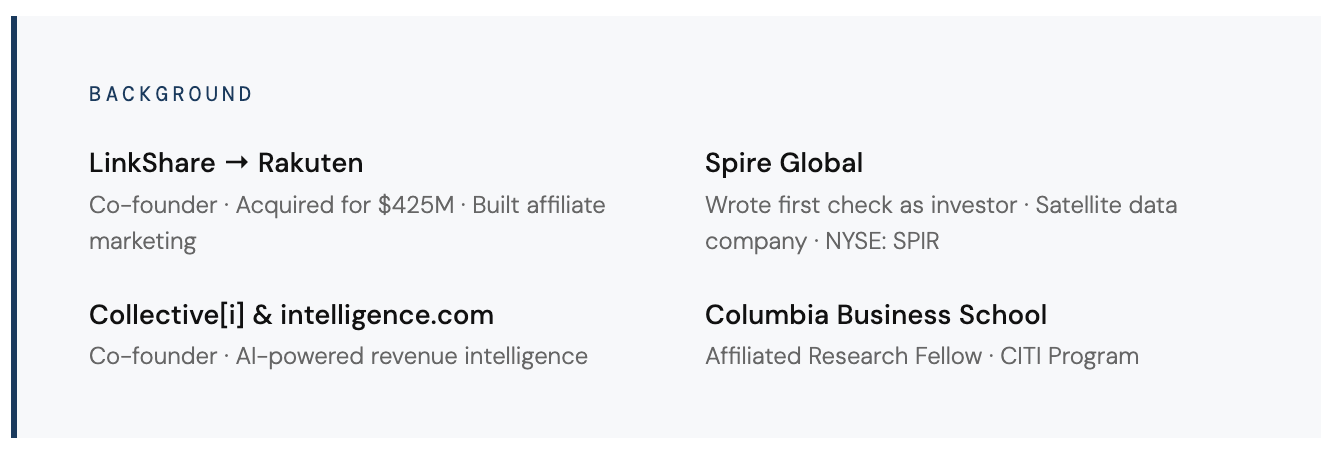
My name is Stephen Messer and along with my cofounders started LinkShare in 1996. Affiliate marketing wasn't a category yet. We made it one, sold to Rakuten for $425M, and somewhere along the way helped invent what we'd later call the influencer economy — though nobody called it that then. Spire put satellites in orbit. Small ones, tracking ships, planes, and weather systems in real time.
Collective[i] is what I'm working on now. The simplest way I can describe it: what ChatGPT and Anthropic are doing for language, we're doing for economic behavior. We're building an AI that studies how the world actually does business — how decisions get made, how relationships drive outcomes, how capital moves — so we can predict what happens next. People use it for sales and GTM, for PE and VC and more. They also use it for HR, logistics, financing, hiring. Wherever human decisions drive economic outcomes, that's the problem we're working on.
intelligence.com is a different kind of network. Not a social network — those exist to monetize your attention. This is built around the relationships you've spent your whole life actually earning: the colleagues who trust you, the partners who've delivered, the people you'd call at midnight with a real problem. We want to make those connections more valuable, more visible, and more useful — built on authenticity and transparency rather than follower counts and engagement metrics. Read more here and if you want to join me on Intelligence.com click here, its free.
I'm an Affiliated Research Fellow at Columbia Business School's CITI program. I've spoken at Wharton and Cannes Lions. I've been inside three major technological transitions and I'm in the middle of a fourth.
None of that makes me right.
What it gives me is a vantage point. A set of pattern recognitions built over decades of watching new technologies arrive, get misread, get overcorrected, and eventually reshape everything anyway. I write from that place — not to lecture, not to position, but to think out loud and see where I'm wrong.
Because here's what I actually believe: the right answers to the questions AI is raising aren't sitting in any one person's head. They're going to emerge from argument, from disagreement, from people with different experiences pushing back on each other's assumptions. A researcher who sees something I missed. An operator who's lived something I've only theorized about. A skeptic who's right about the thing I'm most confident about.
I started Artificial Common Sense because I want that conversation. Not a comment section — a genuine exchange. Disagree with me. Tell me where my reasoning breaks down. Share what you're seeing from where you sit. The goal isn't consensus; it's clarity. And my strong suspicion is that we'll get to better answers together, faster, than any of us will get to alone.
That's the bet this publication is making.
If that sounds like something worth being part of — read, push back, share what you think. The conversation is the point.
What you'll find here
01. Counterintuitive takes
Arguments that challenge the consensus, and back that challenge up with data and experience, not vibes.
02. Practitioner perspective
Analysis written from inside the machine, from someone actively building AI-powered companies, not covering them.
03. Historical context
Essays that connect today's AI moment to prior technological revolutions, the patterns most people are missing.
04. The thing nobody is saying
The observation most people are dancing around but won't commit to. That's usually where the most useful thinking lives.
As seen in
The New York Times • The Wall Street Journal • Forbes •Fortune