Serial Is Not a Compliment.

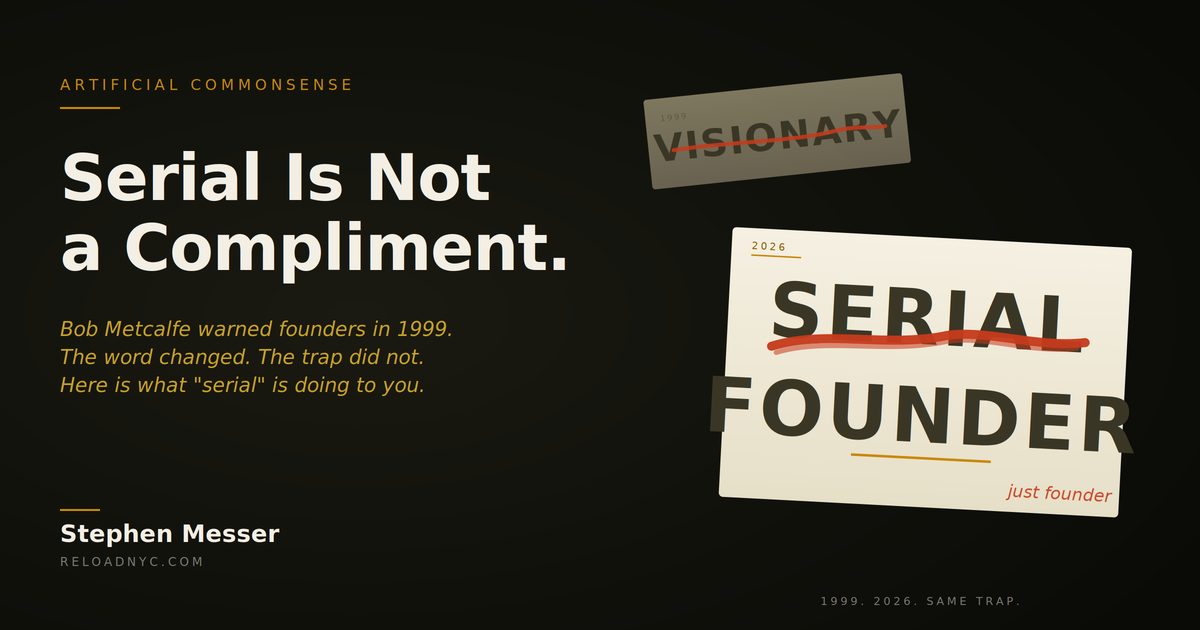
Bob Metcalfe told founders in 1999 never to let a publicist call them "visionary." He wrote it after watching the same board that praised him with the word replace him with a professional operator. The word visionary faded. The trap did not. It got a new label. This is what "serial entrepreneur" is actually doing to the founder you fund, cover, sit on a board with, or love. And why I interrupt anyone who uses it.
Stephen Messer · Co-founder, Collective[i] & Intelligence.com. Co-founder, LinkShare (sold to Rakuten, $425M). EY Entrepreneur of the Year and 2x Deloitte Fast 50 Winner. Board Member, Spire Global (NYSE: SPIR).
For a lot of the people who will read this, a founder's life looks a little crazy from the outside. You take an unproven idea. You leave a safe job and the health plan behind. You raise money if you can, or you self-fund (read credit card debt) and pray. You work in a way that damages your health and your marriage. You bring the idea to market, get told you are wrong and then over time find out if you were actually right.
Do that once and most people call you brave or reckless depending on the outcome. Do it twice, and the vocabulary changes. You become a serial entrepreneur.
Almost every time someone says the phrase to me, they think it is a compliment. It is not, and I want to spend a little time explaining why. This piece is for the investors, the board members, the journalists working in good faith, and the friends who reach for the phrase without thinking. It is also for the founders who let it slide and are wonder why the pattern that follows keeps looking familiar.
The word itself.
Serial. Who else in modern speech gets that word attached to their identity. Serial killer. Serial rapist. Serial cheater. Serial abuser. Pause on that list for a second. Every use of "serial" as a personal descriptor in ordinary English is describing a pathology.
Now try the same word on any other kind of business role. Serial CEO. Serial CFO. Serial board member. Serial general counsel. Nobody says these. Almost every public company on the New York Stock Exchange is run by someone who has done the job before at two or three or four other places. The word for that is experience. Doing venture capital is, quite literally, the same act repeated over and over with new companies. A senior partner at Thrive or Benchmark who has funded a hundred companies is not called a serial investor. He is called an investor. Repetition is the job. At best you may add "Good" or "bad" as a descriptor before any of those titles but never serial.
Do it as a founder and the word attaches. You are a serial one. The framing sounds admiring until you notice that the person saying it has never applied the same framing to their own line of work.
What the word does inside the head of the person saying it.
The word is not neutral. It is doing quiet work in the room. What it plants unconsciously in the mind: this person has crazy ideas, gets things off the ground, and then they need to move on. What it hides: this person investigated an opportunity, learned the category deeper than anyone else in the room, convinced a small group of very talented people to leave safe jobs, convinced investors to write large checks against nothing but a story, convinced customers to try something new, and then built an organization that outlived its start. Years of that work compresses into the shorthand of "the idea guy."
Once the word is on you, it starts writing the next chapter for you. The board hears it. The next round of investors hears it. The reporter writing the profile hears it. When the company scales past what one person can hold in their head, the label is already sitting there ready to explain why the founder is not fit to keep running it. Time for adult supervision. Time for a real operator. Founder-friendly transition.
The word did the work before anyone had to say aloud what they meant.
The Steve Jobs test.
The Steve Jobs everyone remembers is the man who came back to Apple, shipped the iPod, shipped the iPhone, built Pixar into a machine that reset animation and got bought by Disney.
That Steve Jobs did not exist for most of Steve Jobs's career. Go back and read the coverage from 1988 to 1996. The Steve Jobs of NeXT is a guy who sold his company for a price a lot of people thought was too much for what Apple actually got. The Steve Jobs of the first Apple run is the guy who could not scale the company he founded, was a bit crazy and had to be replaced by an outside CEO. The word patterns in the coverage of that period are almost identical to what we now call serial entrepreneur. Idea guy. Great imagination, poor operator. A visionary who needed adult supervision.
Then he came back. He shipped a Mac people wanted. He shipped the iPod. The word disappeared. Nobody called him a serial founder anymore. Nobody called him a visionary in the diminishing sense. The person had not changed. The company had. The vocabulary shifted to fit the outcome.
Elon Musk lived through the same arc. In 2008 he was the guy who had sold PayPal, could not make Tesla work, and was blowing up rockets in the Pacific. Serial founder was the shrug people used at parties, who else would go to Russia to buy a rocket or start an electric car company....at the same time. By 2013 the shrug was gone. By 2020 a serious journalist would not have used the word about him without irony.
The word is a floor. The floor lifts when the scoreboard rises. Which should tell you the word was never describing the person. It was describing the height of the last outcome.
Bob Metcalfe already wrote this piece.
I am not the first person to write about this pattern. Bob Metcalfe wrote it in November 1999 in the MIT Technology Review. His column opens with a single sentence:
In 1982 my board of directors started calling me a visionary, and I ate it up.
He was warning founders about a different word. Visionary. Same trap, different decade.
The story behind that sentence is worth knowing. Metcalfe co-invented Ethernet at Xerox PARC. He walked out of PARC in 1979 because Xerox could not figure out how to sell the thing he invented, and he founded 3Com in his Palo Alto apartment. He was CEO for the first three years. Then his board started calling him a visionary. The board brought in Bill Krause to run the day-to-day. Metcalfe held onto the title of vice president of sales and marketing and a board seat and kept doing the persuasion work. He was the mythology. What he was no longer allowed to be was the operator.
In April 1990 the same board named Eric Benhamou president and COO. In May, Metcalfe resigned as vice president and board member after being passed over for the top job. He was thirty-four years old when he founded 3Com. He was forty-four when the board that had spent eight years praising him for his vision decided he was not the person to run it at scale. He spent the next ten years as a columnist at InfoWorld. When he sat down in 1999 to write about what had happened to him, his conclusion was direct:
My advice is never let a publicist call you a "visionary." I've hung out with the visionaries at the famed Xerox Palo Alto Research Center. I've been a successful Silicon Valley entrepreneur. I wouldn't touch "visionary" with a 10-foot pole.
He also wrote this, which is the whole game in one sentence:
Where visionaries can be good at persuasion, CEOs are good at wielding authority. Visionaries transcend organizations, resources, and current realities, while CEOs master them.
Read that line twice. The visionary is the one who cannot master the organization. That is the box, said out loud, by a man who lived inside it and watched it close on him. He was telling founders in 1999 that the compliment was the setup.
He was right. The word visionary did fade. Something replaced it. What replaced it is serial entrepreneur.
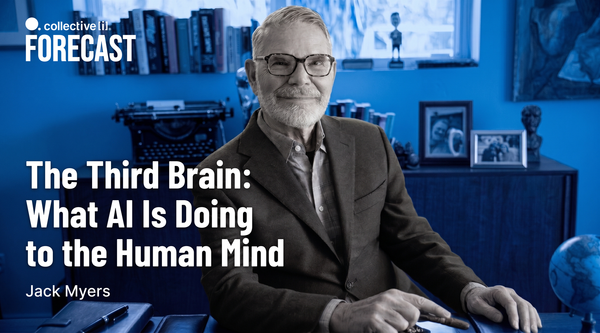
Metcalfe returned to these themes on Collective[i] Forecast if you want to hear it again in a conversation with my sister Heidi, my LinkShare and Collective[i] co-founder, after he won the Turing Award in 2023. The word had changed by then. The trap had not.
Same job. Same box. Same setup for the replacement. New vocabulary.
Travis Kalanick's hotel room.
The clearest recent case of the pattern running to completion is Uber.
On May 26, 2017, Travis Kalanick's mother Bonnie was killed in a boating accident on Pine Flat Lake in California. His father was seriously injured. Travis buried his mother and took a leave of absence to help his father recover.
Eleven days after the burial, two Benchmark partners walked into his hotel room in Chicago with a resignation letter and told him to sign it that day. If he refused they would go public with a campaign against him. He signed. He resigned publicly on June 21, 2017. Benchmark then sued him a few weeks later to try to strip him from the board as well and to unwind a 2016 governance change that had given him extra voting seats.
Uber went public in 2019. Benchmark got its return. The company that once fought for every mile of ground is now a mature ride-share business inside a mature category. The fight is out of it. Travis started Atoms, an industrial AI and physical robotics company that is now the parent of CloudKitchens, the autonomous haulage business Pronto, and a set of robotics businesses building specialized robots for food, mining, and transport.
In July 2026 Atoms raised $1.7 billion led by Andreessen Horowitz. Ben Horowitz joined the board. Uber joined the round. Read that back. The same Uber that pushed him out in 2017 wrote a check nine years later to back the next thing he built. If you want a live demonstration of what the label is worth over time, that is it. All that value from Atoms is lost to the Uber shareholder because of what Benchmark did.
Nobody at Benchmark ever said Travis was too serial to run the mature company. The words they used in the coverage were visionary, gifted at zero-to-one, needs an operator for one-to-a-hundred. Different words. The same box. The same excuse to move him aside at the exact moment the outcome got large enough to matter to the cap table.
Compare Mark Pincus to Jack Welch.
Mark Pincus is an old friend of mine. He built Zynga into a monster in gaming from nothing. Judgment on people, on market timing, on product mechanics, on incentive design at a scale that no one else in that category had figured out. When mainstream business media covered him during the growth years, most of the coverage was about his management practices. Was he too demanding. Was he too intense. Was the culture too much for the employees.
Now take the coverage of Jack Welch over the same career decades. Welch spent twenty years at GE. He was famous for firing the bottom ten percent of his workforce every year. He forced everyone in a company of hundreds of thousands to learn Six Sigma. He restructured entire divisions on gut. These are dramatic, controversial management moves. The coverage was almost entirely reverential. His methods became business school curriculum. Books were written about his leadership philosophy.
Mark built something new from zero. Jack ran a machine someone else had built. Both used aggressive management styles. Both moved fast. Both broke conventions. One got treated in the press as a temperamental founder who could not manage his own creation. The other got treated as a demanding leader whose methods deserved to be studied. Mark was the better leader, Jack left a company that relied on financial engineering, yet Jack is studied to this day.
That gap has nothing to do with the actual work. It has to do with the word that got attached to the person before the sentence started.
The founder they should have promoted.
There is another version of this trap that runs after an acquisition. A large public company that has stopped growing buys a smaller founder-led company that is disrupting them. The board of the acquiring company almost always keeps the incumbent CEO. The founder they just bought becomes a division head, or an SVP of innovation, or someone with a title and no operational authority over anything that matters. Two years later the founder leaves. The disruption they were building leaves with them. The parent company keeps not growing.
The obvious business decision, in most of these cases, is the opposite. The founder who just built the thing that scared the incumbent into buying is the person who should run the combined company. The incumbent CEO who bought the thing because he could not build it should not. Why hire a recruiting firm to find a carbon copy of the guy you are replacing. Hire a bank and bring the new DNA in to the legacy firm, two birds one stone.
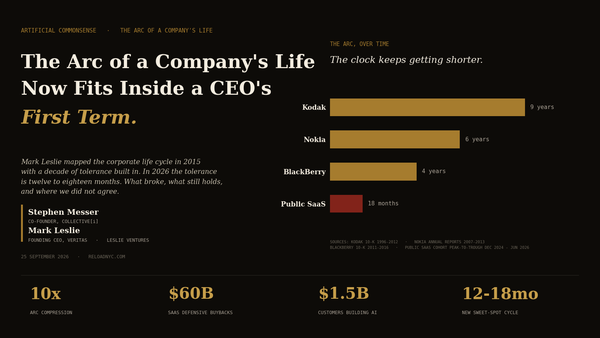
Mark Leslie thinks about this more clearly than anyone I know. Mark ran Veritas Software as founding chairman and CEO, taught leadership at Stanford GSB for twenty-one years after, and has spent the better part of two decades sharpening a framework he calls Opportunity-Driven versus Operationally-Driven leadership. I read Mark's work like scripture. We had dinner earlier this month to argue about whether the arc of a company's life still holds in an AI-first world.
Mark's position, is that only the CEO can set vision and inspire an organization. The CEO seat has to be occupied by the Opportunity-Driven leader. Operationally-Driven leadership belongs in the number-two role, keeping the trains running on time. Pairing an Operationally-Driven CEO with an Opportunity-Driven number two does not work. The vision does not reach the organization from the second chair.
Read Mark's framework with the acquisition case in mind. The incumbent CEO of most large mature companies is Operationally-Driven. That is often why the company can no longer grow. The founder who just built the thing that took a piece of their market is Opportunity-Driven. That is why the founder built it in the first place. Mark's framework says put the founder in the CEO seat. Unconscious bias, encoded in the word serial, says leave the operator in charge and box the founder into a vision role that Mark has said out loud does not work.
Steve Jobs saved Apple that way. Apple acquired NeXT in 1997 to get the operating system. The founder came with the deal. It took a few months for the board to give up on Gil Amelio, the serial CEO running Apple into the ground, and put Steve into the interim CEO seat. He rebuilt the company from that chair. If the board had trusted the incumbent operator over the acquired founder, Apple would be a footnote. When Steve stepped down, the board put in Tim Cook, and now John Ternus. One was an operationally driven, it will be interesting to see what John turns out to be.
Elon Musk did not get the same treatment. His own board pushed him out as CEO of the newly merged X.com and Confinity in September 2000 while he and his wife were flying to Sydney for their honeymoon. Peter Thiel took the seat. eBay acquired PayPal two years later and kept the operators the board had installed. Musk had to build the argument again at Tesla, at SpaceX, and at every company after, before the vocabulary caught up.
If eBay had acquired Elon's X.com and replaced Meg with Elon as CEO of the combined firm in 2002, PayPal might have become what Musk had been trying to build. The shareholders of eBay must at some point been thinking the same as they watched Elon build more value outside of Ebay than Meg did. Had Elon been ceo, all that value might have all been theirs.
The founder you just acquired is the person you cannot otherwise hire. They drive change from the top because they carry the muscle memory of what it takes to build something people want. They are the least risky bet on the table, and the board sees them as the riskiest, in large part because the word serial has been sitting in the room the whole time doing quiet work.
The founder you cannot hire is the founder you just bought. Put them in the seat.
What the inside actually feels like.
I want to say something the investors and journalists reading this rarely hear founders say out loud, because saying it out loud is another thing that gets you called serial.
Doing this work as a founder damages you. You do not sleep well for years. You carry the weight of every person who left a safe job to work for you and every customer who bet on your promise. If you have a family, you owe them time you do not have. If you are alone, you owe someone the version of yourself you cannot show them because there is no version left at the end of the day. Your body wears down in ways your friends who took the corporate track do not experience. Suicide in this group is more common than most people realize and every founder knows someone affected by this. Loneliness is close to universal. I have not met a founder that did not miss a payroll or two at some point or live with crushing credit card debt from keeping the firm alive. There is a reason founders spend so much of their social lives with other founders. It is not clubbiness. Nobody else understands the specific shape of the pressure.
The reason many of us do the thing more than once, especially after a failure, is not always because we love it. It is because the skill set you gain as a founder does not translate back to corporate life. Reasoning from first principles rubs against a bureaucracy that is optimized for playing it safe. I made the operating-system version of that argument in The Hypothesis Company.
First principles is what lets a founder keep working. It is also what makes them unemployable inside the company (other than leadership) that has stopped growing. The founder is trained to survive based on focusing solely on outcomes that drive success. The corporation is organized around process. The two are allergic to each other.
We are, with the exception of a small number of other founder friends, alone in this. My co-founders at LinkShare and at Collective[i] are part of that small number for me, and I have had great success. Most founders do not have that. The word serial makes the pattern look like a personality choice. It is a labor pattern that comes from the fact that nobody who has done this once fits neatly back into the machine that is set up for people who have not.
The cost to your cap table.
I have been arguing this on ethics and identity so far. Let me put it in a place investors will feel.
Every time you install the label serial founder on a person you fund, you are unconsciously pre-writing the story of why you will replace them at scale. You are giving your future self, or whoever holds your board seat two years from now, permission to look at a hard quarter and reach for the box. The founder becomes the great imaginer who could not run the mature company. The next CEO becomes the real operator.
Sometimes that call is correct more often it is not. Some founders should not run the mature company. Fine. The trap is the quiet decision you made eighteen months earlier when you accepted a word that did the work for you. The word made the call. You just executed it later.
Look at what that quiet decision cost at Uber. Look at what it cost at 3Com, which most people under forty do not remember because the company got sold to HP after fifteen years of Metcalfe-less growth that never produced anything close to what Ethernet promised. Look at the number of companies that came out of the founder ouster fine but never great. The word does not just insult the founder. It shows up on the cap table. Had you used the word CEO instead of serial founder you might have focused on getting a great COO to help operationally. Instead you replaced the founder.
A better word.
If you want to compliment a founder, tell them what they built. Tell them what changed in a market because of their work. Tell them what you learned from them. The name of the thing they built, in the sentence where you compliment them, is often the strongest tribute you can pay.
If you need a qualifier, use the same qualifiers you use for everyone else. Good founder. Great founder. Bad founder. You would say good CEO, great CEO, bad CEO. You would say good investor, great investor, bad investor. Extend the same curtesy.
If the founder is still running the company, they are a CEO and founder. Say CEO first. That order matters. It establishes that the person owns the whole role, not the idea part alone.
If any of that sounds too neat, run a small test the next time you meet with an investor. Call them a serial investor. Wait for the reaction. It will not be a smile.
Interrupt.
The first time someone called me a serial entrepreneur on a stage, I let it slide. The second time I did not. Now, on a podcast, I interrupt. On a television segment, I stop the host mid-sentence. When a journalist puts it in an intro, I ask them to rewrite before we record. When a young founder tells me it happened to them and shrugs, I tell them not to shrug next time.
There is very little a founder controls in the arc of a company. What we can control is the vocabulary the world uses to describe our work, our role, and we can refuse to accept a compliment that is doing quiet damage. Bob Metcalfe gave that advice in a magazine in 1999. Not enough people took it seriously then. The word changed. The trap did not.
If you are the investor, the board member, the reporter working in good faith, or the friend at dinner about to reach for the phrase, ask yourself what you are actually describing. If the answer is pattern rather than work, use a different word.
And for the families that support founders, for the early employees who are always a part of the founding journey, know just how important you are.
So, if you are the founder listening to it, do what I do now.
Interrupt.
Subscribe at reloadnyc.com. Free. No paywall. No course at the end. Just the work.
If this piece changed how you are going to introduce the next founder you meet, forward it to one person who needs to read it. A board member who is about to write the "adult supervision" memo. A reporter drafting a founder profile this week. A friend who reaches for "serial" the way a lazy compliment reaches for anything. One person. That is how the vocabulary changes.
Post it on X, tag @smesser, and tell me where I am wrong. Share it on LinkedIn if there is a founder in your network who has spent the last decade being described as serial when what they were doing was building. Tag them at linkedin.com/in/stephenmesser.
Sources
1. Bob Metcalfe, Invention Is a Flower, Innovation Is a Weed, MIT Technology Review, November 1999. Contains the "1982 my board of directors started calling me a visionary" opening and the visionary-vs-CEO framing quoted in this piece. technologyreview.com/1999/11/01.
2. Bob Metcalfe published quotes on visionary/CEO distinction and his "10-foot pole" advice, collected across public interviews. Bob Metcalfe biography via Wikipedia; The Henry Ford, Bob Metcalfe - Visionaries on Innovation. Metcalfe was a speaker on Collective[i] Forecast, hosted by Heidi Messer, following his 2022 ACM A.M. Turing Award, announced March 22, 2023.
3. 3Com founding, Metcalfe's CEO tenure 1979 to 1982, Bill Krause's arrival as president, and Eric Benhamou's appointment as president and COO in April 1990 followed by Metcalfe's May 1990 resignation. Sources: FundingUniverse History of 3Com Corporation; Éric Benhamou biography via Wikipedia; Computerworld, 3Com: One of the longest running shows in networking.
4. Bonnie Kalanick killed in boating accident on Pine Flat Lake, Fresno County, May 26, 2017. Father Donald Kalanick seriously injured. Sources: NBC News, May 27, 2017; AFP via Inquirer.
5. Two Benchmark partners went to Travis Kalanick's hotel room in Chicago 11 days after his mother's burial and presented a resignation letter with a same-day ultimatum, threatening a public campaign if he refused to sign. Detailed in Kalanick's own subsequent court filing against Benchmark and in coverage of investor Shervin Pishevar's letter to the Uber board. Sources: Business Insider via Yahoo Finance, August 2017; Inc./Business Insider on the Kalanick filing.
6. Travis Kalanick's resignation as Uber CEO, June 21, 2017. Sources: CNN Money; Fortune timeline; CNBC timeline.
7. Uber IPO, May 2019. Travis Kalanick's post-Uber trajectory: founded City Storage Systems in 2016, renamed to Atoms in March 2026, consolidated CloudKitchens (food), Pronto (mining/autonomous haulage), and a new Transport unit under one equity structure. Atoms closed a $1.7 billion round led by Andreessen Horowitz on July 22, 2026, with Uber, Bain Capital Ventures, Fifth Wall, Chemistry, A*, K5 Global, Abstract, SV Angel, and Alpha Square Group participating. Ben Horowitz joined the Atoms board. Sources: TechCrunch; SiliconANGLE; Los Angeles Business Journal.
8. Jack Welch tenure at GE (1981 to 2001), including forced-ranking bottom-ten-percent policy and company-wide Six Sigma rollout. Standard business press coverage and Welch's own Jack: Straight from the Gut. Referenced for contrast with the coverage Mark Pincus received during his tenure at Zynga.
9. Mark Leslie, The Arc of Company Life, First Round Review, 2015. Leslie's Opportunity-Driven versus Operationally-Driven leadership framework, subsequent writing on Leslie's Law and Leslie's Compass, and The Sales Learning Curve (with Charles Holloway), Harvard Business Review, 2006. Leslie was founding chairman and CEO of Veritas Software and taught at the Stanford Graduate School of Business for twenty-one years. The correction on the framework, that the CEO seat must be the Opportunity-Driven leader and Operationally-Driven leadership belongs in the number-two role, reflects Mark's current position as of September 2026.
10. Elon Musk ousted as CEO of the merged X.com and Confinity (later renamed PayPal) in September 2000 while flying with his then-wife Justine to Sydney for their honeymoon. Peter Thiel succeeded him as CEO. eBay acquired PayPal for approximately $1.5 billion in July 2002. Musk was the largest individual shareholder in PayPal at the time of the acquisition. Standard historical sources on the X.com/Confinity merger and the PayPal board vote.
11. Apple's acquisition of NeXT in December 1996 for approximately $429 million. Gil Amelio, then Apple CEO, brought Steve Jobs back as advisor. Amelio was removed by the Apple board in July 1997 and Jobs was appointed interim CEO in September 1997. Jobs became permanent CEO in 2000. Standard Apple/NeXT historical sources.