The Arc of a Company's Life Now Fits Inside a CEO's First Term.

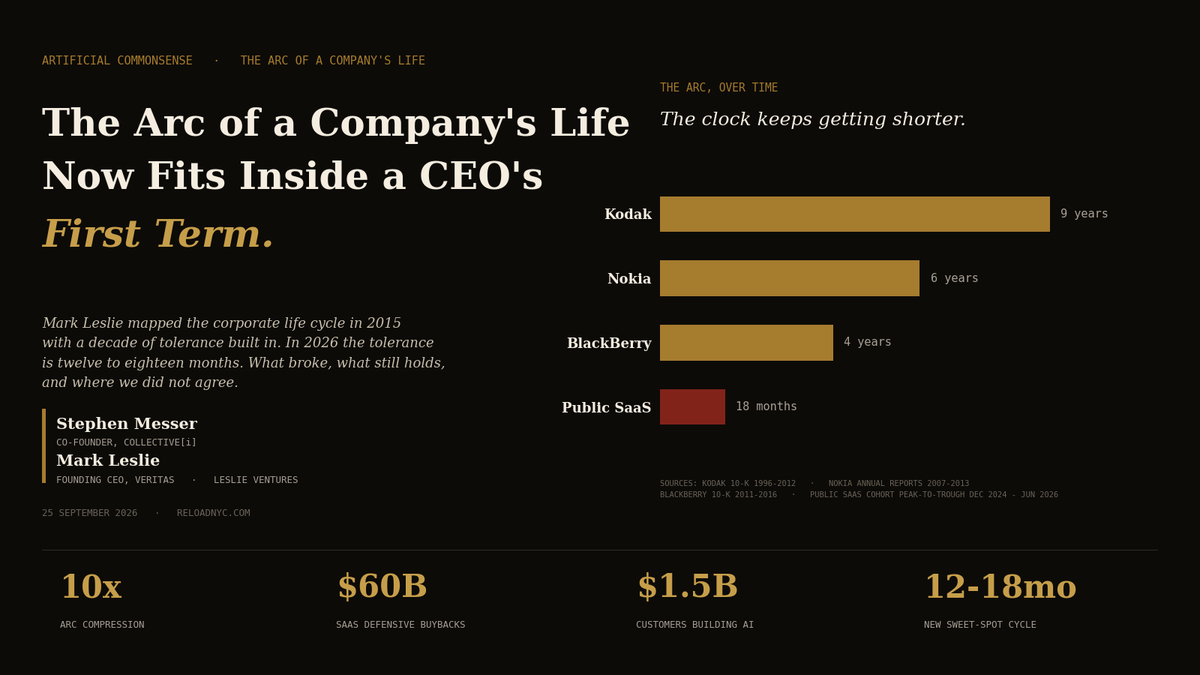
Twenty-six years after Marc Benioff picketed Siebel with actors and champagne, he borrowed twenty-five billion dollars to run the same defensive playbook against himself. Mark Leslie wrote the framework for this in 2015. He and I had dinner. This is what we agreed on.
By Stephen Messer
Co-founder, Collective[i] and Intelligence.com. Co-founder, LinkShare (sold to Rakuten, $425M). Board member, Spire Global (NYSE: SPIR).
September 2026. Join me at Intelligence.com
And
Mark Leslie, Founding Chairman and CEO of Veritas Software, which grew from twelve employees and $95,000 in annual revenue to 6,000 employees and $1.5 billion in revenue with $400 million in operating profit. Managing Director, Leslie Ventures. Lecturer in Management, Stanford Graduate School of Business, twenty-one years. Author of The Arc of Company Life, Leslie's Law, Leslie's Compass, and, with Charles Holloway, The Sales Learning Curve. Investor in Collective[i].
In February 2000, Marc Benioff hired actors to picket the Siebel Systems user conference in San Francisco. Hand-lettered signs. The End of Software. Champagne on buses parked outside the venue. Tom Siebel was inside telling his customers Salesforce.com was a fad. Oracle bought Siebel in 2005 for $5.85 billion. Benioff won.
In March 2026 he borrowed twenty-five billion dollars against a pristine balance sheet to buy back his own stock. Twenty-six years to the month after the picket, Salesforce is Siebel. Fred Turner at Curative is the one selling T-shirts now, except it is not T-shirts. It is a canceled six-hundred-thousand-dollar Salesforce contract and a CRM his team rebuilt themselves in two months with AI agents.
Twenty-six years to the month after the picket, Salesforce is Siebel.
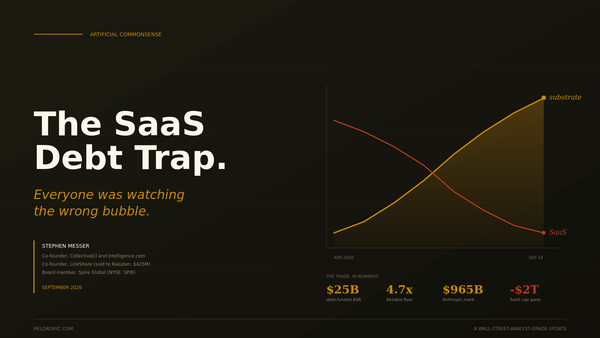
I wrote about the mechanics of the SaaS debt trap a few days ago. Mark Leslie wrote the framework for it in 2015. This piece is the mechanics through the framework.
Mark built Veritas from zero to $1.5 billion in revenue as its founding CEO. He then spent twenty-one years teaching the corporate life cycle at the Stanford GSB. His paper The Arc of Company Life is one of the most read pieces on how companies grow and how they die. He is an investor in Collective[i]. We had dinner a few weeks ago and discussed the arc. He read this piece last week. What follows is what we agreed on.
I said the arc has changed. He said not really. We were both partly right.
The Frame in Ninety Seconds
Companies enter markets, grow, mature, decline. Operational excellence will not save them from the decline. Transformation prolongs the arc, and the right moment to transform is when things are still going well, not when they are falling apart. Money in the bank. Talent. Momentum. Market power. Mark calls the moment the Sweet Spot of Maximum Optionality.
Leaders come in two flavors. Opportunity-Driven leaders take the swing when the sweet spot opens. Operationally-Driven leaders emphasize execution and predictability. Wall Street rewards the second kind. History rewards the first. Nokia was Mark's exhibit A for the failure mode. Ellison at Oracle, Bezos at Amazon, and Nadella at Microsoft were his exhibits for how to prolong the arc. Andy Grove had the same insight from the inside and called it the strategic inflection point.
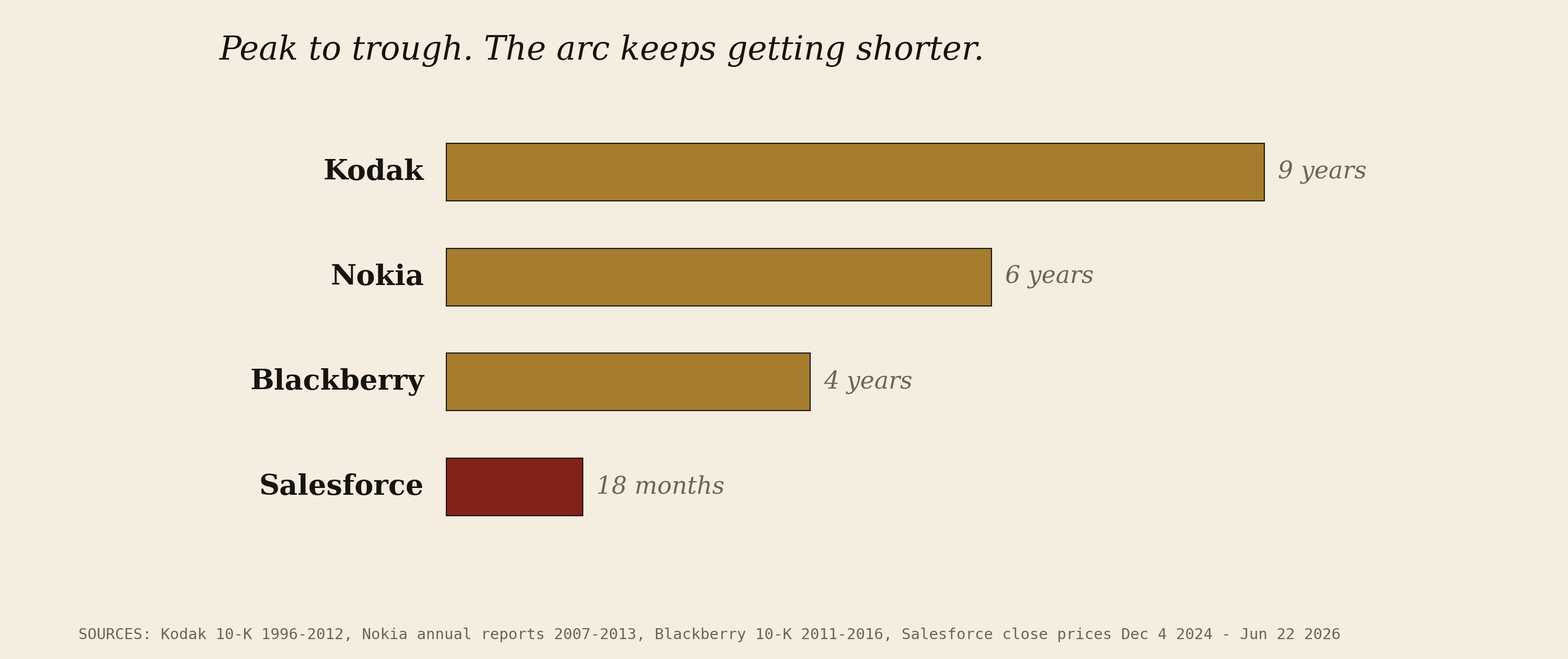
The frame worked for two decades because the clock ran slow. Kodak had ten years. Nokia had five. Blackberry had three. What changed in the AI-first world is the clock. Language models replaced software-shaped work, the compute layer moved under the model layer, and the consulting layer that used to walk companies through transitions is itself running out of runway. Three transitions stacked. The ten-year decline curve got compressed into quarters.
The Whole SaaS Category Is Running the Failure Mode in Public
Every large public SaaS company is running some version of Mark's failure mode right now. Different playbook variations. Same underlying decision. HubSpot is down forty-eight percent from its all-time high. The board approved a billion-dollar buyback with Q4 2025 earnings and launched Breeze AI in Q1 2026. Announce the AI overlay. Buy back the stock. Do not rebuild the product.
Workday is down forty-three percent from its high. The company reported agentic ARR growing over two hundred percent year over year and signed partnerships with Google Cloud and Anthropic through 2025 and 2026. The pattern is partner your way into AI rather than commit the capital to become the AI-native version of yourself. Workday still runs on the same architecture it ran on in 2015. The AI is a layer, not a rebuild.
ServiceNow lost eighteen percent in a single day on the Q4 2025 print. The company then announced partnerships with NVIDIA and OpenAI. The partnership announcements are the tell. When you cannot build the substrate yourself, you announce a partnership with the substrate builder and hope the market reads the announcement as strategy. It is not. It is the same operationally-driven CEO defense mechanism at a company with a different logo.
Adobe is down thirty to fifty percent depending on measurement window. Firefly and Sensei are the AI layers. Runway, ElevenLabs, and Black Forest Labs are the AI-native competitors eating from below. Every Adobe earnings call for the last four quarters has been about how well Firefly is being adopted inside the creative suite. The creative suite is not the answer to Runway. The rebuild of the creative company itself would have been.
Oracle, SAP, Microsoft, and NetSuite are all on the receiving end of the same pressure from Rillet on the finance stack. Rillet raised a hundred million dollars at a billion-dollar valuation in under forty-eight hours in August 2026, led by ICONIQ, with Sequoia and Andreessen Horowitz following on. Six hundred customers. ARR doubled in the quarter preceding the raise. Half its migrations come from Intuit. Thirty percent from NetSuite plus Sage Intacct. Twenty percent from Oracle Fusion, SAP, Workday, and Microsoft Great Plains. That is not one incumbent under threat. That is the entire back-office incumbent stack under one small threat none of them saw coming twelve months ago.
Every one of these companies chose to layer, buy back, partner, and cut costs. Not one committed the capital Mark's paper says the sweet spot is for.
Salesforce Is Where the Story Sharpens
Salesforce is running the same failure mode. It is running it at the sharpest number, at the greatest scale, with the most debt on top. In March 2026 Salesforce issued twenty-five billion dollars in bonds to fund an accelerated share repurchase. Senior notes went from $8.5 billion to $33.3 billion in one quarter. Total balance-sheet debt above $41 billion. Eighteen months earlier the company sat on $5.6 billion in net cash. Today it carries $27.9 billion in net debt.
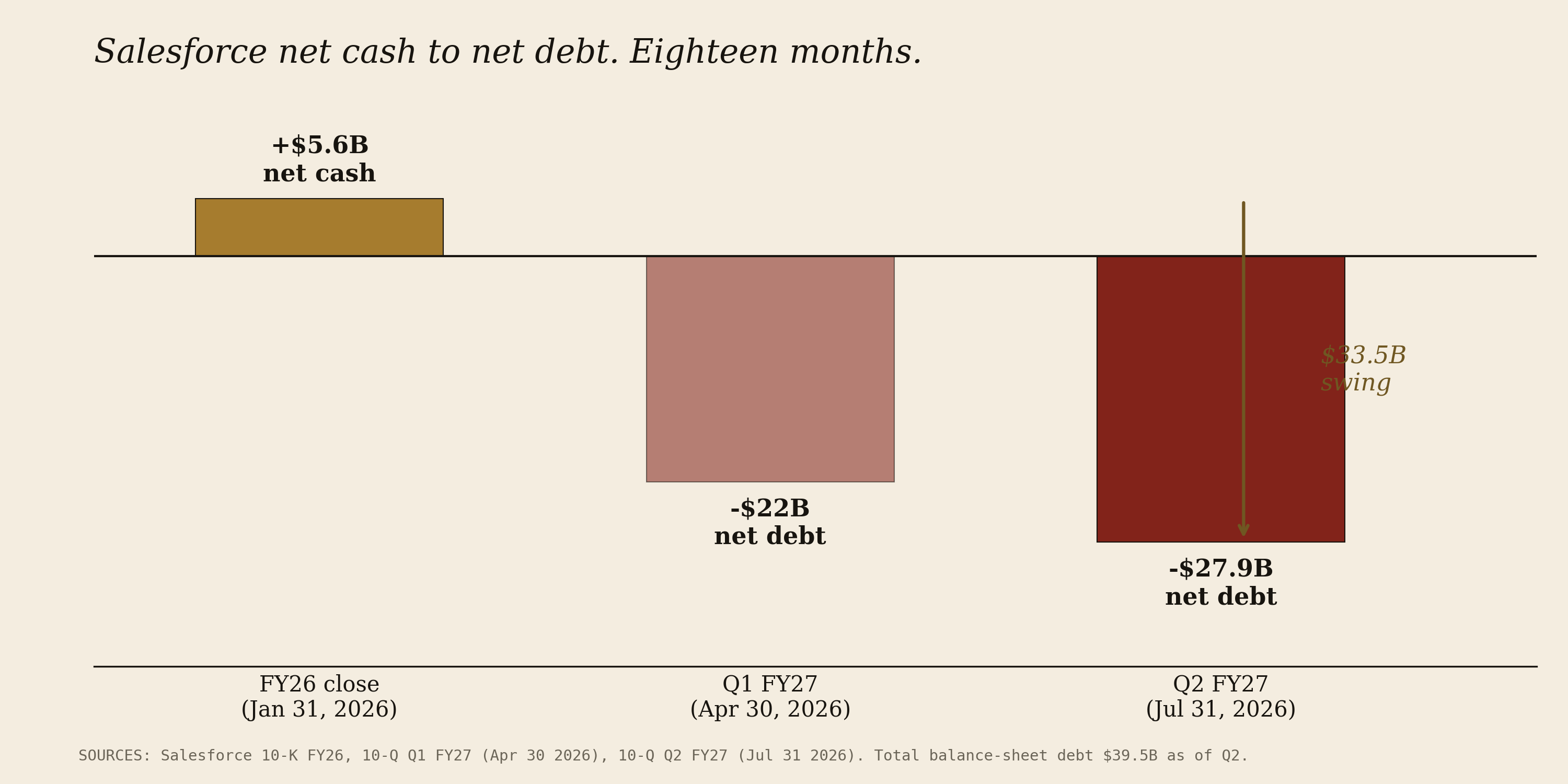
Benioff did not just spend the money Mark's paper calls the money component of the sweet spot. He spent it, then he borrowed against what was left, then he spent the borrowed money too. The optionality Mark says the leader has to preserve during maximum optionality has now been legally pledged to bondholders who do not care whether Agentforce works.
He spent it, then he borrowed against what was left, then he spent the borrowed money too.
The average cost basis on the repurchased shares is $198. Salesforce hit a fifty-two-week low of $147 in June, three months after the ASR closed, which meant the trade was underwater by twenty-five percent inside a quarter. The stock has since rallied to about $263 on the Anthropic markup and the Claudeforce rename. Jim Cramer said this week that "whatever was ailing the stock is over." That is what the operationally-driven CEO's biggest cheerleader always says on the dead cat bounce. Cramer said the same on the way down for Sun in 2007 and Nokia in 2010. It has been a week since Dreamforce and the stock is already falling, down almost 5% in 5 days vs. the nasdaq which was up 1% for the same timeframe (as of writing).
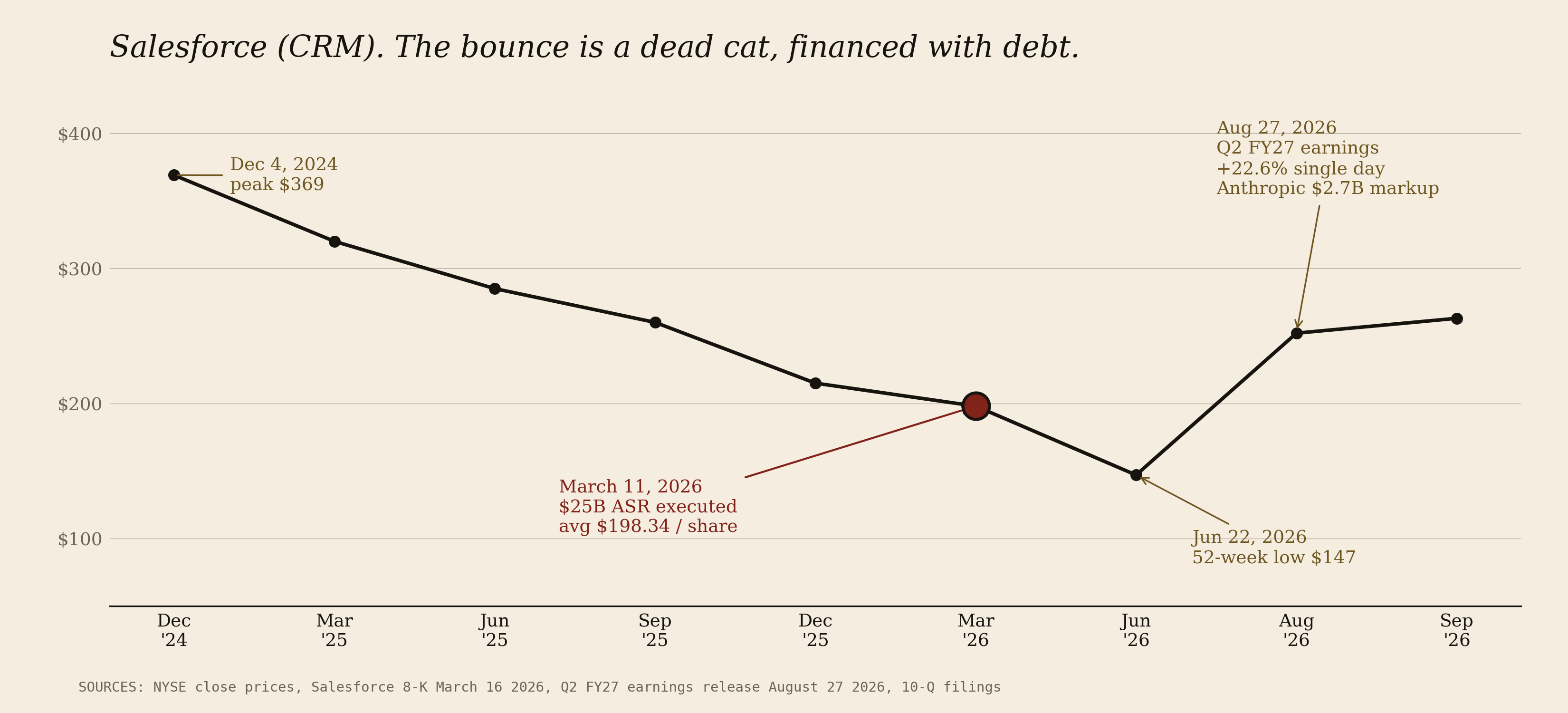
The rally puts the trade back in the money on paper. The debt is not on paper.
On the August 26 earnings call Benioff floated selling Salesforce Ventures' Anthropic stake to help pay down the buyback debt. The stake is up $2.7 billion, and that unrealized markup covered ninety-six percent of the quarter's EPS surprise the market clapped for. Sit with that sentence for a minute. The best-performing asset on Salesforce's balance sheet is a piece of the AI lab building the model most likely to replace Salesforce's own product. And Benioff is now thinking about selling it to pay down the loan he took on to buy his own stock at the top.
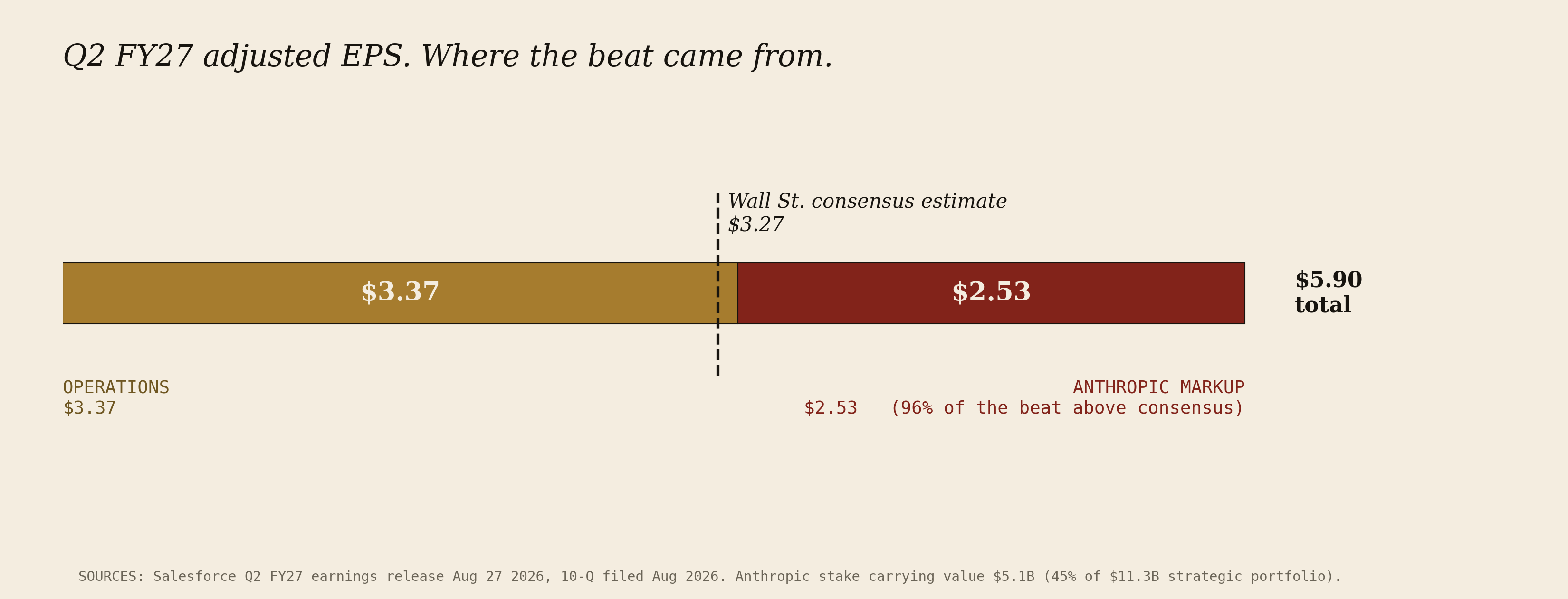
The best-performing asset on Salesforce's balance sheet is a piece of the AI lab building the model most likely to replace Salesforce's own product.
The bull case is straightforward. Agentforce hits the $63 billion fiscal-2030 revenue target. Free cash flow of $14.4 billion swallows the debt without noticing. The buyback ends up brilliant. Every operationally-driven CEO who ran this playbook made the same bet at the same point in the arc. Nokia bet on Symbian. Blackberry bet on BBM. Siebel bet on the CRM standard he had defined a decade earlier. Sun bet on Java. None of them made the bets because they thought they would lose. All of them ended up sold to Oracle or Microsoft on the cheap.
The customers are already telling you where this ends. Kirkland & Ellis committed $500 million to build proprietary AI in-house. Morgan & Morgan committed a billion. Two law firms out-invested the entire public SaaS category on the thing the vendors should have built. When your customers are willing to build the software you sell, you are already inside Mark's decline phase, and you do not yet know it. At Collective[i] we see the client shift to an AI model everyday. The fact that we allow them to keep what they have until they are ready to shift as opposed to rip and replace is something no SaaS company expected would happen. Its the playbook all the AI model companies are playing now, and it guts SaaS quielty.
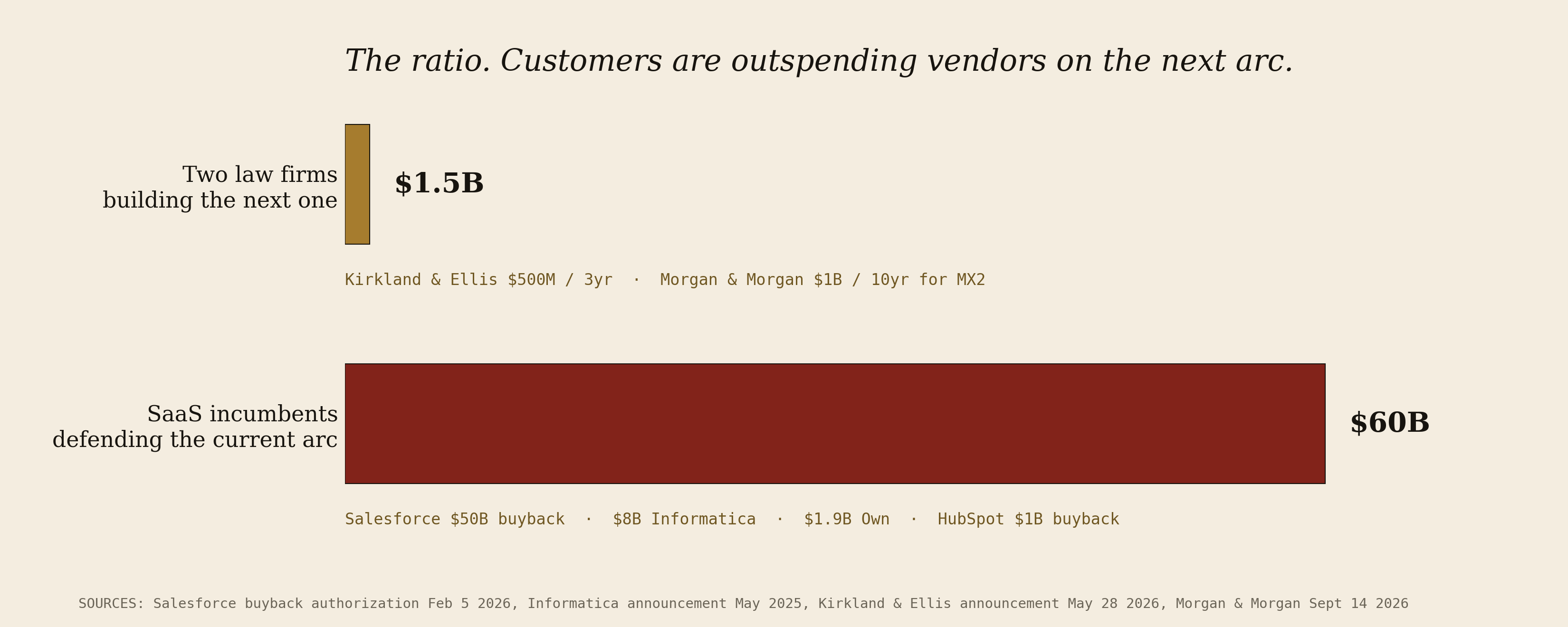
The LinkShare Retailer
There is a memory from LinkShare I keep coming back to when I think about the bounce.
Late 1999, I sat across from the CFO of a large national retailer that today does not exist. He wanted me to help him explain to his board why the internet was going to be worth taking seriously as a channel. He compared his e-commerce revenue to his revenue in one midsize store in Ohio and used the comparison to make the internet sound bigger than his board had assumed. It was a smart move for that meeting. It was catastrophic framing for the actual question. Amazon was not building another store. Amazon was building the store that would kill the concept of another store.
The SaaS category is doing the 1999 retailer thing on Agentforce and Breeze and Now Assist. Every AI overlay is being sold to shareholders as a channel expansion of the old business, not as a rebuild of the underlying company. The buyer is not confused. Curative, Collective[i] and Rillet are the receipts.
Where Mark and I Actually Disagreed
The only real disagreement is whether the sweet spot is a moment or a state. I went into dinner arguing that the sweet spot is not a moment anymore, it is a permanent state a leader has to run full-time. Mark pushed back. He said permanent state is overstating it. In his frame the sweet spot still opens and closes the way it always has, only the cycle is now twelve to eighteen months instead of a decade. A good leader plans for the next transformation window and takes it when it opens.
The difference is not academic. My frame says every leader has to run the transformation muscle continuously or die. Mark's frame says a good leader plans for the next transformation window. His version is more useful to boards. Mine, IMHO, is more useful to founders. We agreed the empirical answer will show up over the next three years.
Mark's view, held passionately: only the CEO can set the vision and inspire the organization. The CEO seat has to be the Opportunity-Driven leader. Number-two is where Operationally-Driven belongs, keeping the trains running on time. You cannot flip these. A great number-two cannot compensate for a CEO who does not set the vision.
That changes the board's job. Every SaaS board that reads this piece has to answer one question. Is the person in the CEO seat right now Opportunity-Driven or Operationally-Driven? If Operationally-Driven, the board has to move them out of that seat. A number-two with a bigger budget does not fix it. The Salesforce board approved a debt-funded buyback of twenty-five billion dollars without visible dissent. Every other SaaS board on the list above signed off on a buyback, a partnership, or both. That tells you where those boards are on the question of the arc.
Mark and I agree that boards always wait too long. From the operator side, we both think that leaders and boards need to be more proactive. The compression of time to impact makes it more expensive to be wrong. A board that would have gotten away with waiting a decade under the old clock now closes the window in twelve to eighteen months. We will know inside two years which SaaS boards took the seat question seriously and which ones handed it to the bond market.
What Comes Next
Mark's paper ended with the line every operator quotes. There is no finish line.
There is no finish line, and the finish line moves faster now than at any moment in the last hundred years. The compression is the gift. The sweet spot arrives sooner and reopens more often, so the Opportunity-Driven leaders Mark spent his career championing get more chances to swing, not fewer.
Nadella ran that posture at Microsoft. Cloud first, then AI at scale before the industry knew how to name the moment, then compute as a first-class product. Microsoft is worth three trillion because he treated the sweet spot as a discipline instead of an event. Huang jumped from graphics to AI compute on the same instinct and NVIDIA is worth more than every SaaS company on the list combined. Each adopted the ecosystem play that I first discussed in The Most Expensive Money in the Room. Bezos compressed thirty years of business-model reinvention into ten for two decades running. In 2015 those were the exceptional performers. In 2026 they are the minimum posture.
Salesforce still has time. Every SaaS CEO on the list still has time. The window is short and it is open. Every CEO reading this piece already knows which category they are in.
Read the paper. Read the news. Take the swing before someone else does it against you.
Build with judgment in the loop.
Intelligence.com is the operating layer for leaders who have decided the sweet spot is worth running as a discipline. A network built on scoped, accountable AI. Request access.
Subscribe for the next piece: reloadnyc.com.
Send this to the CEO on your board or in your portfolio who read Mark's original paper and treated the sweet spot as a moment to plan for.
If you think we have the frame backwards, reply. We would rather be argued with than agreed with.
This is not investment advice, not a recommendation to buy, sell, or short any security, and not a solicitation.
Footnotes
- Benioff's picket of the Siebel Systems user conference is documented in multiple Salesforce histories. Oracle acquired Siebel Systems in January 2006 for $5.85 billion in cash and stock.
- Fred Turner, CEO of Curative, on 20VC with Harry Stebbings, July 2026. Turner reported canceling a $600,000 annual Salesforce contract and rebuilding CRM functionality internally in two months using AI agents; Curative targeting 80% of its SaaS spend for internal replacement in 2026; Anthropic bill grew sixfold in six months; contracting cost per deal fell from $1,500–$2,000 to about $70; credentialing time fell from two-to-three months to roughly 12 hours. Business Insider confirmed the Salesforce cancellation on July 21, 2026.
- Veritas Software under Mark Leslie as founding Chairman and CEO (1990–2001): grew from twelve employees and $95,000 annual revenue to 6,000 employees and $1.5 billion annual revenue, with $400 million in operating profit. In 2000, Veritas was the tenth largest independent software company by revenue and third largest by market capitalization.
- Mark Leslie, "The Arc of Company Life – and How to Prolong It," First Round Review, 2015.
- Andrew S. Grove, "Only the Paranoid Survive," Currency Doubleday, 1996. Grove originated the term "strategic inflection point" to describe the moment when the fundamentals of a business change.
- Kodak: peak market capitalization approximately $31 billion in 1997; Antonio Perez joined 2003 to lead digital pivot; Chapter 11 bankruptcy filing January 19, 2012. Nokia: peak market share approximately 40% around 2007; iPhone launched June 2007; handset business sold to Microsoft September 2013 for approximately $7.2 billion. BlackBerry: global smartphone OS share peaked at 20.1% Q1 2009; pre-announced fiscal Q2 2014 earnings missing estimates by nearly 50% September 20, 2013.
- Category context, spring–summer 2026: HubSpot -48% from all-time high; $1 billion buyback authorization Q4 2025 earnings; Breeze AI launch Q1 2026. Workday -43% from all-time high; agentic ARR growing over 200% YoY per Q2 FY27; partnerships with Google Cloud and Anthropic 2025–2026. ServiceNow single-day -18% on Q4 2025 print; partnerships with NVIDIA and OpenAI. Adobe -30–50% depending on measurement window.
- Rillet Series C, announced August 18–19, 2026: $100 million raised at $1 billion valuation, led by ICONIQ, with participation from Sequoia, Andreessen Horowitz, Bain Capital Ventures, Battery Ventures, FirstMark, Scale Venture Partners, and Creandum. Round came together in under 48 hours per CEO Nicolas Kopp. Rillet emerged from stealth in 2024; ARR reportedly doubled in the quarter preceding the raise; more than 600 customers including Neuralink, Skild AI, and Mercor.
- Salesforce Form 10-Q, quarter ended July 31, 2026: senior unsecured notes outstanding of $33.3 billion with maturities to March 2066, up from $8.5 billion at the prior quarter. Total balance-sheet debt approximately $39.5 billion, including a $6.0 billion five-year term loan for the Informatica acquisition. Salesforce Form 8-K, March 16, 2026: $25 billion accelerated share repurchase at $198.34 average price, 103 million initial shares delivered.
- Salesforce share price: 52-week low of approximately $147 on June 22, 2026, roughly three months after the March 2026 ASR closed at $198.34 average. Recovered to approximately $263 by early September 2026 on the August 26, 2026 Q2 FY27 earnings print and expanded Anthropic partnership announcement (branded "Claudeforce").
- Salesforce Q2 FY27 earnings, reported August 26, 2026. Revenue $11.35 billion (+11% YoY); adjusted EPS $5.90 versus $2.91 prior-year. Salesforce Form 10-Q, quarter ended July 31, 2026: unrealized gains on privately held equity investments of $2.9 billion, including $2.7 billion related to the Anthropic investment. $2.53 of adjusted EPS of $5.90 came from strategic-investment gains, approximately 96% of the beat over consensus of $3.27. Excluding the markup, adjusted EPS was approximately $3.37. Anthropic valuation approximately $965 billion at the May 2026 pre-IPO round.
- Kirkland & Ellis, announced May 28, 2026: $500 million commitment over three to four years to build a proprietary AI platform. Firm revenue: $10.6 billion in 2025. Morgan & Morgan MX2 platform, announced September 14, 2026: $1 billion commitment over ten years; approximately 5,000 monthly active users; licensing to peer firms planned starting late 2027.
- Mark Leslie, "Leslie's Compass," Mark's framework for evaluating go-to-market and business-model decisions. Taught at Stanford Graduate School of Business and applied across Leslie's Leslie Ventures portfolio work.
Related Reading
Mark Leslie
The Arc of Company Life – and How to Prolong It. First Round Review, 2015.
Leslie's Compass. A framework for go-to-market and business-model decisions. Stanford Graduate School of Business.
Podcast: Mark Leslie: Putting the "We" in Leadership. Stanford Graduate School of Business.
Stephen Messer
Software Is Over. reloadnyc.com/software-is-over/
The SaaS Debt Trap. Everyone Was Watching the Wrong Bubble. reloadnyc.com/the-saas-debt-trap/
Artificial CommonSense · reloadnyc.com · © 2026 Stephen Messer and Mark Leslie