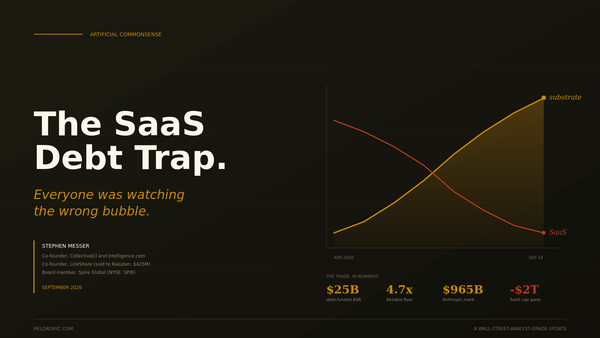
The Most Expensive Money in the Room.
Wall Street calls it a bubble because the money moves in a circle: Nvidia into OpenAI, OpenAI into Oracle, Oracle into Nvidia. This is the third time a tech industry has run this experiment. AOL was the first. WeWork was the second. Here is what's actually different this time.

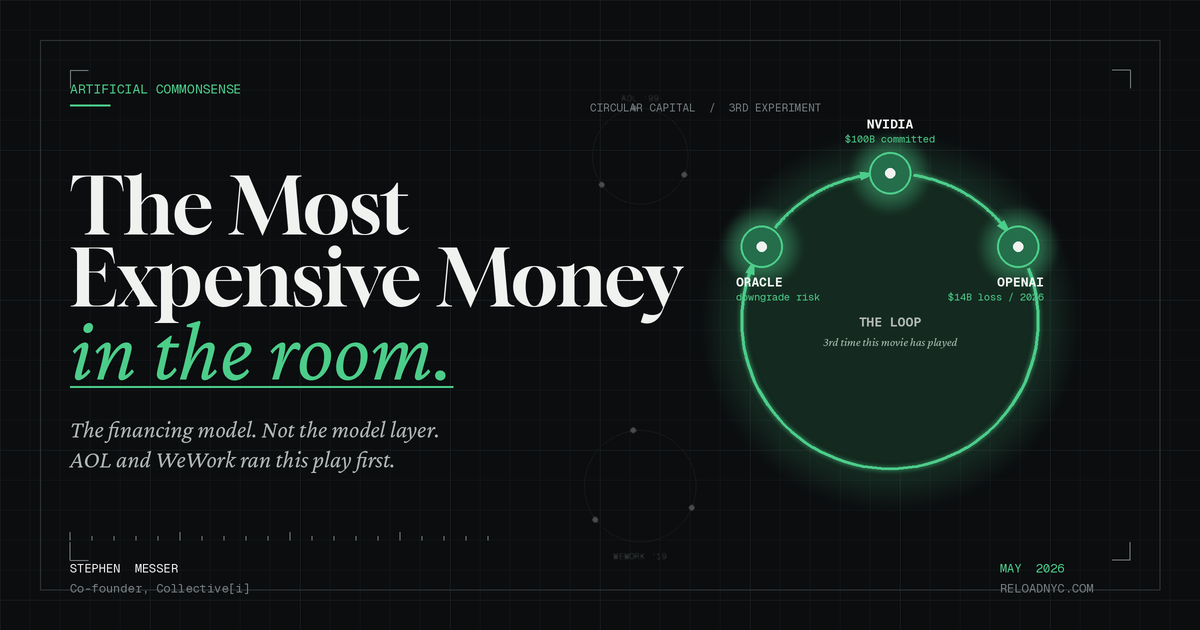
Wall Street Is Still Warning About the Wrong AI Bubble.
Stephen Messer, Co-founder of Collective[i] and LinkShare (sold to Rakuten for $425M, 1996–2005). EY Entrepreneur of the Year/Deloitte Fast 50 winner. Board member, Spire Global (NYSE: SPIR). Building intelligence.com
There is an argument sweeping through Wall Street analysts. The AI capital structure is a bubble because the money moves in a circle. Nvidia invests in OpenAI. OpenAI commits to Oracle. Oracle buys Nvidia chips. Bernstein's Stacy Rasgon flagged the "circular concerns" the day the Nvidia-OpenAI deal was announced. Seaport Global's Jay Goldberg, who holds one of the rare sell ratings on Nvidia, called the structure "kind of like having your parents co-sign on your first mortgage." Analysts have tagged more than $800 billion in these arrangements. In the last thirty days, Nvidia announced another $750 billion in deals on top of that, including a proposed $250 billion backstop on OpenAI's lease of a $500 billion Ohio data center hub. The concern is real. The framing misses the story.
This is the third time a technology-adjacent industry has run the same experiment. Using capital structure as the growth engine of the business itself. AOL was the first. WeWork was the second. The commodity LLM providers are running the third one right now. What each of these has in common is a genuine innovation in how growth gets financed. What each has in tension is a different business model sitting underneath that innovation. The financing structure is not what determines the outcome. The business model on the receiving end of it is. That distinction is the thread this piece is going to pull, and it is the argument that opens a longer series about how tech financing itself is being rewritten in front of us.
One clarification before we go further. What Wall Street is calling "AI" in this bear case is a specific slice of the AI landscape. The commodity large language model providers. OpenAI, Anthropic, and Google's Gemini team. Their business model. Their financing structure. Their capital commitments. I laid out the reason those three sit inside a commoditizing category in Peak Token, and I mapped the categories of AI that operate on entirely different economics (economic models, drug discovery, robotics, world models, trading models) in The Only Fight That Matters in AI. The circular financing concern applies to the commodity LLM providers specifically. It does not apply to the categories of AI where the business model has a real moat. That distinction matters for everything that follows.
AOL: The First Experiment in Capital-Driven Growth
The AOL story that gets remembered is the fraud story. That is not where AOL started. Steve Case built one of the most extraordinary businesses of the internet era. AOL delivered an 11,616 percent return to shareholders over the 1990s, the best-performing stock of the decade. At its peak, half of all internet users in the United States accessed the network through AOL. When AOL closed its January 2001 merger with Time Warner, valued at $165 billion, it was the largest corporate merger in history. Nothing that happened next changes what Case built.
The financing innovation underneath that growth is what matters here. During the late 1990s, venture capitalists poured money into dot-com companies whose growth strategy was to spend that money on advertising, on the platforms with the biggest audiences, to establish category leadership. AOL was one of the two dominant recipients of that spend, along with Yahoo. Pets.com is the case that everyone remembers. Amazon-backed at 54 percent through Jeff Bezos, Hummer Winblad-backed on the venture side, the company spent $17 million on advertising in Q2 2000 alone against $8.8 million in revenue. Pets.com signed a "premier pet site" deal with AOL and CompuServe, one of hundreds of exclusive category placements the VC-backed portfolio companies competed for on the biggest audience networks. Multiply that dynamic by every category the dot-com boom touched and you have the growth engine underneath AOL's advertising business.
The dynamic worked while the bubble was expanding. VCs put money in. Portfolio companies spent it on ads to win their category. AOL booked the revenue, its stock rose, and the merger with Time Warner closed at the peak. When the Nasdaq bubble popped in March 2000, that second-order capital stopped flowing. VC-backed portfolio companies could not raise the next round, could not spend on ads, and started going bankrupt. Pets.com liquidated in November 2000, 268 days after its own IPO. The advertising revenue that had funded AOL's growth engine dried up in months.
The round-trip transactions came in the tail, engineered by operational executives to bridge the gap. Between 2000 and 2002, some AOL Time Warner people arranged advertising deals with counterparties like PurchasePro and Homestore where AOL effectively funded the buyer's advertising purchase. Seventeen counterparties were identified across the SEC investigation. Time Warner restated $500 million in advertising revenue, paid $300 million to settle SEC charges, and $210 million to settle Department of Justice charges. PurchasePro founder Charles Johnson was convicted of stock fraud and obstruction of justice. Case resigned as chairman in 2003, though no senior AOL Time Warner executive was criminally charged. The fraud was engineered inside the operational layer, and it attached itself to the story of everything Case had built above.
ON THE RECORD · SEC V. TIME WARNER (2005)
The SEC complaint concluded that AOL Time Warner "effectively funded its own advertising revenue by giving purchasers the money to buy online advertising that they did not want or need." The seventeen identified counterparties included PurchasePro, Homestore, and Veritas Software. Veritas paid a $30 million civil penalty for a single $20 million round-trip that inflated both companies' revenues simultaneously. Time Warner's $300 million SEC settlement and $210 million DOJ settlement were both entered without admitting or denying wrongdoing.
What that experiment taught. Capital-driven growth can build a real business at real scale. It also builds structural fragility when the ecosystem of buyers depends on continued capital inflows to keep buying, because the buyers stop buying the moment the capital stops flowing. The financing innovation was real. The dependency was one layer too deep. When the second-order capital dried up, the first-order revenue disappeared with it. The tail-end fraud was one failure mode. The structural fragility across the middle was a different one, and it was already there before the fraud arrived.
WeWork: The Second Experiment
A decade after AOL, WeWork ran a different version of the same experiment. Adam Neumann and Miguel McKelvey founded the company in 2010 as commercial real estate arbitrage. Sign long-term leases with landlords on soft post-recession terms. Spend capital to renovate and furnish the space. Sublease it in short-term parcels to freelancers and small companies. On its own, the model was a real estate leverage play with modestly interesting margins and no particular reason to command a technology multiple.
The financing innovation was in the framing. Neumann positioned WeWork as a technology company rather than a real estate business. Software valuations. Growth multiples. The tech-company story attached to a building let Neumann negotiate landlord concessions no ordinary tenant could get. Free rent periods. Fit-out subsidies. Equity-style participation. The landlord was no longer just a landlord. Their balance sheet now depended on WeWork's growth continuing, because their asset's value was marked to the occupancy WeWork provided.
SoftBank ran the same play at the capital layer. Masayoshi Son met Neumann for twelve minutes in 2017. On the way to his car, Son told Neumann he needed to "think bigger." SoftBank ended up investing more than $10 billion in WeWork through 2019. That capital funded expansion to 111 cities in 29 countries, 527,000 members, over 600 locations. WeWork's private valuation reached $47 billion. The framing worked, right up until the public market saw the numbers.
The August 2019 IPO filing broke the story. The S-1 disclosed close to $1 billion in losses in the first six months of 2019, on long-term lease obligations of $47 billion against short-term subscription revenue. Public markets refused to price a real estate leverage business at technology multiples. The marketed valuation range came down from $47 billion toward $15 billion, then toward $10 billion. Neumann resigned as CEO within six weeks. The IPO was withdrawn. SoftBank's rescue package valued the company at roughly $8 billion, a $39 billion collapse in weeks. WeWork filed for Chapter 11 in November 2023 and emerged the following year under Yardi Systems. SoftBank's cumulative loss on WeWork reached approximately $16 billion, the single largest documented growth-capital loss on one position in venture history.
What that experiment taught. The framing change is only as durable as the market's willingness to accept it. Neumann's landlord concessions were real. SoftBank's capital was real. The network of committed participants was real. What broke was the story that tied it all together. When the public market refused the technology-multiple framing, the entire structure had to be repriced against real estate economics, and no capital in the world could bridge the gap between the two valuations. The financing innovation was real again. The business model underneath it could not carry the framing it had been sold at.
The LLM Providers: The Third Experiment Is Running Now
Which brings us to the current experiment and the specific concern Wall Street is naming out loud.
In September 2025, Nvidia announced up to $100 billion in investment in OpenAI, structured to release as each gigawatt of the 10-gigawatt buildout comes online. OpenAI committed to purchasing millions of Nvidia GPUs, deployed through cloud providers Nvidia also sells to. OpenAI signed a $300 billion contract with Oracle for cloud capacity starting in 2027. Oracle spent tens of billions purchasing Nvidia chips to build that capacity. Oracle's remaining performance obligations grew to $523 billion by Q3 FY2026, up 438 percent year over year. Microsoft's equity stake in OpenAI, reset in April 2026, is worth approximately $135 billion at a 27 percent diluted position. Analysts tagged more than $800 billion in these interlocking arrangements across the AI supply chain.
Then, in the last thirty days, another $750 billion was added on top. On July 27, 2026, Nvidia entered talks for a backstop of up to $250 billion to help OpenAI raise debt against a 10-gigawatt Ohio data center campus in Pike County, on a decommissioned federal uranium enrichment site, with power supplied by a $33 billion natural gas plant pledged by Japan. The developer is SB Energy, a SoftBank subsidiary. The lease and construction debt sits behind Nvidia's credit. The chips inside are a separate deal, reportedly $350 billion of them. The same day, Nvidia announced a $500 billion partnership with SK Group, an investment in Ilya Sutskever's Safe Superintelligence, and a $1 billion investment in Naver's AI data center co-developed with Brookfield. Nvidia's credit-default-swap spread recorded its biggest intraday move since the market for them opened in November.
The bear cases are worth naming precisely.
THE BEAR CASE · WHAT ANALYSTS ARE ACTUALLY SAYING
Bernstein · Stacy Rasgon: the Nvidia-OpenAI arrangement "will clearly fuel circular concerns." Compared the structure directly to Nortel and Lucent vendor financing in the dot-com era.
Seaport Global · Jay Goldberg: holds one of the rare sell ratings on Nvidia. Described the structure as "kind of like having your parents co-sign on your first mortgage" and "emblematic of bubble-like behavior."
UBS: put the OpenAI-Nvidia direct arrangement at up to 13 percent of Nvidia's projected 2026 revenue.
Barclays: downgraded Oracle to "underweight" and warned the credit rating could approach junk status if capex continues to outpace revenue conversion.
February 2, 2026: Oracle issued a statement saying it remained "highly confident in OpenAI's ability to raise funds and meet its commitments." One venture capitalist called the language "literally bank-run." Oracle stock closed down 2.8 percent that day.
An accounting-side critique circulating in the same window: hyperscalers depreciate Nvidia hardware over five or six years while the real economic life of a chip runs closer to two or three. Understating depreciation flatters reported profit. The gap is estimated at roughly $176 billion of understated depreciation across the industry between 2026 and 2028, with Oracle overstated by nearly 27 percent and Meta by 21 percent on 2028 estimates.
The underlying economics fuel the concern. OpenAI is on track to lose approximately $14 billion in 2026 on approximately $25 billion in annualized revenue, a negative 55 percent operating margin. Cumulative losses through 2029 are projected at $115 billion. Compute commitments across Nvidia, AMD, and Oracle exceed $1 trillion. Microsoft is spending nearly all of its $25 billion in quarterly free cash flow on AI infrastructure. Oracle's capex for fiscal 2027 is projected at $95 billion against $55.7 billion in fiscal 2026, and it needs to raise approximately $40 billion in debt and equity to service the buildout. The company already carries $130 billion in notes payable.
The specific business model risk sits on top of all of this. Commodity LLMs are commoditizing faster than the labs can defend their pricing. Moonshot released Kimi K3 on July 17, 2026, a 2.8-trillion-parameter open-weights model, matching much of the closed frontier on coding and agent tasks at a fraction of the cost. Zhipu's GLM-5.2, DeepSeek V4, Nous Research's Hermes 4 family, and half a dozen other open-weights releases have been closing the capability gap on a rolling basis. If the underlying models are becoming a commodity, the premium pricing that the entire circular financing structure depends on is under pressure at the same rate. That is the risk analysts are naming correctly, and it is the risk this specific version of the experiment carries.
The Situational Awareness Case Study
The clearest illustration of both the upside and the downside of ecosystem-driven capital sits in a single fund. Leopold Aschenbrenner published a 165-page essay called Situational Awareness: The Decade Ahead in June 2024, weeks after leaving OpenAI's superalignment team. The essay argued that the compute, algorithmic, and infrastructure trajectories pointed toward AGI by around 2027, and that the physical bottleneck on that path was power, memory, data centers, and the industrial supply chain around them. He raised roughly $225 million in September 2024 to invest against that thesis, backed by Nat Friedman, Daniel Gross, Patrick and John Collison, and later Jane Street.
The fund's public equity book grew from that $225 million to $5.52 billion by the end of 2025, a twenty-two-fold increase in twelve months. The positions were physical infrastructure names. Vistra. Constellation Energy. Bloom Energy. CoreWeave. Nebius. Memory, including SK Hynix, Micron, and Sandisk. Aschenbrenner shorted the broader semiconductor sector even as he went long infrastructure. Leverage on the position reportedly ran as high as 400 percent. Private positions included Anthropic, Fluidstack, MatX, and T1 Energy. By July 24, 2026, the fund had delivered a 439 percent net return in the first half of 2026 alone and had grown to approximately $45 billion in assets.
One week later it collapsed. Semiconductor stocks fell 35 percent in a month. Aschenbrenner's holdings, largely in AI infrastructure names, sold off with them. Margin calls hit. Prime brokers scrambled to raise cash. By the end of that week, the entire public equity book had been sold to Ken Griffin's Citadel at a discount. Fund assets fell from $45 billion to roughly $10 billion in a single week. The private positions in Anthropic, Fluidstack, MatX, and others remained. Everything else was gone.
Aschenbrenner was right about the transformation. He was wrong about expecting it to run in a straight line. That specific mistake is the one I made the case against in The Last Great Head Fake in Software History. The trajectory of a technology cycle is never linear. It moves in bursts, plateaus, and unexpected reversals. Any investment strategy that requires the line to be straight is going to break at exactly the moment the underlying transformation looks most obvious. Aschenbrenner's fund was, in effect, funding the entire cycle of change he had described. LLMs. Inference chips. Power. Data centers. Memory. Each of those bets was structurally correct on the direction. Each was fragile against the specific timing.
The lesson here is not that the model is bad. The lesson is that this model amplifies whatever it points at. When the underlying transformation is real and the position is durable, the amplification produces the 439 percent return. When the underlying transformation is real but the position depends on straight-line pricing (semiconductors trading at high multiples, memory pricing holding, hyperscaler capex accelerating without interruption), the same amplification produces a $35 billion drawdown in a week. The ecosystem-financing model is not the risk. The business model it is pointed at is.
As an aside, the bond markets are telling the world that they have come to the same risk assessment that hit Aschenbrenner's holdings, for the hyperscalers. I bring this up because whether this trade works or does not, I do not think its the point about how powerful ecosystem funding can be.
What Is Different, With the Concrete Examples
The circular concern is real. It is also incomplete. Four structural differences separate the current experiment from the first two, and each is now visible in specific deals.
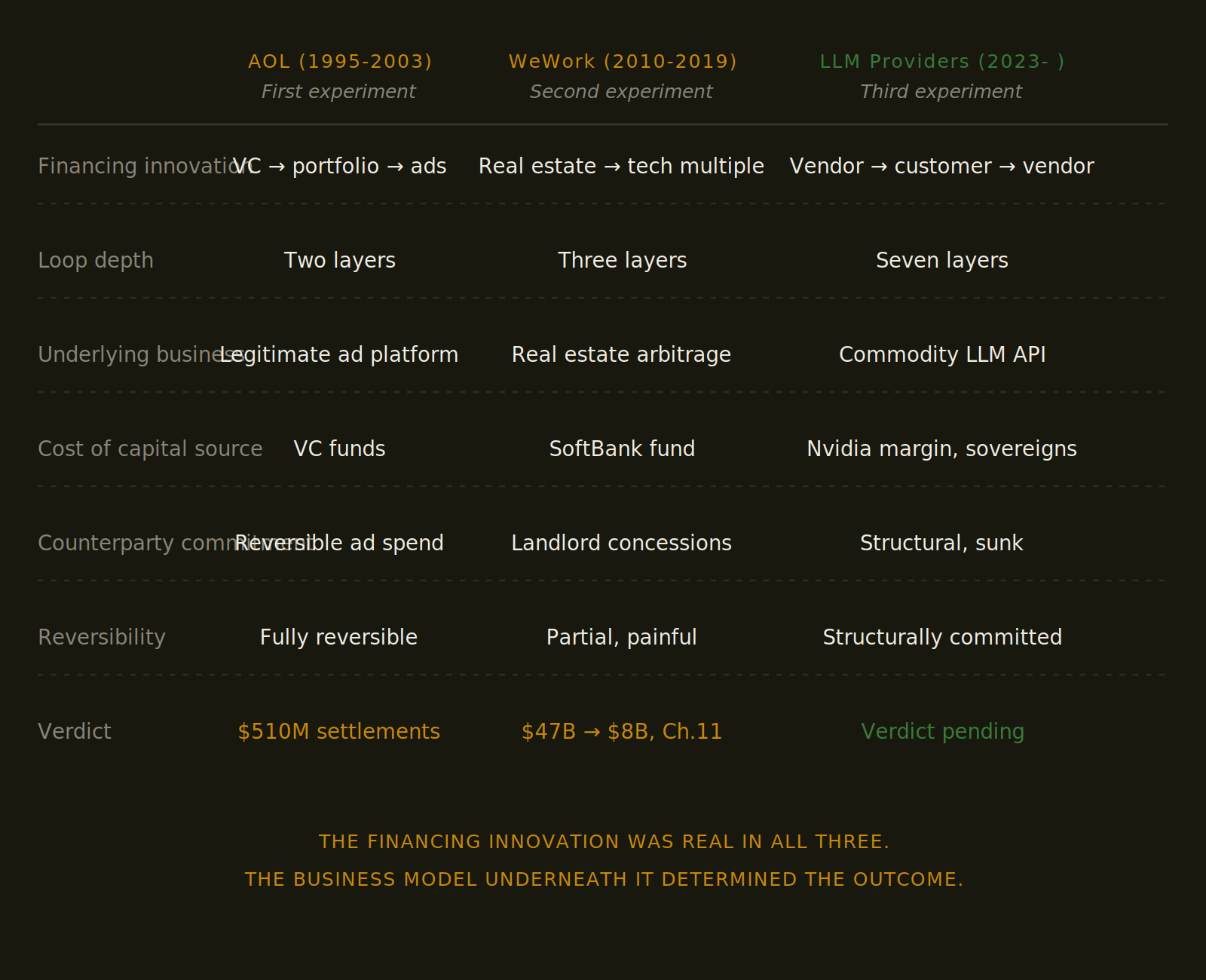
The loop extends further down than either previous experiment. AOL's loop was two layers deep (VCs into portfolio companies, portfolio companies into AOL ads). WeWork's was three (landlords, WeWork, SoftBank). The LLM capital loop touches seven layers. Chip manufacturers. Hyperscalers. Banks and private credit. Power companies and utilities. Land owners near viable grid infrastructure. Construction and equipment suppliers. Governments and national security policy. I made the compute-side argument in The Trillion-Dollar Trade Wall Street Isn't Seeing and the physical-AI-side argument in Real Disruption. The permitting and political layer of this loop is itself where enormous economic value is being locked or released, an argument I made in The American Dream Has a Permitting Problem and Time Kills All Deals.
The financial players are running the same structure at institutional scale. BlackRock, Microsoft, Global Infrastructure Partners, and MGX launched the AI Infrastructure Partnership in September 2024, targeting $30 billion in private equity capital rising to $100 billion including debt. Nvidia joined later. In October 2025, the partnership announced a $40 billion acquisition of Aligned Data Centers from Macquarie, the largest data center transaction in history at 6.4 gigawatts of operational and planned capacity. In Q4 2025, BlackRock closed on $12.5 billion for the partnership. Larry Fink has set a target of $400 billion in private markets fundraising by 2030. Separately, BlackRock's GIP unit formed a €2 billion joint venture with ACS in November 2025 for a 1.7-gigawatt data center pipeline across the US, Europe, Asia, and Australia. Blackstone spent $16 billion in APAC acquiring AirTrunk. These are not venture bets. These are infrastructure positions being built by the largest asset managers in the world, on their own cost of capital, which is a fraction of what any venture fund could underwrite.
The counterparties are structurally committed at a scale neither previous experiment could match. Microsoft has $25 billion in quarterly free cash flow at stake. Oracle carries $523 billion in RPO on its balance sheet. Nvidia's operating margin is roughly 75 percent, which is why the company can afford to be both supplier and financier in the same transaction. Data center construction is running at $70 billion per quarter in the U.S. alone. Power capacity commitments run into gigawatts under long-term purchase agreements. Land near viable grid infrastructure has been repriced permanently. Banks lent against the assets. Once these commitments are made, they cannot be walked back the way a landlord could stop signing WeWork leases or a venture capitalist could stop funding Pets.com. The physical infrastructure will exist regardless of which company runs the models on it. That is a categorical shift from the reversibility of the first two experiments.
The strategic-capital motivation is different. When Microsoft invests in OpenAI, it is not asking for a venture-style multiple. It is asking whether Azure grows. Azure growing at 29 percent per year is the return. Oracle burning free cash flow on data centers is not the behavior of a company manufacturing revenue. It is a company betting its balance sheet on a real infrastructure position. In 2025, private equity and alternative investors led AI deals totaling $63 billion while venture capital led $38 billion. The biggest single investor, SoftBank, committed $40 billion. These are strategic investors whose return calculation runs through their own business growth, and that changes the shape of the commitment. I described the operating-side version of this same shift in The Companies Winning at AI Are Playing a Different Game.
What is not different is the risk that sits on top of all of this. Every one of these structural strengths depends on the LLM providers delivering the revenue that justifies the buildout. That revenue depends on premium pricing that the open-weights competition is compressing every quarter. The loop can be as deep and as committed as the diagram allows, and the business model on the receiving end of it can still fail to service the debt. Aschenbrenner's blow-up is exactly that risk running in miniature, at fund scale, on a two-year timeline.
CHART 1 · THREE EXPERIMENTS IN CAPITAL-DRIVEN GROWTH
The same financing innovation, running against three different business models. The financing was not what determined the outcome. The business model underneath it was.
SOURCES: SEC v. Time Warner (2005) filings and $300M settlement, DOJ deferred-prosecution agreement 2004; WeWork S-1 (August 2019) and post-IPO-cancellation valuation reporting; SoftBank Vision Fund public disclosures; Bernstein Research, Seaport Global, UBS, and Barclays analyst notes on Nvidia, Oracle, and the OpenAI capital stack; Financial Times reporting on OpenAI-Nvidia-AMD compute commitments; The Information on OpenAI internal projections; BlackRock AIP disclosures Q4 2025; Aligned Data Centers acquisition October 2025.
The Corporate Playbook Has Already Changed
The most consequential shift is not what analysts are calling out. It is what corporate boards are quietly doing. The old model for growing tech capability was acquisition. Cisco bought its way to networking dominance. Oracle bought its way to enterprise dominance. Facebook bought Instagram and WhatsApp. Full ownership. Regulatory scrutiny. Balance-sheet consolidation. That was the playbook for twenty-five years.
The middle model was the acquihire. When Microsoft wanted Inflection AI's Mustafa Suleyman and Karén Simonyan in March 2024, it paid a $650 million licensing fee, hired the team, and left the company standing under a new CEO. Inflection kept its independence on paper. Microsoft got the leadership and the IP without triggering the antitrust review a full acquisition would have brought. The FTC eventually looked. The UK CMA cleared it. The precedent was set. Fourteen months later, in June 2025, Meta paid $14.3 billion for a 49-percent, non-voting stake in Scale AI at a $29.2 billion valuation. Alexandr Wang moved to Meta to run its superintelligence lab. Scale stayed independent with Jason Droege as interim CEO, keeping its other clients including Meta's competitors. Same shape. Larger scale. Even less regulatory friction.
The new model is the one this piece is really about. Ecosystem capital deployed not to consolidate a target, and not even to acquire its leadership, but to accelerate a company whose success now materially grows the investor's own business. Nvidia's up-to-$100 billion into OpenAI is one version. BlackRock's $12.5 billion partnership with Microsoft, MGX, and Global Infrastructure Partners is another. Blackstone's $16 billion AirTrunk purchase is a third. Sovereign vehicles, hyperscalers, credit funds, and infrastructure investors are moving into positions that were traditionally venture-scale, at institutional cost of capital, and the venture-scale players cannot compete on the same terms.
The reason the shift is happening now is that the SaaS companies with the cheapest cost of capital are also the ones with the highest need to transition. Their public-market cash flows are enormous. Their business models are increasingly under attack from the AI-first alternatives I mapped out in Software Is Over, Software Is Not Going Down Alone, and The Last Great Head Fake in Software History. The pace of that attack was just made painfully visible in a single deal.
On August 4, 2026, Bending Spoons, the newly-public Italian holding company for legacy tech brands including AOL, Eventbrite, Evernote, Vimeo, and WeTransfer, announced the acquisition of Airtable for $1.285 billion enterprise value and $2.25 billion in equity value. Airtable had raised $735 million at an $11.7 billion valuation in 2021, led by XN with participation from Silver Lake, Iconiq, Salesforce Ventures, and T. Rowe Price. The Bending Spoons deal represented an 89 percent discount from that peak, and roughly a 44 percent discount from the $4 billion secondary-market valuation Airtable's shares had traded at earlier in 2026. Late-stage investors including Thrive Capital, Coatue, and CRV are taking significant losses. This is one of the first major SaaS-era exits at scale, and the discount is the signal. The market for large-scale SaaS acquisition is repricing in real time. Companies still carrying 2021 valuations should assume their exit range has moved. Boards that had been waiting for a rebound should read the Airtable print carefully. The dead cat bounce is not coming back for most of them.
What that means for the corporate playbook. If you are the CFO of a large public SaaS company with strong cash flows and a business model that is beginning to look tired against AI-first alternatives, you have two choices. Move now, using your balance sheet to invest in the AI companies whose success would either accelerate your own transition or absorb the AI displacement into your own P&L, at prices set before the next Airtable print. Or wait, watch the multiple compress, and eventually get bought by the next Bending Spoons at a discount. The traditional Corporate Venture Capital route is not the answer either. CVC funds are typically structured as venture-style side pockets, disconnected from the operating business, competing with venture capital on venture terms. The ecosystem model is different. It uses the operating balance sheet directly. It structures returns through business acceleration, not just fund multiples. It also lets the corporate participant deploy at a cost of capital that no venture fund can match.
Special-purpose vehicles are becoming the connective tissue for this shift. SPVs let a corporate participant syndicate a strategic position with credit funds, sovereigns, and other operating counterparties without carrying the full commitment on its own balance sheet. The BlackRock/Microsoft/GIP/MGX AI Infrastructure Partnership is exactly this shape. Aligned Data Centers was acquired through the SPV. So was AirTrunk. So is most of the $63 billion in AI-focused private equity that ran past the $38 billion in venture capital last year. Newer variants are already emerging. This is the beginning of a durable shift in how large-scale tech financing gets done, and it is the subject of the next piece in this series.
The Design Principle
A business model that solves a client problem drives revenue. A business model that also drives growth for its supply chain, its capital providers, and the economic ecosystem around it creates something categorically different. The nature of every party's motivation shifts. A standard investor hopes for a return. A strategic investor who needs your company to succeed in order to grow their own business has a different level of commitment. They will do things a financial investor would not. Take below-market pricing. Provide infrastructure at cost. Make political arrangements. Commit capital before the financial case is obvious.
The math on cost of capital is what makes this model structurally superior when it works. A traditional venture fund has a cost of capital in the mid-teens. Nvidia's operating margin, which is essentially the same variable for its ecosystem investments, is roughly 75 percent. A sovereign wealth fund's cost of capital for infrastructure runs low single digits. A hyperscaler funding its own supply chain uses free cash flow that would otherwise sit in Treasuries. When each layer of the stack contributes capital at the cost of capital appropriate to that layer, the overall efficiency of the growth engine is dramatically higher than a stack financed entirely by venture money. The blended cost of capital across the AI infrastructure loop is lower than any single-layer alternative. That is the real innovation. It is not a bubble. It is arithmetic. In a stack that includes Nvidia margin, sovereign infrastructure funding, and hyperscaler free cash flow, venture capital is now the most expensive money in the room. That is the sentence every founder and every general partner needs to sit with.
The most durable version of this model is the one where the loop participants cannot exit without significant pain. Sunk costs transform hope into commitment. The landlord who granted concessions, the hyperscaler that built the data center, the bank that lent against the infrastructure, the power company that signed the long-term PPA, none of them can walk away cleanly. That irreversibility is the mechanism that makes the loop self-reinforcing. I made an adjacent version of this argument in Infinite Leverage. The engine of growth is not the customer alone. It is the network of committed participants whose own success depends on yours.
Two risks govern every loop of this shape. Commodity risk. If any participant can get the same benefit from a competitor, the loop dissolves when credible alternatives emerge. This is the risk the LLM providers face specifically. If the underlying model is a commodity, every supply chain participant redirects toward whoever offers the best terms. I laid out this exact commodity dynamic across the model layer in Peak Token.
Demand authenticity. The loop amplifies whatever signal is at its core. Real demand produces compounding. Manufactured demand produces a synchronized correction when it becomes visible. AOL's late-stage demand was manufactured through round-trips after the second-order capital collapsed. WeWork's was real but bounded by the price the public market would pay for a real estate business. The LLM providers' demand is real at scale but constrained on margin by open-weights competition. That is a real risk, and it is the risk the analysts are naming correctly.
The Real Innovation, Regardless of How the Third Experiment Ends
The point of this piece is that ecosystem financing is the innovation, independent of whether the current LLM providers succeed with it. When the underlying business has real value and defensibility, this model creates value at a scale no simpler financing structure can. Faster time to deployment. Lower blended cost of capital. Structural alignment across the supply chain, the customer, and the sovereign layer. Compounding through the network effects of every participant's own growth. I made a version of the benefits argument in We're Complaining About the Wrong Thing. The AI capital buildout is producing real infrastructure, real jobs, real land value, real power generation, and real strategic optionality against a Taiwan disruption. The debate over whether the frontier lab margins will service the debt is a real debate. It is not the whole story. The whole story is that a new financing model is being road-tested at trillion-dollar scale, and the components that survive the LLM verdict are going to reshape how every capital-intensive company at scale gets built for the next twenty years.
When the underlying business does not have real value or defensibility, the same model produces the opposite outcome. The acceleration burns more capital, faster, than any traditional structure. That is what Aschenbrenner's fund demonstrated in miniature. Correct thesis. Wrong duration assumption. Ecosystem-scale amplification. A $35 billion drawdown in a week. If the commodity LLM business model does not hold on margin, the same amplification produces losses that will make the WeWork write-down look small. The systemic risk on the way down is the exact mirror of the growth engine on the way up. That is the trade every serious investor and board should be pricing now.
What This Means for Founders and Boards
The financing innovation is worth studying. Not because the LLM providers will necessarily succeed with it, but because the innovation is going to appear again, in adjacent industries, and the founder or board who understands it has a structural advantage. The question is not who wants my product. It is whose business grows when mine grows. Who in the economic ecosystem around me has a material stake in my success that goes beyond hoping for a return? In each category the answer is different. Real estate: landlords and lenders whose balance sheets respond to occupancy. Infrastructure: suppliers who scale their own businesses on the back of your demand. Platforms: creators, advertisers, and developers who benefit directly from the platform's growth. Defense and government: customers who build their own capabilities around your product. Biotech: research institutions, hospitals, insurers, and regulators whose funding models depend on breakthrough therapies. In each case, the question is the same. Can you structure the relationship so their commitment becomes structural rather than optional? Can you turn a hope for return into a need for your success?
When the answer is yes, the capital chain is the engine of growth, not the cost of it. The more people who are in the loop, the more momentum it generates. The size of the opportunity is measured by the sum of every economic interest aligned with your success. I made a version of this argument for boards weighing their AI strategy in The Safest Move You Can Make With AI Will Cost You Everything. The moat is not the product. It is the network of participants whose success is tied to yours.
For boards of large public SaaS companies, the message is more urgent. You have the cheapest cost of capital in the room and the largest need to transition. The pure acquisition playbook is closing. The acquihire playbook is available but does not solve the transition problem, only the talent problem. The ecosystem model is the one that gets you AI-first exposure at your own cost of capital, with structural alignment rather than dilution. The Airtable precedent should be read as a warning to move before the next Airtable print is your own.
Steve Case built a great business. Adam Neumann had a clever real estate insight. The current LLM providers built the most extraordinary technology deployment in modern history. All three represent an experiment in how capital funds growth. Only one of them has a business model verdict still pending. The financing model itself is going to keep running long after that verdict is delivered, because the arithmetic on blended cost of capital does not care which specific company ends up on the winning end of it.
What Comes Next
This is the first of three pieces on how tech financing itself is being rewritten. The next piece goes deep on the mechanics of what is replacing traditional venture capital. Corporate strategic capital deployed at operating cost of capital. Sovereign infrastructure vehicles. Credit funds moving into positions that used to be venture equity. SPVs syndicating strategic positions across parties who would never have shared a cap table in the old model. The piece after that goes deep on why venture capital, as a structure, may no longer be the right vehicle for most of what gets called tech. When every serious company at scale is a tech company, and when the cost of capital differential between an operating strategic investor and a venture fund is what it is, the venture model has to change. It is changing already. Most of the market has not priced the shift yet.
If you want them delivered when they publish, subscribe at reloadnyc.com. Free. No paywall. No course at the end. Just the work.
If this piece changed how you are thinking about the AI capital stack, or about the shape of tech financing going forward, forward it to one person who needs to read it. A partner at your firm. Someone on your investment committee. A director on your board. A founder trying to structure a strategic round. One specific decision-maker in your world. That is how the argument moves. One reader telling another.
If you are the person who just got this forwarded to you, welcome. Subscribe at reloadnyc.com. Two dozen pieces in the archive. Another two dozen in the queue.
Reply if you want to argue. Post it on X, tag @smesser, and let me know where I am wrong. Share it on LinkedIn if the boards you sit on need to see it, and tag me at linkedin.com/in/stephenmesser. The pieces get sharper when readers push back.
RELATED READING · RELOADNYC
The Only Fight That Matters in AI. And Nobody Is Even Naming It.
The orchestration layer above the commodity model layer. The categories of AI that operate on entirely different business economics from the LLM providers.
Peak Token. Why the Frontier Just Priced Itself Out of Its Own Market.
The commodity risk inside the LLM providers' business model, priced in real time. Why open-weights competition is compressing the margin every quarter.
The Last Great Head Fake in Software History
Why technology cycles never run in straight lines, and how the SaaS incumbents are being priced for a rebound that is not coming.
The Trillion-Dollar Trade Wall Street Isn't Seeing
The compute side of the AI capital loop. Every US data center is a free call option against a Taiwan disruption, and every one of them is a permanent economic bet.
We're Complaining About the Wrong Thing
The benefits of the AI capital buildout that the bubble-versus-real debate keeps missing. Real infrastructure, real jobs, real strategic optionality.
The Companies Winning at AI Are Playing a Different Game
The recursive loop on the operating side of the same shift. Different game, same mechanic.
Infinite Leverage. Building a Company with More Agents Than People.
The engine of growth is the network of committed participants whose own success depends on yours.
The Safest Move You Can Make With AI Will Cost You Everything
The math on the responsible-caution position, for any board still thinking it can wait this out.
Stephen Messer
Co-founder of Collective[i] and Intelligence.com. Co-founder of LinkShare (sold to Rakuten for $425M). Board Member, Spire Global (NYSE: SPIR). Writes at reloadnyc.com.
Connect on intelligence.com