The Only Fight That Matters in AI. And Nobody Is Even Naming It.
Every AI debate is stuck at the model layer — bubble or not, whose benchmark wins this month. All interesting. None of it decides who owns AI. The real fight is one layer up: whoever owns the orchestration layer gets the next twenty years.

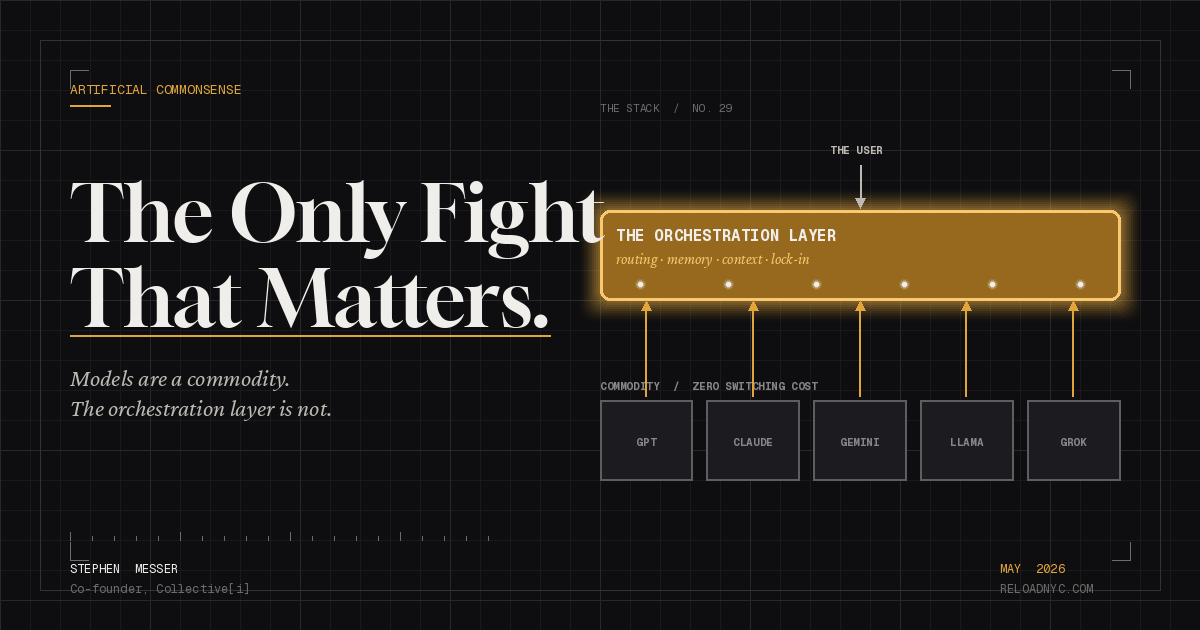
The Orchestration Layer. Where All the Lock-In Actually Lives.
Stephen Messer, Co-founder of Collective[i] and LinkShare (sold to Rakuten for $425M, 1996–2005). EY Entrepreneur of the Year/Deloitte Fast 50 winner. Board member, Spire Global (NYSE: SPIR). Building intelligence.com
The debate about AI has been stuck at the wrong layer for eighteen months. Is the model layer priced correctly, or is it a bubble? OpenAI's revenue against its costs. Anthropic's revenue against its compute bill. The frontier labs against every open-source model closing the gap. The debate is fine. It is also not the interesting one.
The real fight is one layer up. Whoever ends up owning the orchestration layer between the models, and the lock-in that comes with it, gets the next twenty years of compounding.
If you still thought the commodity models had a moat at the consumer layer, watch what happened in March. The Pentagon cancelled Anthropic's $200 million military contract after Anthropic refused to remove restrictions on autonomous weapons and domestic mass surveillance. OpenAI signed the replacement deal the same week on the exact terms Anthropic had rejected. Users reacted. ChatGPT uninstalls spiked 295 percent in a single day. One-star reviews jumped 775 percent. Claude overtook ChatGPT on the U.S. App Store the same week. ChatGPT's share of global chatbot traffic dropped from 87 percent to 65 percent over the following months. Users voted with their feet in a matter of weeks, over a single ethical disagreement, and the switching cost was zero.
No barrier to exit. No barrier to entry. The illusion that consumers would stay loyal to their AI vendor evaporated in about a week. Ask the next question. If the daily token limits on your chatbot were removed, or if your twenty dollars a month became unlimited because a Chinese model runs at a fraction of the cost, would you switch? For most people the answer is obvious. The vendor knows it too. Nobody in the industry disputes the commodity thesis out loud. Nobody acts like it either, which is the tell. The players fighting to defend their model-layer positions are the ones about to lose the game. The players I would watch instead are the ones building at the layer above the commodity. Some of them will surprise you.
The Search Engine Wars Are the Right Analog
Every search engine in the late 1990s was a commodity. AltaVista, Excite, Lycos, Infoseek, Ask Jeeves, HotBot, Yahoo's directory. Users switched between them casually. The ranking algorithms were different but not decisive. What separated the winner from the losers was not the search technology itself. It was the economic engine that funded everything else.
Bill Gross's Goto.com introduced the auction-based paid-search model in 1997. Overture, its renamed successor, was acquired by Yahoo in 2003 for $1.63 billion. Google licensed the same idea for AdWords in 2002, refined it, and turned it into an auction-driven revenue machine that generated more cash than every other search engine combined. By the early 2000s every search engine was losing quality to link farms, keyword stuffing, and paid ranking manipulation. Fixing it required paying more engineers to stay ahead of the SEO industry than any of the losing search engines could afford. Google could afford it. The search-quality war was not won by cleverness. It was won by capital, and the capital came from the economic engine sitting one layer above the search algorithm.
Google understood something the others did not. Even the auction was not enough. Even with the best cash flow in the industry, Google spent the next fifteen years frantically building lock-in on every other side of the customer relationship. Gmail. Maps. Waze. YouTube. Chrome. Android. Docs. Photos. Cloud. Each of those is a story about a company that knew its core product was interchangeable and moved as fast as it could to make leaving unthinkable. The auction produced the cash. The lock-in ecosystem produced the retention. Both were required. Neither was sufficient alone.
Everything about AI right now rhymes with search in 1999. The models are a commodity, the market is treating the commodity as the prize, and the fight that decides who wins the next twenty years is happening one layer above them. That layer is orchestration, and the lock-in it generates is the AI equivalent of the AdWords auction combined with the Gmail-Maps-Waze-YouTube ecosystem that came after. Whoever owns it gets the capital flywheel that funds everything else, and the retention that makes the flywheel spin instead of leak.
The Commodity Model Layer Is Already Priced Like a Commodity
The half-life of a frontier lead used to be eighteen months. That was the entire investment thesis for OpenAI, Anthropic, and Google's Gemini team. Build a model, hold the lead for a year and a half, defend the premium pricing, use the margin to build the next one. That thesis is gone. The gap between the best closed model and the best open one is now measured in weeks. Zhipu AI released GLM-5.2 in June 2026 under an MIT license, with a one-million-token context window, matching the closed frontier from OpenAI and Anthropic on coding and agent tasks at a fraction of the cost. Moonshot shipped Kimi K3 on July 17, 2026, a 2.8-trillion-parameter open-weights model billed as the largest ever released. DeepSeek V4 runs code generation at roughly $0.30 per million tokens against $10 and up for Western equivalents. Nous Research has been shipping Hermes open-weight variants at 405B parameters since August 2025 under permissive licensing. Every time a closed lab ships a new capability, an open-weights version follows within weeks, cheaper, downloadable, and running anywhere.
The commodity models are becoming the Linux of AI. Linux won the operating-system layer of the internet because it was free, open, and good enough. Nobody made a fortune selling Linux. The money moved one layer up, to Red Hat, then to AWS, then to every application built on top of the free substrate. The same shape is playing out with AI models right now, and the country making the biggest bet on the Linux side of it is not the United States.
Whether the open models were trained from scratch or distilled from closed frontier output does not matter. The outcome is the same either way. I laid out both sides of this argument earlier this year, one week apart, in The Bull Case for the Model Makers and The Bear Case for the Model Makers, so readers could hear the strongest version of each. Even in the bull case the weaknesses were already visible, and every piece I have written since (including Peak Token) has pointed to how weak these players actually are. The frontier is no longer a durable position. It is a temporary status.
Yann LeCun is making the same argument from the architectural side, and it is more damaging than most investors have registered. The entire valuation case for the model layer was built on the idea that these systems would keep scaling toward AGI. LeCun is one of the people who brought us the LLM, and he is now the one telling anyone who will listen that language models are not the path to it. His words are that the industry has become "LLM-pilled," which is not a subtle way to say the world has bought a story that will not hold. LeCun left Meta in December 2025 to found AMI Labs on a billion-dollar seed round, the largest ever raised by a European startup, on the bet that language models trained purely on text will not reach general intelligence. Their capability ceiling is set by the fact that the data they learn from is text about the world rather than the world itself. Hold a pen upright and let go. A toddler knows it will fall. Ask a language model the same question and it generates a fluent, plausible-sounding answer with no grounding in physical cause and effect at all. LeCun made the full case at a recent ciforecast.com event: "From Machine Learning to Autonomous Intelligence," at intelligence.collectivei.com/upskill/video/791294396.
Fei-Fei Li is making an adjacent version of the same argument from Stanford. Her company World Labs raised over a billion dollars on the bet that spatial intelligence, learned from the physical world rather than from text, is the frontier that matters next. Her Upskill conversation "Humanistic AI: Putting People at the Center of Innovation" is at intelligence.collectivei.com/upskill/video/624725134.
Two people with almost nothing in common, one pricing the market and one designing the architecture, arrive at the same word for the same technology. Commodity. One says the price must collapse because everyone is drawing on the same data. The other says the capability has a ceiling because that data was only ever text. Neither is arguing the other's case. Both land in the same place.
The Unique Models Run on Data Nobody Else Can See
Call the commodity models what they are. The second category needs a different name. The unique models. Unique for two reasons that compound. Their training data is proprietary by construction. The network effects that surround them make them stronger every day as more members join.
Economic models are the first category, and the one I know best because it is what we built at Collective[i]. The model studies the economy itself. Where demand is expanding. Where activity is happening. Where it is fading or already gone, beyond what any lagging indicator can tell you. Enterprise deals are one example of the curve in motion. Private equity acquisitions of new portfolio companies, enterprise contracts signed or renewing or dying, products sold versus ones that languish, each is a data point on a much larger pattern. Context that shifts with external influence (inflation, war, regulation) all the way down to the individual interactions by and between companies. The model predicts those movements with a precision that manual analysis and human judgment cannot match. I have laid out the specific use cases in prior pieces including Your Buyer Has a Process. Collective[i] Knows What It Is., Workflows vs Outcomes, and The Companies Winning at AI Are Playing a Different Game.
Relationship models are the second category. Trained to analyze the shadow economy of social capital earned and spent daily in every professional interaction, Intelligence.com unearths the graph of who actually knows whom, how those relationships evolve in strength over time, how introductions travel, and which relationships turn into real outcomes rather than staying dormant.
Trading models are the third. Jane Street runs neural networks on decades of order-book data that nobody outside the firm has access to. Renaissance, Citadel, and Two Sigma run variants of the same play. Jane Street's own machine-learning team describes financial market data as "regime-y," changing structure with pandemics, elections, and regulations, and the firm invents its own architectures for the problem. No public-internet training corpus is close to what these firms sit on.
Drug-discovery models are the fourth. DeepMind's AlphaFold. Isomorphic Labs, which released a proprietary drug-discovery engine called IsoDDE in February 2026 that scientists have compared to "an AlphaFold 4." Recursion Pharmaceuticals. Trained on structural biology data that has nothing to do with language at all. I mapped this category alongside the economic and revenue-intelligence category in The Intelligence Stack.
Robotic and world models are the fifth. LeCun's AMI Labs. Fei-Fei Li's World Labs. Trained on physical and spatial interaction rather than the collected works of the internet. I made a version of this argument in Real Disruption: the AI reshaping the physical world is running in dark factories, drug labs, and autonomous aircraft, and that is where the durable value settles.
Five categories today. More coming. Legal-precedent models. Materials-science models. Geological models. Weather models trained on satellite constellations. Every category where the data is proprietary and the domain rewards depth is where a new unique model will emerge. Each becomes a lever that, depending on what a company needs most, shapes which orchestration layer that company ends up routing through. That is where the next five to ten years of enterprise strategy plays out. Owning a unique model is only half the game. The other half is the layer that decides which model handles which part of a problem, and how the answers combine. That layer is where the lock-in lives.
The Orchestration Layer Is Where the Lock-In Actually Sits
Routing between two LLMs from two different labs is a rounding error. The models are close enough to interchangeable that the routing decision is mostly about cost, and the switching cost of moving from one to the other is measured in engineering days. That is what the March consumer switch to Claude proved. There was nothing to unlock.
Routing between a language model, an economic model, a relationship model, a trading model, a protein model, and a world model is categorically different. The outputs are not interchangeable. The cost of asking the wrong specialist is a wrong answer, not just a slower one. The switching cost of moving away from an orchestration layer that already knows which specialist handles which kind of question is measured in years and lost accumulated learning. That is where the lock-in comes from. Not the individual model. The layer that decides which model handles which part of a problem, how the answers combine, which memory persists across queries, and how the whole thing learns from what worked yesterday. I made a narrower version of this case in The Next Computer Is Alive and The Intelligence Stack: the winning architecture is many specialists working together rather than one generalist asked to do everything, and the orchestration layer is what makes that architecture actually work.
The mechanic that turns orchestration into lock-in is the recursion loop I described in The Companies Winning at AI Are Playing a Different Game and Infinite Leverage. An agent acts. The work gets scored. The lesson gets written down. The next run is better. That loop is the whole competitive advantage, and it only compounds well at scale.
A single company running the loop on its own data learns from its own history. Real, but bounded. A network running the loop across thousands of companies learns from every deal, every relationship, every buying pattern, every failure that happens anywhere on the network. What looks like a rumor inside one company is a distribution across a market. This is the exact mechanism that made Google search compound. More users produced more query data, which produced better rankings, which produced more users, which produced better ad targeting, which produced more capital, which produced better engineering, which produced better rankings. The same flywheel is about to run at the orchestration layer, and it will only spin for the players whose recursion runs on a market rather than a customer.
Enterprise software, and the agents now running inside it, need this same kind of model. An understanding of the economy and the relationships that move within it. Whether the work is agentic or human, and whatever internal function the technology manages, it requires a level of orchestration only an economic model can provide. Without that, agents and people operate in the dark. The impact a referral has on a hire or a product purchase. The investment that happens because of a private reference. The seller with ten times the odds of closing because of a warm introduction. The choice to expand investment in one product line while another quietly heads toward extinction, along with the pricing, supply chain, and inventory decisions that follow from it. Collective[i] and Intelligence.com are models that coordinate execution based on what, and who, is driving the economy at any given moment.
The AI market is going to sort itself into two categories. Companies whose recursion runs on their own data, and networks whose recursion runs on a market's data. One curve is linear. The other is not. Once the second curve pulls ahead, it does not come back.
Four Kinds of Player Are Racing for the Same Layer
Nobody has won the orchestration layer yet. That is exactly why every serious player is racing for it. Four categories of contenders are visible, and each is running a different play.
The commodity model labs. OpenAI, Anthropic, Google. All three are extending downstream from the commodity layer they already dominate. Anthropic's Claude Code and the Model Context Protocol. OpenAI's Deployment Company, launched in May 2026. Google's Gemini integrations across Workspace and Cloud. Real infrastructure. None of these labs owns a unique-model of its own in the sense I described a section ago, which means each is betting it can orchestrate specialist intelligence it does not build and cannot see fully inside of.
The legacy SaaS incumbents. Salesforce, Oracle, SAP, ServiceNow, Workday. Retrofitting orchestration onto systems that were built for a pre-AI world. I made the arc-of-inevitability case across three pieces: Software Is Over, Software Is Not Going Down Alone, and The Last Great Head Fake in Software History. The AI Shuffle and Workflows vs Outcomes explained why bolting agents onto workflow tools built for humans typing into fields does not produce an orchestration layer. It produces a faster version of what already existed, which is exactly the wrong output.
The unique models. Collective[i]. Intelligence.com. DeepMind. AMI Labs. World Labs. Isomorphic Labs. Jane Street. Each produces proprietary intelligence nobody else can. None on its own has all five kinds of brain a real orchestration layer would need to route between. The interesting strategic question is which of them opens its own model up to the others, and on whose terms.
Open source and open standards. Model-agnostic, domain-agnostic layers with no single owner. The Model Context Protocol. Nous Research's Hermes 4 family, and the Hermes Agent framework Nous released in February 2026. OpenClaw, the open-source agent harness that had 85,000 active instances in China by mid-March 2026, nearly double the U.S. figure. The only category with no war chest of its own, and the only one whose incentive is fully aligned with the customer using it rather than with the vendor selling it. Also the strategy China is quietly betting on from below, in a way that will matter to how this whole race resolves.
Every one of these categories can name a plausible thesis for winning the layer. Only two of them have the structural setup that makes the thesis credible.
The Forward-Deployed Engineer Is the Tell
Watch what the commodity model labs and the legacy SaaS incumbents are doing about talent, not what they are saying about product.
Anthropic launched a forward-deployed engineer function in May 2026. OpenAI stood up its Deployment Company days earlier. Both are, in effect, in-house consulting arms whose job is to sit inside customer environments, understand each customer's specific data, workflows, and idiosyncrasies, and manually build the orchestration the product cannot yet build on its own. That is a Palantir move. Palantir made forward-deployed engineers famous because its product needed intense human customization to work well for each customer. The move is defensible. It is also expensive, non-scalable in the traditional software-margin sense, and a strong tell that the labs know the orchestration layer is not something the model alone can deliver.
The pricing side of this problem is where it gets ugly for the commodity labs. Cursor spent most of 2025 running on Anthropic's Claude at retail API pricing while Anthropic was running wholesale economics on its own Claude Code product, and by early 2026 the margin trap was closing. In March 2026, Cursor launched Composer 2 as its "in-house" flagship. Developers intercepted the API response within twenty-four hours and found the model ID: kimi-k2p5-rl-0317-s515-fast. The base was Moonshot's Kimi K2.5, a Chinese open-weights model, with Cursor's reinforcement-learning stack on top. Elon Musk confirmed it publicly with a three-word tweet to his 237 million followers: "Yeah, it's Kimi 2.5." Cursor acknowledged the base and shipped Composer 2.5 in May with Kimi disclosed openly. When Kimi K3 released on July 17, 2026, Musk weighed in again with a single word: "Impressive." Three months later SpaceX acquired Cursor for $60 billion, a rescue from a margin trap that only widened the longer Cursor defended a Western closed-model dependency it had already quietly abandoned.
You can see the pressure on the commodity labs directly, and it is being said out loud on the record. Anthropic's founders have been publicly calling for restrictions on Chinese open-source models. Sam Altman posted on X on July 15, 2026, that OpenAI's GPT-5.6 Sol was already "half the price" of Anthropic's Claude Fable 5 and that OpenAI would be "happy to deliver at one-quarter of the price." Weeks earlier the Wall Street Journal reported OpenAI was internally weighing drastic reductions in token pricing. xAI, Meta, and OpenAI have all cut prices in the second quarter of 2026. Anthropic's own Q1 2026 operating margin came in at negative 122 percent while the company was completing a $65 billion funding round at a $965 billion valuation. This is not defensive posture from a position of strength. It is a pricing war the commodity labs are running against each other while the Chinese open-weights models sit 60 to 90 percent below the entire Western pricing stack. None of it speaks to owning the orchestration layer. It speaks to defending a commodity position long enough to figure out what happens next.
Consulting is a bridge product, not an endgame. Whoever finishes the real orchestration layer first wins the customer. Whoever runs out of bridge before that happens loses. The forward-deployed engineers may not have enough time to build the barriers to entry before the pricing collapse runs the play out from under them. If you are reading this as a leader of a company, you are probably already having second thoughts about letting these consultants sit inside your environment trying to build lock-in on their vendor's behalf, on your dollar no less. That is the right instinct. The customer is the one paying to build a wall around themselves.
The Legacy SaaS Players Have the Same Token Problem, One Layer Removed
The pricing pressure on the commodity model labs has a downstream effect nobody in the SaaS industry wants to name out loud. When the labs need growth to offset the pricing collapse under them, they look for the biggest available market. Coding is that market. Every quarter the coding models get sharper and cheaper. Every quarter the CTO and the CIO get more comfortable using them for work that used to require an outside vendor.
The result is predictable. A CRM your company pays Salesforce seven figures a year for can be rewritten as a custom AI-first application over a weekend. That much was already true a year ago. What has changed is the economics underneath it. What would have cost a small fraction of the Salesforce bill on a Western frontier lab last summer is now a fraction of that fraction when the coding agent is running on Kimi or another open-weights model. Building the replacement is almost free today. That is not a savings on the SaaS line item. That is the SaaS line item eliminated, replaced by a maintenance cost so low it barely shows up on the same P&L. The same coding agents that ship the replacement handle the ongoing upkeep for a rounding error. The same applies to the middle-tier ERP, the field-service tool, the applicant tracking system, and most of the vertical SaaS a Fortune 500 pays a hundred million a year for.
The commodity model labs need CTOs and CIOs to run those projects because it fuels the labs' next quarter of growth. The CTOs and CIOs already wanted to run them, because it gives them back the control they lost to SaaS twenty years ago, plus cost savings they cannot generate any other way. The engineers on the ground, the ones nervously watching AI take over pieces of their own jobs, have a strong personal incentive to be the one who cuts a seven-figure vendor line to zero. Nothing demonstrates irreplaceability to a CFO like taking a permanent, recurring cost off the balance sheet. The alignment across all three levels of the customer is what makes this trade unstoppable.
SAP, Microsoft, Salesforce, and every other SaaS incumbent will tell their boards that cheaper open-source models mean their AI-feature spend goes down a little. That is a comfortable story. It is also the wrong story. The more likely outcome is that weekend projects at their largest clients replace many of those vendors outright.
The standard SaaS defense is that their code bases are enormous and irreplaceable. The truth is those code bases are enormous because they were built to support every kind of client. Most clients use less than five percent of any given SaaS product. The rest is overhead. Feature bloat that was necessary for the vendor's sales motion and unnecessary for the customer's actual workflow. Most firms need a trimmed-down version of what they bought, customized for their operations, and nothing else. An AI-first rebuild that ships that specific five percent as its whole product is a categorically better fit than the incumbent, and it costs a tenth of what the incumbent charges.
I made a version of this argument in Workflows vs Outcomes. The data SaaS was built to capture is the wrong data for AI to learn from. The workflow those systems standardize is the wrong workflow for AI to accelerate. Most of what an AI orchestration layer needs to learn has already been stripped out of the SaaS record by design. Both problems get solved at once by building an AI-first version of the product from scratch, on the data the customer actually generates rather than the data the workflow forced them to enter.
Building the AI-first replacements for the twenty biggest categories of enterprise SaaS may end up being the biggest trade of the next five years. This is not just my argument. It is already happening at the largest AI-native companies in the market. Block cut roughly 4,000 employees in February 2026 as Jack Dorsey publicly reoriented the company around what he called intelligence at the core of everything it does. Coinbase's Brian Armstrong cut 700 employees on May 5, 2026, with the stated goal of becoming, in his words, lean, fast, and AI-native. Two days later Cloudflare's Matthew Prince cut 1,100 employees on the same rationale, filing the 8-K with the SEC as a plan designed to accelerate the company's evolution to an agentic AI-first operating model. All three companies were posting record numbers when they cut. The restructuring was not about cost. It was about replacing the SaaS stack, the internal tooling, and the human workflow that had been built for a pre-AI world.
I have made the AI-first argument at length across Software Is Over, What It Means to Be AI-First, and The Race Is On. The through-line across all three is that becoming AI-first requires eliminating the SaaS stack that stripped the reasoning out of the workflow in the first place. Klarna's story from 2024 (replacing Salesforce and Workday, revenue per employee going from $400,000 to $700,000 in a single year) was the early tell. Block, Coinbase, and Cloudflare are the mid-2026 version of the same play at scale. The companies still trying to layer AI on top of the incumbent SaaS stack are running a strategy the market leaders already abandoned.
It is going to become a badge of honor on quarterly calls. CFOs will report software spend as a percentage of revenue, and CIOs will race each other to see who can drop it fastest. Cost-out from software will replace the token-maxing nonsense I called out in Peak Token as the benchmark for real AI adoption. Token-max was always the wrong metric. It was measuring inputs. The right metric is what the AI displaced on the balance sheet. The biggest displacement target on that balance sheet is the SaaS stack. The winners on the other side of the trade are the unique-model companies that everyone routes through, because a unique specialist is a required node in any orchestration layer worth the name. The commodity labs and the SaaS incumbents need the specialists more than the specialists need them.
This Is Also a Country Race. China Is Playing It Openly.
Every argument I have made so far is a company argument. There is a country argument sitting underneath it, and it may end up mattering more than any of them.
The West's bet on AI is a closed-model bet. OpenAI, Anthropic, and Google spent five years building frontier models behind APIs, priced above the market, defended by capital and talent nobody else could match. That was the moat. The moat is now eroding in front of everyone's eyes.
China's bet is the opposite one. DeepSeek, Qwen, Kimi, Zhipu's GLM, Meituan's LongCat. Every serious Chinese lab has released open-weights models, mostly under permissive licenses, mostly downloadable, mostly cheap enough to run that a developer anywhere on Earth can pick them up over a weekend. On many benchmarks, particularly in agentic coding, Chinese open-weights models are already ahead of the closed Western frontier. The Cursor/Kimi story from March is the version everyone knows. The version people miss is that Cursor is not the outlier. It is the visible example of a pattern running quietly through hundreds of Western AI companies whose "proprietary" coding and reasoning capability is actually a Chinese open-weights model with a light layer of fine-tuning on top.
The orchestration piece of the same bet is where China is playing hardest and where the West is barely playing at all. In March 2026, Baidu ran mass in-person events in Beijing to teach the public how to install and set up OpenClaw. Zhipu released AutoClaw, a local Chinese version of the same open-source agent framework. Free setup sessions. Free training. Kids and retirees "raising lobsters," the local nickname for OpenClaw's mascot. Alibaba shipped MuleRun, an "always-on AI workforce" of agents, in May 2026. According to the Council on Foreign Relations, active OpenClaw usage in China nearly doubled U.S. usage by mid-March 2026, 85,000 to 48,900, and the gap is widening every quarter. The strategic implication is uncomfortable. The West is defending a model layer that is already commoditizing. China is making the model layer a commodity as fast as it can, and building the population expertise to own the layer above it. If the underlying models are free and interchangeable, the country that shapes the orchestration layer around them shapes the AI economy on top of it. If the population that operates that layer at scale is Chinese, the standard will be Chinese too.
I made a related argument in The Trillion-Dollar Trade Wall Street Isn't Seeing about the compute side of this fight. The orchestration layer is the software mirror of the same trade. Whichever standard the world routes through in five years sets the terms for every AI-driven business built after it. If the West spends this decade defending a commoditizing model layer while China quietly makes orchestration the open substrate on top of Chinese open weights, the strategic outcome will be settled long before Washington notices.
CHART 1 · THE TWO LAYERS. THE TWO FIGHTS.
The commodity model layer is where the money is being talked about. The orchestration layer is where the money is actually going to settle.

Sources: Reuters coverage of GLM-5.2, Kimi K3, DeepSeek V4 releases 2026; Nous Research Hermes 4 technical report Aug 2025; Anthropic and OpenAI disclosures on Deployment Company and FDE launches May 2026; Jane Street ML public materials; DeepMind AlphaFold and Isomorphic Labs public research; AMI Labs and World Labs funding announcements; Similarweb chatbot traffic data Mar-Jul 2026; Council on Foreign Relations analysis of OpenClaw adoption in China Jun 2026.
Karp and Nadella Are Already Making the Wrong Move
While China plays this openly, the two most credible executives in enterprise technology in the West are pitching the wrong strategy publicly, and one of them made his first move on Friday. On July 24, 2026, Satya Nadella co-signed and publicly promoted an open letter titled "Open Weights and American AI Leadership," signed by twenty-five companies including Nvidia, Meta, Palantir, Mistral, Hugging Face, IBM, Dell, and Y Combinator. His post on X read that "open-weight models are essential to a healthy AI ecosystem" and that Microsoft is "outlining a path for open-weight models to strengthen American competitiveness." Not signed: OpenAI. Not signed: Anthropic. The two commodity model labs Microsoft has poured tens of billions of dollars into were left off the list on purpose.
Read what happened underneath that letter. Nadella is publicly acknowledging that the commodity model layer is going to be an open-weight standard. He is also positioning Microsoft as the orchestration layer that lets every enterprise switch between those open models without getting locked into any one of them. On the surface this is a customer-friendly move. Underneath it is the same wall the search-portal executives were pitching in 2001. Enterprises should route through Microsoft's stack, use Microsoft's "proprietary learning environment," and let Microsoft own the orchestration relationship. The models get commoditized. Microsoft holds the customer.
Alex Karp at Palantir is running the same play from the forward-deployed side. His argument is that Palantir's engineers embed inside customer environments to build the AI system for each customer specifically, and once embedded they own the orchestration for that customer forever. Same wall. Same customer-lock-in premise. Different starting point.
The full response publishes here in about a week. The short version is that both plays are missing the piece that matters. Microsoft does not own a unique model of its own in the sense described earlier in this piece. Palantir does not either. Both companies are pitching orchestration layers built on top of commodity models and human consulting, which is a defensible near-term business but a fragile one. Whichever orchestration layer wins the enterprise decade is going to be the one that also owns the specialist intelligence on the other end of the routing decision. That is what Microsoft cannot deliver on its own, and it is why Nadella's own letter, read carefully, is an invitation for whoever does own the unique models to come route through Azure. It is the pitch of a broker, not of an owner.
The Trade
For finance readers and boards thinking about how to position against what is coming, three things matter.
Own the layer or feed the layer. Every viable strategic position in AI over the next five years reduces to either owning a piece of the orchestration layer, or being a required node inside somebody else's. The middle position, which is trying to compete with the orchestration layer while renting the models under it, is a losing hand. Companies stuck in that middle position include most SaaS incumbents and most first-generation AI startups whose product is a thin layer on top of a commodity model.
The unique models are the trade the market is not yet pricing correctly. Take the lesson of the internet generation. The first-generation companies (Netscape, AOL, Yahoo, Excite, Lycos, Ask Jeeves) captured most of the imagination and most of the venture capital of the 1990s. Almost none of them ended up being where the money was made. The money was made by the companies that owned the layer above those first-generation products (Google's AdWords, Amazon's marketplace, Facebook's ad graph, Salesforce's CRM, Apple's App Store, LinkShare's affiliate network now owned by Rakuten) after the first-gen substrate had commoditized. The market today is over-invested in commodity-model companies and under-invested in unique-model companies where the actual battle for lock-in is going to be fought. That is the mispricing worth positioning against, and it is the trade I would build a portfolio around today if I were starting one from scratch.
Ask what layer your incumbents actually own. If you sit on a legacy SaaS board, the honest question is whether your company can win the orchestration layer for the vertical you already own, or whether someone else will win it and turn your product into a passthrough. If you sit on an AI leader's board, the honest question is whether the forward-deployed engineer function is a bridge or a permanent business model, and what the acquisition path looks like from bridge to real orchestration layer. If you sit on the board of a company trying to become AI-first, the question I laid out in The Safest Move You Can Make With AI Will Cost You Everything applies. The moat is not the model. It is the layer you control and the network of customers whose data compounds inside it.
Look for the specific lock-in mechanics inside every company you underwrite. Is the customer's data pooling with other customers' data on a network the vendor owns? Then the lock-in is real and the trajectory is exponential. Is the customer's data staying inside the customer's account, protected but not compounding across the market? Then the lock-in is bounded, and the vendor is competing on features rather than on network effects. Is the vendor running an orchestration layer that routes to specialist models the vendor does not own? Then the vendor is a broker, not an owner, and the specialists can cut them out the day they decide to. Every enterprise AI investment thesis reduces to one of those three shapes.
The trade is not the model. It is the layer above the model, and the network feeding the layer. Any thesis that stops at the frontier lab is priced for the last inning.
What Comes Next
Every piece in Artificial CommonSense takes something the market treats as consensus and shows what it is missing.
The next piece in this series goes deep on the modern professional graph of relationships and why it is about to change how every serious business gets done. Why the introductions that used to travel through five people now travel through one specialist model that knows both sides. Why the incumbent version of the professional graph is about to look like Yahoo's directory next to Google. Why the companies that own the relationship graph at scale end up owning the entire commercial workflow that runs on top of it. Which is why Intelligence.com is where I have placed my own bet on that shift.
The piece after that is the Karp and Nadella response I mentioned above. Both pieces are the direct sequel to the argument in this one. If you want them delivered when they publish, subscribe at reloadnyc.com. Free. No paywall. No course at the end. Just the work.
If this piece changed how you are thinking about the AI trade, forward it to one person who needs to read it. A partner at your firm. Someone on your investment committee. A director on your board. A founder still building on the commodity-model stack. One specific decision-maker in your world. That is how the argument moves. One reader telling another.
If you are the person who just got this forwarded to you, welcome. Subscribe at reloadnyc.com. Two dozen pieces in the archive. Another two dozen in the queue.
Reply if you want to argue. Post it on X, tag @smesser, and let me know where I am wrong. Share it on LinkedIn if the boards you sit on need to see it, and tag me at linkedin.com/in/stephenmesser. The pieces get sharper when readers push back.
Related Reading · ReloadNYC
Peak Token. Why the Frontier Just Priced Itself Out of Its Own Market.
The compute economics of the commodity model layer, and why the pricing collapse was inevitable from the data side up.
The Bear Case for the Model Makers
Commodity data at the bottom of the stack meant commodity prices at the top of it. The base rate was set from the start.
The Companies Winning at AI Are Playing a Different Game
The recursion loop that separates the leaders from the pilots, and why every week the gap widens.
The Intelligence Stack. What to Buy, What It Replaces, How to Wire It Together.
A working map of the commodity brains, the open-source alternatives, and the unique-model specialists worth wiring together.
Your Buyer Has a Process. Collective[i] Knows What It Is.
What an economic model built on private commercial data can see that no language model ever will.
The Trillion-Dollar Trade Wall Street Isn't Seeing
The compute side of the same country race. Why every US data center is a free call option against a Taiwan disruption.
Real Disruption
The AI reshaping the world is not the chatbot. It is running in dark factories, drug labs, and autonomous aircraft, and that is where the durable value settles.
The Safest Move You Can Make With AI Will Cost You Everything
The math on the responsible-caution position, for any board still thinking it can wait this out.
Stephen Messer
Co-founder of Collective[i] and Intelligence.com. Co-founder of LinkShare (sold to Rakuten for $425M). Board Member, Spire Global (NYSE: SPIR). Writes at reloadnyc.com.
Intelligence.com maps the relationships you actually have, not the connections you collected. Connect with me there and let us share our networks with each other.