Workflows vs. Outcomes: Why CRM-First Is the Wrong Foundation for AI
CRM was built to standardize work. AI needs to know what to optimize for. Bolt AI onto a workflow tool and you get faster workflows — not better outcomes. That's why every sales metric has moved the wrong direction for 15 years.

Stephen Messer, Co-founder of Collective[i] and LinkShare (sold to Rakuten for $425M, 1996–2005). EY Entrepreneur of the Year/Deloitte Fast 50 winner. Board member, Spire Global (NYSE: SPIR). Building intelligence.com
When you use ChatGPT to write a document, you do not open Word, then Google, then Grammarly, then a research assistant, then a copyeditor. You describe what you want and you get it. The stack collapses. The intermediate steps — all of the workflow that used to exist between "I need a document" and "I have a document" — disappear. The intelligence delivers the outcome directly. This is not a minor efficiency improvement. It is a different model of how work happens: outcome-first rather than workflow-first, intelligence rather than process.
Now consider how a CRM-first sales organization works when it needs to know whether a deal will close. It does not get an answer. It runs a process. The rep updates their deal stages. The manager reviews rep updates. The director rolls up manager adjustments. The VP adjusts for known patterns. The CRO receives a forecast that has passed through four human filters — each correcting the last — and none of them have seen what the buyer actually did this week. The outcome the organization needs — a reliable answer to "will this deal close?" — is buried under a workflow that was designed for a different purpose entirely.
This is the fundamental problem with CRM-first AI. AI needs something to optimize for. Feed it a workflow tool, and it optimizes the workflow. But the workflow was never the objective. Revenue was. Winning deals was. Building the relationships that make buyers want to buy from you again was. The CRM doesn't know any of that. It knows which fields got filled in.
What CRM was actually built to do — and what that costs
The CRM had a genuine insight at its origin: if you could standardize how salespeople recorded customer interactions, you could give managers visibility, enforce accountability, and replicate the behaviors of top performers across a team. The value proposition was process discipline and management control. Both of those are real organizational needs.
But look carefully at what was required to deliver them. Standardization required everyone to use the same field definitions. Visibility required everyone to enter data in the same format. Accountability required tracking which activities were completed. Replication required documenting the behaviors of top performers and encoding them as playbooks — turning individual craft into institutional procedure.
Every one of those requirements moved the organization away from something that actually drives revenue and toward something that looks like revenue activity. Territory definitions standardize coverage but ignore the reality that great sellers have personal relationships that cross geographic lines. Compensation structures drive behavior toward CRM-measurable metrics and away from the relationship investment that doesn't show up in any field. Playbooks capture what worked for one seller at one moment in one market and turn it into mandatory procedure — eliminating the Darwinian learning process through which great sellers find their voice, test new approaches, and generate the next generation of what works.
The seller's voice. The thing that builds trust — the ability of a seller to be genuinely themselves in a buyer conversation, to bring their own perspective and judgment rather than reciting a script — is exactly what playbook enforcement trains away. Great selling is not a process. It is a relationship. You cannot standardize a relationship.
Darwinian learning. Top performers are top performers because they found approaches that work for them in their market. Before CRM, those approaches spread organically — other sellers noticed what was working, adapted it, improved it. CRM-enforced standardization captures one moment of what worked and freezes it. The living ecosystem of competitive selling becomes a museum of historical technique.
The relationship network. A seller who has spent ten years building trust with buyers in a specific industry has something irreplaceable: real relationships. CRM territory enforcement says those relationships are only valuable within defined geographic or vertical boundaries. The relationship that crosses a territory line is off-limits, even if activating it would close the deal in a week.
Feedback from buyers. The CRM records what sellers chose to log about what buyers said. It does not record what buyers actually thought, felt, or needed. The feedback loop from market to seller runs through a human filter — the seller's selective interpretation of what they heard — before it reaches the system. That is not a feedback loop. It is a diary.
The market has rendered its verdict on this model. Every performance metric in enterprise sales has declined over the period in which CRM adoption reached ubiquity and the sales stack built on top of it reached full maturity. Win rates from roughly 30% to 17-21%. Quota attainment from 70% of reps hitting their number to fewer than 25%. Sales cycles stretched 38% longer than five years ago. And simultaneously, the cost of running the revenue function has escalated — tool spend, SDR fully-loaded cost, RevOps headcount — while output has declined. The stack is not neutral. The stack is a brake.
The ecommerce lesson B2B never learned
For the last twenty years, consumer ecommerce has been running a live experiment in what happens when you put the buyer at the center of every decision. The results are available to anyone who wants to study them. B2B selling, for the most part, has not.
Amazon does not show you products it cannot ship to your address. Netflix does not serve you movies it knows you will not watch. Spotify does not play music outside your observed taste profile. Google Maps does not give you a route to memorize — it navigates for you in real time, adapting as conditions change. Every major AI-native consumer application is optimized around one question: what does this specific user need, right now, to get the outcome they are looking for?
None of these systems are workflow tools. They do not teach you a process. They do not ask you to fill in fields. They do not enforce a standard procedure. They observe behavior, learn from it, and deliver outcomes — personalized to you, at the moment you need them, without requiring you to do the administrative work of using the system.
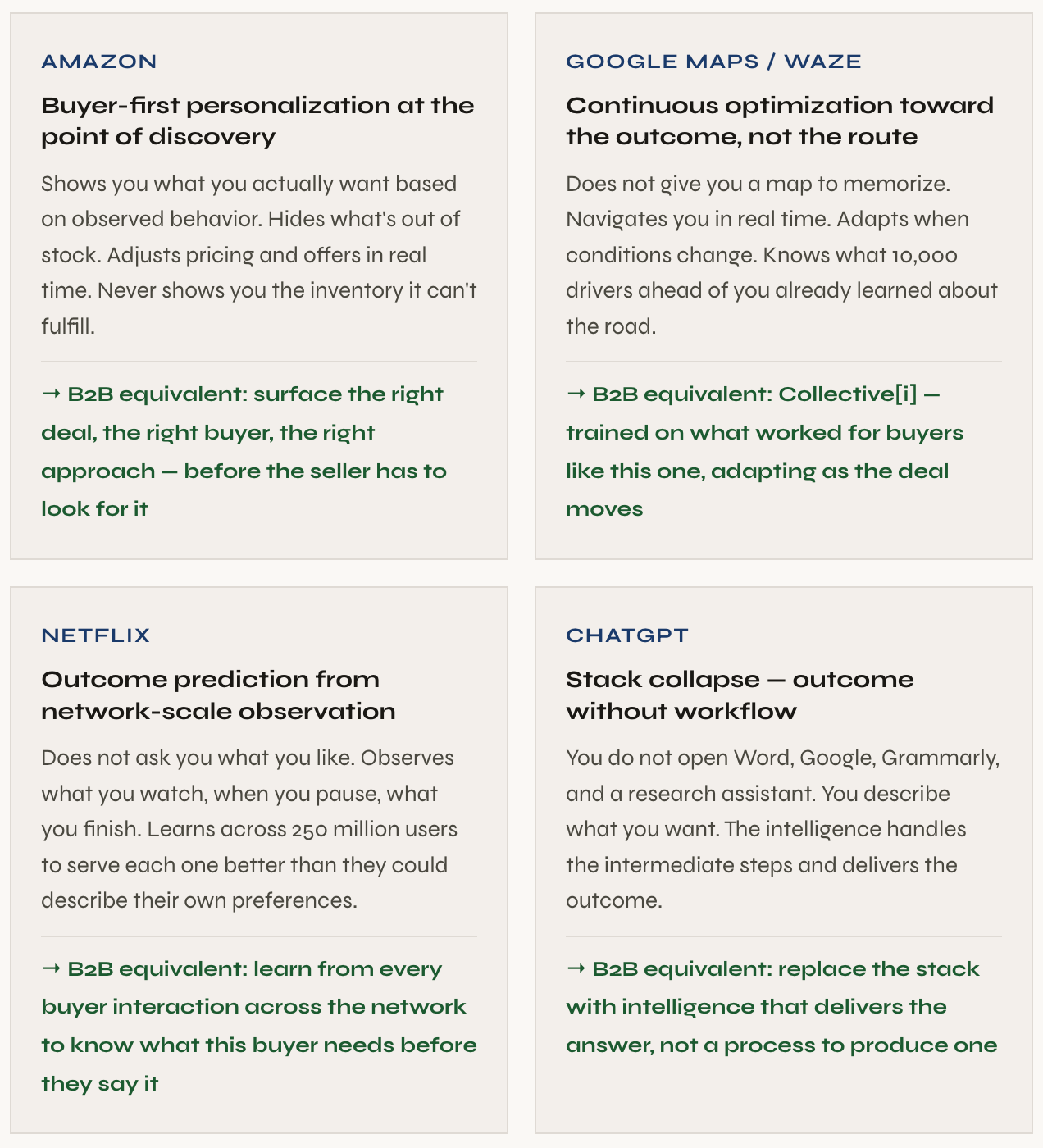
The pattern across every one of these systems is identical: they were designed around what the user is trying to accomplish, not around the administrative process of using the tool. They are outcome-optimized, not workflow-optimized. They learn from the behavior of the many to serve the needs of each individual. They improve continuously as usage grows. And none of them require the user to do the data entry that makes the system work — the system observes directly.
B2B selling, structured around a CRM-first model, is the opposite of every one of those characteristics. It is workflow-optimized, not outcome-optimized. It learns from what sellers choose to report, not from what buyers actually do. It applies standardized playbooks to individuals rather than adapting to each one. And it places the entire data entry burden on the people whose time is most valuable when spent on buyers.
AI needs to know what it is optimizing for
This is the central problem with AI added to a CRM-first stack, and it deserves to be stated precisely. AI is an optimizer. To produce useful results, it needs a clear objective — something to maximize or minimize. When you add AI to a workflow tool, the objective the AI can see is workflow completion: did the stage get updated? was the email sent? was the call logged? The AI optimizes for what the system was designed to measure.
But workflow completion is not the same as revenue growth. A rep who updates every CRM field perfectly and sends every sequence email on schedule can have a terrible quarter. A rep who misses half their CRM obligations but spends every available hour in genuine conversations with buyers who trust them can have a great one. The CRM measures the first rep as high-performing and the second as non-compliant. The revenue numbers tell the opposite story.
This is not a data quality problem. It is a design objective problem. The CRM was not built to optimize for revenue. It was built to standardize workflow. AI running on top of that foundation inherits the same design objective — workflow optimization — and delivers it more efficiently. You get better-completed workflows. You do not get better revenue outcomes.
AI that optimizes workflows makes the process faster. AI that optimizes outcomes makes the business better. The CRM measures processes. Collective[i] measures what buyers do — and optimizes toward winning deals, not completing them.
The Waze for sales — what buyer-first AI actually looks like
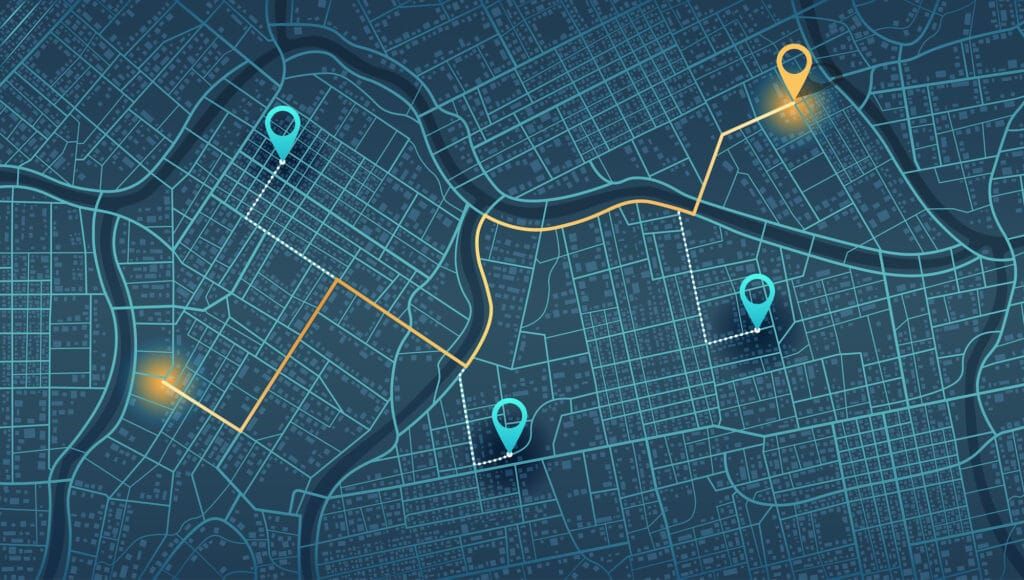
The Wall Street Journal called Collective[i] "the Waze for sales" and the analogy holds in a precise way worth understanding. Waze is not a better printed map. It is not a faster version of the process you used to follow to plan a route. It is a fundamentally different system that inverted the model: instead of telling you what the map looked like when it was printed, it tells you what the road looks like right now, informed by everything the network has observed.
The key to Waze is that it learns from every driver on every road simultaneously. By the time you encounter the traffic jam or the road closure, Waze already knows about it — because fifty drivers ahead of you encountered it first and the system learned from their experience. Your navigation is improved by the collective intelligence of everyone who traveled this road before you.
Collective[i] applies this same architecture to commercial relationships. Every buyer-seller interaction that flows through the network — across thousands of companies, millions of relationships — teaches the system something about how buyers in this industry, at this company type, at this deal size, at this stage of evaluation, actually behave. By the time your seller is in a conversation with this buyer, the network already knows what has worked with buyers like this one. Not from your company's historical deals. From the full experience of everyone who has successfully navigated a buying process like this one.
This buyer's buying process. Not the generic industry average. What this specific type of buyer — at this company size, in this vertical, with this stakeholder configuration — actually does when they evaluate a purchase. How long each stage takes. What signals indicate real momentum versus performative evaluation. What typically stalls them. What accelerates them.
Who in your network knows this buyer. The relationship graph that connects your organization to the buyer's organization through second and third degrees — connections that no CRM can see because they exist across organizational boundaries. The former colleague who now works at the buyer's company. The investor who sits on both boards. The connection that changes a cold outreach into a warm introduction.
What approach worked for buyers like this one. The message that resonated. The framing that moved the conversation forward. The timing that corresponded with internal readiness to buy. Derived not from your company's playbook but from what the network has observed across everyone who has sold successfully into this buyer type.
Where this deal actually stands. Not what the CRM stage says. What the buyer's engagement pattern reveals about where they are in their real decision process — derived from observed behavior, not seller reports.
This is what buyer-first AI looks like when it is built correctly. Not a workflow tool with a natural language interface. A system trained on the actual behavior of commercial relationships, optimized toward the outcomes that matter — deals won, revenue grown, relationships that compound — rather than the workflows that used to be required to manage the process of trying to achieve those outcomes.
The B2B ecommerce gap — and why it is closing
Consumer ecommerce spent twenty years teaching buyers that they are in control of the purchasing experience. You do not have to see products in the wrong size. You do not have to talk to a salesperson who doesn't know your history. You do not have to wait for the store to open. The experience adapts to you — continuously, in real time, without requiring you to explain your preferences.
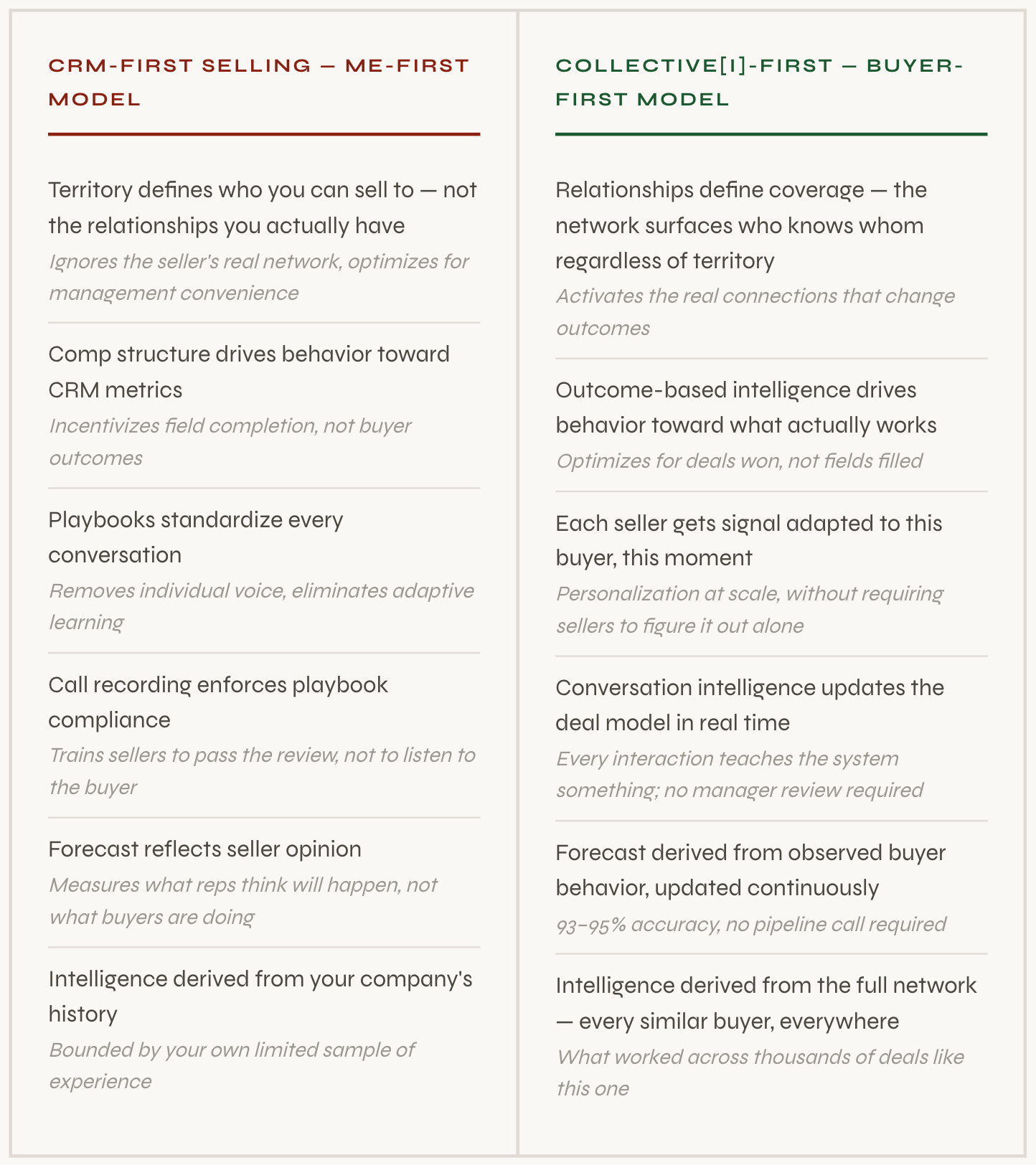
B2B buying has been lagging this expectation. The buyers who bring consumer expectations into enterprise purchasing — and they do, because they are the same people — encounter a selling experience that is organized around the seller's convenience. Territory assignments determine who calls them, regardless of the relationships that actually exist. Playbooks determine what the seller says, regardless of what this specific buyer cares about. Stage definitions determine where the seller thinks the deal is, regardless of where the buyer's actual decision process stands.
71% of B2B buyers now expect the same level of personalization in their business purchases that they receive in consumer experiences (McKinsey). 77% will not consider a purchase from a vendor who cannot demonstrate they understand the buyer's specific situation. These numbers are not aspirational targets. They are the current baseline expectation. The selling organizations that are meeting it are winning. The ones running CRM-enforced standard processes are not.
The numbers that the stack produced
The results of the CRM-first model are not ambiguous. Across the fifteen-year period during which the enterprise sales stack reached full maturity — when CRM adoption became universal, when the supplementary tools (call recording, sequence automation, intent data, forecasting platforms) completed the modern stack — every performance metric moved in the wrong direction.
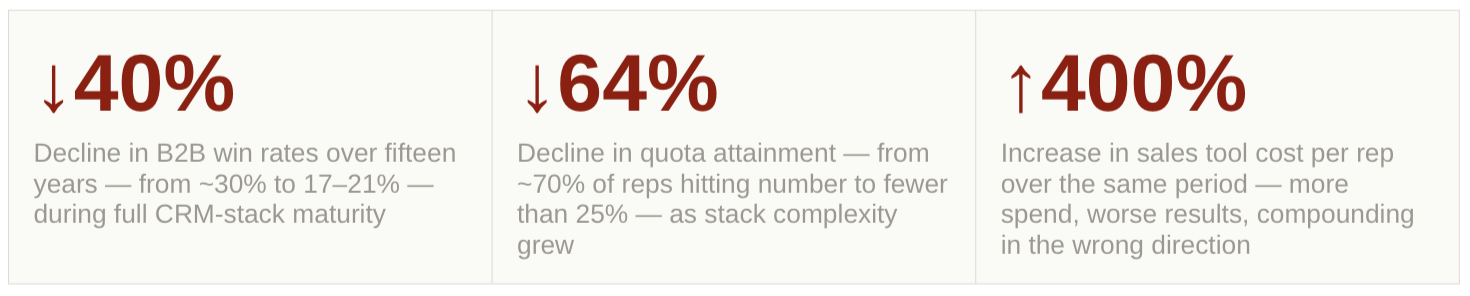
These numbers are not independent. They are the predictable output of a system optimized for workflow compliance rather than buyer outcomes. The stack got better at enforcing its own process. The buyers, meanwhile, developed higher expectations, more complex evaluation processes, and more ways to complete their research without talking to a seller who was following a script.
The market's response to this pattern was the SaaSpocalypse: $2 trillion in enterprise software market capitalization erased in early 2026 as investors concluded that AI agents would obsolete the per-seat workflow tools that make up the stack. The market was right about the obsolescence. What it understated was the depth of the architectural problem — it is not just that workflow tools are replaceable by AI. It is that they were never the right foundation for what revenue organizations actually need.
What AI-first actually means — beyond the buzzword
AI-first is not a technology claim. It is a design philosophy. It means the system was designed from the start around outcomes — what are we trying to achieve, what behavior are we trying to drive, what decision are we trying to improve — rather than around workflows. It means the intelligence is the product, not a layer added to a process tool. And it means the data the system learns from is the behavior that matters — what buyers actually do — rather than what sellers choose to record.
The ChatGPT analogy matters here. When you use ChatGPT, you do not install Word. You do not open Google. You do not run Grammarly. You do not hire a research assistant. The stack collapses into the intelligence. The system handles the intermediate steps — the workflows that used to exist between intent and outcome — and delivers the result directly. This is what happens in every domain where genuine AI replaces workflow tooling: the workflow disappears because the intelligence makes it unnecessary.
In the revenue function, the equivalent is Collective[i]: not a replacement for one tool in the stack but the intelligence that makes most of the stack unnecessary. The forecast call disappears because the system produces a better forecast automatically. The pipeline review disappears because the system monitors pipeline health continuously. The pre-call research disappears because the system briefs the seller proactively. The CRM data entry disappears because the system captures activity without requiring it. What remains is what only the seller can do: build the relationship, exercise judgment, be present in the room.
The shift from CRM-first to Collective[i]-first is not a software migration. It is a rethinking of what the revenue function is for. CRM-first says the revenue function exists to execute a defined process efficiently. Collective[i]-first says the revenue function exists to win deals and grow revenue — and that every element of how it is organized should be in service of that outcome, not in service of the process.
The companies that made this transition are posting numbers that don't make sense by the old model's logic. Forty-five percent revenue growth Year One at Fortune 500 companies. Thirteen percent win rate improvement in Q1. Teams hitting full-year quota by month seven. These are not incremental improvements on the existing model. They are what happens when you remove the brake and replace it with an accelerator — when intelligence optimized for outcomes replaces tooling optimized for workflows.
The pattern that produced the fifteen years of declining metrics is simple to name: the selling organization was organized around the seller's needs (management visibility, workflow standardization, activity compliance) rather than the buyer's needs (personalization, relevant timing, a seller who understands their specific situation). The tools reinforced this orientation at every level — territory, comp, playbook, forecast.
AI built on top of that foundation does not fix the orientation. It accelerates it. You get faster workflow enforcement, better-optimized sequences, more efficient data entry. You do not get a selling organization that actually knows its buyers. For that, you need intelligence built from the ground up around what buyers do — trained on the patterns of commercial behavior at network scale, optimized for the outcomes that matter, with no workflow requirement standing between the seller and the signal.
In Part Three, we translate this into concrete math. What does the productivity impact look like when the system handles everything that is not selling — and what does the revenue potential look like when sellers spend their time on buyers instead of on the stack that was supposed to help them?
No team to operate it. API access to systems you already own. The brain handles the internal. The seller handles the buyer. This is what the architecture change looks like in practice.
The results are documented. The transition is happening. The only variable is timing — yours, and your competitor's. collectivei.com
Sources & data
- Win rate decline ~30% → 17–21% — HubSpot State of Sales 2024; Ebsta B2B Benchmark (−18% vs. 2022, −27% vs. 2021); historical benchmarks
- Quota attainment decline ~70% → 16–25% — Salesforce State of Sales (multiple editions); Bridge Group; SPOTIO
- Sales tool cost increase: 15–20% annually — Gartner SaaS spend growth; SaaStr (Salesforce $500/seat vs. $250 five years ago)
- 71% of B2B buyers expect personalization — McKinsey
- 77% of buyers won't consider a purchase without personalization — MarketingProfs
- 70% of the buyer's purchasing process complete before engaging a seller — 6sense, 2024
- CRM data completeness: ~25% of activity actually logged; 37% of reps admit fabricating CRM data — DevRev/AskElephant, 2026
- "Waze for sales" — The Wall Street Journal on Collective[i]
- SaaSpocalypse — SaaStr; FinancialContent, February–March 2026
- Collective[i] results — Collective[i] customer data