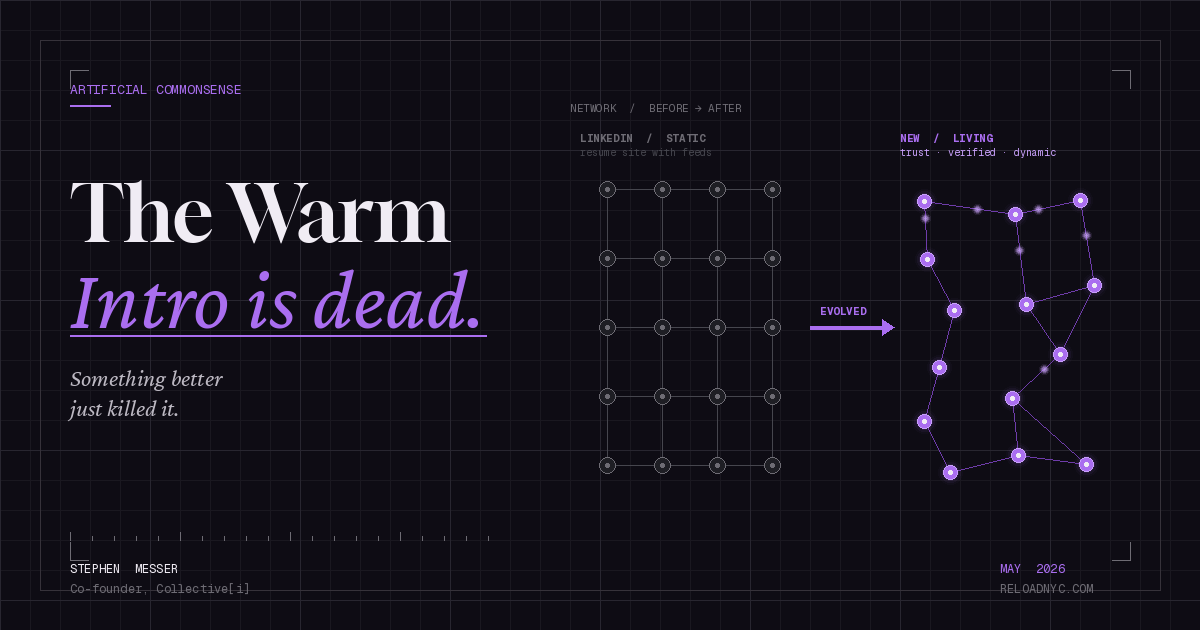
The Warm Intro Is Dead. Something Better Just Killed It.
Every personal social network evolved. Every messaging app evolved. Only professional networking is still a résumé site with feeds glued on top. That ends now, and it changes how anyone with a network gets to use it.

Stephen Messer, Co-founder of Collective[i] and LinkShare (sold to Rakuten for $425M, 1996–2005). EY Entrepreneur of the Year/Deloitte Fast 50 winner. Board member, Spire Global (NYSE: SPIR). Building intelligence.com
A few years back a founding partner at a top-ten VC and I had dinner. He asked about a deal I was in. I sent the warm intro that night.
A few days later a different founder reached out to me looking to raise. I sent a warm intro to both of them.
The next message from the VC surprised me. Going forward, he preferred I ask him first before making a warm introduction. He called it the double opt-in. I would email him. He would decide. Then I could send the intro.
He is a friend. I told him if he wanted double opt-in from me, I would send the deal elsewhere. I have told a lot of other VCs the same thing since. A few of those deals turned into the kind of returns any fund would build itself around. He never saw them. Neither did any of the others who asked for a permission slip first.
What VCs Forget About the Favor
Understand what actually happens when I send a warm intro to a VC. I get no finder's fee. I get no carry. I get no consulting relationship. Every VC has money. Money is what they sell. When I point a founder to one, it is a favor I am doing for the VC on the belief that the founder is worth their time.
Asking me to do more unpaid work on top of that favor tells you something about where the VC world has drifted. For a role with the word capitalist in the title, it feels a little communist. Great founders raise their own funds today for exactly this reason.
Take Mark Pincus and Steve Lurie. Mark founded Zynga and now runs Workplay Ventures. About as well known as it gets in venture. A great founder, a great investor, and a terrific human. His new book Life at the Speed of Play from HarperCollins is the shortest way to learn what makes him special. Steve is an up-and-comer and a great friend. He worked for Mark at Zynga and was mentored by him, which explains a lot. Both treat every deal I send them with respect. That makes me want to send them better deals. A lot of great deals never reached the VCs who asked me for double opt-in. I am glad. Why would I send a founder to that kind of person? That is what networks are for.
I have written elsewhere about why venture capital is more at risk than most of the industry believes. Shortly I will have two articles covering The Last Disruption and The Circle of Capital which lays out the model already replacing it. These pieces are about a different problem, sitting underneath both.
One Player. No Competition. One Frankenstein.
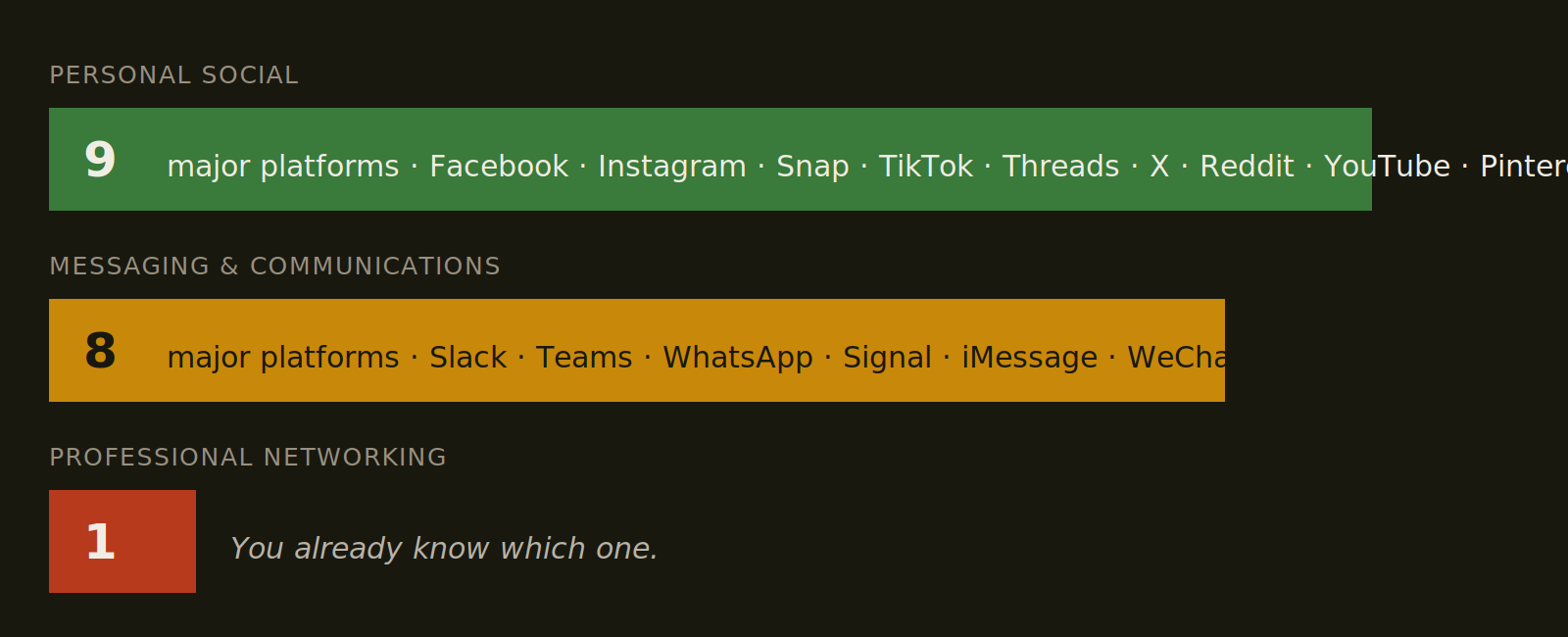
Look at how you communicate. Slack. Teams. WhatsApp. Signal. WeChat. iMessage. Discord. Half a dozen more depending on the room.
Look at how you socialize. Facebook. Instagram. Snap. TikTok. Threads. X. Reddit. YouTube. New ones every year.
Look at how you network professionally. There is one. You do not need me to name it. Every professional you know is on it, and the absence of competition is so obvious most people have stopped noticing.
CHART 1 · THE ABSENCE OF COMPETITION
Every other layer of your digital life has options. The one that pays your bills has one.
Source: Author survey of active consumer categories, 2026. Selection criteria: North American monthly active users above 50 million, or dominant regional equivalent.
It started as a résumé site. Somewhere along the way it turned into a social network mimicking the ones we use in our personal lives. Feeds full of AI-slop articles. Followers. Connections. Endorsements from strangers. The résumé still sits underneath, only now it looks like Instagram. Perfect title progression. No gaps. Most people wait six months before updating their profile so a short stint never shows up in anyone's feed.
The result is a Frankenstein. Not dead. Not alive. We all use it. It is a shell of what it was and a mockery of what it was meant to be.
I have 15,000 connections on it. I do not know 15,000 people. I do not think anyone does. Look at your own list. Everyone is connected. Nobody actually knows anybody.
That is the design problem. Personal social does not need vetted photos of dinner. Professional networking needs the truth. About people. About companies. About the specific thing personal social never even attempts: the warm introduction.
The Intervention
A few years ago at Collective[i] we noticed something we could not explain.
Our predictions on who was going to win B2B deals were sharpening every quarter. The economic foundation model behind the platform was getting more accurate over time. One pocket of deals kept breaking the pattern. Predictions right up until the last minute, then wrong.
Years of research got us to the answer. We called it an intervention.
An intervention is when someone picks up the phone to a CEO they have known for twenty years. A friend. Someone whose connection is deep enough to walk past the sales process, past the evaluation team, and land straight on the decision maker's desk in the last week of a deal that was going another way.
You may have taken one of those calls. You may have made one.
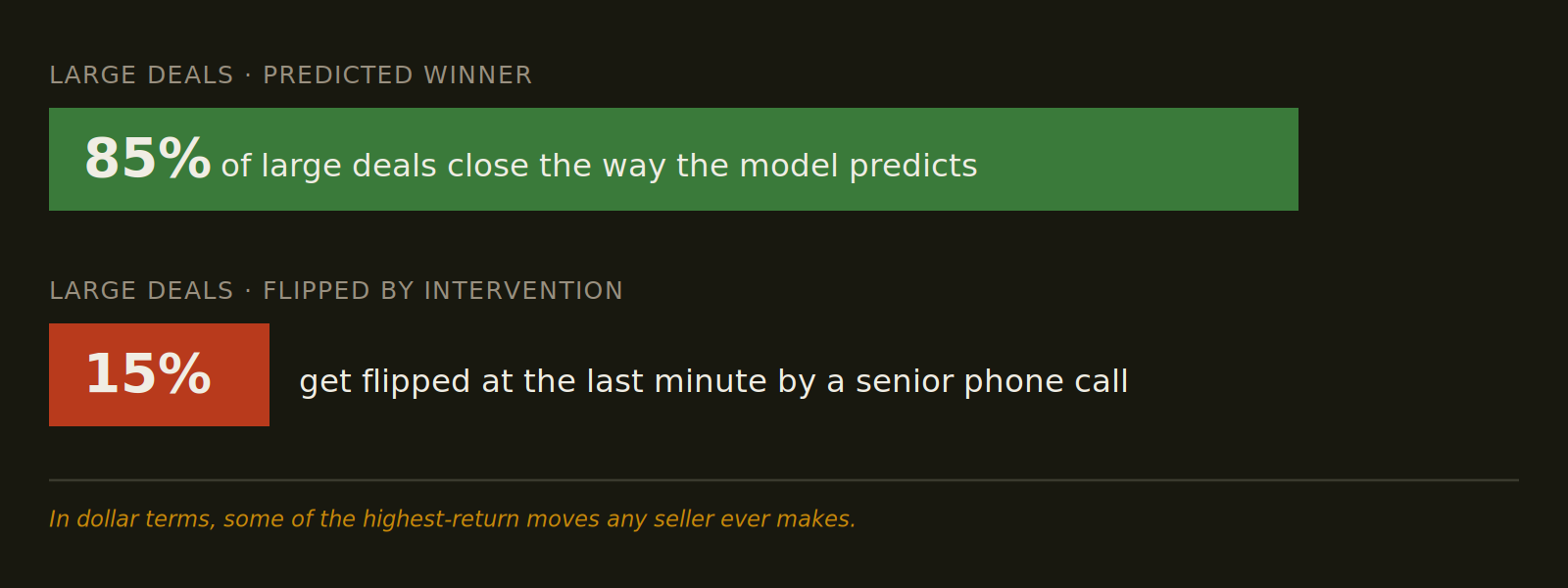
The pattern only showed up in very large deals, about fifteen percent of the sample, where the seller was going to win hands down. When a managing director on the losing side knows the loss is coming, they will go outside the process to find anyone with a real, deep relationship to the CEO or the board. On smaller deals it is not worth the political cost. On the biggest ones it is worth every bit of it.
CHART 2 · THE FIFTEEN PERCENT
A small share of deals. The biggest ones in the pipeline. Flipped by a phone call at the last minute.
Source: Collective[i] internal research on large B2B deal outcomes across the pipeline. Segment defined by deal size above the 85th percentile with prediction confidence above 80% at the sixty-day mark.
Fifteen percent is the number that sounds small. These were the largest deals in the pipeline. Swinging them meant tens of millions of dollars changing hands. In dollar terms, one of the highest-return moves any seller could make.
If a well-timed call from the right person is that powerful, why does everyone else only reach for it on the biggest deals? Because the friction is too high anywhere else. The tools we have for finding those relationships are broken.
The Anatomy of a Warm Intro
Watch what happens when a normal professional tries to reproduce the intervention pattern.
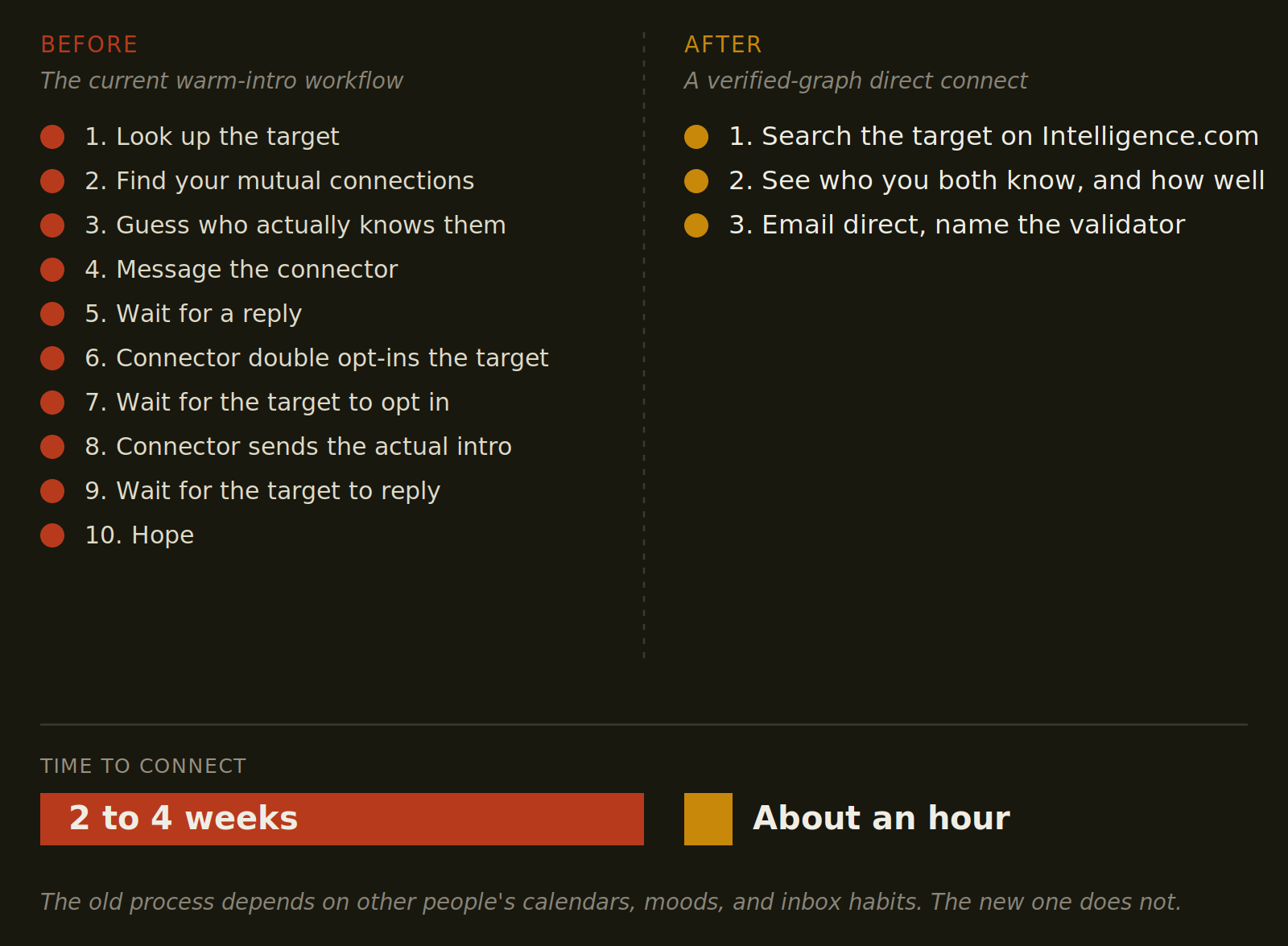
You look up a target on the one professional network. You have twenty mutual connections. Which of them actually knows the target? The platform will not tell you. Everyone is connected. Everyone always is.
You have two options. Reach out cold and pray. Or do the work. Message the mutuals. Figure out which of them actually knows the target, and whether the relationship is helpful or hurtful. Ask the strongest for a warm intro. If they are polite, they will not just send it. They will double opt-in, meaning they email the target for permission. Another wait. If the target says yes, the connector sends the intro. Now you wait to see if the target replies.
Two to four weeks. Sometimes longer. Sometimes never.
The double opt-in has a well-known history. Fred Wilson at Union Square Ventures proposed it in 2009 to protect senior investors from unwanted intros. I have known Fred since the LinkShare days. I get his take. I differ with him on what it means in practice today. The intent is fine. Protect the target's time. Protect the introducer's reputation. The design puts all the friction on the person doing the favor and all the delay on the person trying to make something happen. This is our best tool for reproducing the same intervention that flips the biggest deals in the world.
CHART 3 · THE ANATOMY OF A WARM INTRO
Ten steps, three weeks, one endangered relationship. Or three steps, one hour, zero favors owed.
Source: Author observation across the venture and executive-search communities, 2020 to 2026. Time-to-connect figures reflect typical, not extreme, cases.
First Principles
Take the whole thing back to first principles. What does professional networking need to do?
Stay inside a circle of trust. People you know. People who know the people you trust.
Verify the data. Self-reporting is what created the mess.
Know the depth. How well two people actually know each other, not whether a connection exists on paper.
Ask why one more time. Why do we need to ask for a warm intro at all? If I can verify that two people I trust know each other well, why route the introduction through a three-week negotiation that puts every ounce of the cost on the connector?
What We Built at Intelligence.com
A year ago we launched Intelligence.com to answer exactly that.
You grant it access to your email and calendar in a safe and Soc2/GDPR way. An AI reads through the signal and builds a verifiable graph of who you actually know, and how well. It updates as relationships change. It only surfaces people you have real evidence of a relationship with. Reciprocity. Recency. Volume. Response times. Overlap with your trusted contacts. Real depth, not a checkbox.
You can still connect with new people. Connecting alone does not put them in your working graph. The AI waits for the evidence. When you actually meet, when messages get exchanged, the graph updates.
The second feature is what matters more. An AI agent reaches out to your network and trades your graph with theirs. Family. Friends. Colleagues. Anyone you already trust. When they opt in, you both see each other's networks and how strongly each of you knows every contact. That becomes your extended network.
Search anyone. See whether you share mutuals, who they are, and how well each of them knows the target. See who is the strongest path in.
You no longer need to ask for a warm intro. You can write directly. Something like: I see you know Heidi Messer well. Please ask her about me. I would like to speak with you about X.
That is a different email entirely. You are telling the person you want to meet that you have a validator, that the validator will vouch for you, and that the validator is close enough to them that both of you know it. Trust transfers in a single message.
There was nothing the double opt-in was protecting that a verified graph does not protect better.
What This Unlocks
Back-channel a hire before you make the offer. Raise capital without the double opt-in wall. Sell into a target account by finding the closest path to the actual decision maker. Vet a board member, an investor, or a business partner without cold-messaging strangers. Everything that used to take weeks of routing takes an hour of writing.
Come back to the intervention data. Those calls only surfaced on the biggest deals because friction blocked them everywhere else. Remove the friction and the intervention pattern applies to every deal. Every hire. Every capital raise. What used to be a fifteen percent effect on the biggest wins in the world becomes a superpower you reach for every day.
Why It Has to Be AI-First
One more reason we built it this way. Agents.
I wrote in Infinite Leverage about how the ceiling on what a company can do is about to be lifted. The limit used to be how much your people could carry. Agents remove that limit. Agents need context to work well. They need to know who you know, and whose agents to trust. Without a verified graph, an agent has to guess, and guesses at scale become a spam problem for everyone on the receiving end.
In The Jobs Nobody Has Heard of Yet I made the case that new categories create roles nobody sees coming until they are everywhere. Affiliate marketing was one of those. What we built at LinkShare in 1996 seemed impossible to explain at the time. A decade later there were millions of people earning income from it. Verified professional networking is the same shape of category. Somebody was going to build it. Better a category with real trust than another AI wrapper on top of a Frankenstein.
There is a larger point in this too. As AI takes on more of the work that used to define a career, the résumé stops carrying weight. What survives is trust between people. Your network, and the extended network it gives you, becomes the new résumé. That is what you get valued for. No AI is going to replace the trust between humans who have shown up for each other over years.
You Do Not Have to Fake It Anymore
For twenty years, the professional network we all used trained everyone to fake it. Inflate the connection count. Polish the résumé until it looked like Instagram. Wait six months to update after a short stint so nothing looks off. Trade endorsements with strangers.
The whole thing rewarded performance over truth. A version of you built for a feed. Not a version other humans could actually rely on.
Verified networks reverse that. They reward the relationships you actually built. The friends who pick up the phone. The years of showing up quietly, being honest, and doing the work.
I once sat on a board with a VC from a top firm. Some VCs add value on a board. Some do not. He was in the second group. In a verified world, no logo would have shielded him. Founders would have known before they took a check. Better investors would have gotten those deals. Everyone in the room comes out ahead.
That is the outcome I care about most. The last twenty years of professional networking made a lot of good people feel small. The next decade can hand them back the value of the relationships they earned. One honest connection at a time.
If you want to see what that feels like, join. If we have not met, use my invite link. If we have, connect with me directly and let us share networks.
The warm intro is dead. Something better just killed it.
RELATED READING · RELOADNYC
The Last Disruption
Why venture capital is finally about to be disrupted by the same forces it helped create in every other industry.
The Circle of Capital
A new funding model emerging from AI, and why the investors winning are the ones whose business depends on the company's success.
The Jobs Nobody Has Heard of Yet
New categories create roles nobody predicts. Affiliate marketing was one. Verified networking is the next.
Infinite Leverage
Building a company with more agents than people. Why every agent needs a verified graph to work.
What It Means to Be AI-First. And How to Get There.
The operational playbook. Not philosophy. What the companies pulling away are actually doing.