AI-First rivals are 50x faster than you. Your team's gut is why. This piece fixes that.
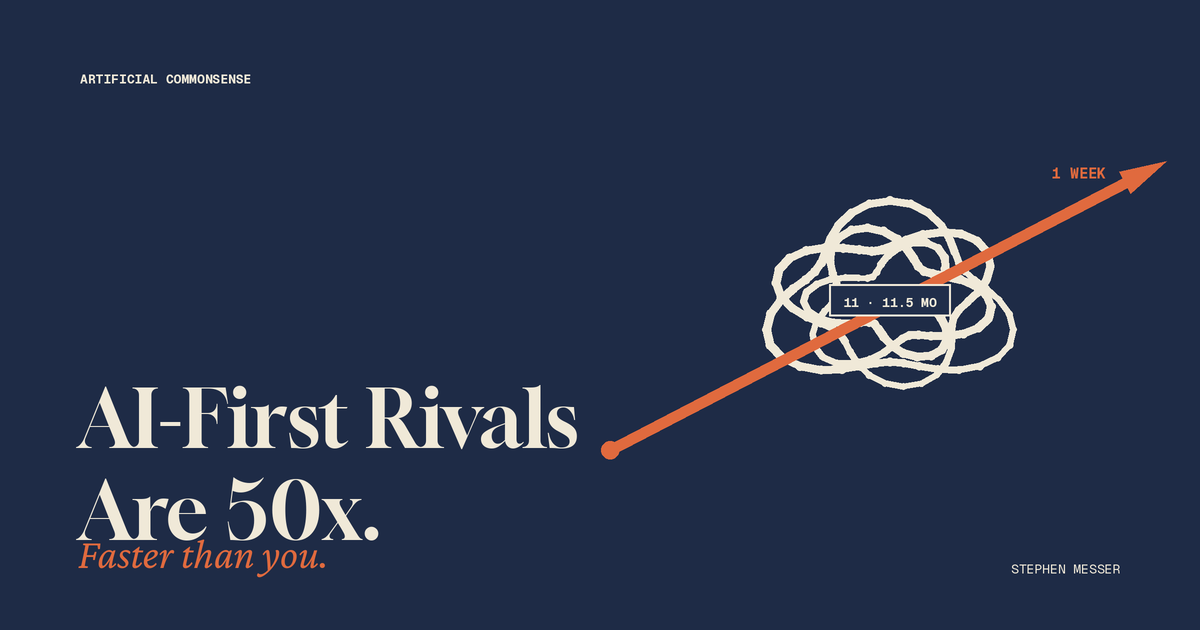
Your buying committee: 11 people, 11.5 months to close. Your AI-first rival: one person, one week, same decision. The gap isn't the tool. It's the committee that used to be your insurance policy and is now the anchor holding your company underwater

Stephen Messer
Co-founder, Collective[i] & Intelligence.com. Co-founder, LinkShare (sold to Rakuten, $425M). Board Member, Spire Global (NYSE: SPIR). E&Y Entrepeuner of the year winner/Deloitte Fast 50 winner (2x). Join Intelligence.com to share our networks.
Your enterprise buying committee is now 11 people. Your average decision on a tool over $100,000 takes 11.5 months to close, according to Gartner. AI-first competitors are running the same decision as an experiment in a week. That is a 50x speed gap. It is the reason a small number of businesses are scaling faster than any company in history, and the reason the rest are watching their market share get taken quarter after quarter without ever seeing what hit them.
The gap has a cause, and the cause is you. You still believe your gut is the best way to make big decisions. You still believe committees produce better outcomes than individuals. Both used to be right. Today the same gut that made your career is what will end it, and the committee that used to be your insurance policy is now the anchor holding your company underwater. Disagree at your peril. Read on and see if you still feel the same way by the end.
This is the third piece in a series on the skills needed to be one of the companies pulling away and how bias is a real risk in AI. The first piece diagnosed your gut. Great instinct plus a machine that agrees with everything you say at machine speed is the largest error multiplier of mistake ever handed to a senior executive, in other words, a weapon of mass destruction. The second piece, co-written with Mark McDonald at Gartner, diagnosed the tool. What you are being sold as intelligence is a genie in a bottle, and treating it as a genius is what puts your company at risk.
This piece takes those two risks and scales them. Across your team, understood and you have a clear advantage in an AI first world, misunderstood and you have a weapon of mass destruction all over your organization waiting to go off.
Through the politics that historically hold the team together. Into the legacy buying committee that decides what gets tried. That combination is the 50x gap I opened this piece with, and it is widening. Belief was the right operating system when projects took months and a wrong call cost you a year. The world does not run at that speed anymore. As always in these pieces, the diagnosis comes with the fix. Read on for how to become a winner in an AI-first world that is already upon us.
The Skill That Made You Great Is Now a Bottleneck
What makes tech so hard is that overnight it can take a skill that took a lifetime to build and make it obsolete. Take limo and taxi driving. There was a time when a professional driver in New York knew shortcuts no one else used, could feel when a route was about to jam, and got you across town faster than any rookie. That intuition was real, earned over years, and it was worth real money, especially to a New Yorker who values time more than most.
Then Waze arrived. Seemingly overnight, the skill was gone. Worse, it became an anchor. A driver using their gut ended up with a frustrated passenger asking why they were skipping Waze, because Waze was better. For a while, drivers rejected the shift. You heard the line at the time. Waze always makes this mistake at that corner. Waze never gets this bridge right at rush hour. Any Waze user knew what that was. A person reinforcing their personal bias at the passenger's expense. Today no one argues.
Then Uber and Lyft and then Waymo and Tesla Cybercab. Once the route was in the phone, any driver could be the best driver, any car could self drive you anywhere. The skill that once justified a premium became irrelevant. The drivers who adapted thrived and new models emerged . The ones who clung to their knowledge as proof they were still needed became the last generation of a dying trade. Its a lot easier to see this kind of change when its not you and your career.
The pattern is playing out again, one level up where my readers play. Every senior leader I know has spent a career building judgment. Read the room, sense the market shift, spot a bad deal before the numbers confirmed it. Rewarded every time it worked. Promotion, compensation, reputation, all of it reinforcing the same lesson. Trust your gut, because your gut is good.
Then the environment changes and the gut starts getting things wrong, and the leader cannot see it happening. Marshall Goldsmith captured it in one title. What Got You Here Won't Get You There. The skills that made you successful in one era become the baggage that slows you down in the next. The more successful you were, the harder it is to let go, because your identity is built around the thing that worked. Belief in your own judgment is the last thing a successful person questions, and it is the first thing disruption punishes.
Belief in your own judgment is the last thing a successful person questions, and it is the first thing disruption punishes.
You Are Now Managing AI Brains, Not Just People
Every leader in every real company has just picked up a second team. It sits alongside the people team on the org chart, and almost nobody in the building has been trained to run it, to learn its strengths and weakness (see prior articles on bias magnified) and many sadly think it is the one model they already know.
The reality is that it is not Claude, or Chatgpt. To be AI first means that you are adding an ever growing list of specialized AI brains that cover all the areas their business needs. They are interconnected and along with agents will run more and more of your company. What you are learning now with a language model is just how limited that model actually is. This is why you need to worry about AI washing (the old SaaS tools with an AI wrapper) that I wrote about in the AI Shuffle.
The second team is a collection of AI brains, and the brains are not interchangeable. Language models are cheap, fast, sycophantic, and useful inside a narrow band of work. Economic models predict outcomes that either come true or do not, which is what we build at Collective[i]. We study the demand curve. That work shows up most often as sales predictions because roughly one in eight workers is in sales and the example lands fast, but the same class of model runs the pricing engine at an airline, the risk engine at a hedge fund, the allocation engine at a PE firm, and the pipeline engine at a VC. Biology models fold proteins and shortcut drug discovery by orders of magnitude, which is what AlphaFold, Isomorphic Labs, and Recursion are doing to a decade of pharma R&D. Robotics and world models let a machine see, plan, and act in physical space, which is what Physical Intelligence, Figure, Skild, and Waymo are shipping. Weather models beat the ECMWF operational ensemble on 97 percent of verification targets at a fraction of the compute. Vision models catch cancer on a scan before the radiologist reads it. Materials models design alloys and semiconductors human iteration would not have found in a century. I covered which brain solves which class of problem in The Companies Winning at AI Are Playing a Different Game, and the substrate underneath in The Next Computer Is Alive.
Managing that second team is the new leadership skill that matters most. The same one a good manager uses to know which person on the team is right for which project. The manager who cannot read the people fails. The leader who cannot read the brains fails the same way, only faster, because the brains execute at a speed the people team never could.
Three things about managing brains that are the same as managing people. You have to know what each is good at. You have to know where each fails. You have to know which one gets which decision. Get those three wrong and the wrong brain runs the wrong decision at machine speed, and the mistake compounds inside the company before anyone in the org chart catches it.
One thing about managing brains that is not the same. There are fewer of them. A senior operator might have managed thousands of people across a career. The number of AI brain categories worth understanding today is around a dozen, and it grows slowly. That is the entire good news. A leader can learn this. The impact of each brain is greater than a single hire, the feedback loop is faster, and the leverage is asymmetric. A CEO in 1995 who could not delegate to humans wasted a career. A CEO in 2026 who cannot manage brains wastes a quarter.
This is why the AI-first companies are already flattening. Jensen Huang runs NVIDIA with 36 direct reports and no one-on-one meetings, trimmed from 55 last year. The layers of middle managers who used to translate belief downward are exactly the layers AI is compressing out. I covered the specific move that no longer works, propose a project and buy time and call it strategy, in The Oldest Trick in Management Just Stopped Working, and the middle-layer version of the same shift in an upcoming article The Scribe Never Became King. What replaces the old org chart is smaller leadership teams sitting closer to more builders, running more agents than people. I wrote the builder-side version in Find Your Builders and the leverage-side version in Infinite Leverage. In that shape, every leader sits closer to the builders, and the cost of a leader who cannot read the brains goes up fast.
When Belief Was the Right Tool, and Why it Becomes a Risk
For most of the software era, belief was the only tool that made sense. Rolling out a new enterprise system took nine months on a good day and years on a bad one. The stakes of a wrong call were enormous, because the wrong call meant doing the same work over, with a different product, at the same glacial pace.
Boeing learned how expensive a bad call is when its ERP transition collided with its manufacturing ambitions. Supply chain coordination failures where SAP misconfigurations contributed to parts delivery breakdowns helped park roughly fifty 737s on the tarmac at one point. Across the industry, ERP implementations fail at a rate around 75 percent, and only about 30 percent finish on time and on budget. Lidl abandoned its SAP project after seven years and half a billion euros. Revlon's botched rollout cratered its stock and drew lawsuits.
In a world where bad calls cost that much, belief was reasonable insurance. A leader who said "my gut tells me this vendor is wrong for us" and was right saved the company a fortune. The slower the execution cycle, the higher the value of good judgment at the front end. That math made sense for decades.
It does not make sense anymore.
Speed Changed the Math
The reason belief stops working as an operating system is speed, and the math is not close. Go back to the opener. A test that takes a week and involves the two or three people who actually run it costs almost nothing. A buying committee of 11 people debating a $100,000 tool for 11.5 months costs a lot more than the software they are buying. Start with 11 salaries times the fraction of their time spent on the committee. Add the distraction cost across every other project each of them touches. Add the option value of every experiment you did not run in that window. From a first-principles view, that math is insane. Inside your company it is institutionalized.
Every person on that committee is afraid their gut will fail them, and the committee is what they built to protect it. The same fear keeps old tools wrapped in an LLM getting sold to you as AI. Nobody in the room wants to change what they already believe about their category. We are in a period of disruption where AI is only one of several forces reshaping the ground under your company. I covered the substrate shift in The Next Computer Is Alive, the capital shift in Tech Is Not an Asset Class, and the operating shift in The Companies Winning at AI Are Playing a Different Game. Waze forced the change on drivers anyway. The market will force it on you.
The shift is from belief to hypothesis. A belief is a conclusion. A hypothesis is a question with a test attached. A belief says, "this will work because I have seen things like it before." A hypothesis says, "this might work, and here is how we will know in a week." The first closes the door on learning. The second opens it. The speed at which a company can run experiments, get results, and act on them is becoming the single best predictor of who wins. I made the pricing-side version of this argument in Peak Token. Same shift, different layer.
A belief is a conclusion. A hypothesis is a question with a test attached. One closes the door on learning. The other opens it.
The Breakaway Speed. What 11 Stakeholders and 11.5 Months Actually Costs You.
Belief has other costs baked into the buying process that make the math worse. Deals above $1 million pull 14 to 23 stakeholders into the room, per Forrester's 2023 B2B Buying Study. 77 percent of buyers describe their last purchase as very complex or difficult, per Gartner. 81 percent are dissatisfied with the vendor they chose. 86 percent of B2B purchases stall somewhere in the process, per Apollo's 2026 benchmark. Every stakeholder added lowers the odds of a good decision and raises the odds of a delayed one.
Now compare that to the AI-first company. Amazon runs a pricing test in a day. Anthropic ships an update to a partner and iterates on the response within the week. Cloudflare runs internal tooling that lets engineers try, ship, and measure a change in the time a traditional committee would take to schedule the meeting where it might be discussed. Roughly 50 weeks versus one. A 50x speed gap on the identical class of decision.
50x describes a different speed of company. The gap compounds the moment it opens. The AI-first company runs 50 experiments in the time the belief company runs one. Every quarter, the AI-first company learns 50 things the belief company does not. Over four quarters that is 200 lessons the belief company will never catch up to. By the second year, the belief company has slid into an adjacent category nobody wants to buy from anymore.
This is why AI-first companies are pulling away at scales no incumbent has seen. Not because they hire better. Not because they have more capital. Because they compound learning at 50x the rate. If you are on the wrong side of that gap, the market caps of the winners over the next five years are going to look absurd, and they are going to be earned. If you are on the right side, you already know this.
By the second year, the belief company has slid into an adjacent category nobody wants to buy from anymore.
Why This Matters for the Board
Every CEO on your dashboard is operating in the new environment. A subset is running the new operating model. The rest are running the old operating model with new tools bolted on. That difference is going to show up in the numbers over the next four quarters and in the market cap over the next twelve.
The tell is not the AI budget. Every company has an AI budget. The first tell is whether the leadership team can name three hypotheses currently under test, the date each one will be read, and the decision that changes based on each result. The second tell is whether they can name which brain they are running each experiment against, what that brain is good at, and where it fails. Both tells are cheap to run and unusually predictive. If the CEO can answer both, you are looking at a company running on hypothesis with a leader who understands their tools. If the answer is a slide about "our AI strategy" with a vendor logo and a maturity model, you are looking at the compounding-error machine the first two pieces described.
Mark McDonald's Intelligence Supercycle research at Gartner reads the same signal from the buyer side. Enterprise spend is shifting from tools to answers and outcomes. Vendors who survive that shift are the ones whose customer is paying for a measurable result. The ones who do not are the ones whose customer is paying for the belief that a tool exists.
Data Wins Over Gut Every Day
I am not arguing experience is worthless. A leader who has seen a dozen cycles still has pattern recognition that matters. Emotion carries real signal, and a person with no feel for people is as dangerous as one with no feel for facts. I wrote about that in The One Thing AI Can't Fake. The gut is one of the brains on your team now. Its edge is real. Its failure mode is what the first piece in this series diagnosed. It confirms whatever you already believe, at machine speed, with a citation attached.
The balance has shifted, permanently. In a world where you can and should test in days and learn in weeks, the leader who runs experiments outperforms the leader who runs on instinct, no matter how good the instinct used to be. The professional driver who memorized the streets lost to the driver with Waze. The brand marketer who trusted the upfront lost to the team that tested everything. The law firm that believed AI was not ready is losing to the one that tried it in January. Data wins over gut every day. The question is whether your company is set up to produce the data or is still running on the gut of whoever has been in the room the longest.
The Warning Sign for Boards, Investors, and Fellow Leaders
I opened the first piece in this series on a scene every tech leader knows. Every parent at every dinner corners someone in tech and asks the same question. What should my kid study to be successful in this new world. I want to close the series on the same scene, from the other side of the family.
Every kid has also tried to help their parent set up something on their phone. If your parent is the one who refuses to try, gets frustrated the moment the interface looks unfamiliar, and asks you to just do it for them, you already know the tell. Age has nothing to do with it. Posture does. Some 70-year-olds run a full life on tools their kids helped set up once. Some 45-year-olds still call the family for help every time an app updates its icon. The difference is whether the person is still learning.
That is the same tell for a CEO, a portfolio manager, and a fellow board member. If the CEO on your dashboard says "we have AI" the same way your parent says "I have the Facebook," you already know what you are looking at. Someone who has heard about the tool, wants credit for having it, and is not learning what it actually does. If the CEO cannot name which brain runs which decision, does not know that an LLM is only one kind of AI, and cannot articulate the difference between an economic model, a robotics model, and a language model, that is the AI-era version of "I have the Facebook." The tell is cheap to run. The consequences of missing it compound at machine speed.
At Collective[i] we watch this play out every week. The leadership teams that ask the sharpest questions are the ones already using the tool on their own pipeline. The ones that ask "how do we know it will work for us" are the ones whose competitors are already three quarters ahead. We wrote the buyer-side version of that same pattern in Your Buyer Has a Process. Collective[i] Knows What It Is. At Intelligence.com, the same posture shows up in relationships. Leaders who can name the last five real conversations they had with people in their network, and what came of each, are running on hypothesis. Leaders who list their LinkedIn connections as their network are running on belief. I wrote the network-layer version of that argument in The Warm Intro Is Dead. Same pattern. Different layer.
For boards, investors, and fellow leaders, that is the actionable output of the whole series. You cannot fix another CEO's gut. You can spot the tell. And when you spot it, you can decide whether to fix it or replace them before the market does.
Closing the Series
Three pieces. One argument. Great gut in a slow-execution world was an asset. Great gut in a fast-execution world, plus AI as a yes-man, plus a marketing narrative that dresses limits up as intelligence, is a liability the size of the company you built on it. It is the weapon of mass destruction I warned about.
Being right on your gut feels good. It is also hard to repeat. Living inside a company where the boss is right by fiat and everyone else is wrong by default is exhausting. It is worse than exhausting. It attracts the wrong people. The best of your best leave. The politicians stay. And the room slowly fills with people who care more about who is right than about what is true.
The hypothesis company, something I will describe in an upcoming article runs on the opposite. Being wrong there is how you learn faster. The politics around who was right and who was wrong go away because the number lands and settles the argument. If the goal is to win, the company where data rules attracts the people who also want to win. Not the ones who want to look like they are winning.
The path forward keeps what made you great. Name it. Know when it is the right tool and when it is the wrong one. Run the rest of the operating model on hypothesis. Manage the second team of brains the same way you would manage the first team of people. Know what each is good at. Know where each fails. Point the right one at the right decision. Let the results, not the room, settle the argument.
One last thought, if you think all my articles are telling you to do everything in a different way, know that I am not. If you start with first principles and apply it to an AI first world, everything I share here is just the logical way to work. It is not a set of rules, but the logic of how works looks like in this new world written down. Once you start on the path, it becomes easy to see how each of these steps make sense, speed adoption, lead to success and more. My hope is that I am providing a clear playbook to explain the "why" to someone who may not be on this journey yet or to give the underlying reasons to people starting but still not clear on the why behind what they are doing.
What Comes Next
Post it on X, tag @smesser, and tell me where I am wrong. Share it on LinkedIn if the boards, investment committees, or executive teams you sit on need to see it, tag me at linkedin.com/in/stephenmesser, and tag the people who should be in the argument. Dario Amodei. Sam Altman. Satya Nadella. Alex Karp. Marc Andreessen. Larry Fink. Jamie Dimon. Ken Griffin. This is the conversation every board, every executive team, and every investment committee needs to be having in public before the next AI decision gets made.
If you are the person who just got this forwarded, welcome. Subscribe at reloadnyc.com. The archive covers the capital shift, the compute substrate, the AI-first operating model, and the motivated reasoning that keeps smart rooms wrong.
Connect with me on Intelligence.com for access to my entire verified network. If you and I both use it, we can share the parts of each other's networks that matter and stop the LinkedIn-connection theater the last section described.
Forward it to one person who still runs their company on belief.
Books Worth Reading on This Subject
- Thinking in Bets by Annie Duke. A poker champion on treating every decision as a probability instead of a certainty. The closest thing to a field manual for replacing belief with hypothesis.
- The Lean Startup by Eric Ries. Build, measure, learn, and kill what does not work before it kills your budget.
- Experimentation Works by Stefan Thomke. How Booking.com and Microsoft built experimentation into their operating system while most organizations still treat it as a side project.
- What Got You Here Won't Get You There by Marshall Goldsmith. Why the skills that made you successful become the habits that hold you back.
- Superforecasting by Philip Tetlock and Dan Gardner. The best forecasters update constantly and hold their beliefs lightly. The worst are confident and wrong.