The Next Computer Is Alive
Everyone projecting AI's future needs is doing the same math: more models, more data, more chips, more power. Linear extrapolation from a technology that is running out of room. Disruption always looks far away — until it arrives overnight. Here's what's actually coming.

Stephen Messer, Co-founder of Collective[i] and LinkShare (sold to Rakuten for $425M, 1996–2005). EY Entrepreneur of the Year/Deloitte Fast 50 winner. Board member, Spire Global (NYSE: SPIR). Building intelligence.com
Every projection you've read about AI's future — the power requirements, the chip demand, the data center buildout, the cost curves — is built on a single assumption nobody states out loud: that silicon will keep scaling.
It won't. Not forever. Not even for much longer at the pace we need.
I want to start with chips — not because the geopolitics is the story, but because understanding where silicon actually is right now sets up everything that comes after. And because the linear projections everyone is making about AI infrastructure are almost certainly wrong in the same direction they've always been wrong about technology: they underestimate discontinuity.
The Most Complex Objects Humanity Has Ever Built
Take a moment with this number: 2 nanometers. That's the size of TSMC's latest chip architecture — the transistor gates now being cut into silicon at the leading edge of what human civilization can manufacture. A strand of DNA is about 2.5 nanometers wide. The transistors in your next phone will be smaller than the molecules that carry your genetic code.
The engineering required to do this is almost incomprehensible. ASML — the Dutch company that makes the extreme ultraviolet lithography machines used to etch these chips — produces equipment so complex it requires 457 specialized suppliers across 15 countries, takes 13 months to build one unit, and ships in 40 containers. A single machine costs $350 million. There are fewer than 200 of them on the planet. ASML is the only company that can make them.
The fact that almost all of this manufacturing happens in Taiwan is a genuine strategic risk — China's military exercises around the island have grown more frequent, and TSMC controls approximately 70% of global foundry revenue and over 90% of the world's most advanced chip production. But that's not the point I want to make. The Taiwan risk could be resolved tomorrow by onshoring and it wouldn't change the underlying problem. The problem is physics.
All of the projections for AI's power needs, chip requirements, and infrastructure costs assume silicon keeps delivering. The people making those projections haven't thought hard enough about what happens when it doesn't.
Moore's Law — transistor density doubling roughly every two years — is slowing. The 2nm process took longer to develop than 3nm. The 1.4nm generation after that will take longer still. Quantum tunneling, heat dissipation, and the cost of each new node transition are making the next generation harder to reach than the last. We are approaching the physical limits of what silicon can do.
Meanwhile, every AI infrastructure prediction is a straight line extrapolated from current silicon. More models require more chips require more power require more data centers. The IEA projects data center electricity consumption doubling by 2026. Goldman Sachs projects 160% growth in data center power demand by 2030. These numbers assume the compute substrate stays the same.
Technology doesn't work that way. The disruption looks distant, then irrelevant, then obvious in hindsight. I watched it happen with the internet, with mobile, with AI itself. I'm watching it happen again right now. The two places it's happening: quantum computing, and — the one almost nobody outside the lab is watching — biology.
Quantum: Why Everyone Is Talking About It, and What They're Missing
Quantum computing is getting attention mostly for one reason: Q-Day. The moment a quantum computer becomes powerful enough to break modern encryption. RSA-2048 — the standard protecting most of the world's financial transactions and sensitive data — was once estimated to require 20 million physical qubits to crack. Recent research compressed that estimate to under one million. The timeline for cryptographic risk has become a national security issue.
That's a real concern. But it's not the most interesting thing about quantum computing — and it's not why I'm mentioning it here.
The Thing Nobody Is Talking About: What If the Computer Was Alive?
Let me ask you a question that sounds like science fiction but isn't.
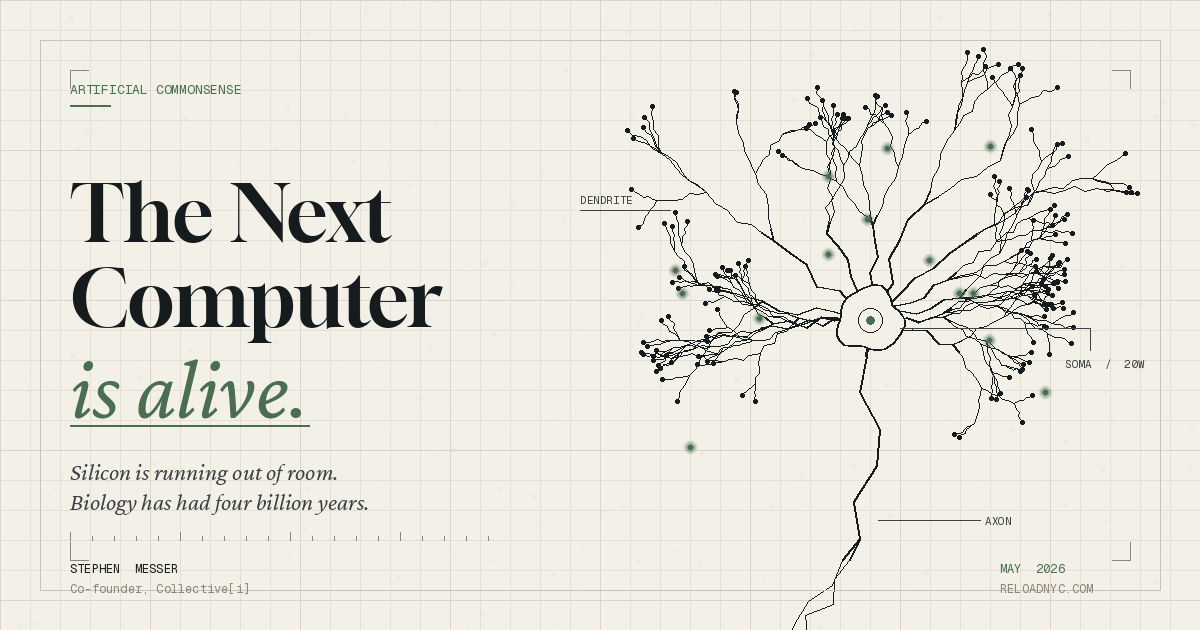
Your brain uses approximately 20 watts to power 86 billion neurons, each making up to 10,000 synaptic connections. To simulate that same brain on a silicon supercomputer would require the power output of a nuclear power plant. You are walking around with more processing power and more energy efficiency than anything humanity has ever built — and you're doing it on a bowl of oatmeal and some coffee.
AI researchers have spent decades trying to model this. Artificial neural networks are loosely inspired by biological ones. But 'loosely' is doing a lot of work in that sentence. The artificial neuron in a neural network is a vastly simplified mathematical abstraction of a biological neuron. It doesn't self-organize, doesn't self-repair, doesn't learn from single examples, doesn't operate on an event-driven basis that fires only when needed. It consumes orders of magnitude more energy per computation than its biological counterpart.
So a group of researchers and engineers, confronted with this gap, asked the obvious question: what if instead of simulating neurons, we just used neurons? What if the computer was alive?
Biological neurons are approximately one million times more energy-efficient than the artificial neurons in our best silicon AI systems. Evolution had four billion years to optimize this. We've had seventy. The gap is not a coincidence.
This is the field of wetware computing — also called organoid intelligence or biocomputing — and it has crossed from research curiosity to commercial product faster than almost anyone expected. Two companies have now shipped hardware. Dozens of research groups are running experiments on living neural tissue right now, via cloud APIs, from their laptops. And the results are strange, impressive, and only beginning to be understood.
What's Actually Happening in the Lab Right Now
In 2022, the team at Cortical Labs published a paper in the journal Neuron that got a lot of attention. They grew human neurons in a petri dish, connected them to a silicon chip via electrodes, placed them inside a simulated game environment, and gave them electrical stimulation as feedback. The neurons taught themselves to play Pong. Not perfectly. But reliably, adaptively, and faster than machine learning algorithms trained on the same task.
Neurons in a dish. Playing Pong. Without anyone programming them to do it.
Then, in March 2025, Cortical Labs launched something that should have made far more headlines than it did. At Mobile World Congress in Barcelona, they unveiled the CL1 — the world's first commercially available biological computer. A self-contained unit. $35,000. Real human neurons grown on a custom electrode array, connected to a life-support system that keeps them alive for up to six months. Runs on 850 to 1,000 watts. Comes with a Python SDK. You can code against actual living neurons from your laptop. They've also run Doom on it.
The Companies Building It
LEADING BIOCOMPUTING COMPANIES — 2026
The Timeline: Where This Goes Over the Next Five Years
The Honest Picture
Everyone building AI infrastructure today is using a linear model. More compute, more power, more silicon. The projections are extrapolations from a curve that is already bending.
Silicon chips at 2nm are extraordinary. They are also approaching physical limits that cannot be resolved by engineering harder. The Taiwan dependency matters, but even without it the fundamental constraint remains: we are running out of room to shrink transistors. The energy cost of current AI compute is not a temporary inefficiency — it's a structural feature of building intelligence from chips that weren't designed for the task.
Quantum computing is real and advancing faster than public discourse reflects. Q-Day concerns are driving the headline attention, but the deeper value is in hybrid quantum-classical systems solving specific categories of problems — optimization, molecular simulation, logistics — that silicon approaches poorly. The organizations building toward this architecture now will have compounding advantages in those domains.
Wetware computing is the most surprising story in technology that almost nobody outside the lab is watching. Not theoretical. Not speculative. A biological computer is available for purchase today at $35,000. You can run code against living neurons from your laptop via a cloud API this week. The energy efficiency advantage — one million times more efficient than silicon per logical operation — is not a projection. It's a measurement.
The question is not whether the compute substrate changes. It always has. Vacuum tubes gave way to transistors gave way to integrated circuits gave way to the chips we have now. Each transition looked impractical until it was inevitable.
The question is whether you'll be building on what comes next — or still optimizing the thing it replaced.
Evolution had four billion years to perfect the biological neuron. We're just starting to figure out how to wire it to our software. It turns out it works.