The Safest Move You Can Make With AI Will Cost You Everything.
There is a sentence moving through boardrooms right now that sounds like wisdom and functions like a trap. "We are taking a responsible approach to AI." It gets nodded through. And it is the most expensive position a company can take right now.

Stephen Messer, Co-founder of Collective[i] and LinkShare (sold to Rakuten for $425M, 1996–2005). EY Entrepreneur of the Year/Deloitte Fast 50 winner. Board member, Spire Global (NYSE: SPIR). Building intelligence.com
There is a sentence moving through boardrooms right now that sounds like wisdom and functions like a trap. You have heard it. You may have said it.
"We are taking a responsible approach to AI."
It gets nodded through. It satisfies the board. It threads the needle between the AI skeptic and the AI evangelist in the room. And it is the most expensive position a company can take right now.
Not because caution is wrong. Because with AI specifically, the thing that looks like protection is actually exposure. The risk the careful company is trying to avoid — moving fast and getting something wrong — is smaller than the risk it is actually taking: moving slowly while competitors build the one advantage in business that cannot be bought, copied, or acquired once it exists.
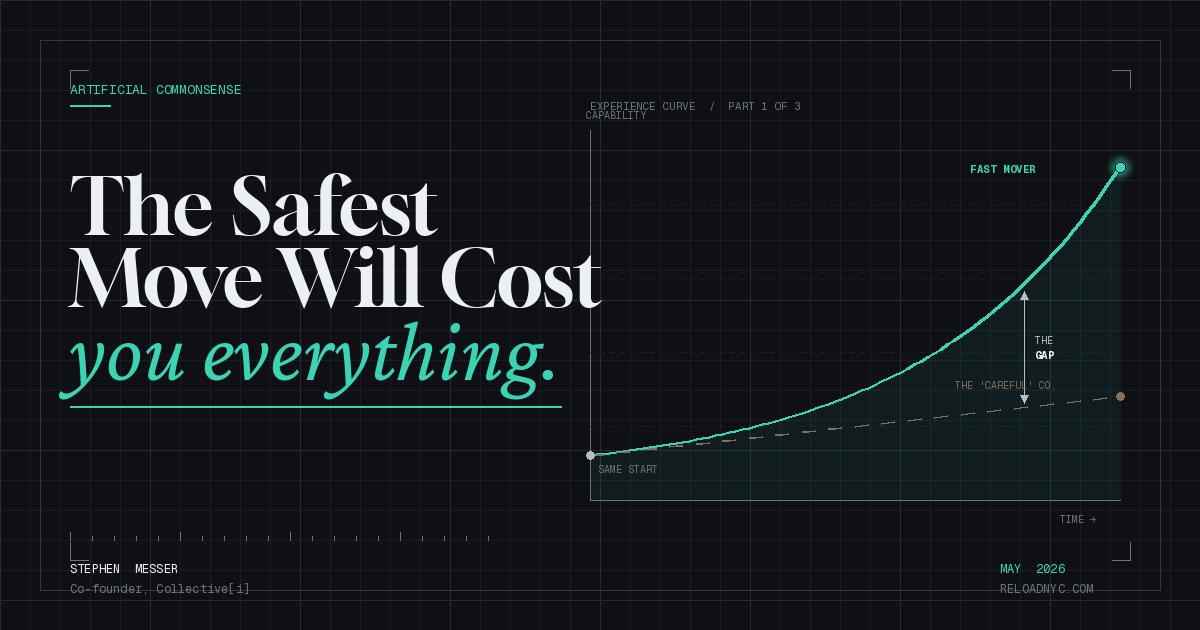
The experience curve.
The Experience Curve. Why This Is the Only Thing That Matters.
The companies that win the AI era will not win because they bought the best model. Model inference costs fell 280-fold between late 2022 and late 2024. Everyone will have good models. The tool is a commodity the moment it ships.
The advantage is the rate at which an organization learns to use intelligence and converts that learning into speed. The company that has been operating AI in production for two years does not just have better outputs. It has different organizational DNA. When the next model ships, they absorb it in days. The company still in pilots absorbs the same new model in quarters.
The model gets copied. The workflow gets copied. The experience curve does not.
The internet era proved this. Google entered search years after AltaVista and Yahoo. Facebook entered social networking after Friendster and MySpace. What they had was not first-mover advantage. They had a higher learning rate. Research on internet-era market structure found a consistent pattern: companies that entered second but moved faster captured an average of 28% market share; companies that moved cautiously captured roughly 10%. The gap was built on the speed of every decision, not the first one.
THE AI GAP — WHAT THE DATA ACTUALLY SHOWS
McKinsey's 2025 workplace AI report makes the finding even more direct: the biggest barrier to AI success is not the technology, the data, or the budget. It is leadership. Employees are ready. The people who are supposed to clear the path are the ones blocking it.
I Have Seen This Movie Before. Here Is How It Ends.
In 1996, when we started LinkShare, the internet did not look like a business revolution to most of the advertising world. It looked like an experimental media channel. The real money was television. The upfronts.
For most of the twentieth century, marketing was a judgment business. Not numbers — judgment. The CMO was evaluated on things that could not be measured: brand equity, creative quality, market positioning. The senior marketing executive was a highly paid opinion, backed by focus groups and instinct, selling conviction to a board that had no better mechanism for evaluating the work.
The upfront was the ritual expression of that world. Networks gathered advertisers and agencies, previewed the coming season, threw beautiful events, and sold large parts of next year's media inventory in advance. Nobody had to be right — because there was no mechanism to prove anyone wrong until the campaign had run, the money had been spent, and the brand tracking study came back months later.
Then the internet showed up and destroyed the ambiguity. Suddenly the question was not where should we advertise. It was how do we reach this specific user, at this specific moment, and how do we know if it worked. Click rate. Conversion rate. Cost per acquisition. A headline tested in the morning, killed by lunch.
LinkShare mattered because it changed how advertisers paid. Performance marketing shifted the risk to the publisher, which unlocked speed of learning. But the more important dynamic was economic: the early mover to a new channel did not just learn faster. They learned cheaper. When you are one of the first brands on a new platform, the platform needs you more than you need it. Founder pricing. Dedicated support. Early access. The learning curve is subsidized by the investors who need you to prove the idea works.
Here is the flywheel. Every customer acquired through the cheaper new channel lowered average cost of acquisition across all channels. That lower average cost meant more room to spend in the expensive channels your slow-moving competitors owned exclusively. You got more customers, which lowered your average cost further, which let you outbid them in their own channels. The early mover was not just learning. They were compounding.
The mindset shift was not incremental. The brand CMO was asking: where should we advertise, how do we protect equity. The performance marketer was asking: how fast can we improve this, can we automate that improvement. One was managing a reputation. The other was running an optimization engine.
This is what I watch happening now in the revenue side of the world. The companies that went early on intelligence infrastructure are running an optimization engine on every deal, every relationship, every commercial signal. The early mover discount has been paid. The compounding has started.
The executive describing their AI approach as careful and responsible is making the same bet the old CMO was making in 1999. The market is not waiting for readiness. It never does.
The Responsibility Trap. This Is the Real Danger.
There is a reason the 'responsible approach to AI' language is so seductive. It is not dishonest. The risks of AI are real. Hallucination. Bias. Data leakage. Regulatory exposure. Autonomous action in high-stakes environments needs guardrails.
The trap is treating every AI action as if it carries the same risk. That is how you get a committee reviewing an internal summarization tool with the gravity of a medical diagnosis system. That is how 'responsible' becomes a synonym for 'everything moves at the speed of the most nervous person in the room.'
Responsible AI is not slow AI. Responsible AI is knowing where speed is safe and where judgment is mandatory. Draw that map explicitly. Pre-approve the low-risk categories. Build serious controls around the high-risk ones.
The Responsibility Trap has a specific symptom: the company that is extremely good at governance but cannot tell you which number AI has moved. Pilots that track tool adoption, not outcome improvement. Quarterly reviews that show usage charts, not business metrics.
Buffett's textile lesson applies here. Berkshire's textile operation kept investing in better equipment. Each investment looked rational. The problem was every competitor made the same investment. The lower cost became the new industry baseline. Nobody got a durable advantage because every efficiency gain was immediately shared with the competition and then with the customer.
Most AI strategies are buying the new loom. The competitor buys it too. Your gain becomes the new price of admission. The company that breaks out of the Responsibility Trap asks what can we now do that was impossible before. Not lower cost. Different capability. Different learning rate. That is where the experience curve starts separating from the field.
The Reckoning. Who Wins and Who Watches.
In ten years, every company will use AI the way every company now uses computers. The tools will be everywhere. The models will be cheaper. The fear will fade. The average company will eventually catch up to the basic capability.
But the market share will already be gone.
Most companies will not fail at AI because they chose the wrong vendor. They will fail because they tried to preserve the old company with new technology. They will run pilots. Hold hackathons. Publish responsible AI principles. Add AI features to existing workflows. Buy the new loom and wonder why the margins did not last.
Then they will look at the companies pulling away and assume those companies took more risk. They will be wrong.
The companies pulling away understood the real risk earlier. The risk was not moving too fast. The risk was letting the organization learn too slowly. Every week of delay was a week without building the experience curve. Every steering committee was a week the competitor did not have to wait.