The End of Car Ownership. You Just Don't Know It Yet.
Americans spend $11,577 a year on a vehicle that sits parked 95% of the time. Self-driving services are now operating in a dozen US cities, with more arriving monthly. The car is about to become what the landline became after the mobile phone: something you wonder why you ever paid to own.

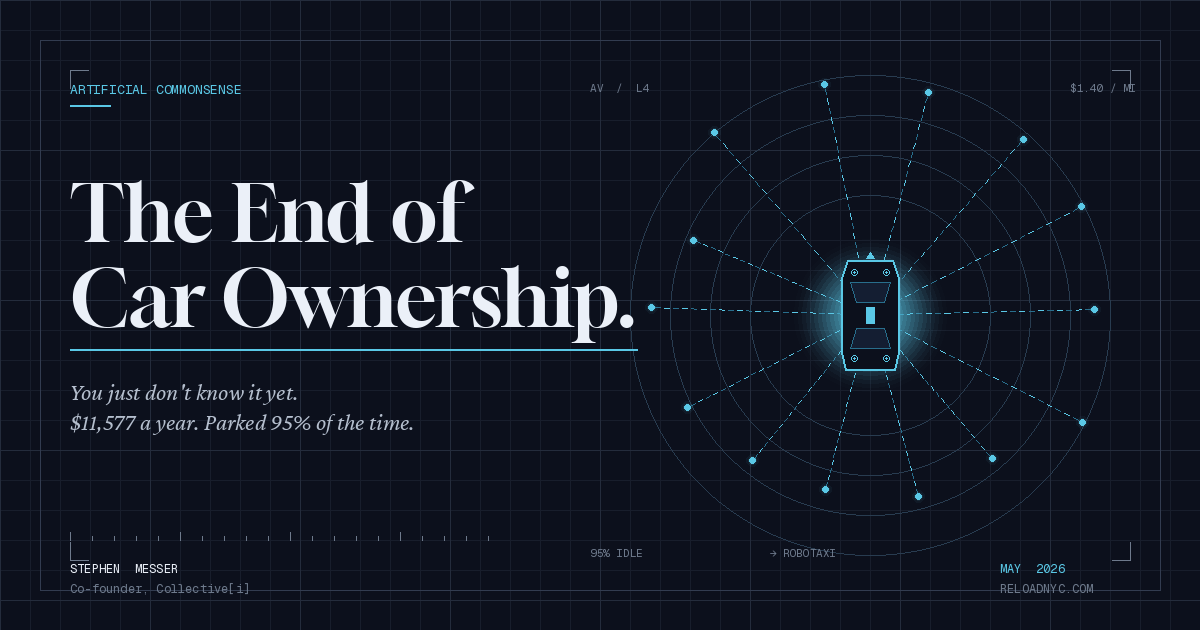
Stephen Messer, Co-founder of Collective[i] and LinkShare (sold to Rakuten for $425M, 1996–2005). EY Entrepreneur of the Year/Deloitte Fast 50 winner. Board member, Spire Global (NYSE: SPIR). Building intelligence.com
I live in New York City. I used to own a car. For years it was something I held onto, the way people hold onto habits they've had since before the world changed. Then Uber and Lyft arrived, and I ran the numbers, and the car was gone within six months. It was the easiest decision I'd made in years. The car was a cost center wearing the costume of freedom.
What happened to me in New York is about to happen across America. Not because everyone is moving to a city. Because the economics of car ownership are about to shift as dramatically for suburban and rural households as they shifted for urban households when ride-hailing arrived. The agent of that shift isn't an app. It's a car with no driver.
The Real Cost of a Car. Laid Out Honestly.
The average American car payment gets the most attention because it appears on a monthly statement. But the payment is only part of the cost. AAA's 2025 Your Driving Costs study puts the total at $11,577 per year, about $965 per month. Kelley Blue Book's five-year total averages $80,238. Depreciation alone accounts for $4,334 per year, 37% of total ownership cost, and unlike every other expense, it never appears on a monthly statement. It silently erodes the asset you bought.
THE TRUE COST OF CAR OWNERSHIP
Think about that utilization number. Four to five percent. The car you've financed, insured, registered, maintained, and found parking for is in active use for about an hour a day. The only reason this has made sense historically is that there was no alternative. That constraint is ending.
The moment a robotaxi is cheaper per mile than the cost of owning a car, including depreciation, insurance, fuel, and maintenance, is the moment the car becomes a luxury, not a necessity. That moment is coming fast.
Where Self-Driving Actually Is Right Now. Not Where It's Been Predicted to Be.
Waymo passed 500,000 paid rides per week in early 2026. It completed 14 million fully driverless trips in 2025, tripling its 2024 volume. It now operates in more than ten US cities including San Francisco, Los Angeles, Phoenix, Austin, Atlanta, Miami, Dallas, Houston, Nashville, Denver, and Las Vegas, with international expansion to London and Tokyo underway. At an average fare of $20 per trip, Waymo generated approximately $286 million in revenue in 2025.
Tesla launched its unsupervised robotaxi service in Austin in January 2026, expanded to Dallas and Houston in May 2026, and is targeting seven cities by mid-2026. Tesla's pricing: $3.00 base plus $1.40 per mile, roughly half the cost of Waymo. Morgan Stanley estimates Tesla at approximately $0.81 per mile vs $1.36-1.43 for Waymo. ARK Invest projects Tesla's Cybercab at $0.20 per mile by 2030.
For context: Uber currently charges roughly $1 to $2 per mile in most markets. The trend line for autonomous vehicle costs is downward fast, toward a price point where taking a robotaxi is cheaper per mile than owning a car.
For City People, This Is Obvious. For Everyone Else, Here's Why It Matters.
I understand the skepticism from outside major metropolitan areas. 'That's great for San Francisco. My suburb doesn't have Waymo.' This is a reasonable current-state objection. It's not a reason to assume the future looks like the present.
Consider what happened with ride-hailing. Uber launched in San Francisco in 2010. By 2015 it was in hundreds of American cities. By 2020, rural areas were being served for the first time in decades. The economics of autonomous operation are even more favorable than ride-hailing, because there's no driver to pay. As fleets scale and multiple providers compete, service area expands and price comes down. Suburban and exurban deployment follows urban deployment the same way it always has.
The eVTOL dimension makes this even more interesting for genuinely rural areas. Companies like Joby Aviation, Archer, and Wisk are developing autonomous air taxis that can connect communities without roads. The cost per mile follows the same cost-reduction curve as every electric vehicle category. Within this decade, autonomous aerial transportation for the last 50 miles is commercially plausible.
The Unlocked Value. This Is the Part That Surprises People.
The conversation about autonomous vehicles usually stays on the cost side: what you stop paying. I want to spend time on the value side, because I think it's larger and less discussed.
What Happens to the Car Industry. And to the City.
About 30% of urban land in American cities is devoted to parking. Surface lots, parking structures, garage floors under office buildings, streetside spaces. That's land sitting empty most of the day waiting to receive cars that will sit empty for the rest of it. As vehicle utilization goes up, the number of vehicles needed declines. As vehicles decline, the land they occupy becomes available.
Every parking lot is a future housing site, park, retail space, or mixed-use development. The cities that begin converting this land as autonomous vehicles reduce the parking requirement are the cities that grow into it rather than waste it. This is the same logic as the permitting argument: change the infrastructure assumption and the city has room to grow.
The Two Articles Together. Here's the Real Story.
Part 1 was about the robotic kitchen. This part is about the autonomous car. Separately, each is an interesting technology story. Together, they describe something larger about what daily life is about to look like for American families.
Consider what two working parents spend their non-working time doing. Cooking. Driving. School pickup. Grocery runs. Errands that require the car. These aren't chosen activities. They're the maintenance load that daily life imposes. They consume the hours between the end of the workday and the moment the family is finally together.
The robot kitchen handles the cooking. The autonomous vehicle handles the driving and the errands. The garage becomes something useful. The school pickup happens without anyone having to leave. The grocery run doesn't require forty-five minutes in traffic.
What's left after that maintenance load is removed is time. Time that used to go to the functional necessities of family life can go instead to the things families actually want to do with it. The living room becomes the social center it used to be. The dinner table returns. The evening is available rather than consumed.
Every major household technology shift of the last century freed up time that families used to spend on maintenance and returned it to the rest of life. The robot kitchen and the autonomous car are the next ones. They're here.
The question I keep asking about every development in this series: not 'how do we do what we already do, faster,' but 'what becomes possible that wasn't possible before?' When cooking is handled and driving is handled, a family has more hours available for the things that matter. That's not a marginal efficiency improvement. That's a change in what a day can contain.
KEY NUMBERS