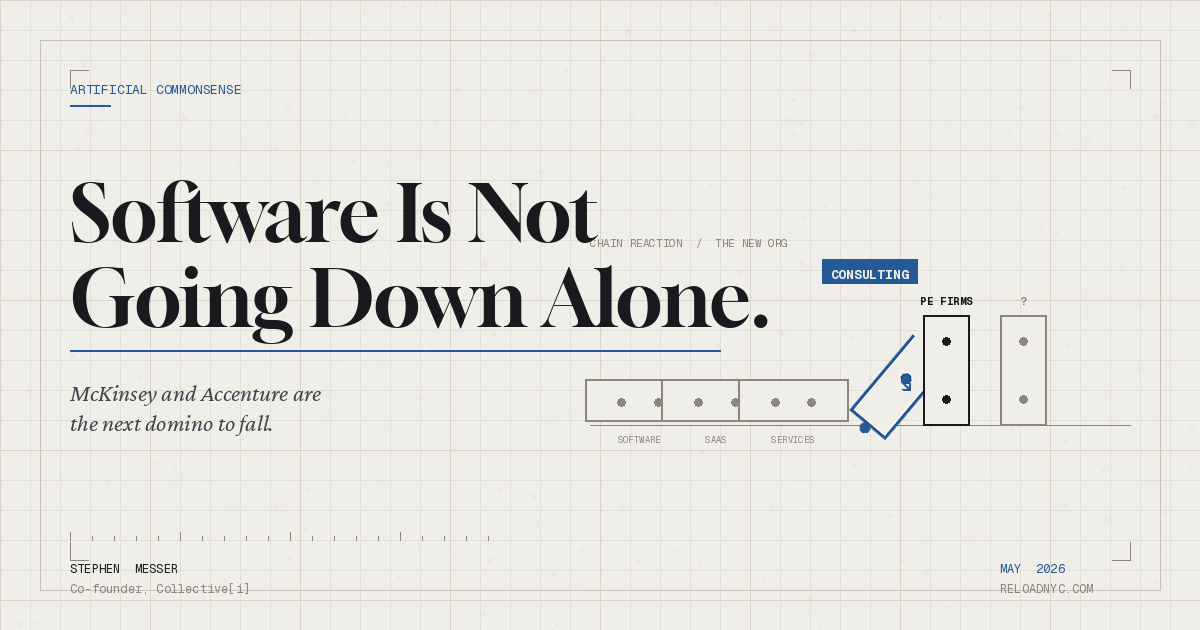
Software Is Not Going Down Alone.
McKinsey and Accenture are the next domino. Not because AI does their job. Because AI does their job better, faster, and permanently. That is a different kind of disruption. And it has already started.

Stephen Messer, Co-founder of Collective[i] and LinkShare (sold to Rakuten for $425M, 1996–2005). EY Entrepreneur of the Year/Deloitte Fast 50 winner. Board member, Spire Global (NYSE: SPIR). Building intelligence.com
The last post was about the $5.5 billion OpenAI and Anthropic committed to going around the consulting firms entirely, embedding forward-deployed engineers directly into enterprises to rip out the legacy stack and wire in intelligence infrastructure. The announcement was not a threat. It was a verdict.
This post is about what comes next. Because the consulting firms going away is not just a market story. It is a fundamental rethinking of how organizations learn, adapt, and compete. The question worth asking is not who fills the gap. The question is whether the gap still exists.
What You Were Actually Buying from McKinsey.
Strip away the methodology decks and the partner dinners and the frameworks with four quadrants. What you were actually buying was this: a consultant who had already seen your problem somewhere else. Someone who had watched a company in your situation try three things, seen two fail, and was now telling you to do the third one. You were buying the accumulated experience of people who had been inside enough companies to know what the right answer looked like.
You were also buying cover. A McKinsey recommendation gave a CEO institutional protection when presenting to the board. 'The best strategic advisory firm in the world told us this is the right path' is a different sentence than 'we think this is the right path.' The brand was not just marketing. It was risk management.
That model had a structural constraint: the knowledge was stored in people. You could not scale it faster than you could train senior partners. The pyramid model existed because the bottleneck was human judgment at the top. Everything else was staffing.
Now ask yourself what happens when an intelligence model has ingested the outcomes of more companies, more transformations, more strategy engagements than any single consulting firm has ever touched. When the pattern recognition is no longer limited by how many engagements one person has sat in on. When the model has seen not just the projects that McKinsey published as case studies but every earnings call, every bankruptcy filing, every operational disclosure from every public company for the last twenty years.
The model may already be more accurate than McKinsey. Not on every question. But on the kinds of questions McKinsey gets paid to answer, the ones where the answer is already in the data if you know where to look, there is a strong argument that the intelligence layer wins. And it wins permanently, because it updates every day.
The Generalist Problem. This Is the Part Most People Are Getting Wrong.
PE firms are going to hire these people. They already are. Bringing former McKinsey and BCG partners onto value creation teams, believing the pedigree translates into the AI era. It does not. And I want to be specific about why.
The consulting firms produced brilliant generalists. People trained to walk into any industry, any problem, any organization and apply a framework. They were taught to find patterns across contexts. They were taught to ask the right questions. They were taught, above all, to find the lock-in: the moment in a transformation where the client needs the firm permanently rather than episodically.
These are exactly the wrong skills for what is coming.
Building the intelligence org is not a generalist problem. It is a systems problem. It requires people who understand how AI actually works, not conceptually but architecturally. Which models do what. Where each one has edges. How an economic model and a language model and a vision model interact when you wire them together. What a feedback loop needs to look like for the system to actually improve. What data you need, in what form, at what latency, for a prediction to be actionable rather than decorative.
The consulting firm people do not have this. They have something worse than ignorance: they have a framework for it. They can explain AI confidently enough to run the engagement and produce the deck. They cannot build the architecture. And in the recursive org, the deck is not the product. The architecture is.
There is a phrase these people used for years that tells you exactly where they were: 'data is the new oil.' They were not wrong. They just missed the entire point of their own analogy.
Data is exactly like oil. In raw form it has some value but mostly it just sits there. The real value accrues to the refinery, the entity with the capital, the infrastructure, and the scale to turn raw crude into something everyone depends on. An individual oil well owner sitting on a field in West Texas does not get rich just because oil is valuable. They get rich because a refinery exists to process what they have. Without the refinery, the oil stays in the ground.
Every company digitizing its data for the last thirty years was an oil well. The refineries are Visa, Google, PayPal, and now the model companies. The value of any individual company's data, in isolation, is close to zero. The value of aggregated signal across millions of companies, transactions, and relationships is the foundation of the most valuable businesses ever built.
Here is the thing that should have been said in every boardroom where a McKinsey partner presented the 'data is the new oil' slide: your company is an oil well. You will never be a refinery. The question is not how to make your data more valuable. The question is which refinery you give it to, on what terms, and what you get back. The consulting firms had thirty years of access to the raw crude, sat in rooms with every major company in every major industry, watched the model makers getting built, and did not fund a single one of them. Did not create a single refinery. Did not tell their clients that the value was going to the aggregators, not the producers, because that conversation would have undermined the 'digital transformation' engagement they were billing for.
That failure is not incidental. It is diagnostic. The people who were supposed to understand where value was going, who had better access to the data than almost anyone, missed the most important structural shift of the last generation. These are not the people you want leading the next one.
They are experts in steam. The world has moved to electricity. The skills do not transfer. They become an anchor. A person who deeply understands how to optimize a process built around human workflows will slow down the AI transformation, not accelerate it, because their instinct is to improve the process rather than replace it. This is not a failure of intelligence. It is a failure of the right kind of intelligence for the moment.
OpenAI, Anthropic, and Palantir are not going around the consulting firms because service businesses are good business. They are going around them because they have looked at what these firms deliver and concluded they are getting in the way.
The Time Problem. Three Years Is Now the Wrong Unit of Measurement.
The classic consulting engagement ran eighteen months to three years. That was the cycle: assess the current state, design the future state, build the roadmap, implement, measure. This timeline existed because the transformation being managed was moving through human organizations at human speed. Change management took time. Training took time. Adoption took time. The eighteen-month timeline was not laziness. It was the actual pace of organizational change when humans are the change agents.
The recursive org does not change at human speed. It changes at the speed of the data. An intelligence model that learns from every interaction does not need an eighteen-month change management program to adopt a new approach. It tests the new approach against the old one, measures the result, and shifts weight toward what works. The cycle is days, not years.
This matters because the consulting model is not just slow. It is the wrong shape. The consulting model assumes a project: a beginning, a middle, and an end. A defined problem with a defined solution. The recursive org does not have projects. It has continuous adaptation. The goal is not to reach the right answer. The goal is to keep getting less wrong, faster, as the environment changes. There is no end state. There is only the current state and the direction of improvement.
A consulting firm cannot sell this. The business model requires a defined scope, a defined deliverable, and a defined end date. Continuous intelligence with no defined end date is not an engagement. It is infrastructure. And infrastructure is sold by the companies that build it, not by the firms that advise on it.
Is There a Role for Generalists at All?
Some. But not the ones being produced by the current talent pipeline.
The Harvard and BCG study on AI and consulting work found something important: AI made average performers significantly better. It made top performers improve less. The implication is that what AI cannot do is the thing that the best people in any field were already doing better than the average. Genuine insight. The ability to see a situation that has no historical analog and know what it means. The capacity to walk into a room, understand the actual problem in twenty minutes, and know the answer before the analysis is complete.
Those people exist. They are not common. They were always the rare ones at the top of the pyramid whose judgment the whole system was organized to deliver. The difference is that in the old model, you needed the whole pyramid to support one of them. In the new model, the pyramid is gone. The person with genuine foresight, working directly with intelligence infrastructure, is a fundamentally more powerful operator than the same person working with armies of analysts.
The people worth keeping are not the generalists. They are the specialists who went deep enough in something real that they actually understand what AI can and cannot do in their domain. The person who spent ten years inside a specific industry, building actual systems, seeing what worked and what did not, and has now learned to wire intelligence into the problems they understand at depth. That person is incredibly valuable. The person with a consulting framework and a general understanding of 'AI transformation strategy' is not.
The Government Question. The Last Bastion Is Not Safe.
The consulting firms have always had government as the reliable floor. Long procurement cycles. Established relationships. Massive budgets with limited outcome accountability. The model was nearly impervious to disruption because the buyer had little incentive to optimize.
That is changing, and it is changing at a pace that should worry firms that were banking on government as a buffer.
On January 9, 2026, the Pentagon released its AI strategy with the explicit mandate to operate at 'wartime speed.' On March 22, 2026, Palantir's Maven Smart System was designated a program of record. The Army gave Palantir a potential $10 billion enterprise agreement in July 2025. The first kinetic strike using AI-powered autonomous drones on US soil happened in January 2026.
Drone warfare has made the consulting timeline incompatible with operational reality. A drone swarm making targeting decisions in milliseconds does not wait for a transformation roadmap. The Pentagon is not hiring McKinsey to figure out its AI strategy. It is embedding intelligence infrastructure and calling it the new operating system.
DOGE cancelled significant federal consulting contracts. Accenture cited the US federal headwind specifically in its FY25 results. The last bastion is not a safe harbor. It is the next front.
The CEO Track Is Being Repriced.
McKinsey alumni run a staggering number of Fortune 500 companies. The pedigree was a genuine signal: someone who could learn any industry quickly, synthesize complexity, and operate with credibility at the board level. Boards trusted it because it had worked.
The signal is being repriced. Boards that watched their companies fall behind while competitors built AI-native architectures are asking a different question now. Not 'did this person have excellent training and broad experience?' but 'can this person turn AI into operating leverage?' Those are not the same question, and for many people with consulting backgrounds, the honest answer to the second one is no.
The CEO of the recursive org needs to be able to define outcomes with enough precision that intelligence systems can pursue them. To evaluate whether the intelligence infrastructure is actually working. To make bets on architectures that have no historical precedent. To understand, at least functionally, why an economic model and a language model are different tools for different problems and when each one is right.
The consulting track produced people who were excellent at understanding problems they had not personally operated in. The AI era rewards people who operated deeply in something real, understand it at the level of the machine, and can build systems rather than advise on them. Pedigree alone no longer carries weight. Boards want leaders who turn AI into operating leverage. The pipeline that used to produce those leaders is no longer the right pipeline.
THE NUMBERS BEHIND THE TRANSITION
The PE World and What Actually Matters Now.
Private equity is where this transition is happening fastest and most visibly. The traditional PE value creation playbook: hire McKinsey to diagnose the portfolio company, bring in an SI to implement, measure the result at exit. The consulting fee was a line item in the investment thesis.
That model is being replaced by something structurally different. AI is the third value lever, alongside financial engineering and operational excellence. EY's Q4 2025 survey: two-thirds of PE firms expect to invest over a quarter of their total budget in AI by 2026. 84% have appointed a Chief AI Officer. FTI Consulting's 2026 PE AI Radar: 95% of funds report AI initiatives meeting or exceeding their business case criteria.
But most of what PE firms are currently calling 'AI value creation' is the wrong thing. Giving everyone a license to a large language model is not AI transformation. It is productivity enhancement. The firms that are generating real returns are the ones that figured out the network model: an intelligence platform deployed across a portfolio learns from every company simultaneously. The same model that understands commercial behavior at one portfolio company immediately improves predictions at every other company in the portfolio. This is not additive. It is multiplicative.
At Collective[i], we see this in PE value creation teams directly. When an economic model for predicting commercial outcomes is embedded as the intelligence layer informing every portfolio company's revenue decisions, the results are measurable. Nine months off IRR minimum, consistently. The value creation team is not running quarterly portfolio reviews and calling McKinsey to benchmark. The intelligence system surfaces the signal in real time and the team acts on it. That is a fundamentally different relationship between intelligence and action than anything the consulting model was built to deliver.
What the PE firms hiring former consultants for value creation are actually getting is people who are expert in the last thirty years of transformation. They understand how to manage change through human organizations at human speed. They know how to navigate the political dynamics of a portfolio company. They know how to build a presentation that gets a board to approve a roadmap.
What they do not know is how to wire together an economic model, a language model, and a relationship graph so that the portfolio company's commercial intelligence updates every day and surfaces the next best action before any human has noticed the signal. That is a systems engineering problem. It requires people who have spent years inside the technology, not advising on it from the outside.
My Prediction. And What This Era Will Look Like in Hindsight.
The firms disappear. Not immediately. First, companies reflexively run to the familiar helper when uncertainty spikes. McKinsey and BCG win contracts in the next two years that they should not win, because CEOs under pressure reach for what they know. The familiar answer beats the right answer when the board is anxious and the timeline is short.
Then the evidence compounds. Every Klarna result, every Block restructuring, every quarter of JPMorgan disclosing billions in AI-attributed value makes the question louder: why are we paying for a three-year engagement when the intelligence infrastructure delivers continuous improvement? The answer, 'because we trust McKinsey,' gets harder to say with a straight face. Not because McKinsey did bad work. Because the category became obsolete.
The best talent inside these firms leaves first. The people who actually understand the technology go to OpenAI's Deployment Company, to Anthropic's enterprise JV, to Palantir, to the AI-native firms being built right now. What remains at the legacy firms is the institutional brand, the client relationships, and the people whose skills were more suited to the old model than the new one.
The firms splinter. The partners with the best client relationships take those relationships to smaller, specialized practices. The brand loses its premium without the talent that justified it. The SI arms of the major firms struggle to justify their existence when the intelligence labs are deploying their own engineers. The model that sustained these firms for thirty years, the analytical pyramid built on information asymmetry and process complexity, no longer has the conditions it needed to thrive.
Here is the thing I want to say about this that almost nobody is saying: this is not a bad thing. The end of the consulting era is like watching the last season of Mad Men. Don Draper was brilliant at what he did. The era was real. The work mattered. And you watch it now and think, that is really how it got done. Rooms full of people, billable hours, slide decks, framework presentations, eighteen-month roadmaps. Brilliant people doing the best they could with the tools they had.
We are so far past that world now. The tools we have are incomparably better. The intelligence layer knows what is working at your company right now. It does not need to fly in from Chicago. It does not need three months to complete an assessment. It does not need a kickoff meeting. It is already running. It already knows. The question is whether your organization is wired to hear it.