Infinite Leverage. Building a Company With More Agents Than People.
Every business in history has been capped by the same constraint: you can only do as much as your people can do. That constraint just ended. What you build next is limited only by how clearly you can define what you want intelligence to pursue.

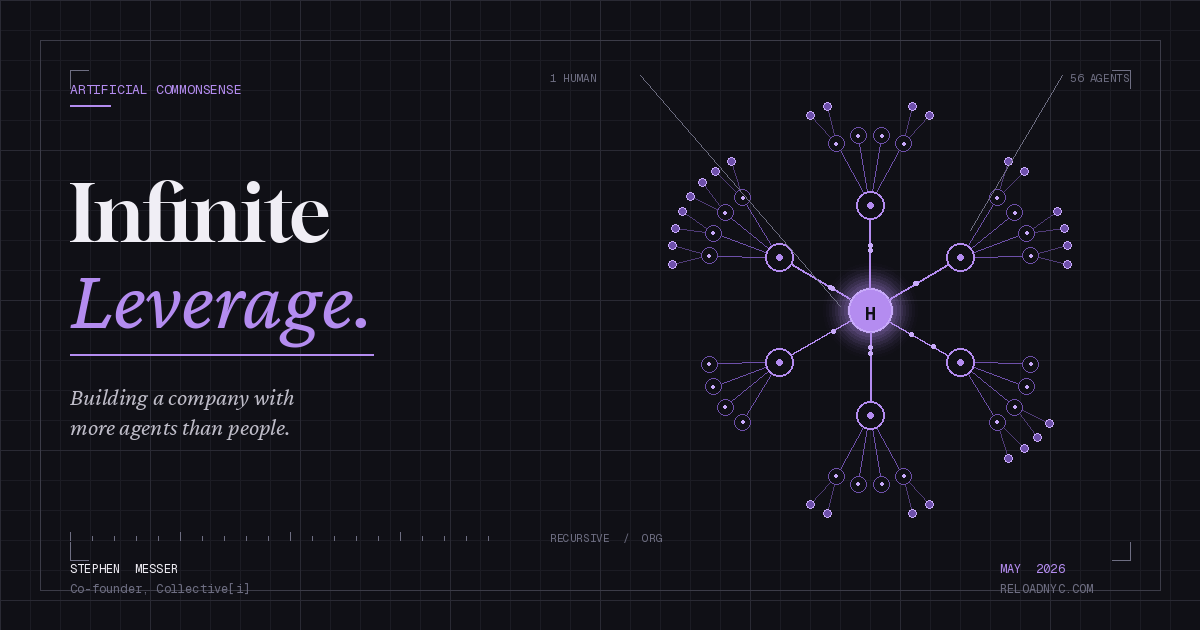
Stephen Messer, Co-founder of Collective[i] and LinkShare (sold to Rakuten for $425M, 1996–2005). EY Entrepreneur of the Year/Deloitte Fast 50 winner. Board member, Spire Global (NYSE: SPIR). Building intelligence.com
Every constraint in business eventually traces back to people. Not enough sellers to cover the market. Not enough analysts to process the data. Not enough managers to run the reviews. Not enough hours in the day to do the work that needs doing. The history of business strategy is largely the history of working around the limits of human capacity.
That constraint is ending. Not gradually, not theoretically. Now.
What's replacing it is something that has no historical equivalent. Leverage has always existed in business, financial leverage, operational leverage, brand leverage, but every form of it has eventually hit a ceiling. At some point the debt has to be serviced. The operation has to be managed. The brand has to be earned. People have always been the ceiling.
Agents don't create a higher ceiling. They remove it. The company that deploys intelligence correctly doesn't scale linearly with headcount anymore. It scales with clarity, specifically, how precisely its leadership can define the outcome they want to pursue. That is a fundamentally different kind of leverage. And unlike every other kind, it compounds automatically with every cycle.
This is the architecture of the infinite leverage company. How it's built, what it's made of, and why the humans inside it end up doing the only thing that has always required them.
The Constraint That Just Disappeared
For most of business history, the binding constraint on what a company could do was headcount. You couldn't enter a new market without hiring people to serve it. You couldn't analyze more data without hiring analysts. You couldn't run more sales conversations without hiring more sellers. Growth required people, and people required time to hire, train, ramp, and retain. That dynamic shaped everything: org design, capital allocation, the pace of expansion, the definition of ready.
Agents break this constraint entirely. An agent doesn't ramp. It doesn't need to be retained. It doesn't burn out at month nine of a difficult quarter. It doesn't require a manager-to-IC ratio. And critically: it doesn't get more expensive as it scales. The marginal cost of the hundredth agent doing a task approaches zero. The thousandth costs the same as the first.
This is not an incremental efficiency gain. It's a structural change in what's possible. The company capacity-constrained at 50 salespeople can now run the equivalent coverage of 500. The analysis team that could process one market at a time can now process twenty simultaneously. The ceiling on ambition that used to be set by headcount is gone. What replaces it is clarity, specifically, how precisely the leadership can define the outcome they want to pursue.
Every other form of leverage in business history has had a ceiling. Debt gets serviced. Operations get complex. Brand gets diluted. Intelligence-based leverage is different because it compounds with every cycle rather than degrading with scale. The more you use it, the better it gets. That's not leverage. That's infinite leverage.
The old limit was capacity. The new limit is clarity. The companies that win won't be the ones with the most people. They'll be the ones who can most precisely define what they want intelligence to pursue, and build the feedback loops that make it sharper every day.
The Brains. What They Do and How They Fit Together.
The recursive org is not a single AI system. It's an architecture, multiple specialized intelligence models, each doing what it does best, connected by agents that route their outputs into each other's inputs. A network of brains, each with a different kind of vision, all pointed at the same outcome.
Each of these brains is valuable alone. Together, they're something categorically different. A language model that can read a customer's communication history, combined with an economic model that predicts their likelihood to renew, combined with a voice model that synthesizes the last three calls, creates a picture of that customer that no human team could assemble fast enough to act on. That's the recursive org — not the individual brains, but the connections between them.
Agents: The Connective Tissue
Brains don't coordinate themselves. Agents do.
An agent is the unit of action in the recursive org. It takes an output from one brain and converts it into an input for another. It takes a prediction from an economic model and converts it into a task list. It takes a compliance flag from a vision model and routes it to the department that needs to act. It takes a risk signal from a financial model and triggers a review before the human would have known to schedule one.
The agent doesn't just relay information. It acts on it, updates based on the result, and feeds what it learned back into the model. That feedback loop, prediction, action, result, update, is what makes the org recursive. Every cycle produces a slightly better prediction. Every better prediction produces a slightly better action. Over time, the system knows your business, your customers, and your market in a way that no static tool ever could.
Here's the part most people underestimate: agents change with the data. There's no manifesto required to shift direction. No all-hands to announce a new strategy. No change management program to get buy-in. When the data changes, the agent's behavior changes. The org adjusts continuously, automatically, without the friction that organizational change has always created.
And because agents can run variations, ideas become tests almost instantly. A hypothesis about a better way to approach a customer segment doesn't require a project, a pilot team, and a six-month review cycle. It becomes an agent instruction, runs against real data, and produces real results in days. The winning approach gets adopted. The losing one gets discarded. The org learns from both. The distance between 'we think this might work' and 'we know whether it works' has collapsed from months to days.
This is how new businesses emerge from the recursive org. Not from strategic planning cycles, but from tested ideas that outperformed expectations. The agent that was optimizing one outcome discovers that a variation of the approach works better in a different context. That discovery becomes a new product, a new market, a new line of business, not because someone had a vision but because the feedback loop surfaced an opportunity that no one had specifically gone looking for.
The Flat Org. Why Hierarchy Becomes Overhead.
The traditional management hierarchy exists for one reason: information degrades as it moves. Each layer of management is a translation layer, signal goes up, decisions come down, and each translation loses fidelity. The manager exists to interpret what happened at the ground level and communicate a version of it to leadership. Leadership exists to synthesize across managers and make decisions from incomplete pictures.
This is not a design choice. It's a workaround for the limits of human information processing. You couldn't have one executive looking at every customer interaction, every deal, every process output. You needed layers because you needed humans, and humans can only hold so much.
When the intelligence layer is horizontal, when every brain sees every relevant signal, when every agent reports the result of every action directly back to the model, when leadership can see the full picture in real time without it being filtered through six layers of summary, the hierarchy becomes unnecessary overhead. The middle layers that existed to aggregate and translate information no longer have information to aggregate and translate. The org flattens not as a management philosophy but as a logical consequence of the architecture.
The companies moving fastest right now look nothing like a traditional org chart. Small at the top, a leadership team with sharp outcome clarity. Deep in intelligence infrastructure, models, agents, feedback loops. Almost flat in the middle, because the middle was always just translation, and translation is exactly what language models do better than humans.
WHAT THE NUMBERS SAY ABOUT THE NEW ORG STRUCTURE
The Human Role. This Is the Part People Get Wrong.
The default assumption when people hear 'more agents than people' is subtraction. Fewer jobs. Smaller teams. The human being replaced.
That's not what I'm describing. The recursive org doesn't need fewer humans. It needs different humans, doing different things. And the things it needs humans for are exactly the things that have always differentiated the best people from the average ones.
No model knows what a customer actually wants before the customer has articulated it. No agent can read the room in a negotiation and sense that the stated objection isn't the real one. No brain can build the kind of trust that comes from a relationship where you've shown up, delivered, and been honest over years. These are not skills that will be automated. They're the skills that the recursive org amplifies, because when the agent handles everything that doesn't require human judgment, the human can spend all of their time on the things that do.
Trust is not a soft concept in this architecture. It is the substrate that everything else runs on. The relationship graph is only as valuable as the relationships in it. The prediction about what a customer needs is only actionable if the customer trusts the person delivering it. The signal the human brings back from a conversation is only useful if they were in the kind of relationship where the customer shared something real. Trust is infrastructure. The human who invests in it, maintains it, and earns it over time is building the most durable competitive advantage the recursive org has.
How to Actually Build This. Starting Now.
The mistake most companies make is treating this as an infrastructure project. They start with the technology: what models do we need, which agents do we deploy, how do we wire them together. That's the wrong starting point. The right starting point is the outcome.
Pick one thing the org needs to be better at. One metric. One part of the business where the gap between where you are and where you should be is measurable and real. Then work backward: what intelligence would help close that gap? What actions would that intelligence need to take? What feedback loop would make those actions better over time?
That's the first agent. Not a platform. Not an architecture review. One specific outcome, one brain to inform it, one agent to act on it, one feedback loop to improve it. You can be live in days. The feedback starts accumulating. And what you learn from the first one tells you exactly what the second one should be.
The Companies That Don't Make This Shift. Here's What Happens.
They don't disappear immediately. They keep operating, keep hiring, keep running their quarterly cycles. But the companies that have made the architectural shift are compounding. Every quarter, their intelligence is slightly better. Their agents are slightly more capable. Their humans are slightly more focused on the high-value work. The gap widens automatically, without anyone declaring a strategic initiative to widen it.
At some point the gap becomes visible in the numbers. Win rates. Customer retention. Revenue per employee. Time to close. The traditionally structured company looks at the data and sees that they're losing ground, and they respond the way organizations always respond when they feel competitive pressure: they call for a project. A new system. A transformation initiative. A steering committee.
And that, as Part 1 of this series described, is exactly the wrong response. The project is the tell. The recursive org doesn't win because it has better tools. It wins because it's improving continuously while its competitors are waiting for their next project to complete.
The window to start is always now. Not because the technology will disappear, it won't, but because every quarter you wait is a quarter of compounding that doesn't happen. The org that starts today will have a year of feedback loops, a year of prediction improvement, a year of agent optimization before the one that starts next year. That gap compounds too.
The recursive org doesn't win once. It wins continuously, because it's designed to get better at winning. Every cycle makes the next one faster. That's infinite leverage, and it's available to build right now.