The Death of Privacy. The Rise of Unbreakable Communications.
Two mega-trends land the same year. One ends privacy for anyone in public life. The other makes wiretapping impossible forever. Both reshape society more than the AI everyone still writes about — and neither has entered the conversation yet.

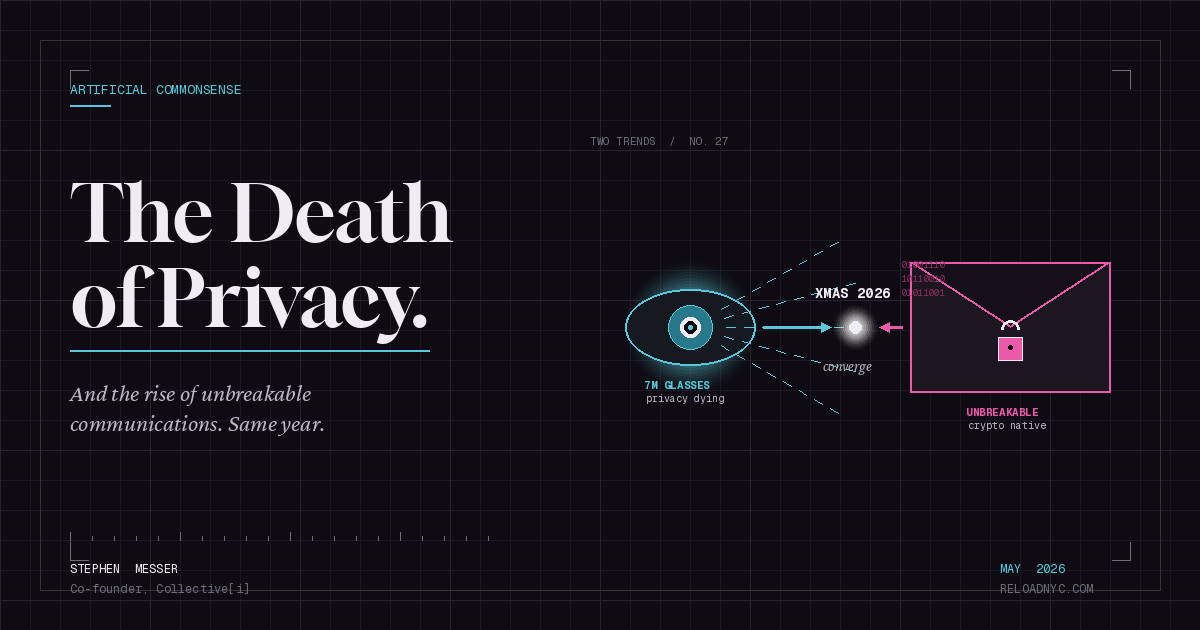
Both Arrive at the Same Time. Christmas 2026.
Stephen Messer, Co-founder of Collective[i] and LinkShare (sold to Rakuten for $425M, 1996–2005). EY Entrepreneur of the Year/Deloitte Fast 50 winner. Board member, Spire Global (NYSE: SPIR). Building intelligence.com
Two trends are arriving in the world at exactly the same moment. One is ending privacy for anyone participating in public life. The other is making it impossible for governments to wiretap communications ever again. Both are large enough on their own to reshape society. They arrive together. Neither trend cancels the other, and neither has been prepared for by anyone I have talked to at the policy, corporate, or family level.
I write about AI most weeks on this blog, and regular readers know I think the AI transformation is one of the largest shifts of our lifetime. This week I want to step back and describe two other convergences arriving at the same time. Placed side by side with those, the AI transformation stops looking like the only story of the decade. It starts looking like one component in a much larger reordering.
This is not meant to scare anyone. It is meant to give the AI conversation the perspective it currently lacks. What we are doing today with AI pales in comparison to a world that is rapidly coming, perhaps as soon as Christmas of this year.
The Death of Privacy Is Sitting on Seven Million Faces
The first trend has been sitting on people's faces for two years, and until recently was easy to miss.
In 2025, EssilorLuxottica sold more than seven million pairs of Ray-Ban Meta smart glasses. That is roughly triple the combined total for 2023 and 2024. In June 2026, Meta unveiled the next generation. A 12-megapixel ultra-wide camera. Five-microphone array. Open-ear audio. 3K video capture. A "super sensing" mode that runs continuous analysis of what the wearer sees and hears, hands-free. Live AI. Live translation. A viewfinder in the lens on the display models. A neural wristband that lets the wearer control the camera without touching the frames.
Google announced in early 2026 that Gemini-powered glasses will arrive later this year in two form factors: audio-only, and display-based. Apple has been openly preparing to enter the category. When Apple enters, and Apple always enters last, the category stops being niche. Seven million pairs a year becomes tens of millions.
The important thing about these devices is that they replace the phone for most of what most people do with a phone during the day. Making calls. Taking photos. Getting a translation. Asking a question. Checking directions. The stigma of Google Glass ten years ago has been erased by Ray-Ban partnerships that make the frames look like ordinary sunglasses. Some journalists are already using Meta glasses as hidden-camera reporting tools. In June 2026 the Columbia Journalism Review profiled a Turning Point USA correspondent using them to record on Skid Row precisely because they blend in.
A developer toolkit for third-party access to the glasses' sensors shipped in 2025. Not a device with recording built in. A platform for whatever anyone else wants to build on top of it. Face recognition. Voice recognition. Emotion detection. Whatever the next developer wants to try. In early 2026, Meta was reported to be using contractors in Nairobi to review real user footage as part of its training pipeline. The content the contractors saw was highly personal, and the people captured in the footage had never consented to being recorded at all.
The small LED indicator that lights up when the glasses are recording exists. Most people wearing them have stopped thinking about it, and most people around them are not looking.
This is what the first trend looks like from six feet away. Seven million of these devices are in circulation right now. Tens of millions will be by this time next year.
What "Everyone Is Recording" Actually Feels Like
The technology now exists. Almost nobody has thought seriously about what it means socially.
Every gossipy conversation you have will be heard by the person you were gossiping about. Every offhand political remark you make at a bar table will be captured, likely by the person seated at the next table who is not paying much attention to you at all. Every family fight in a hotel lobby. Every joke that lands badly. Every private moment you were sure was private because there was nobody around who cared to look.
There are two societal equilibria a culture can settle into once this happens, and I do not know yet which the world will pick.
The first is what you might call the Larry David equilibrium. Larry David on Curb Your Enthusiasm is a character who says exactly what he thinks in every situation and does not care how it lands. Everyone around him is uncomfortable at first, and everyone around him eventually forgives him because that is just who he is. Over eleven seasons the audience adjusts. The offensive things Larry says stop being scandals. They become the price of a friend who is honest to a fault.
Applied to a smart-specs world, this is the equilibrium where everyone says what they actually think, in front of everyone else, all the time. The threshold for offense moves upward because the volume of recorded honesty is too high to punish selectively. Society becomes more forgiving of awkward moments. The category of "public figure" collapses because there are no non-public figures anymore. Reality television is what everyday life looks like. So is the honesty.
The second is what you might call the USSR equilibrium. People stop speaking at all. Public conversation becomes performative and hollow. Real conversation moves indoors, then into rooms with no phones or specs, then into a state where nobody says anything meaningful in front of another human being. The threshold for outrage stays where it is, so every recorded misstep produces a career-ending event. The society becomes politer but a lot less honest.
My guess is that most of the Western world drifts toward the first equilibrium, more or less by inertia. The AI-driven analysis pipeline that could turn every recording into a career-ending event will be overwhelmed by the sheer volume of recordings. The interesting question is what happens at the edges of that equilibrium, where a specific incident becomes a specific viral event. That is where the second-order effects start to matter.
The Book That Called It in 2010
Gary Shteyngart's 2010 novel Super Sad True Love Story described a near-future America where every citizen wears an äppärät, a personal device that broadcasts personal data (credit scores, health data, attractiveness ratings, employment history) publicly to everyone in visual range. People rate each other and are rated in real time. The society has become post-literate. Reading a physical book is embarrassing. Everything worth knowing about a stranger sits on their device broadcast, visible from across a room. The novel was published fifteen years too early to feel plausible. It reads now like a manual.
The specific thing Shteyngart got right is that the technology arrives before the culture around it, and the culture rewrites itself to make participation feel obligatory. His characters do not experience the surveillance state as oppressive. They experience it as normal. Everyone knows your credit score. The embarrassing thing is having a low one. Everyone can rate your appearance. The embarrassing thing is being rated low. The oppression comes from the ranking, not the visibility. Everyone participates because everyone else does, and dropping out costs more than participating.
That is roughly the transition we are living through right now. Children born this year will experience "someone was not being recorded during that dinner" as strangely as their parents experienced "someone did not have a smartphone during that dinner." The prior era's expectation of privacy stops being an assumption and starts being a preference. The preference is expensive to hold, and most people will not hold it.
The Ring Precedent Is Already Written
The template for what comes next was set by Ring cameras a decade ago, and it is worth understanding in detail.
Ring cameras started as a consumer product for answering your door remotely. Within a few years, police departments were asking Amazon for footage. Amazon obliged, through a tool called Request for Assistance that let law enforcement query users directly through the Neighbors app, without a warrant, without judicial oversight. In February 2024, after years of public criticism, Amazon shut the tool down.
In July 2025, Amazon reinstated warrantless police access to Ring footage through a new partnership with Axon and its Fusus real-time public safety network. The reversal was announced at Axon Week, framed as community-sourced evidence. The Fourth Amendment protects against government surveillance. It does not protect against a corporation you agreed to give footage to voluntarily, and then handed to the government.
This is the arc every consumer surveillance product ends up on. A device is introduced for a narrow purpose. It gets popular. Law enforcement discovers it. Corporate policy resists warrantless access for a while, then finds a workaround. The workaround becomes standard. The Fourth Amendment does not enter the picture because the surveillance is technically voluntary. You bought the camera. You installed the camera. You accepted the terms of service.
Smart glasses will go through the same cycle, on a compressed schedule. The first major criminal case where glasses footage is subpoenaed for something the wearer would not have volunteered is a matter of months. The first case where footage is provided without a warrant, under an emergency exception, is a matter of a year. The first time an authoritarian regime uses ambient glasses recording to identify a protester is already happening in places where Meta glasses are sold and worn.
The First Casualties Are Already in Sight
The pattern will play out at three levels. Individual, political, and corporate.
At the individual level, some kid loses a scholarship over an offhand remark captured by a classmate's Ray-Bans in a coffee shop. Some job candidate loses an offer because their bachelor party from three years ago was recorded by a fellow guest and posted to a forum by someone with a grudge. Some marriage ends because a whispered aside at a dinner party made it to a Ring-style clip on a spouse's phone. There will be viral cases every month starting almost immediately.
At the political level, the interesting question is what happens to graft. A politician cannot take a bribe in a private restaurant if the table three seats over is streaming to a set of glasses whose owner has been paid by a competitor. This should be a good thing for democratic accountability, and in the short term it will be. Over the medium term, corruption moves to venues that can enforce a no-glasses rule, which means access to political favor becomes concentrated in a smaller set of venues controlled by a smaller set of gatekeepers. The corruption does not disappear. It moves upward.
Alongside that, we get the Kanyefication of political speech. Radical groups on the left and radical groups on the right both find their radical ideas aired continuously, in public, from the mouths of members recorded by other members. The DSA meeting is on tape. The neo-Nazi meeting is on tape. The initial shock at both wears off in months, as it always does. The society either becomes more numb to outlandish public speech, or splits into hard camps that no longer share a public conversation at all. My working guess is a bit of both, and neither is a healthy outcome.
At the corporate level, Apple v. OpenAI is the case study nobody is treating as one yet. On July 10, 2026, Apple sued OpenAI in the Northern District of California, alleging that OpenAI has been systematically hiring Apple hardware engineers to obtain confidential product designs. More than four hundred former Apple employees now work at OpenAI. Two former Apple hardware leads, including a VP who spent twenty-four years at the company, are named as defendants. The suit reads as a talent-bottleneck problem. It is also the opening act of a category of corporate espionage that is about to get much worse.
The Second-Order Effects Nobody Is Pricing
The most disturbing near-term implication is what happens to terrorism. On October 7, 2023, Hamas fighters wore GoPro-style body cameras during their attack on southern Israel, and some of them livestreamed atrocities directly to social media as the attack was happening. The 2019 Christchurch mosque shooter livestreamed on Facebook. The 2022 Buffalo Tops shooter livestreamed on Twitch. The precedent is already in the record.
Smart glasses collapse the friction between committing an atrocity and broadcasting it. Dedicated body cameras draw attention. Meta Ray-Bans do not. Every future attack of this kind will be livestreamed by default, from a first-person perspective, in high definition, to a global audience of hundreds of millions, in real time. Platform moderation lags livestreams by minutes at best. That is enough time for the footage to be captured, mirrored, and redistributed permanently.
Authoritarian regimes will respond in one of two ways. Some will ban smart glasses entirely, following the model China has used with foreign social platforms. Others, the more sophisticated ones, will require them as instruments of state surveillance, so that every citizen's field of view is potentially reviewable by the regime. The distinction between the free West and the authoritarian rest, on this dimension, is no longer whether the surveillance exists. It is who has the keys to review the footage.
The deepfake problem gets stranger, not simpler. A world saturated with genuine footage makes fakes easier to detect through cross-referencing. It also trains the audience to trust video absolutely, because for a decade there has always been a real recording available. When the first truly undetectable deepfake enters that environment, it lands with more force than any fake has ever had. My working guess is that cryptographic signing at the moment of capture becomes critical infrastructure inside three years. The smart-specs manufacturers themselves have the strongest incentive to build it, because their footage needs to hold up in court.
A lot of ordinary crime becomes harder. Petty theft in a public space is a bad idea when every third pedestrian is running visual capture. Bar fights get adjudicated overnight. Vandalism becomes a documented act rather than an anonymous one. Crime does not disappear. It moves. It moves indoors, into rooms where specs are banned. It moves to targets who will not report. It moves to categories the specs cannot catch, like financial fraud, insurance fraud, and organized crime conducting its business over signal-clean channels.
The consequence for interpersonal ethics is more interesting than the consequence for street crime. Marital infidelity, at least the kind that requires a physical meeting in a public place, becomes remarkably difficult in a world where any hotel lobby is a camera. Some marriages become more honest. Some marriages just move the affair to different geography. Discretion becomes a status good, and the venues that can enforce it become the ones where the powerful conduct their off-record lives. The rest of the population lives in the transparent version of the same world.
The Corporate Nightmare Nobody Is Writing Policy For
Now imagine Meta Ray-Bans walking into that same room where Apple's next hardware roadmap is being discussed.
The bring-your-own-device policies of the 2010s were hard for enterprise IT to write. The AI policies of the 2020s have been harder. The smart-specs policies of the next twelve months are going to be a nightmare that current enterprise governance is not equipped to write, and the policies will start being needed roughly next quarter.
Apple, which is famous for internal secrecy, will need a policy on whether an employee can wear Meta glasses into a hardware review meeting. Meta will need a policy on whether an employee can wear Apple glasses into a product planning meeting. The Pentagon will need a policy on whether contractors can wear either into classified spaces. The Federal Reserve will need a policy on whether reporters can wear either into a rate decision briefing. Boards will need to think about their own meeting rooms.
Every one of these policies runs into a specific problem. The specs are eyewear. Once the specs replace the phone for enough functions, they become accessibility devices. Once they are accessibility devices, the Americans with Disabilities Act imposes real obligations on employers around accommodation. Banning them wholesale becomes legally difficult. Permitting them creates the exact information-security problem the policy was designed to prevent.
The right answer, presumably, is a signaling technology that makes it obvious when specs are recording and enforceable when they are not. That technology does not exist at consumer scale yet, and it will not exist in time. In the interim, the policy in every serious enterprise will be some version of "we prohibit them and hope for the best," and every serious enterprise will find that policy unenforceable in practice. The Karp-and-Nadella-wall argument I wrote about last week has a mirror image here. You cannot build a wall against a threat that walks in on the face of a visitor.
The Apple v. OpenAI complaint reads, in this light, like the very first case of a category that is about to get much larger.
The Other Trend. Unbreakable Communications.
Now the second trend. It appears to run in the opposite direction of everything above. It arrives on exactly the same timeline.
At the same moment consumer surveillance devices are ending the expectation of privacy in physical space, quantum technology is landing in two forms that together rewrite what "private communication" even means. The first form is quantum communications, which produces channels that no eavesdropper can ever listen to. Not with a wiretap. Not with a warrant. Not with a national security letter. Ever. The second form is quantum computing, which will inside a decade become powerful enough to break the classical encryption protecting nearly every file that has ever moved over the internet. Diplomatic cables. Medical records. Legal proceedings. Corporate trade secrets. All of it decrypted retroactively, in the same years the smart specs are broadcasting everyone's next conversation.
Combine those three moves and you get a society with no historical analog. Everything you say in public is on file. Everything you wrote in the past is cracked open. Anything you say now on a properly secured quantum channel is unrecoverable forever. Some categories of information have zero privacy. Others have absolute privacy. Which category any given piece of information falls into depends on where it lives, who owns the infrastructure, and how old it is. The person you are having lunch with may be recording you. The email you sent your lawyer in 2015 may be in a foreign intelligence archive. The message you send that same lawyer this afternoon on a quantum-keyed channel may be safer than anything anyone has ever committed to writing.
We have no rules for that world. No mores. No agreed set of expectations. The legal and social frameworks in place today were built for a world where privacy was roughly continuous, protection was roughly equal everywhere, and digital secrets aged into the archives at a rate slow enough for norms to keep up. That world is ending on both ends of the spectrum at the same time.
We are in for strange times.
The technology is called quantum key distribution, or QKD, and the mechanics are worth understanding at a level of detail most business coverage skips. QKD encodes information in the quantum states of individual photons. The state of any given photon is described by a wavefunction. If anyone tries to observe that photon in transit, the observation collapses the wavefunction. Both the sender and the receiver see the tampering. The physics of quantum mechanics guarantees this. It is not an engineering property that can be improved on or worked around. It is a law of nature.
Quantum key distribution generates encryption keys that cannot be intercepted without both parties knowing about the interception. Two organizations exchanging keys over a QKD link know, with the certainty of physical law, that no third party has copied the key. This is the only wiretap-proof channel humans have ever built.
QKD is not the encryption itself. QKD is the way you deliver encryption keys that the two ends of the pipe are going to use. Once you have the keys, you use standard cryptography to encrypt the actual messages. The distinction matters, and it is the reason QKD becomes strategically important precisely as classical encryption is about to break.
China Is Already Running It. At National Scale.
China's investment in quantum communications is a decade old and has produced by far the largest deployed system in the world.
In August 2016, China launched the Micius satellite, named for the ancient Chinese philosopher Mozi. It was the first quantum communication satellite ever built. Over the next decade it demonstrated satellite-to-ground quantum key distribution at kilohertz rates over twelve hundred kilometers, intercontinental key exchange between Chinese and European ground stations, and real-time quantum-secured video conferences between China and Vienna, seventy-six hundred kilometers apart. Micius decayed and re-entered the atmosphere in January 2026, after nearly a decade of service. The Jinan-1 microsatellite, launched in 2022, is still operational.
The bigger deployment is on the ground. China's operational quantum communication network now spans more than twelve thousand kilometers of fiber, 145 backbone nodes, across eighty cities in seventeen provinces. The Beijing–Shanghai backbone alone runs two thousand kilometers. Combined with the satellite link, it produced a 4,600-kilometer quantum communication network serving approximately 150 participating users. The network carries traffic for hundreds of Chinese government agencies, state-owned enterprises, and banks. This is not a research demonstration. It is a carrier-grade production system, at national scale, that no other country has come close to matching.
Nothing comparable exists in the West. Canada plans to launch its QEYSSat quantum communication satellite in 2026, five hundred kilograms lighter than Micius, designed for a longer operational life. Europe's EuroQCI program is spending roughly ninety-seven million euros on a satellite-plus-terrestrial quantum communication constellation. The United Kingdom has an active national program. The United States has DARPA-level and NIST-level research, but nothing at China's scale of deployment. Jian-Wei Pan, China's father of quantum, has publicly targeted a higher-orbit Chinese quantum satellite at ten thousand kilometers altitude within five years. From that altitude, QKD could run around the clock rather than only during satellite passes.
The endpoint of the QKD trajectory is a global network of wiretap-proof communication channels, first between government agencies, then between banks and other regulated institutions, then between corporate boards and their advisors, then between people who care enough about being unlistenable to buy the service. This is not fifteen years away. This is closer to five.
CHART 1 · THE TWO TRENDS. WHERE BOTH STAND IN MID 2026.
One is ending privacy for anyone in public life. The other is making communications impossible to intercept. Both land at national scale in the same year.
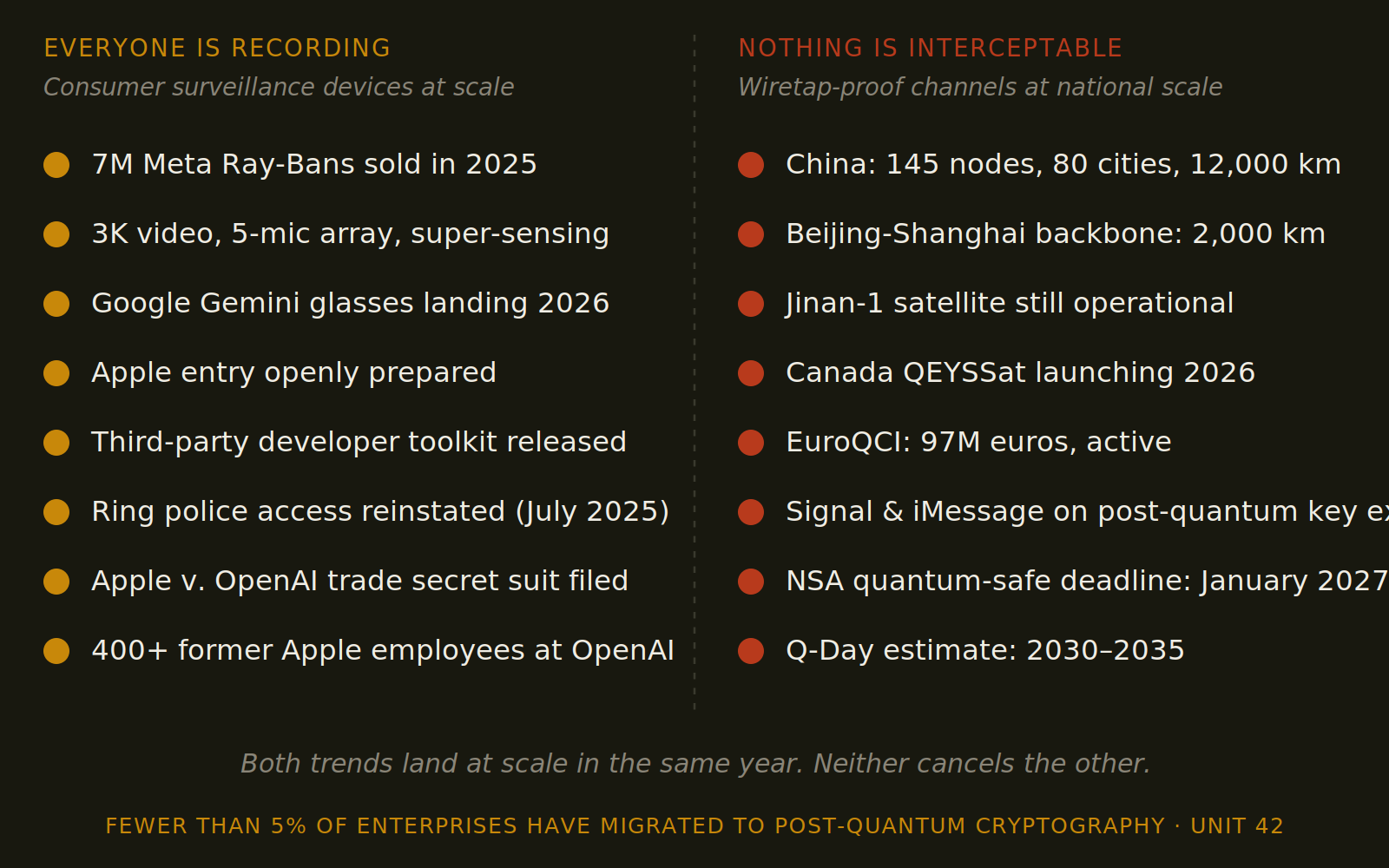
Source: Ray-Ban Meta smart glasses 2025 unit sales (EssilorLuxottica, Meta). Meta Ray-Ban next-generation specifications (Meta, June 2026). Google Gemini glasses roadmap (Google, 2026). Ring / Axon Fusus partnership (Axon Week 2025). Apple Inc. v. Liu et al. filing (N.D. Cal., July 10, 2026). China quantum network scale (postquantum.com China QKD reference, April 2026). Q-Day timelines and CNSA 2.0 deadlines (NIST, NSA, Palo Alto Networks Unit 42, 2026).
The Other Half of Quantum. Q-Day.
The reason all of this matters right now, and not in fifteen years, is that a second quantum technology is arriving on a parallel timeline. Quantum computing.
Quantum computing is often confused with quantum communications, and the two point in opposite directions on security. Quantum communications makes encryption unbreakable. Quantum computing breaks the encryption everyone currently uses. Both rely on quantum mechanics. They arrive at incompatible destinations.
The specific concern is a class of algorithms discovered by Peter Shor in 1994. Shor's algorithm, run on a sufficiently large quantum computer, breaks RSA and elliptic-curve cryptography. RSA and ECC are the schemes that protect nearly every encrypted connection on the modern internet. HTTPS. Your bank. Your VPN. Your messaging app. Signed software updates. Nation-state diplomatic cables. Everything.
For a long time, the estimated hardware requirement for breaking RSA-2048 sat somewhere around twenty million logical qubits. That number has been coming down fast. In 2025, Google Quantum AI published work that brought the estimate under one million logical qubits. The largest deployed quantum processor in 2026 holds about eleven hundred noisy physical qubits. The gap is still huge, but it is closing faster than almost anyone predicted a year ago.
The industry calls the day a cryptographically relevant quantum computer arrives Q-Day. Serious estimates now cluster in the 2030 to 2035 range. The National Institute of Standards and Technology finalized three post-quantum cryptography standards in August 2024. The National Security Agency's Commercial National Security Algorithm Suite 2.0 mandates that all new national security acquisitions be quantum-safe by January 2027, and that full migration be complete by 2035. The United Kingdom's National Cyber Security Centre has told critical infrastructure to migrate by 2031. NIST has set 2030 as a deprecation deadline for RSA and ECC.
Fewer than five percent of enterprises have started the migration.
This is where the two quantum technologies intersect strategically. Enterprises that keep running RSA past 2030 are exposed to Q-Day. Enterprises that migrate to post-quantum cryptography are still exposed to nation-state wiretap of the classical channels they use every day. The only category of communication that comes out safe on both sides is quantum key distribution, which is precisely what China has been building for the last decade. There is now a strategic reason for every major economy to build one.
Harvest Now, Decrypt Later. The Threat Is Already Here.
The most consequential fact about Q-Day is that it is already affecting decisions today, five to ten years before the technology arrives.
The industry term is harvest-now-decrypt-later, sometimes shortened to HNDL. Nation-state adversaries are collecting encrypted internet traffic today, at scale, and storing it. When the quantum hardware to decrypt it arrives, they decrypt it retroactively. Anything with a long secrecy lifetime is exposed in 2026, not in 2033.
The list of what has a long secrecy lifetime is longer than most executives realize. Defense communications. Diplomatic cables. Medical records. Genomic data. Financial transactions. Intellectual property. Attorney-client communications. Anything the enterprise assumed was private on TLS or a VPN in 2026 is available to whoever archives that packet stream today.
Palo Alto Networks' Unit 42 confirmed HNDL as an active nation-state activity in its 2026 Global Incident Response Report. The Federal Reserve published a working paper on HNDL risk to distributed ledger networks in 2025. Signal migrated to post-quantum key exchange in 2024. Apple migrated iMessage to post-quantum key exchange in 2024. Most enterprises have not started.
What HNDL means operationally is that a serious CISO cannot wait for Q-Day to arrive to migrate cryptographic infrastructure. The decision has to be made today, on data that will need to remain confidential in 2035, based on best-guess timelines for hardware that does not yet exist. NIST's post-quantum standards give the technical answer. The organizational answer requires an appetite for cryptography spend most companies have never had. This is a real budget item now, not a research topic.
The Trade
For finance readers thinking about what all of this means for the companies you underwrite or advise, four moves matter.
Watch consumer smart glasses as an emerging category. Meta's wearables division is now a meaningful revenue vector on top of advertising. EssilorLuxottica's stock trades on smart-glass volume. Google's Gemini glasses will land later this year. Apple's entry will legitimize the category the way Apple legitimized the phone. Track the units, not the announcements. Seven million to fifteen million is the trajectory to model into 2026.
Watch enterprise post-quantum migration as a discrete budget line. Every serious CISO organization will be building a crypto-agility project inside twelve months. The vendors of that stack (Cloudflare, Palo Alto, IBM, Thales) will benefit even if they are not the ones pricing the underlying algorithms. The migration is a five-year IT capex cycle for every regulated industry, and it starts in 2026.
Watch the QKD infrastructure buildout. China is well ahead. The United States is well behind, and the strategic gap is starting to attract federal attention. Public companies with real QKD capability are still few. The interesting investment thesis is not any single vendor. It is the appropriations trajectory over the next three years. Watch the FY 2027 defense authorization for the first line items. I made a version of this geopolitical argument in The Trillion-Dollar Trade Wall Street Isn't Seeing. Quantum communications is the next lane of that same trade.
Ask every board you sit on what its policy on employee smart glasses will be in twelve months. If the answer is "we have not thought about it," the board is already behind. If the answer is "we ban them," ask how the ban will be enforced when the specs become an accessibility device. There is no comfortable answer yet. The boards that start thinking about it now are the boards that will have one when it matters.
What Comes Next
The reason I wanted to write this piece is that most conversations I have about AI treat it as the biggest thing happening in the world right now. It is not.
If you have been reading my work for a while and thinking about the AI transformation from first principles, this piece should put that transformation into perspective. The AI transformation is enormous. I have written about it every week for three months, from The Companies Winning at AI and What It Means to Be AI-First through AI Is Everywhere Except in the GDP Numbers
Everything I have written on AI still stands, which is kind of crazy given the speed everything changes. What this piece adds is that AI is arriving inside a much larger convergence of technologies that will reshape society more than any of them alone. Everyone recording everything, and no communication being interceptable, are two of them. There are others. I plan to write about them over the coming months.
If you want the next piece delivered when it publishes, subscribe at reloadnyc.com. Free. No paywall. No course at the end. Just the work.
If this piece changed how you are thinking about the convergence of trends beyond AI, forward it to one person who needs to read it. The board member who has not thought about smart-specs policy. The CISO who has not started the post-quantum migration. The friend who has been asking why you are worried about all this. That is how the argument moves. One reader telling another.
If you are the person who just got this forwarded to you, welcome. Subscribe at reloadnyc.com. Two dozen pieces in the archive already. Another two dozen in the queue.
Reply if you want to argue. I read every one. The pieces get sharper when readers push back.
RELATED READING · RELOADNYC
Karp and Nadella Are Selling You a Wall
Ten percent of your alpha lives inside the walls. Ninety percent is externality. The wall does not help you against the threat that walks in on a visitor's face.
The Trillion-Dollar Trade Wall Street Isn't Seeing
The geopolitical hedge missing from the AI infrastructure trade. Quantum communications is the next lane of the same trade.
AI Is Everywhere Except in the GDP Numbers. Here Is What Triggers the Break.
The productivity paradox in real time. Why the AI trigger is closer than most investors think, and what to position for.
The Companies Winning at AI Are Playing a Different Game
Systems of intelligence versus silos of intelligence. Why the winners rebuild instead of layer.
What It Means to Be AI-First. And How to Get There.
The operational playbook for phase three. What the companies pulling away are actually doing.
The Trade-Off Nobody Is Making
Millions of people now have access to a doctor, a lawyer, or a tutor through AI who never had access before. The upside nobody is pricing.
Stephen Messer
Co-founder of Collective[i] and Intelligence.com. Co-founder of LinkShare (sold to Rakuten for $425M). Board Member, Spire Global (NYSE: SPIR). Writes at reloadnyc.com.
Intelligence.com maps the relationships you actually have, not the connections you collected. Connect with me there and let us share our networks with each other.