Karp and Nadella Are Selling You a Wall.
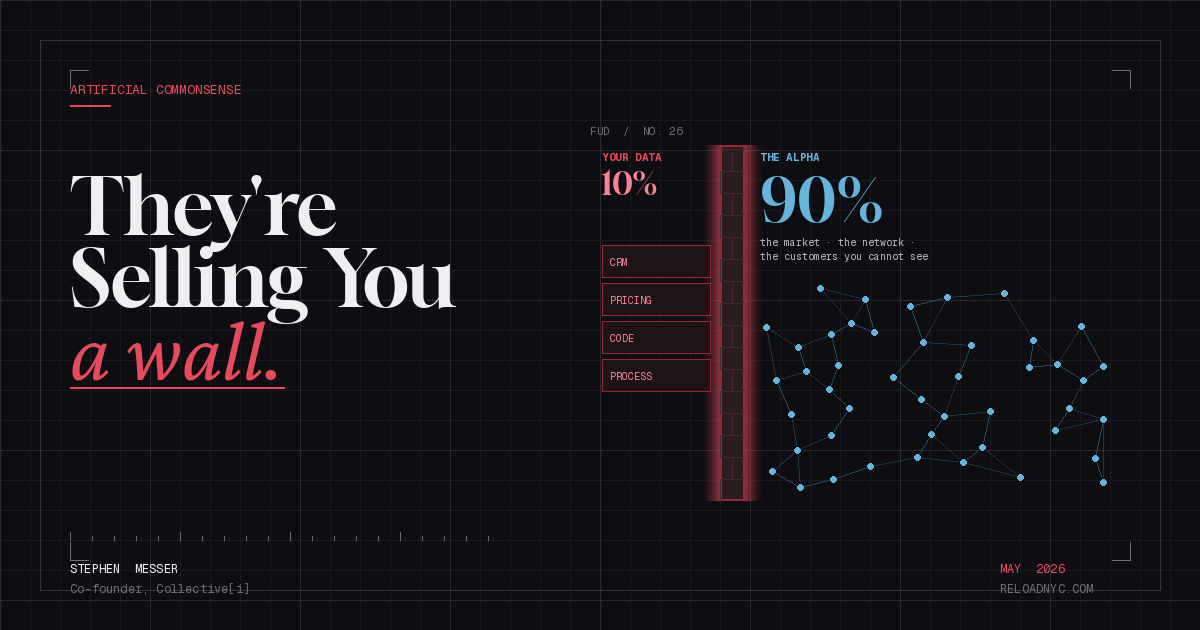
Two respected CEOs spent July 2026 running the same play: build a wall around your data. Both are selling the wall. But only 10% of what makes you competitive lives inside it. The other 90% is externality — visible only at network scale, invisible from behind their walls.

Ninety Percent of Your Alpha Lives Outside It.
Stephen Messer, Co-founder of Collective[i] and LinkShare (sold to Rakuten for $425M, 1996–2005). EY Entrepreneur of the Year/Deloitte Fast 50 winner. Board member, Spire Global (NYSE: SPIR). Building Intelligence.com
Two of the most respected CEOs in enterprise technology went on the record in July 2026 to tell you the same thing about your AI strategy. On CNBC's Squawk Box in early July, Alex Karp of Palantir argued that enterprises are giving up their "alpha" by letting proprietary data flow through frontier AI models. On July 12, Satya Nadella of Microsoft published a viral X post naming what he called the "Reverse Information Paradox." Every correction your employees make to an AI model, in Nadella's framing, leaks institutional know-how to the provider. His prescription: retain ownership of your data, build "proprietary learning environments" on the cloud, and adopt orchestration layers that let you swap models freely. Both went viral in the enterprise tech press within ten days of each other. Both are making a version of the same argument.
Both are also selling their book.
This is FUD. Fear, uncertainty, and doubt. Microsoft turned it into an art form in the browser wars, and the playbook has been running quietly in enterprise sales cycles ever since. The mechanics never change. Raise a fear the customer had not considered. Establish uncertainty about their current path. Seed doubt about the alternative. Sell the product that resolves all three.
Nadella wants you to fear frontier labs and doubt any solution that does not run inside a proprietary learning environment on his cloud. Karp wants you to fear your own data leaks and doubt any solution that does not lock every byte behind a wall his company sells the software for. Both arguments are internally consistent. Both resolve into a specific enterprise product each company sells. Palantir stock is down twenty-five percent in 2026 and Michael Burry has publicly shorted it. Microsoft is repositioning itself as the trusted enterprise partner in a market where the frontier labs it invested in have started competing with its cloud. Neither company is being irrational. Both are running the play their P&L needs them to run right now.
A note before I go further. I have known Alex Karp for years. I respect what he has built. Palantir is an important company, and Alex is one of the more thoughtful advocates in tech for Western values and Western security. His work has helped keep America and the West safer than they otherwise would be. I say what follows knowing all of that. He also has a habit anyone who has worked with him knows well. He tells the story that matches what his company is selling right now. That is not a criticism. It is what a great CEO does. It also means the argument has to be evaluated on the merits, and on the merits it does not hold up.
Where They Claim to Be Right. Even That Doesn't Hold Up.
Both would tell you they are right about a specific class of data. Your product code. Your algorithms. Your internal cost structure. Your pricing model. Your proprietary process. The customer data you gathered because your customer trusted you specifically to hold it. Roughly ten percent of what makes a modern company competitive. All of it is what economists call rival, meaning that my having it means you do not.
For that class of data, keeping the wall sounds reasonable. If AI providers absorb the data, they can turn it into a service sold to your competitors.
I am not sure the argument holds up even there.
In an AI-first company, the moat is not the training data you hand a language model. The moat is the recursive stack the company builds around its own operations, as I laid out in What It Means to Be AI-First, The Companies Winning at AI Are Playing a Different Game, The Intelligence Stack, and The Next Computer Is Alive. That stack learns from your context in ways no general-purpose model absorbs through a few thousand prompts and corrections. Feeding a language model some of your proprietary data does not transfer that moat.
The other half of the argument is weaker still. Language models have become commodities at the layer most enterprises use them. I made that case in Peak Token. The frontier labs are not sitting on infinite cash. They need what they have to keep training the next generation. They are not rushing into your industry to build a competing enterprise business off your leaked prompts.
They are, however, coming for one specific market. Software.
Which is exactly the market Karp and Nadella sell into.
The picture the two CEOs are drawing is one where the frontier labs are the threat and their walls are the defense. The picture that fits the actual evidence is one where the frontier labs are coming for their software business, and telling their customers to build walls is a way to lock in one more cycle of software revenue. This is not protecting your alpha. It is protecting theirs.
Where They Are Wrong. The Other Ninety.
The other ninety percent is externalities.
An externality is any pattern of behavior that happens outside your own company's walls. Your buyer's committee dynamics. Your candidate's employment history. Your supplier's other supplier relationships. The credit behavior of every counterparty who has ever transacted with a business similar to yours. The competitive dynamics of every market you sell into. Every part of your business that touches another entity has this shape, and the pattern that matters lives on the other side of the interaction, not inside your walls.
For externalities, keeping your data on prem does not protect anything. You literally cannot see the pattern by studying your own data alone. The signal only becomes visible when a network of participants pools enough of the same external observation that a model can find the shape underneath. Any organization defending itself behind Karp's wall or Nadella's cloud on this class of data is not protecting alpha. It is denying itself access to the pattern its competitors are already using.
The idea that you have something no one else has and you should protect it sounds reassuring. It also describes only a small fraction of what makes a company competitive. Build your operating brain around the Karp and Nadella framing and you will make yourself less competitive than every organization that participates in the relevant networks. You will be sacrificing your business to feel good about ownership.
The Proof Already Ran. Cybersecurity.
If any of this sounds abstract, look at the industry that already ran the experiment Karp and Nadella are proposing. Cybersecurity.
Thirty years ago, cybersecurity meant installing an antivirus product on your machine and updating its signature database when the vendor shipped a new one. It ran locally, looked at local files, and shipped on a CD. Standalone. On your machine. Your data. The Karp and Nadella framing about data, the assumption that what matters is what you own and control, is exactly the assumption that defined that era of cyber.
That era ended around fifteen years ago. CrowdStrike was founded in 2011 on the specific insight that traditional antivirus was broken at the root. Sophisticated attackers had moved to targeted campaigns that signature-based detection could not stop, and any defender working from purely local visibility was going to lose. Falcon launched in 2013 as a cloud-first platform explicitly designed to share threat intelligence across every customer. Today CrowdStrike watches attacks unfold across more than 23,000 organizations, including more than half of the Fortune 100. Cloudflare watches internet traffic patterns at a scale no single customer could ever replicate. The two now exchange threat intelligence bi-directionally, in real time, across their combined customer base.
No serious enterprise CIO buys cybersecurity that is not network-based. The reason is simple. Attackers pool their intelligence across every target. If defenders do not pool intelligence across every organization, they lose. It has not been a close question for a decade.
The cybersecurity industry figured out something the rest of enterprise operations still has not. If the pattern lives outside your walls, defending your walls harder cannot get to it. You have to see the pattern. The pattern only becomes visible in the network.
If you accept that logic for cybersecurity, and every serious enterprise CIO already does, you have accepted it for every function whose signal lives outside the company. Sales. Marketing. Hiring. Credit. Supply chain. Regulatory strategy. The pattern that decides whether you win or lose in any of these lives outside your walls, and only becomes visible at network scale. Karp and Nadella are telling you to un-learn everything the cybersecurity industry spent the last fifteen years teaching you.
A Decade of Watching Something No Single Company Has Ever Seen
We have been running the same play as CrowdStrike, in a different function, for a decade. What follows is what that network revealed. It is a pattern no individual company can see from its own data, and one I have not seen anyone describe publicly. It is the concrete answer to what Karp's wall and Nadella's cloud silo actually cost when they cut you off from the externality.
Ten years ago at Collective[i], we built our first data connector. The theory was simple. A CRM captures what a rep types into it, and nothing more. Everything the rep did not type stayed invisible. The meeting that did not happen. The email that got read but never answered. The competitor whose calendar quietly filled with the same buyer's time. We wanted to see the shape of a deal from outside the CRM, because inside the CRM the deal always looked the way the rep wanted it to look.
That first connector opened up a signal we had not been able to see before. We built the next one. Then the next. A decade in, the platform we run is the largest continuously-updated economic model of B2B buying behavior in the world. It watches every committee-driven decision across our network of participating sellers. Every deal. Every stakeholder we can identify. Every signal a rep never captured because they never saw it themselves.
I use B2B sales as the running example in what follows because roughly one in eight working people is in a sales role, which makes it the easiest context to picture. Anyone on a PE investment committee, a VC partnership, a corporate M&A team, or a board can translate the mechanics directly.
Start with the public data everyone can see. The buying committee is where every deal now lives, and the committee has been growing for a decade. Gartner's tracking of enterprise B2B purchases shows the average committee at 5.4 stakeholders in 2014, 6.8 in 2020, 8.2 in 2024, and 11 or more in 2026. A hundred percent growth in twelve years. Forrester's most recent data puts the average complex B2B purchase at thirteen stakeholders, with eighty-nine percent of buying decisions crossing multiple departments.
Two other numbers matter more than the size. Deals where the seller has engaged five or more stakeholders close at roughly thirty percent. Deals where the seller has engaged only their champion close at five percent. Six times better with the same product, the same price, and the same competition.
The finding that matters most is one everyone in the sales world knows but almost no one will say out loud. Seventy-four percent of enterprise buying committees experience unhealthy internal conflict during the decision process. Three out of every four deals in your pipeline involve buyers who actively disagree with each other about whether to purchase what you are selling, from whom, or at all. The champion your rep is optimistic about is currently arguing with someone your rep has never met.
That is what the industry knows. Here is what the network learned that the industry does not.
How Buyers Actually Kill Deals
The pattern is not confined to enterprise sales. It shows up in every setting where a committee decides whether to say yes or no. Private equity investment committees weighing a new acquisition. Venture firms deciding whether to lead a hot round. Corporate development teams evaluating a strategic combination. Boards weighing a C-suite hire. Any decision that runs through a group of people trying to reach consensus produces the same shape. Here it is.
When a buyer decides they want a deal to die, they almost never say it out loud. Saying it out loud creates political exposure. It requires them to defend the decision. It gives the seller the opportunity to escalate around them. So the buyer does something else.
They bring in two different groups of people.
The first group is brought in to give the champion air cover to make the yes decision. They ask questions the champion has already prepared answers for. They validate the process. They confirm the committee is being thorough. In enterprise sales, this is the group the champion introduces the seller to, the group the CRO's dashboard sees. In a PE deal, it is the associates and friendly partners who ran the diligence. In a VC round, it is the analyst who found the deal and the partner who took the founder to coffee. From the outside, all of it looks like enthusiastic engagement.
The second group is brought in to actually vote no so the champion does not have to kill the deal. It is drawn from parts of the organization the champion has structural leverage over. In enterprise sales, security, procurement, legal, finance, a rival business unit, or an executive with a competing priority. In a PE deal, the risk officer, the operating partner spotting a portfolio conflict, the LPAC member who wants the fund concentrated elsewhere. In a VC round, the partner who never liked the sector, the partner running a competing portfolio company, or the senior GP reserving the fund for a different check. The blocking group is always the reason the deal cannot move forward. The champion tells the seller, sadly, that internal review raised concerns nobody could have anticipated.
We see this same play run in deal after deal after deal. Once you have a model watching across enough committees, the shape stops being subtle. The air-cover group looks like enthusiastic engagement. The blocking group is invisible to the seller until the deal is already dead.
This is one pattern out of many we have found watching the network. There are dozens and dozens of others that have never before been seen and knowing them is the difference between winning and losing. Most of them we have never written about publicly. Each one is invisible from any single company's data, and each one is the difference between winning and losing on a specific class of decision. Buying is just the function where the data is sharpest today. Every function that runs on externalities has its own set of patterns like this one waiting to be seen.
CHART 1 · THE TWO GROUPS INSIDE EVERY KILLED DEAL
The champion introduces one group of buyers to the seller. A different group of buyers votes the deal down.
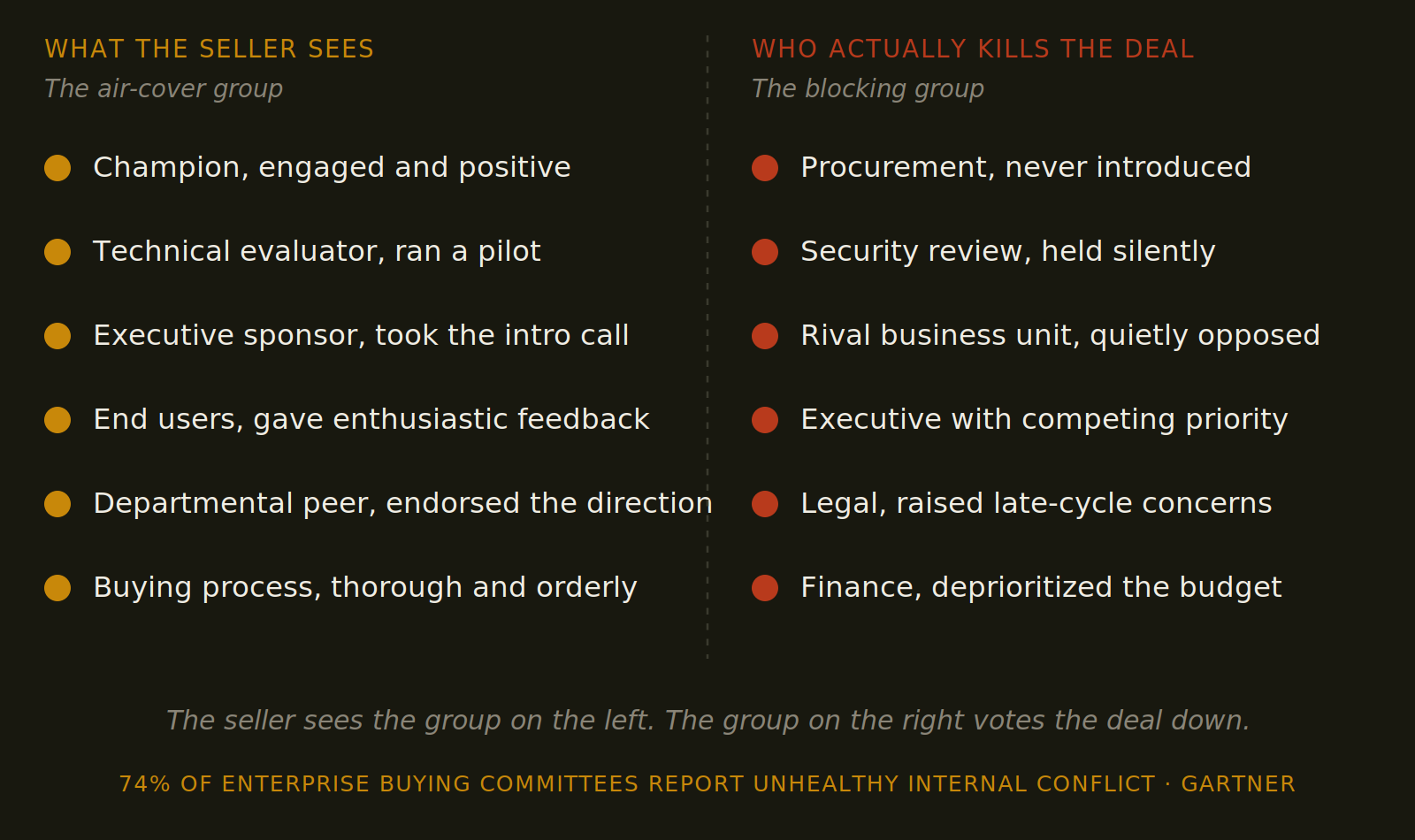
Source: Collective[i] observation across B2B deals in the platform's economic model. Buying committee dynamics research: Gartner Future of Sales (2022, 2024 update); Gartner CSO Survey (2024) on committee conflict rates; Forrester B2B Buying Study (2023, 2024).
Your Champion Isn't Your Champion
None of this shows up on the seller's dashboard. Most organizations have no way to know about this, so they do not prepare for how to deal with this. What you can. not see is what kills you. And the metrics show this. Read any of my past articles on sales and you will see the negative downhill trend on sales results has been perhaps the worst performance of any part of the organization. That is what the sales function has been quietly protecting itself from having to admit.
Your champion, in most enterprise deals, may not actually be your champion in the way your rep believes they are. Sometimes they are a real advocate who does not have the political weight to move the deal. Sometimes they are running a process on your behalf that has already been decided against internally. Sometimes they are using your proposal as a stalking horse to force a preferred vendor to move on price. Sometimes they are keeping you engaged because their job requires them to run three quotes before making a decision. All of these look identical to the rep. All of them look positive in the CRM.
The only way to tell the difference is visibility into the second group. That visibility is what the model provides. Not because it is smarter than the rep. Because it watches a different set of signals. Reciprocity. Response latency. Overlap of the buying committee with the seller's known network. Pattern-matching against thousands of deals with similar shape that already closed or died.
I wrote in Your Buyer Has a Process about what it means to know more about how a buyer buys than the seller does. The pattern in this piece is the sharpest example. The seller thinks the deal is progressing. The model can see, from the outside, that a group has been assembled to kill it. That is a different kind of forecast. The same shape shows up when a PE partner believes they have won a competitive process, or when a venture partner believes the hot founder has committed. The visible signals look positive. The blocking group has already made sure the answer is no.
Who Leads the Buying Group Determines More Than the Product
The second consequence of the pattern matters for anyone on the buying side, and for anyone underwriting a company that sells to other enterprises.
Because most enterprise decisions are made by committees, and because most committees are internally divided, the person who assembles and leads the buying group has enormous influence over the outcome. Not the CEO who nominally sponsors the decision. Not the department head with the loudest voice. The person who decides who sits in the room. The person who runs the process. That person picks the group that determines the direction.
Any investor who has ever wondered why a portfolio company kept losing deals to an obviously worse competitor should be looking here. The competitor was not selling a better product. The competitor was selling into a better-assembled buying committee. Whoever ran the room for the competitor picked people who wanted the competitor to win. Whoever ran the room for your portfolio company picked people who wanted your portfolio company to lose.
This shows up on public earnings calls, in a specific way. When a CFO says "the deals we lost were competitive," the honest translation is that the committee assembly went against them. That is not something the current sales function has any capacity to see, model, or fix. It is the problem the next generation of quantitative sales infrastructure was built to solve and what we do daily at Collective[i].
The Same Pattern Runs Everywhere Externalities Do
The buying committee is where our network watches and where the data is sharpest. The same shape exists everywhere externalities live.
In hiring, when a committee wants to reject a candidate, they bring in one set of interviewers to produce enthusiastic feedback and a second set to raise late-cycle concerns about culture fit or reference gaps. The applicant tracking system sees the first group. The second group drives the rejection.
In credit, counterparty risk lives entirely outside your walls. The default pattern shows up in the network of lenders exposed to that counterparty weeks before it shows up in any one credit book. Every serious credit bureau is a network for exactly this reason. Enterprises still running underwriting on internal data alone keep repeating the same bad-debt cycles.
In marketing, audience behavior across channels is an externality. Your first-party data describes people who already engaged with you. It says very little about the people moving on channels you do not own. A network view of audience movement is the only path to demand generation that predicts rather than reacts.
In supply chain, supplier behavior across your tier system is not visible from your own procurement data. The pattern only becomes visible when suppliers themselves participate in a shared network of observation. Every serious ERP vendor has been trying to answer this for two decades and failing, for the same reason.
Every one of these, the enterprise operating on its own data loses to the enterprise operating on the network. Cybersecurity was the first function to accept this. Sales is where the data is sharpest today. Every other function that runs on external signal is heading the same direction.
Back to Karp and Nadella
The pattern above is why Collective[i] and Intelligence.com exist. To see the second group inside any committee, you need to know who is actually in the room. Not the LinkedIn version. The real version. The people your buyer's leadership trusts. The people who have voted no on similar deals in the past. The rival business unit head who quietly opposes the direction. That information does not live in any single company's CRM. It does not live in the buyer's org chart. It lives in the network of people who have worked with, negotiated with, and lost deals to the same buyers over careers.
Karp would tell you to keep this class of data on prem. Nadella would tell you to keep it inside a proprietary learning environment on his cloud. It does not exist on prem. It does not exist inside any single company. It exists only in the network of participants who pool observations about it, and it is invisible without that pooling. Building the wall or building the cloud silo has the same effect. It cuts you off from the pattern.
The verified professional network I described in The Warm Intro Is Dead is the underlying infrastructure that lets any of this work. The graph inside Intelligence.com reflects who actually knows whom, at what depth, over what history. Collective[i]'s economic model consumes that graph and returns a decision the seller can act on. This is not an incremental improvement on the wall. It is the substrate that replaces the wall for anything that matters outside your walls.
Karp and Nadella are right that alpha lives in what makes you different. They are wrong about where alpha lives for the class of data that determines whether your deals close, your recruiting works, your supply chain holds, or your credit book performs. That alpha lives in the network. Building the wall means giving it up. What sounds reassuring turns out to be the trade that sacrifices your business to feel good about ownership. Meanwhile the frontier labs whose threat their walls are supposed to defend against are busy building software that competes with the products Karp and Nadella actually sell. The story is not about your data. The story is about their software and more likely their entire business model.
The Trade
For finance readers thinking about what this means for the companies you underwrite or advise, three moves matter.
Track sales as a leading indicator of AI-native transformation across your portfolio. The companies that move first on this are the ones that will hit the phase-three break-out I will describe in an upcoming article called AI Is Everywhere Except in the GDP Numbers. The companies that keep the CRO's qualitative-in-quant dashboard are the ones that will keep missing.
Watch the SaaS layer inside your portfolio companies. Salesforce, Workday, and their peers were built for the previous era. The signal to track is whether they are being displaced. Not layered over with AI copilots. Displaced. What you want to see is workflow tools coming out of the stack and a different substrate going in. A substrate of connected intelligences, each pointed at what it is uniquely good at, coordinated through a harness that knows which one to use when. I made the case for this substrate in The Intelligence Stack and in The Next Computer Is Alive. Companies moving to phase three are quietly stripping the SaaS layer and replacing it with this substrate. Companies still buying more SaaS seats are running phase two dressed up as phase three.
Ask the CRO one specific question the next time you sit across from them. "How do you know your champion is your champion?" A CRO with a real answer is running an operation you can underwrite. A CRO with a hand-waved answer is running the same operation every sales leader has been running since 1999. That operation is about to be repriced.
What Comes Next
Every piece in Artificial CommonSense takes something the market treats as consensus and shows what it is missing.
The next piece in this series goes deeper on the role that has been protecting the CRO's dashboard from every side. The information broker. The middle manager. The sales ops analyst. Why the pyramid was breaking before AI arrived, why Amazon, Meta, and CVS all cut middle-management layers in 2024, and why the transition ends up good even for the people losing their roles. If you want it delivered when it publishes, subscribe at reloadnyc.com. Free. No paywall. No course at the end. Just the work.
If this piece changed how you are thinking about the Karp and Nadella argument, or about a portfolio company's sales function, forward it to one person who needs to read it. A partner at your firm who sits on a sales-led company's board. A CRO in your network who is ready to hear it. A GP who keeps missing revenue targets in a portfolio company and cannot explain why. One specific decision-maker in your world. That is how the argument moves. One reader telling another.
If you are the person who just got this forwarded to you, welcome. Subscribe at reloadnyc.com. Two dozen pieces in the archive already. Another two dozen in the queue.
Reply if you want to argue. I read every one. The pieces get sharper when readers push back.
RELATED READING · RELOADNYC
Peak Token. Why the Frontier Just Priced Itself Out of Its Own Market.
Frontier lab economics are breaking. What the pricing collapse means for anyone building on top of a language model.
Your Buyer Has a Process. Collective[i] Knows What It Is.
Thirty years of instruments to study sellers. The buyers were always the ones who decided. What changes when you flip the instrument.
The Warm Intro Is Dead. Something Better Just Killed It.
The verified professional network that lets a seller see who is actually in the room, at what depth, over what history.
AI Is Everywhere Except in the GDP Numbers. Here Is What Triggers the Break.
The productivity paradox in real time. Why the trigger is closer than most investors think, and what to position for.
The Intelligence Stack. What to Buy, What It Replaces, How to Wire It Together.|
The equipment list for phase three. Connected intelligences pointed at the right problems, coordinated through a harness that knows which one to use when.
The Companies Winning at AI Are Playing a Different Game
Systems of intelligence versus silos of intelligence. Why the winners rebuild instead of layer.
Stephen Messer
Co-founder of Collective[i] and Intelligence.com. Co-founder of LinkShare (sold to Rakuten for $425M). Board Member, Spire Global (NYSE: SPIR). Writes at reloadnyc.com.
Intelligence.com maps the relationships you actually have, not the connections you collected. Connect with me there and let us share our networks with each other.