What It Means to Be AI-First. And How to Get There.
Part 1 made the case for urgency. Part 2 covered the people problem. This part is operational. Not philosophy. What the companies pulling away are actually doing, and how to start.

Stephen Messer, Co-founder of Collective[i] and LinkShare (sold to Rakuten for $425M, 1996–2005). EY Entrepreneur of the Year/Deloitte Fast 50 winner. Board member, Spire Global (NYSE: SPIR). Building intelligence.com
This week I got a call from a board member at a top technology company. We have known each other for years. I trust her judgment and I have real respect for her. She did not call about a board matter. She called with the question I keep getting lately, the one Part 2 of this series was actually about. Who is supposed to be leading this.
Board members are carrying a strange weight right now. They are responsible for companies moving at a speed nothing in their careers prepared them for, and the disruption inside AI does not wait for the next scheduled meeting. If you are in technology, the SaaSpocalypse is not a theory. You feel it in how your own engineering team builds now. You see it in how fast new companies reach scale without the headcount that used to be required. The mentality inside the best AI teams is genuinely different from how software got built five years ago. When someone this sharp picks up the phone with that question, I know the moment has arrived. Smart people are waking up.
Nobody wants to be the board member who sat on the company that became the next Nokia. The one who watched an entire market get eaten and only understood what happened once someone else wrote the case study. Every board member I talk to knows SaaS is not walking away from this healthy. Some are quietly hoping the decline takes long enough that it becomes the next board's problem. The warning signs are not subtle anymore. In the last year alone, SpaceX paid $60 billion for Cursor, a four-year-old coding company, at roughly fifteen times revenue. Anthropic launched Claude Design and Figma lost 7 percent of its market value within hours, on a stock already down sharply for the year. Two Nobel Prizes went to AI researchers for AlphaFold in 2024, and drug discovery timelines that used to run five years are now measured in months. This is not a slow-moving story. It is happening inside the space of a single year, and it keeps happening.
The harder problem is most of them do not know where to start. Part 2 covered who should not be running this, the early majority manager who will professionally manage your transformation into irrelevance, and the builder who should be running it instead. That answers who. It does not answer what they should actually do, and neither do the consultants who show up next with three-year engagements built for a world that moves at the old speed.
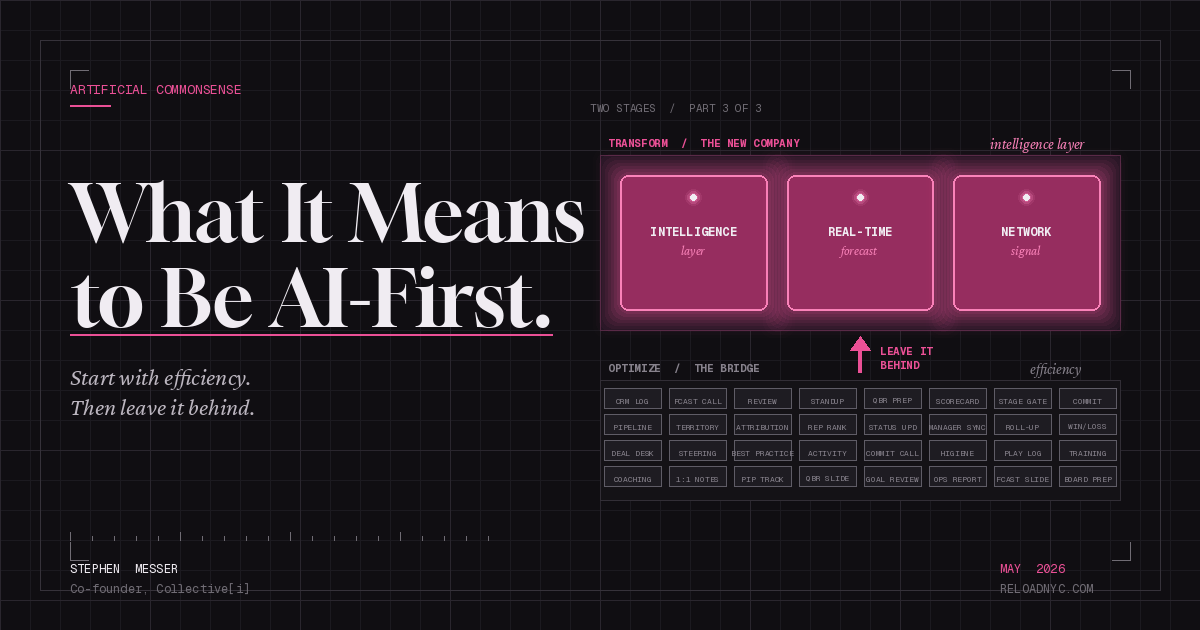
My answer to her was the one I give everyone. Start with efficiency. It is the first win, the one that makes a skeptical board and CFO believe something real is happening. Then I told her the part that matters more. Be ready to leave efficiency behind, faster than your organization wants to move.
Start with efficiency. Then leave it behind.
Efficiency is the bridge from skepticism to belief. It gives the CFO a number. It exposes broken processes. It turns the abstract AI debate into something you can point at. Every AI-first company started here.
Efficiency is also addictive. It lets a leadership team feel bold while doing something fundamentally defensive. Cut cost. Reduce manual work. Automate the old process. Show savings. Declare momentum. Good. Then move.
Efficiency only tells you what the old company no longer needs. The real question is what the new company can now become.
I deal with sales a lot in my role at Collective[i], so I will use it as the example. I could just as easily run the same argument through HR, or finance, or fulfillment. The mechanics change. The story does not. Start with a sales team and you cannot expect them to see the disruptive, first-principles version of what is coming. How could they. They have run the same process on the same CRM for thirty-five years. They believe they have spent a career honing a skill that AI is now quietly making irrelevant. You do not open with that argument. You open with efficiency, which in sales means productivity.
Start with the logging. Reps barely log activity into the CRM, and still lose close to a fifth of their week to it. Salesforce puts actual selling time at 28 to 30 percent of a rep's week. A Forrester study of more than 3,000 reps found CRM data entry alone eats roughly 17 percent. Capture activity automatically instead of by hand, and a rep gets that time back without changing anything about how they sell.
Then the forecast meeting, which looks insane from outside sales. A sales forecast gets built the way election polling used to get built. Poll reps for a gut read on their own pipeline. Layer in a manager who has fifteen minutes to second-guess forty deals. Run it through whatever methodology the company licensed. Call the output a number. Election polling has called plenty of elections wrong doing exactly this. Gartner's research on sales forecasting shows the same failure. Median accuracy sits between 70 and 79 percent. Fewer than half of sales leaders say they have high confidence in their own forecast. Close to 60 percent of what gets forecast in a quarter slides into the next one. Every week, that process burns a full day of selling time across the company to produce a number nobody fully trusts.
If sales leaders were honest, they would admit the only reason their forecast looks respectable is reversion to the mean. Miss high one quarter, miss low the next, average enough quarters and the errors cancel into something that resembles accuracy from a distance. That is not precision. That is noise given enough time to average itself out.
At Collective[i], the forecast runs off a network approach. I am happy to walk through it elsewhere. The short version is that we run at 93 to 95 percent accuracy, every day, without a single person needed to produce the number. I will write separately about how we actually solved that. What it unlocks is worth sitting with on its own.
Once a sales leader sees the number is not just more accurate but consistent, arriving daily without a room full of people stopping work to produce it, the fastest thing they notice is the time back. Logging alone hands a rep close to a fifth of their week. Add the forecast meeting disappearing on top of it and a sales team is looking at 40 to 50 percent more selling time. Not a rounding error. A fundamentally different week. That is a culture change, for a group of people who have hated this exact set of chores their entire careers. The org changes in more ways than that. More to come elsewhere.
That efficiency win is not what we are after. It is what earns the right to move faster than the sales org expected. Sales was never actually an island, even though it always believed it was. Every other function has spent years quietly working around sales' uncertainty. Marketing built its own version of the pipeline number because it never trusted the real one. HR staffed on lagging indicators because a forecast that missed by 20 percent was worse than no forecast. Fulfillment kept extra buffer everywhere because nobody could tell them with confidence what was going to close. That workaround tax gets paid in margin. It gets paid again in whatever the company could have built and didn't, because so much of its capacity was quietly insuring against its own forecast.
Once the forecast is proven accurate and cheap to produce, that ends. The same intelligence stops being a sales tool and becomes a company-wide feed, with the activity behind it captured accurately enough for other departments to actually build on. HR staffs against it. Logistics runs anticipatory shipping, product sitting outside the client's door before the contract is signed. A deal that closes on the last day of the quarter still books in-quarter instead of sliding, the exact failure the old forecast could never fix. That is where a company actually feels the change. It rarely starts there. It starts with a rep getting their week back and a forecast that finally holds up under a straight face. I laid out why the sales stack itself has become the bottleneck in Software Is Over, and 365 Data Centers is the proof, not the theory.
A feature helps a seller write an email. An intelligence layer changes how the company understands revenue. Those are not the same thing. If your AI strategy is still focused on helping people do the old work a little faster, you are still in the old company.
AI-first companies remove the middle. That is not a cost story. It is a speed and reward story.
Go back to the sales example, because it is not really a sales story. Count how many middle managers used to exist just to run that forecast. Someone pulled the numbers. Someone reviewed them with every rep. Someone managed the adjustments when a number did not look right to the person above them. That entire layer existed to broker a piece of information that turned out to be wrong most of the time. Once the forecast is accurate, daily, and automatic, none of that layer is needed. Not reduced. Not needed.
That is where the real unlock starts. It changes how the company is structured. The middle thins out. Leaders move closer to the clients and closer to the work. The information brokers go away, because there is no longer any information that needs brokering. There is just a number that is already correct. Efficiency first. Then a first-principles review that reengineers what the function produces. Then, only after that, a change in how the company itself is structured. Each step makes the next one faster. A flatter company with fewer brokers in the way runs the same loop, efficiency, reengineering, restructuring, on the next function in less time than it took the first. That is the virtuous cycle. It does not stay at one speed. It accelerates.
Cutting cost is the headline. It is not the mechanism. The mechanism is that removing the management layer that exists to broker information gets you something more valuable than a smaller payroll. Leadership sits closer to the client. Conversations move faster. Alignment stops requiring a meeting to produce a meeting. And the money that used to fund the coordination layer funds the people creating the value.
This is happening in public, at scale. In May 2026, Coinbase CEO Brian Armstrong cut 14 percent of the company, about 700 people, and announced a structural rule: no pure managers. Every leader has to also be an individual contributor, a player-coach. The hierarchy is capped at five layers between Armstrong and every one of the 4,300 employees who remain. Coinbase is moving toward “AI-native pods,” in some cases one-person teams directing agents that cover the ground engineers, designers, and PMs used to cover separately. Armstrong's own words: “We're fundamentally changing how we operate: rebuilding Coinbase as an intelligence, with humans around the edge aligning it.”
Meta started this in 2023 with what Zuckerberg called the Year of Efficiency. By 2026, its applied engineering team was running at 50-to-1 employees per manager. Amazon's Andy Jassy set a public target in September 2024 to raise the IC-to-manager ratio by at least 15 percent by Q1 2025, mostly by combining teams. Amazon hit the target ahead of schedule. Jassy's own diagnosis: “You add a lot of people and you end up with a lot of middle managers. And those middle managers, all well-intended, want to put their fingerprint on everything. So you end up with these people being in the pre-meeting, for the pre-meeting, for the pre-meeting, for the decision meeting.”
Not coincidence. Korn Ferry surveyed 15,000 professionals across ten countries. 41 percent globally, 44 percent in the US, say their company eliminated a management layer in the past year. Gallup found the average number of people reporting to one manager rose from 10.9 in 2024 to 12.1 in 2025. Gartner projects one in five companies will use AI to cut more than half their middle management roles by the end of 2026.
The middle management layer existed to broker information. AI made the brokerage unnecessary. What is left is not a smaller company. It is a faster one, with the coordination budget flowing to the people creating the value.
The part that matters more than the headcount number is where the money goes. Not into more jobs overall, the tech sector has genuinely shrunk through 2026, but into a sharp reallocation of who gets paid what. Ravio's 2026 Compensation Trends report, drawn from direct payroll integrations across the industry, found AI and ML roles growing 88 percent year over year even as overall engineering hiring stayed flat. AI expertise commands a 12 percent pay premium in the IC track versus only a 3 percent premium in the management track. The premium is following the builder, not the manager.
Klarna is the case study worth sitting with because it shows both halves of the trade honestly. In 2024, Klarna's AI assistant took over the volume tier of customer service, handling work equivalent to roughly 700 full-time agents. Revenue per employee rose 73 percent year over year. By late 2025, Siemiatkowski was telling analysts revenue had grown 108 percent while operating costs stayed flat, and Klarna had raised pay for the staff it kept, largely by not backfilling roles that came open through attrition. Klarna also learned the edge of the trade. It rehired for the premium, judgment-heavy tier of support in 2025 after satisfaction on complex cases slipped. The lesson is not that AI replaces people. It is that AI redraws the line between brokerage work that disappears and judgment work that gets paid more. Fewer people sit between the client and the decision, and more of the company's money chases the ones who remain.
Revenue per employee is the scoreboard. Not the old rule.
SaaS spent a decade grading itself on the Rule of 40. Growth rate plus profit margin should add up to 40 or better. It is a fine way to grade a company after the fact. It tells you nothing about how the company is built. Two companies can both hit 40 in the same year, one by adding headcount and workflow tools until growth and margin happen to balance, the other by design. The Rule of 40 is an outcome measure. It cannot tell you which of those two survives the next five years.
Revenue per employee, and increasingly revenue per agent, is a structural measure. It asks how much value each person, or each person plus the fleet of agents they direct, actually produces. A company obsessed with revenue per employee cannot hide behind growth. It has to answer for every person on the payroll, and keep answering as the org gets smaller and the work gets done by fewer humans alongside more intelligence.
This is where the recursive org I described in Infinite Leverage becomes something more specific. Call the fully realized version the limitless org. A company where digital employees, agents doing real, accountable work, outnumber the humans, and where that ratio is not a cost-cutting milestone but the entire operating model. Personalization stops being a feature bolted onto a product and becomes the default. Every client gets a version of the service built for exactly their situation, because the marginal cost of that personalization is an agent's compute, not another hire. That is not available to a company still measuring itself on the Rule of 40. It is only available to a company that has made revenue per employee, or revenue per agent, the actual design constraint.
The pattern that shows up everywhere.
Everyone uses Amazon as an example because it got enormous. That is the least interesting part. What made Amazon dangerous was not resources. It was appetite. If something new could produce learning, they tried it. Each experiment bought a little more data, a little more operational skill, a little more confidence that the next weird thing might become obvious later. Then they turned internal capability into external infrastructure.
SpaceX ran the same playbook in aerospace. Every Falcon 9 booster recovery generated data no competitor had, because no competitor was attempting recovery. Each reuse cut per-launch cost by roughly $15 million and fed the next iteration. By 2024, launch costs had fallen 75 to 85 percent versus disposable rockets. SpaceX now controls 60 percent of global commercial satellite launches. The competitors who waited to see if reusability would work now pay to ride SpaceX rockets to orbit.
BYD started making electric vehicles in China when nobody outside China was paying attention. The early years were not profitable. They were educational. Every vehicle built made the next one cheaper through learning-curve efficiencies that only come from volume. By 2024, BYD sold 4.27 million new-energy vehicles at more than double Tesla's volume, with 22 percent global NEV market share and $109 billion in revenue.
The pattern is identical. Early movers learn faster and cheaper. Experimentation is subsidized while the new thing still needs believers. The compounding begins before the latecomers notice the gap. By the time they do, the cost of the same learning has risen and the gap is wider than it looked.
If your company becomes exceptional at using intelligence internally, the next question is not how much cost you removed. It is what your customers now need from you because you have that capability and they do not. Not by having AI. By becoming the intelligence layer other people build around.
WHAT THE COMPANIES PULLING AWAY ARE ACTUALLY DOING
The CEO uses AI personally every day. Not as a toy. Not as a speechwriter. As a management instrument. If the CEO is not fluent, the company will not be fluent. Fluency is not transferable through a memo.
The company picks one outcome. Not “AI transformation.” Not “productivity.” One number. Win rate. Cycle time. Revenue per employee. Forecast accuracy. The company that cannot name the specific number AI is supposed to move has an AI interest, not an AI strategy.
The company builds around different kinds of intelligence, not tools. The model type matters because the problem type matters. Deploying a language model against structured commercial data to predict sales outcomes is a category error that wastes budget and produces the pilot that never scales.
The company kills old work aggressively. The real test of AI is not how many tools you add. It is what you can stop doing. If nothing disappears, nothing transformed. Every AI deployment should come with a sunset date for the process it is replacing.
The company measures outcomes, not adoption. Token usage is not strategy. Seat licenses are not strategy. A metric moved or it did not. If your AI review meetings show charts of how many people are using the tool, you are measuring the wrong thing.
The company treats every rollout as training data for the culture. The goal is not one successful AI project. The goal is an organization that gets faster at every AI project after it. The learning compounds or it does not. That is the test.
The metabolism, not the model.
In ten years, every company will use AI the way every company now uses computers. Tools everywhere. Models cheaper. Interfaces easier. The average company will catch up to the basic capability.
The market share will already be gone.
The winners are not waiting for the world to normalize. They will take share with every new layer of intelligence as it arrives. Language models to compress knowledge work. Code models to rebuild software creation. Economic models to predict demand and revenue. Relationship graphs to turn trust into operating advantage. World models and robotics to change physical operations.
Most importantly, they will learn how to learn.
Not the model. The metabolism. The organizational muscle to turn every new capability into speed before the competitor finishes reading about it. That is the only advantage that does not get commoditized. It is built entirely through repetition, starting now.
That is what I wish I could have said to her in a sentence instead of an hour on the phone. Start with efficiency. It is the only version of this a skeptical board will fund. Do not mistake the first win for the destination. The forecast that needs no one to run it. The layer of managers that quietly stops being necessary. The leadership that ends up sitting closer to the client than it has in years. All of it compounds into a company that learns faster than the one next to it. That gap does not close on its own. It widens, quietly, for as long as one side keeps running the loop and the other keeps scheduling the next pilot review.
The companies pulling away are not taking more risk. They understood the real risk earlier. The risk was not moving too fast. The risk was letting the organization learn too slowly.
PART 3 OF 3
Efficiency gets you in the door. Fewer layers, more builders, and revenue per employee as the scoreboard is what keeps you there.
Artificial CommonSense is published at reloadnyc.com. For revenue intelligence: intelligence.com.
FROM ARTIFICIAL COMMONSENSE, RELOADNYC.COM
Part 1 → The Safest Move You Can Make With AI Will Cost You Everything
Part 2 → Find Your Builders. Or They'll Leave and Start Without You.