The Race Is On
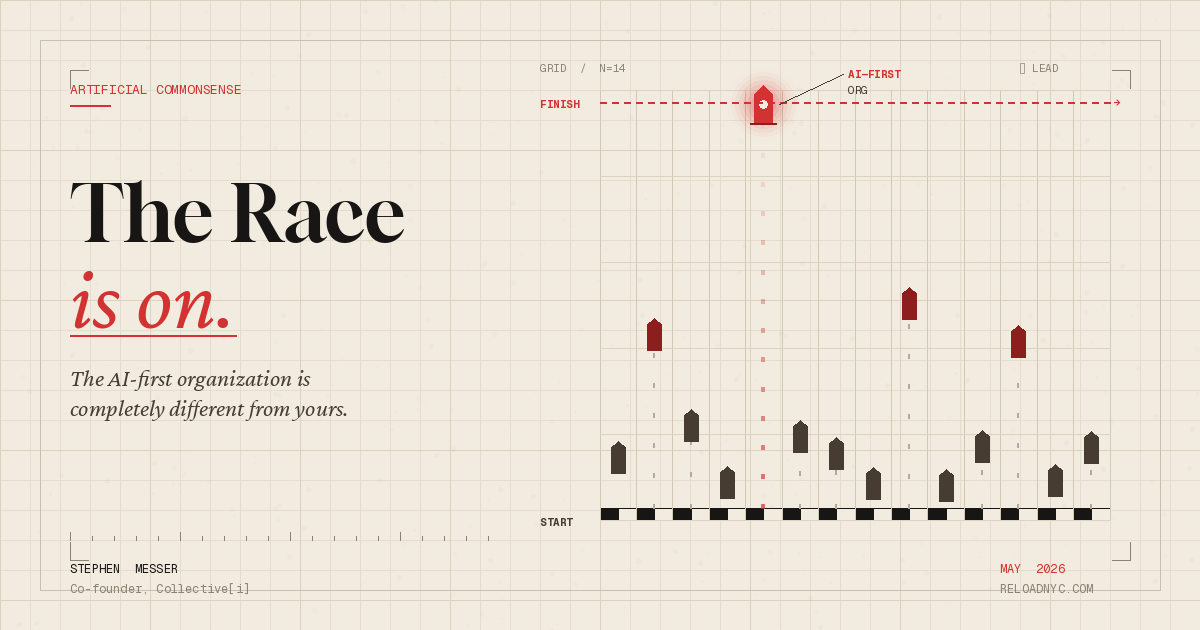
The AI-first organization is completely different from a typical company — and you may not understand why.

Stephen Messer, Co-founder of Collective[i] and LinkShare (sold to Rakuten for $425M, 1996–2005). EY Entrepreneur of the Year/Deloitte fast 50 winner. Board member, Spire Global (NYSE: SPIR). Building intelligence.com
Something important is happening right now and most people are misreading it. This week, Coinbase CEO Brian Armstrong announced he was cutting 14% of his workforce and turning the org chart upside down, eliminating what he called "pure managers," building AI-native pods where a single person can do the work of an entire team, and capping the hierarchy at five layers. Before that, Jack Dorsey cut 40% of Block's staff and said most companies will do the same within a year. Klarna halved its workforce while growing revenue 108%. The headlines call this "AI layoffs." That framing is wrong, or at least incomplete.
In earlier articles in this series, we talked about removing the software stack and replacing it with a system of intelligence, and we talked about the mindset shift from workflows to outcomes. Today I want to connect those two ideas to explain what they produce together: a fundamentally different organizational structure. And I want to give you the historical context to understand why this isn't incremental change. It's structural. It's permanent. And the companies making this move right now are pulling ahead faster than most people realize.
A BRIEF HISTORY OF HOW COMPANIES ORGANIZE
To understand what's changing, you have to understand what it replaced. The modern corporation, with its hierarchies, departments, managers, and process flows, was not designed from first principles. It was designed around the communication and information technology available at the time.
EARLY 1900s — THE LETTER ERA
Hierarchy as Information Control
When business communication moved by letter and took days, organizations needed layers of management simply to relay information. Frederick Winslow Taylor codified this as "Scientific Management," breaking work into repeatable tasks, with managers whose primary job was to coordinate information between workers and leadership. The tall hierarchy existed because information traveled slowly and decision-making required proximity to the top, where the knowledge lived.
1920s–1950s — TELEGRAPH & TELEPHONE
The Rise of the Functional Department
As the telegraph and then the telephone accelerated communication, companies could coordinate across geographies. Alfred Sloan's reorganization of General Motors in the 1920s became the template: decentralized divisions with centralized financial control. This created the functional department model, Sales, Marketing, Finance, Operations, each with its own leadership, its own data, its own vocabulary. The silos were a feature, not a bug. They let large organizations operate with the communication tools available.
1950s–1980s — THE COMPUTER AGE
Data as Power
Mainframes and early computers let companies process data at scale for the first time. This didn't flatten organizations; it created a new layer: the data analyst, the MIS department, the IT function. Information became a source of power because it was still scarce and hard to access. Senior executives asked questions that took weeks to answer. The computer improved the speed of data collection but didn't change who controlled it or how decisions were made.
1990s–2010s — THE INTERNET & SAAS ERA
Software Stacks as Operating Systems
The internet and then cloud software created the modern SaaS stack. Every function got its own tool: a pipeline management tool for sales, a human capital system for HR, an ERP for finance, a marketing automation platform for demand generation. This accelerated execution within functions but created new translation problems between them. Data lived in different systems, used different definitions, required BI teams and spreadsheet armies to reconcile. The information broker became a full profession. The org didn't flatten; it added layers of translation.
NOW — THE INTELLIGENCE ERA
The First Genuine Restructuring
AI doesn't just accelerate the old model. It eliminates the reason the old model existed. The hierarchy was information control. The functional silo was communication constraint. The software stack was the best translation layer available. When a system of intelligence can observe everything, reason across all of it, predict outcomes, and surface the optimal action for every person in real time, the entire architecture built around information scarcity becomes unnecessary. Not outdated. Unnecessary.
WHAT THE HEADLINES ARE ACTUALLY SAYING
Read Armstrong's exact words carefully. He's not describing cost cuts. He's describing a different theory of how a company operates.
"An intelligence, with humans around the edge aligning it." Read that again. That is not a description of a company using AI tools. It is a description of a company that has inverted the relationship between humans and intelligence, where the intelligence is the operating system, and humans are the directors and beneficiaries of it. Armstrong is capping layers at five, eliminating pure management roles, and building AI-native pods where a single person supported by agents can do the work previously requiring separate engineers, designers, and product managers.
Dorsey said something equally direct when he cut 40% of Block's workforce in February:
And Klarna didn't just cut headcount. It halved its workforce from 5,500 to under 3,000 while growing revenue 108% since 2022. Average pay for remaining employees went up 60%. That's not cost-cutting. That's a different operating model producing different results.
THE SOFTWARE STACK PROBLEM YOU DIDN'T SEE
In a prior article, we explored why removing the software stack is the first step toward becoming AI-first. Here's what we didn't fully explain: why that step is so consequential for how you organize.
Think of it as a Jenga stack, rigid and breakable all at the same time. A pipeline management tool for tracking deals. A conversational analytics tool for recording calls. A forecasting tool for predicting revenue. A sequencing tool for outbound. Each does one thing, each sits on top of the last, and the whole structure needs people holding it together to keep it from falling over. Each tool creates its own data structure, its own definitions, its own reporting. "A deal in stage 3" means something different in your pipeline tool than in your forecasting tool. "Activity" means something different in your engagement platform than in your BI dashboard.
This created an entire profession: the information broker. BI analysts, RevOps teams, FP&A analysts, Chiefs of Staff. Their job was not to create value. Their job was to translate between systems, correct bad data (much of it entered by hand, or never entered at all, as in the case of CRM), reconcile conflicting definitions, and produce reports that leadership could actually use. When a board asks a question, the typical answer is "let me get back to you" and the answer can take weeks. When it arrives, it's already stale, stripped of context, and filtered through the judgment of whoever assembled it.
But there's a deeper structural problem that doesn't get talked about enough. The Jenga stack doesn't just create translation problems; it creates an org where only a small number of people can ever see the full picture. The rep knows their deals. The manager knows their team's deals. The VP has a version of the region assembled by RevOps. The CRO has a version of that version, further filtered and summarized. By the time a question reaches the board, it has passed through five layers of human interpretation, each one compressing context, adding bias, and losing signal. The org builds hierarchy not just to relay decisions, but because the information required to make good decisions is genuinely inaccessible to most of the people who need it. Errors compound silently at every layer. Decisions get made on stale data with missing context. And the people closest to the work, the ones with the most current, accurate picture, have the least organizational power to act on what they know.
This was not a failure of execution. It was the best information architecture available. It just created an org shaped by its limitations: tall hierarchies, translation layers, and information brokers as a job category.
Why layering AI on top of the Jenga stack doesn't solve this
At this point, a reasonable person might ask: can't you just put a large language model on top of all that data and get the unified picture you need? It's the question we hear constantly, and it's the premise behind a whole category of products, AI wrappers that sit above the existing stack and promise to synthesize it. In the AI Shuffle article we published earlier in this series, we explained why this doesn't work. Here's the short version.
An LLM is extraordinarily good at reasoning over information that is placed in front of it. What it cannot do is compensate for information that was never captured, never entered, or captured in incompatible formats across a dozen disconnected systems. The Jenga stack's core problem is not that the data is hard to read; it's that most of the relevant data doesn't exist in any system. Conversations happen over email and Slack and phone calls and hallway meetings. Relationship context lives in the head of the rep who's been working the account for three years. Deal risk signals are visible in behavioral patterns that no tool ever thought to measure. The wrapper reads what's there. What's missing is invisible to it.
But even when the conversation data is captured, there's a deeper problem. An LLM has no context for what any of it means in an economic sense. When a buyer says "send me a proposal," is that genuine intent, or is it the most polite way to end a call? A rep with three years on the account knows the difference immediately. They've heard this buyer say it before. They know the pattern. They know whether the energy in that conversation matched the words or contradicted them. A language model has none of that. It reads the words and predicts what words typically follow. It is, at its core, a model trained on language being asked to predict economic outcomes, and those are fundamentally different problems. The result is word slop dressed up as intelligence: fluent, confident, and often wrong in ways that are impossible to detect until a deal you thought was closing goes quiet. That is a catastrophic difference if you are trying to run a company on it.
This is precisely why we built Collective[i] the way we did. Our AI, which we call Telli (short for intelligence), is not a language model applied to sales data. It is a network intelligence that learns how buyers actually buy. Not how they say they buy. Not what words they use in conversations. How deals actually move, stall, accelerate, and close, observed across our entire client network in real time. It learns how each company is changing how it makes decisions right now, what signals predict commitment at this company, in this economic environment, at this deal stage, without ever disclosing anything proprietary between clients. The network effect is the moat. Every deal that flows through our system makes the intelligence more accurate for every other client.
The distinction matters because LLMs are pre-trained on language: on the statistical likelihood that one word follows another. That makes them extraordinary at generating text, summarizing documents, and answering questions about what was said. It makes them poor predictors of what will happen economically. Knowing that a buyer used positive language in the last three calls tells you nothing about whether they have budget, whether procurement is blocked, or whether a competitor just got a better meeting than you did. Economic outcomes are driven by context that exists outside the conversation, context that only a system observing the actual behavior of actual buyers across thousands of similar situations can build. That is not a language problem. It is an intelligence problem. And solving it requires building intelligence from the ground up for that purpose, not wrapping an existing language model in a sales-colored interface and hoping the words lead somewhere useful.
There's a second problem. Even the data that does exist arrives fragmented, inconsistent, and contradictory. A deal is "stage 3" in one tool and "verbal commitment" in another. Activity counts are measured differently by every platform. Forecast categories are defined by whoever configured the system three years ago and never updated. An LLM asked to reason across this produces confident-sounding answers built on incoherent inputs. It doesn't know what it doesn't know. It doesn't flag that the pipeline tool and the forecasting tool are measuring different things. It synthesizes the noise into something that sounds like signal.
The third problem is timing. A wrapper queries data that was entered at some point in the past by a human who may or may not have done it accurately or promptly. An intelligence system that observes in real time, capturing what's actually happening as it happens without waiting for human entry, is operating on a fundamentally different substrate. One is asking questions of a historical record. The other is watching the game live.
When you remove the stack entirely and replace it with a system of intelligence built to observe, capture, and reason from the start, the picture that was previously visible only to a small number of senior people becomes available to everyone, all day, fully current. The rep knows exactly where every deal stands and what to do next. The manager knows where they're needed before anyone asks. The CRO has a live forecast that updates itself. The board gets answers in seconds, not weeks. Hierarchy built to manage the information gap becomes unnecessary, because the gap is gone.
OUTCOME THINKING + INTELLIGENCE = A FLAT ORG
Earlier in this series, we talked about the mindset shift from process to outcomes. Here's what happens when you combine that shift with an intelligence layer that has no information gaps.
The organizational implication is not subtle. If the intelligence layer handles status, translation, forecasting, coordination, and context, the management layers built to do those things become friction, not function. Armstrong called layers a "coordination tax." That's exactly right. In an intelligence-first org, coordination doesn't require human intermediaries. The system coordinates. Humans direct, decide, and execute.
This is also why remote work accelerates in this model rather than threatening it. Traditional hierarchies and matrix organizations need physical co-location because information travels through people. In an AI-first org, information travels through the intelligence layer. Everyone is equally informed. Presence doesn't determine access. That opens the talent market to the entire world, which is a significant competitive advantage against organizations still managing by proximity.
WHAT WE SEE AT COLLECTIVE[I]
Let me make this concrete with examples from our own clients, because the abstract argument only goes so far.
Another pattern we see consistently: what used to be "make-work" disappears entirely. In a pipeline-tool-first organization, seller activity is tracked obsessively because activity is the only proxy leadership has for effort and progress. Sellers log calls, update fields, fill out notes, not because it generates value but because the Jenga stack requires it to produce the reports managers need to produce the forecasts executives need to answer board questions.
When the intelligence layer captures all of this automatically, observing communication, updating context, surfacing insights without anyone entering data, the make-work disappears. Our clients want their sellers at a charity golf tournament where their best buyers are going to be. They don't need to track the activity because the outcomes are visible. They can deploy their sellers as humans, building relationships, exercising judgment, bringing creativity to complex deals, and let the agents handle the day-to-day work faster and more accurately than any human ever could.
The best sellers love this. The worst sellers, the ones who needed the activity theater to hide that they weren't actually moving deals forward, find it uncomfortable. That sorting effect matters enormously for who leaves and who stays when you make this transition.
SO WHY THE LAYOFFS?
Here is the honest answer. In most organizations, a meaningful percentage of roles exist to manage information that an intelligence system renders transparent, translate between systems that a single intelligence layer makes unnecessary, or enforce process in an environment where outcome tracking makes process enforcement redundant. When those functions go away, the people filling them become either unnecessary or resistant, and often both.
This is also not a story about mass unemployment as the endpoint. Klarna cut headcount in half and increased pay 60% for those who remained. Armstrong isn't building a smaller version of the old Coinbase; he's building a different kind of company that can do more with a team that's genuinely empowered rather than tangled in coordination. The people who go deep on this, who build the skills to direct intelligence rather than replace it, are becoming more valuable, not less. They're also attracting the most interesting work, because when agents handle low-value tasks, the work that remains is genuinely high-value.
THE RACE HAS STARTED. THE GAP IS GROWING.
The next time you see a headline about a company cutting headcount and citing AI, I hope you'll read it differently. Some of those stories are cost-cutting with a good PR frame; the analysts are right to be skeptical. But some of them, Armstrong, Dorsey, Siemiatkowski, are describing something real. They're not using AI as an excuse. They're describing a different organizational theory, and they're betting the company on it.
The companies that make this move early acquire compounding advantages. Their costs drop, their output improves, their intelligence gets smarter, and the gap between them and process-first competitors grows every quarter. The companies watching from the sidelines aren't just missing efficiency gains. They're falling behind on a curve that is accelerating.
In this series, we've talked about removing the software stack, shifting to outcome thinking, and now the organizational structure that results when you combine those two moves. What we haven't talked about in detail is how to start, what the first step actually looks like in practice. That's the next article.
If you'd rather not wait, and you want to see what one hour looks like with our team and why it starts to change your entire company starting with revenue, reach out. We've done this enough times now to show you exactly what the transition looks like for an organization your size in your category. The race has started. The question is only where you want to be standing when the gap becomes obvious to everyone.
REFERENCED IN THIS ARTICLE
Brian Armstrong, Coinbase CEO letter and X post, May 5, 2026 · Fortune coverage of Coinbase restructuring, May 5-6, 2026 · Jack Dorsey, Block shareholder letter, February 26, 2026 · CNN Business, Fast Company coverage of Block layoffs, February 2026 · Klarna CEO Sebastian Siemiatkowski, CNBC, Bloomberg, Fortune interviews, 2024-2026 · Frederick Winslow Taylor, The Principles of Scientific Management, 1911 · Alfred Sloan, My Years with General Motors, 1963