The One Thing AI Can’t Fake
AI can now predict a deal, write the email, route the work, and brief the executive. There is one move it cannot make, and it is the move that decides who wins when everything else is equal. A phone call between two people who trust each other.

Stephen Messer, Co-founder of Collective[i] and LinkShare (sold to Rakuten for $425M, 1996–2005). EY Entrepreneur of the Year/Deloitte Fast 50 winner (2x). Board member, Spire Global (NYSE: SPIR). Building intelligence.com
Years ago at Collective[i], our AI got good enough at predicting deals that the people using it stopped arguing with it. A deal the model called won, won. A deal it called dead, died. The scores held across industries, deal sizes, and selling motions. We had built something that could see the future of a pipeline with uncomfortable accuracy.
Then we found the deals it could not explain.
A specific group of large opportunities. The model gave them high odds of closing for the right seller, the one whose product had won the evaluation and whose proposal the buying committee preferred. Then, in the final hours, the deal flipped to a competitor. The committee’s recommendation was overruled. The work of months was set aside in an afternoon.
When our team pulled these deals apart, the same story came back every time. The competitor who was about to lose made a call. A CEO called a CEO. A board member called an old colleague. An investor picked up the phone. The message never varied: give us the business, we will match the price and the terms, and if anything ever goes wrong, you call me directly. Not a rep. Not a support line. Me.
When the person receiving that call had a real relationship with the person making it, the deal moved. The evaluation did not matter. The committee did not matter. A promise of personal accountability from someone trusted at the highest level outweighed every spreadsheet underneath it. It happened only on large deals, the ones worth the escalation, and only when the caller had genuine history with someone senior on the other side. A cold call from a stranger CEO did nothing. A call from someone trusted for fifteen years changed the outcome in an afternoon.
The model could measure everything about those deals except the one variable that decided them. That variable was trust, and it is the most underpriced asset in the economy.
The model could measure everything about those deals except the one variable that decided them. Trust does not show up in the pipeline, the proposal, or the evaluation. It shows up in who picks up the phone, and whether the call gets answered.
What Trust Actually Is
Trust is a word people use constantly and define rarely. The precise version matters here, because it determines what AI can and cannot do with it.
Trust is what lets two people act faster than a contract would require. It is a shortcut through the machinery of verification. When you trust someone, you accept risk on the strength of history instead of documentation. You move before the evidence is complete, because the person is the evidence.
Economists have put numbers on this. The foundational work by Paul Zak and Stephen Knack found that trust is one of the strongest predictors of a country’s growth rate, with each 15 percentage point rise in trust associated with roughly a one point rise in annual growth. The mechanism is transaction cost. In low-trust economies, every exchange carries the overhead of contracts, escrow, monitoring, and legal protection against the possibility that the other side cheats. In high-trust economies, that overhead disappears and the saved energy compounds into growth. The World Bank reached the same conclusion from the opposite direction: societies with higher social trust run more dynamic economies because trust lowers the cost of doing anything complicated.
Trust is built through experience over time. There is no shortcut. A resume does not produce it. A connection request does not produce it. A polished profile does not produce it. Trust comes from having done something together, from having been reliable when it was inconvenient, from having told the truth when the truth was expensive. It compounds the way interest compounds: slowly, invisibly, and then all at once worth more than anyone expected.
A Favor Returned Across an Ocean
I know how this works because I have lived on both sides of it.
In the late 1990s, Heidi and I were building LinkShare and wanted to enter the Japanese market. Mitsui, one of the largest trading houses in the world, became our partner. The negotiation took close to a year. We learned to work across a culture that does business differently than New York does. We spent nights eating together and evenings in karaoke bars, where you learn more about people in three hours than in three months of conference calls. We built relationships from Mitsui’s leadership down to the team who would run LinkShare Japan on the ground. Then we built a real business together.
When the internet bubble burst, two-thirds of our merchant clients vanished, owing us and our affiliate publishers months of fees. We needed capital and we needed it quickly. Mitsui stepped in. They knew exactly what they were investing in, because they had spent a year learning how we thought and how we treated the people around us. That was the due diligence that counted. Their investment saved the company.
Years later, Mitsui came to us with a quiet request. Could we wait a year to receive our royalty payments? The contract said they were owed. Our board had built a budget expecting them. I asked one question: is this something you need? They said yes. That was the entire negotiation. No lawyers, no renegotiation, no argument about what we were entitled to. A favor returned. Everyone on our board was proud to do it, because Mitsui had done it for us when it mattered.
To this day, anyone from that team who asks me for something will get it. That is what trust produces. A speed and a flexibility that no contract can authorize and no process can replicate. You see the same thing in venture capital, where an investor will fund a founder they know on a handshake while a stranger with better numbers waits months for a term sheet. The mechanism runs underneath every important decision in business, and it is nearly invisible to the systems companies use to run themselves.
The honest question is why this happens so rarely. The Mitsui story sounds remarkable, and it should be ordinary. The world got more transactional, the relationships got thinner, and the speed that trust creates got lost in the process.
The Trust Premium Is Measurable
The phone-call pattern we found in our data is not an anomaly. It is the visible tip of an effect that runs through every channel a company sells, hires, and raises money through.
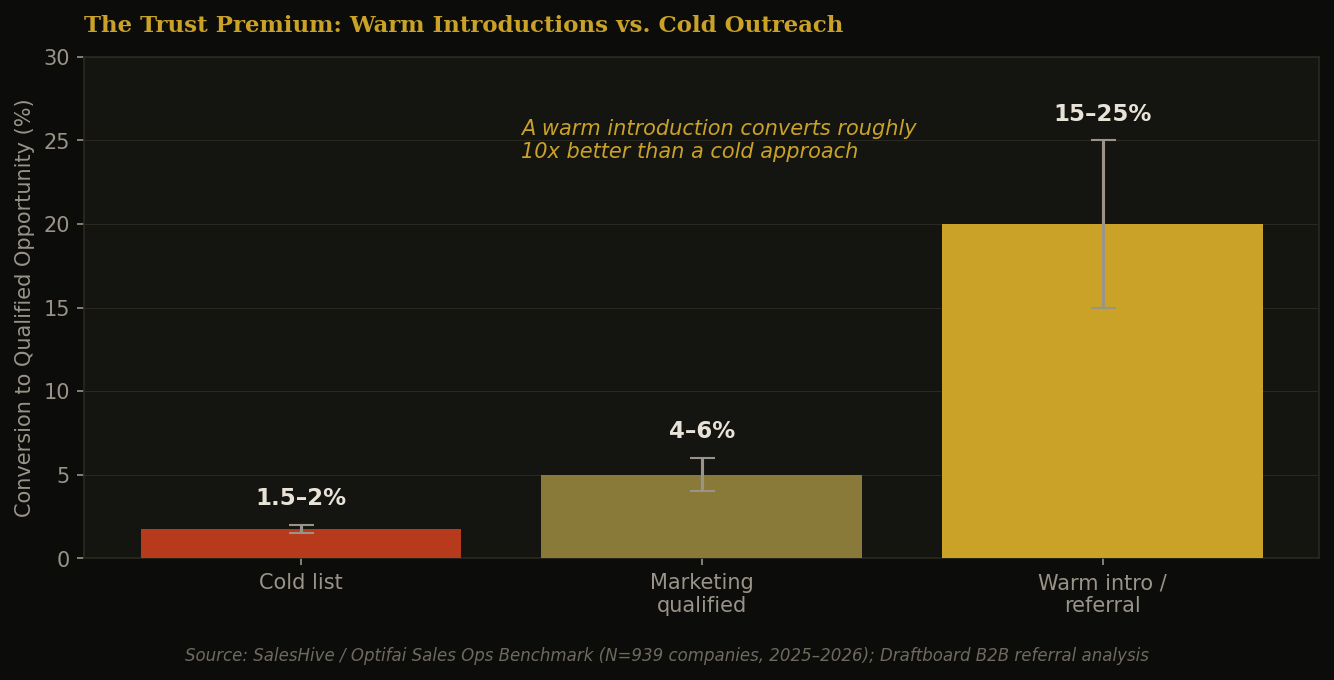
A cold list converts to a qualified opportunity 1.5 to 2 percent of the time. A warm introduction converts 15 to 25 percent of the time, roughly a tenfold improvement before a word about the product is spoken. Sources: SalesHive and Optifai Sales Ops Benchmark, 939 companies, 2025–2026; Draftboard B2B referral analysis.
The gap is not subtle and it is not new. It is the same force Mark Granovetter described in 1973 in the most cited paper in the social sciences, “The Strength of Weak Ties.” Studying how people actually found jobs, Granovetter discovered that more of them came through acquaintances than through close friends, because weak ties bridge into networks your inner circle cannot reach. In 2022, researchers tested the idea on 20 million LinkedIn users over five years and confirmed it at a scale Granovetter never could. The relationship is the channel. The trust riding on it is what makes the channel work.
Trust also compresses time, which in sales is the same as compressing risk. Deals that arrive through a trusted introduction close in roughly half the time of cold ones, because the buyer skips the phase where they decide whether to believe you.
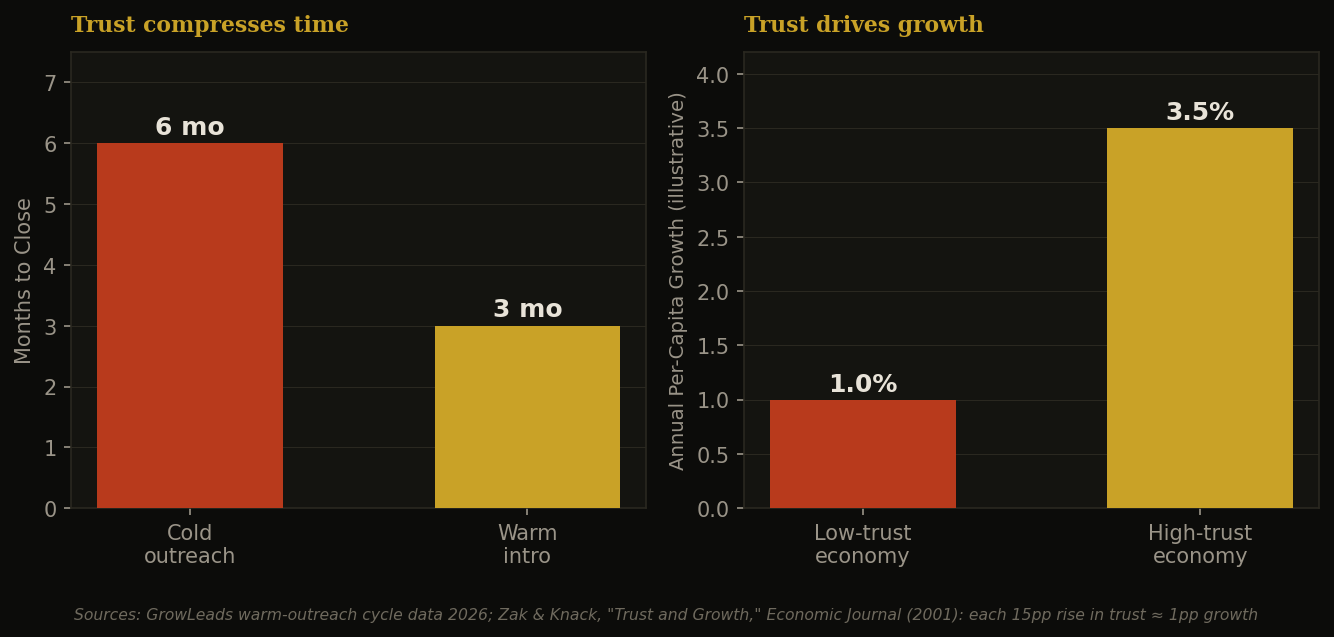
Left: deals sourced through a trusted introduction close in about half the time of cold outreach. Right: the macroeconomic version of the same effect, where higher-trust economies invest and grow faster because they spend less guarding against betrayal. Sources: GrowLeads warm-outreach cycle data 2026; Zak and Knack, “Trust and Growth,” The Economic Journal, 2001.
Same mechanism, two scales. Between two people, trust turns a six-month sale into a three-month one. Across a whole economy, it turns the friction of mutual suspicion into the velocity of mutual confidence. The dollar value is enormous and it almost never appears on a balance sheet.
The Same Force, Pointed the Wrong Way
Trust is powerful enough to be dangerous, and the clearest proof is what happens when someone turns it against the people extending it.
Bernie Madoff ran the largest financial fraud in American history, roughly $65 billion in fabricated account statements, and trust was the entire engine. Regulators later called it affinity fraud. Madoff’s investors came from communities he belonged to, philanthropic boards and cultural organizations and social circles where a personal introduction carried the weight of a guarantee. New money arrived through people who had already invested and who vouched for Bernie because their own statements looked flawless. The feeder funds that pooled billions and sent them to Madoff charged fees for due diligence they never performed, because the trust network made verification feel insulting.
Harry Markopolos handed the SEC a mathematical proof in 2000 that Madoff’s returns were impossible. The SEC investigated, met with Madoff, found him credible, and closed the case. Trust in the man overrode the arithmetic in front of them. The fraud ran another eight years and ended only when the 2008 crisis forced redemptions he could not cover.
Madoff is the cautionary extreme, and he proves the rule. The exact force that lets a CEO close a deal with a phone call, that let Mitsui wire money on the strength of a year of dinners, is the force Madoff bent into the largest theft in market history. Trust moves capital without verification. Pointed honestly, it is the substrate of every good thing in commerce. Pointed dishonestly, it is the most efficient weapon a fraudster has ever had. The power is identical. Only the direction changes.
Where People Build It, and Why AI Keeps Missing It
Think about where the relationships that shaped your career actually came from. High school friends who knew you before you had a title. College classmates from the years you were becoming yourself. The early colleagues who suffered through the same bad job at the same time. For many people the defining network is business school, and most of them know it. I spent years at the Columbia Institute for Tele-Information, CITI, teaching alongside Professor Eli Noam, and the students said it plainly: the degree mattered less than the people. They were paying for proximity to a cohort they would trust for the rest of their lives.
That is an honest description of what a business school sells. It is also a precise description of what the technology industry has tried and mostly failed to replicate. Professional networks became connection counts, a number on a profile and a feed of posts from people you met once or never. The connection request replaced the handshake and stripped out everything that made the handshake mean something. You do not trust someone because they sit in a list. You trust them because you know how they behave under pressure, whether they return the call when it is inconvenient, whether they share the credit when it would be easy to keep it.
A connection is not a relationship. It never was. The map of who you are connected to says almost nothing about who would take your call at 9pm, who would vouch for you to someone that matters, who you would trust to make an introduction without checking what it costs them. That map exists. It just does not live in any database that currently tries to hold it.
A connection is not a relationship. The map of who you know says almost nothing about who would take your call at 9pm, or who would vouch for you to someone who matters. That map is the most valuable thing you own and the least visible.
Why This Decides the Next Phase of AI
We are building toward a world where agents act on our behalf. They schedule, research, draft, follow up, and increasingly decide. The AI-first organization runs on agents that coordinate the work a human process used to carry.
Every one of those actions lands inside a web of relationships, and the agent that cannot see the web will keep making the wrong move with great efficiency. An agent that fires off a cold email does something categorically different from an agent that routes a request through the one person who already knows both parties. An agent that books a meeting between two people who trust each other produces a room where decisions get made. The same agent booking the same meeting between strangers produces a room where nothing happens and everyone checks their phone.
The relationship graph is the context layer that separates an agent that helps from an agent that annoys. Without it, agents are faster ways to do the things that were never going to work. With it, they can do something genuinely new: understand not only what needs to happen, but who should carry it and why they would.
This is the lesson buried in those flipped deals. The seller who lost did not lose on product. They lost because they had no path to the level where the decision was actually made, and their competitor did. The connector, the trusted relationship, was the deciding asset. Everything else was the price of entry. The function standing between a company and the truth about its market is the one quietly corrupting every signal downstream. Relationships are where that truth lives, and the CRM has never once captured them.
Two Kinds of Trust, and Why the Difference Matters
The AI industry tends to collapse two very different things into one word, and the distinction is worth holding onto.
Trusting a self-driving car means trusting that it will get you there without harm. That is functional trust, narrow and earned through reliable performance. You do not confide in the car. You do not ask it for a reference or call it when you are in trouble. Its trust begins and ends with its function.
Trusting a person is different in kind. It is reciprocal, contextual, and built on shared history, and it extends past any single function into a web of mutual obligation. The person who introduces you to an investor would not make the call unless they believed it would go well for both sides, because their own reputation rides on it. The calculation is never mechanical. It carries judgment, social consequence, and the accumulated weight of a relationship neither side wants to spend carelessly.
AI has already earned the functional kind. When Collective[i] started a decade ago, the pushback was almost entirely about whether the AI could be trusted at all. You will never capture all the activity automatically, people said. We cannot forecast our own deals, so why would your machine do better. The skepticism faded, and not because we explained the model. It faded because the model delivered. Deals it called, closed. There was even a brief vogue for “explainable AI,” every system made to show its work, and I always found it quietly funny, because the people demanding explanations were themselves black boxes. Nobody could explain why the best VP of sales in the room had a feel for which deal would slip. They trusted the hunch because it had been right before. The AI earned trust on exactly those terms. Performance, not explanation.
Functional trust is real and it is settled. The open question, the one that decides the next phase, is whether AI can learn to operate inside the other kind: the relational trust between people that actually moves capital, closes deals, and opens doors. Not to fake it, which it cannot, but to understand it, respect it, and help the humans who hold it use it well.
What Comes Next
I plan to keep writing about trust, because it is the thread running under everything else in this series. The recursive advantage compounds faster when an organization’s relationships are visible, because every relationship is a channel for learning. The AI shuffle fails most visibly in sales, where the tools get rearranged and the relationships stay invisible. The end of software as we knew it is partly the story of what standardized workflows did to relationship data, flattening the one signal that actually predicts what a buyer will do.
Trust is the most human thing in the economy. It is why a deal closes, a job gets offered, a company gets funded, a partnership holds. It is why a CEO can override a buying committee with a single call and be right to. It is also how Madoff ran a fraud for two decades. The mechanism is the same in both directions. What changes is the character of the person holding it.
The technology that learns to see trust, to map it and respect it and help people act within it, will matter more over the next decade than another point of model accuracy. The technology that keeps mistaking connection counts for relationships will keep producing confident recommendations that miss the only thing that mattered.
I would like to know what you think. Is trust as central as I believe it is? What would it have to look like inside a product before you would rely on it? What would it take before you let an agent navigate your relationships on your behalf? The answers will shape what gets built next, and I am asking the question in earnest.