Your Buyer Has a Process. Collective[i] Knows What It Is.
For thirty years, we built instruments to study sellers. The buyers were always the ones who decided. This final piece is about what changes when you flip the instrument — and what becomes possible when you know more about how a buyer buys than they expect any seller to know.

![Your Buyer Has a Process. Collective[i] Knows What It Is.](https://storage.ghost.io/c/eb/8a/eb8afca5-199d-47e6-b51d-489d6bb46893/content/images/size/w1200/2026/04/neon.webp)
Stephen Messer, Co-founder of Collective[i] and LinkShare (sold to Rakuten for $425M, 1996–2005). EY Entrepreneur of the Year/Deloitte Fast 50 winner. Board member, Spire Global (NYSE: SPIR). Building intelligence.com
One of our clients is a Fortune 500 company — a household name with a sophisticated, experienced sales organization. They had a prospect: the largest they had ever attempted to land. A company so large, so entrenched with competitors, that the seller assigned to the account had a specific, practiced way of explaining why it would never happen. The switching costs were too high. The incumbent relationships were too deep. The buying process for an account this size took six months minimum. And in thirty years of trying, nobody at his company had ever won them. He was not being pessimistic. He was being rational. Every data point he had access to pointed in the same direction.
Then Collective[i]'s network started seeing something different.
Not in the seller's pipeline. Not in the CRM. In the patterns of commercial behavior flowing through the network from accounts like this prospect — companies of this size, in this industry, at this moment in the economic cycle. Something was changing at this buyer. Leadership transitions, internal project shifts, budget cycle changes — signals the seller had no line of sight to, but that the network had seen the beginning of many times before. The TrueOdds — Collective[i]'s daily measure of actual win probability derived from observed behavior — started moving up.
The seller's leader saw it. The seller was skeptical. For the first few weeks, he resisted working the deal at all. The TrueOdds kept climbing. The size of the opportunity and the rising signal drew attention from leadership — people who would not ordinarily have engaged with a deal this early. Resources started flowing toward it. The seller, watching the signal update daily rather than hearing his own voice echoing in a weekly call, eventually started working it.
Six months later, they closed the largest deal in the client company's history. A deal the seller had written off as a routine market-rate comparison. A deal that would have been deprioritized, under-resourced, and ultimately lost without a system that knew the buyer's world was shifting before anyone inside the selling organization could see it.
The deal did not happen because the seller got better. It happened because the intelligence was finally pointed at the buyer — and the buyer was already moving.
That story contains the argument of this entire series. Not as an argument — as a demonstration. The seller's judgment was based on the seller's history with this prospect. The network's read was based on the buyer's present. The seller was studying himself and thirty years of past experience. The network was studying the buyer and what was actually changing in their world right now. One of those two orientations produces a thirty-year streak of failed attempts. The other produces the largest deal in company history.
This is not a story about AI replacing sales judgment. The seller still had to work the deal. The leadership still had to commit the resources. The relationships still had to be built. What changed was what the organization was looking at — and what the intelligence was derived from. The buyer was the signal all along. We just finally had a system pointing at them.
What the internet taught every industry except B2B sales
When Jeff Bezos built Amazon, the fundamental insight was not about faster shipping or lower prices. It was about instrumentation: if you observe what customers actually do — what they search, what they click, what they add to their cart and then abandon, what they come back for — you know more about what they want than they could tell you in a survey. The product becomes a listening instrument aimed at the buyer, not a reporting instrument aimed at the seller.
Every great internet company learned the same version of this lesson.
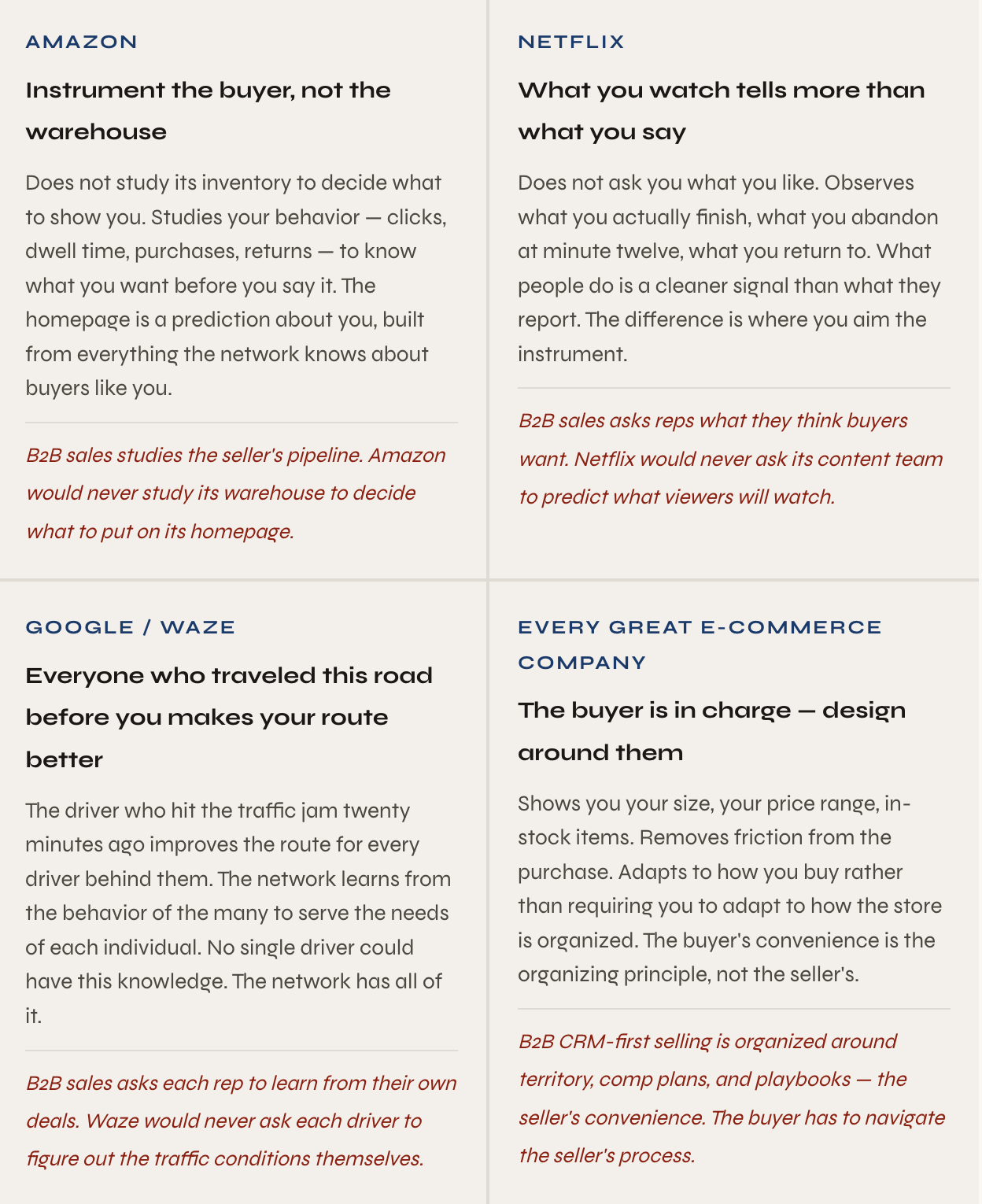
In every one of these cases, the breakthrough was not a better product or a faster process. It was a reorientation of the instrument: from studying the company's internal operations to studying what buyers actually do. The product improved as a downstream consequence of having the right thing in the crosshairs.
B2B sales somehow missed this entirely. We built thirty years of increasingly sophisticated instruments to study sellers — what they enter in CRM, what they say in forecast calls, how they follow playbooks, what their call recordings reveal about their technique. We studied the one party in the transaction who does not make the decision, at the expense of studying the one who does. The Fortune 500 story at the top of this piece is what happens when you finally flip the instrument.
The two problems every buyer is carrying — and the one sales almost never helps with
When a buyer evaluates a purchase, they are simultaneously solving two problems. Sales methodology is very good at helping with one of them. It almost entirely ignores the other. And the one it ignores is frequently the harder one.
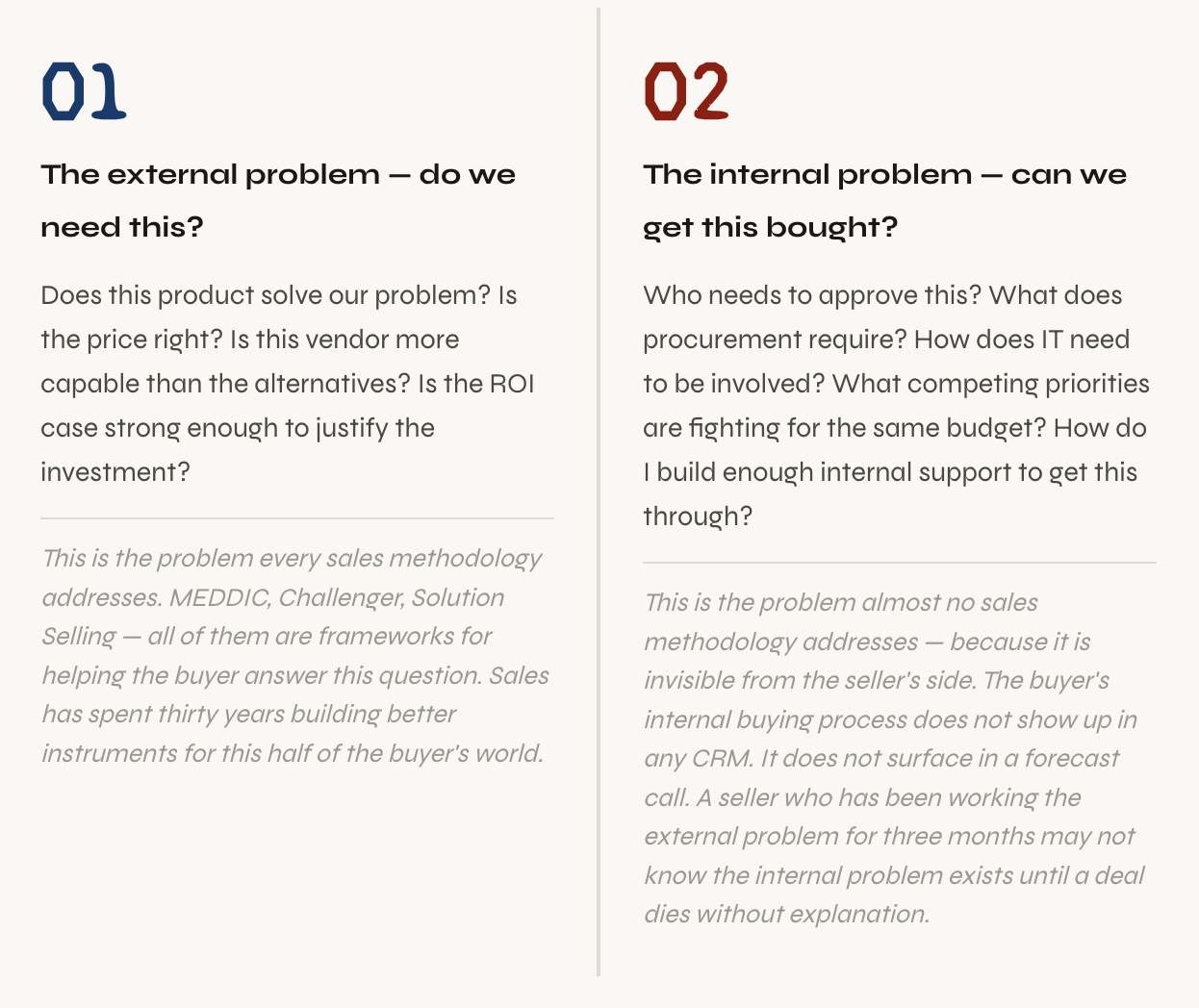
The internal buying process is not an obstacle to the sale. It is the sale. The champion your seller has been working with is not primarily trying to buy your product. They are trying to get something done inside their organization — solve a problem, advance a project, hit a goal — and your product is a means to that end. Everything that makes their internal buying process harder makes them less likely to succeed. Everything that makes it easier makes them more likely to become your strongest advocate.
Think about what this means for how you show up. A seller who helps a champion navigate their internal process — who understands the budget committee, who knows what the competing priorities are, who can help build the internal business case, who does not add administrative burden to an already-complex procurement — is not just more likely to win the deal. They become the vendor the champion wants to sponsor internally, because working with them makes the champion's job easier rather than harder.
That is a different kind of relationship than the one most sales methodology produces. It is the difference between a vendor who is trying to close and an ally who is trying to help the buyer succeed. Buyers know the difference immediately. They have sharp instincts about which one is in the room.
Every buyer is trying to solve two problems at once: the external one you can see, and the internal one you cannot. The seller who helps with both becomes the one the buyer wants to succeed. The one who only works the external problem is just another vendor to be evaluated.
The champion reframe — working their process, not yours
Sales mythology has a specific image of the champion: the internal advocate who fights for your deal in rooms you are not allowed into. The relationship is conceived as your champion navigating your process inside their organization. They carry your message. They manage objections on your behalf. They report back to you about the internal landscape.
Flip it. Your champion is not carrying your message. They are trying to solve a problem and get something approved. You are a means to their end — not the other way around. The question is not "how do I get my champion to advocate more effectively for me?" It is "what is making this champion's internal process harder, and how do I take work out of it?"
When you orient around that question, several things change. You stop presenting features and start thinking about what your champion needs to walk into a budget committee and win. You stop managing objections and start helping them anticipate and pre-address the concerns their CFO will raise. You stop optimizing your sales process and start making their buying process less painful — fewer internal approvals, simpler procurement requirements, cleaner implementation path, lower perceived risk for the people who have to sign off.
The thirty-year prospect at the top of this piece did not close because the seller found a better pitch. It closed because something changed at the buyer — a leadership transition, an internal project shift, a budget cycle realignment — that made the buyer's internal process more receptive to change than it had been in three decades. The seller who was pointed at the buyer's world, rather than their own pipeline stage, could see that shift before anyone else. That is not a sales technique. It is an intelligence advantage.
Every buyer's organization has its own internal mechanics. Budget approval requires a certain committee composition. IT sign-off follows a specific process with specific requirements. Legal review has a timeline that is independent of any seller's close date. Procurement has preferred vendor categories, required documentation, and compliance standards that are entirely invisible from the outside.
A deal that looks ready to close from the seller's side can be six months from closing on the buyer's side — not because the buyer has changed their mind, but because the internal process has its own timeline that the seller was never told about and never asked about.
The seller who knows this — who has done the work to understand how this buyer's organization actually approves purchases, not just whether they want to buy — is the one who sets realistic expectations, allocates time appropriately, and is not shocked by a December close date slipping to March. The surprise close date is almost always a surprise only to the seller. The buyer knew all along.
What the network knows that no individual seller could
Here is the challenge with everything described above: it requires knowledge that is very hard to acquire. Understanding a buyer's internal buying process, their organizational dynamics, their budget cycles, their stakeholder map — all of it requires either direct access (which buyers do not freely give to sellers they are still evaluating) or pattern recognition built from seeing similar buyers navigate similar processes many times before.
No individual seller can accumulate that pattern recognition at scale. They can develop intuition about buyer types they have encountered repeatedly in their career. But the seller working a new vertical, a new company size, a new geography, a new stakeholder configuration — they are starting from scratch on the pattern recognition that determines whether they understand what the buyer is actually navigating.
The network changes this. Collective[i]'s model is trained on the actual commercial behavior of buyers across thousands of companies and millions of relationships — observed over time, not self-reported by sellers. It has seen how buyers in this industry, at this company size, with this stakeholder configuration, actually move through purchasing decisions. It knows what a deal looks like when it is progressing versus when it is stalling. It knows which engagement patterns precede an internal champion gaining influence and which precede them losing it. It knows what changes in a buyer's organizational context — the kinds of changes that triggered the thirty-year deal — look like before they are visible to any individual seller.
This is not a language model producing plausible-sounding text about buying behavior. It is pattern recognition derived from watching how buyers actually behave across the real economy, updated as those patterns shift, applied to the specific buyer your seller is working with right now.
Where the buyer actually is in their process — not where the CRM stage implies, but what the observed engagement pattern reveals about their internal decision timeline. The deal that has been quiet for two weeks because the buyer is in budget committee, not because they lost interest. The deal that is accelerating because an internal deadline just changed.
Who matters that you don't know about — the stakeholder who is influential in decisions like this one but has never been in a meeting with your seller. The connection in your organization's network that reaches the economic buyer through a trusted introduction rather than cold outreach.
What approach works for this buyer type at this stage — not the generic playbook, but what the network has observed across buyers like this one at this moment in their decision process. The message that moves them. The concern that needs to be addressed before they can move forward. The timing that corresponds with internal readiness.
What is changing in the buyer's world — the organizational shifts, market conditions, and contextual changes that affect whether a deal that has been dormant for years is suddenly worth pursuing, or a deal that looked strong last week is now at risk. This is what found the thirty-year deal. Not better selling. Better watching.
The culture shift — making it easier to buy
Everything in this series has been building toward a single cultural question: what does a sales organization look like when it is genuinely organized around the buyer's process rather than the seller's?
The answer is not a methodology change or a training program. It is a consequence of having the right information available at the right time. When sellers know what is happening at the buyer's organization — when they have real intelligence about the internal buying process, the stakeholder map, the competing priorities — their behavior changes without being trained to change. They start helping with the internal problem because they can see it. They start building the business case the champion needs for the budget committee because they know what that committee cares about. They stop managing their own pipeline stage and start managing the buyer's decision process. The intelligence produces the culture, not the other way around.
The goal — and this is what I want to leave with — is to become the vendor whose deals are easy to buy. Not just good products at fair prices. The vendor who has done the work to understand the buyer's internal process well enough to reduce the friction in it. Fewer surprises for procurement. Cleaner implementation paths for IT. Clearer business cases for finance. Shorter approval cycles because the proposal was built around what the approval process requires, not around what was easiest for the seller to present.
When you achieve that — when buyers know that working with you means their internal buying process will be smoother rather than harder — you do not just win more deals. You win them faster. The champion who knows your company does this work becomes your most effective advocate, because they have experienced it. They do not have to believe your pitch. They have evidence.
What the series has been about
Five pieces. One argument. Let me name it plainly before closing.
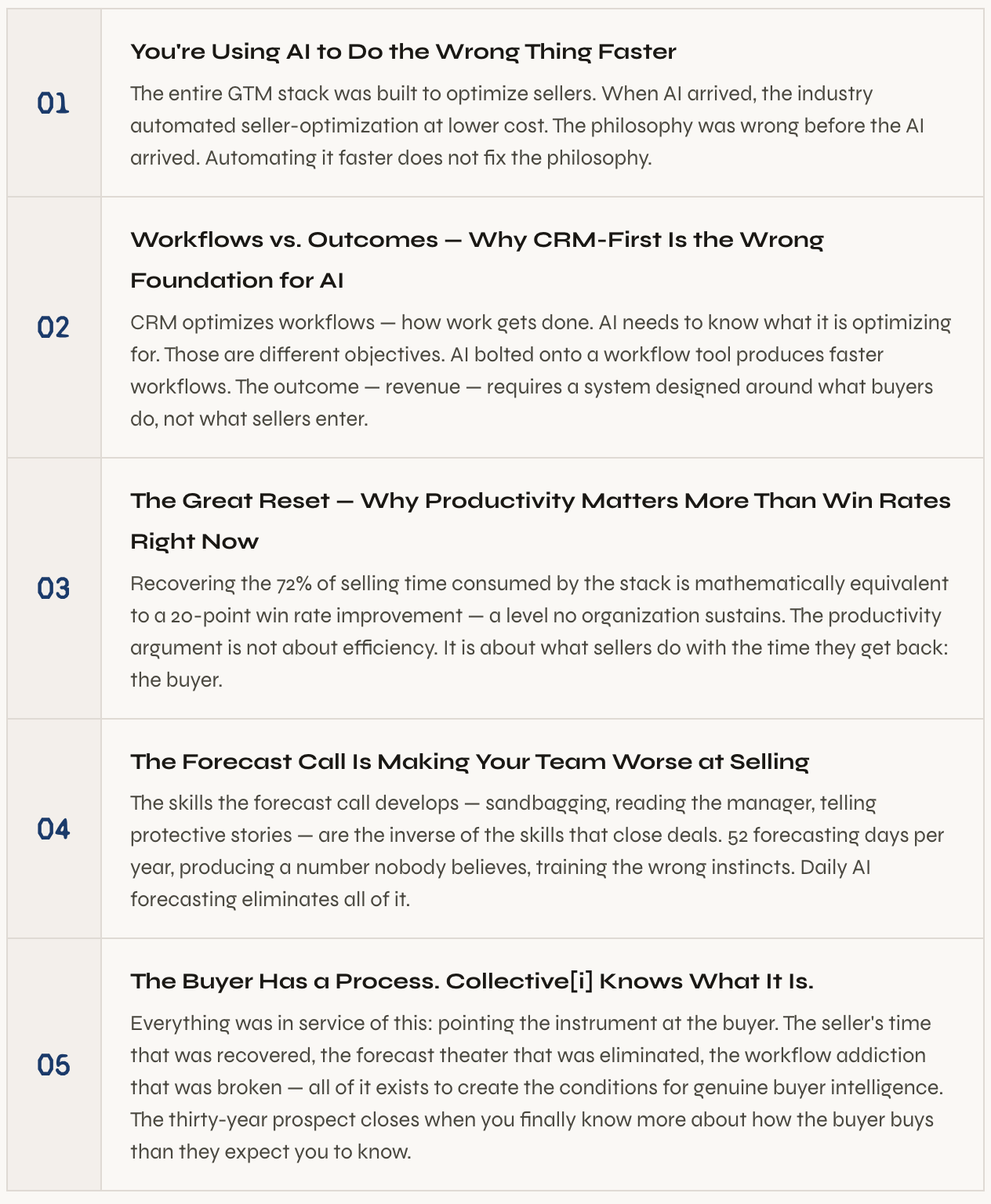
The series started with a $401 million company built by one person with AI tools. It ends with a thirty-year prospect that closed because the intelligence was finally pointed at the buyer. Both are the same story. The intelligence that was missing — about the buyer, their world, their process, what was changing — was always the thing that mattered. We just had no way to gather it at scale until now.
Sales has always been about the buyer. Every great seller has always known this. The tools, the processes, the stacks, the forecast calls — all of it existed in theory to serve that orientation and in practice to serve the seller's management structure instead. The buyer was the signal. We built instruments pointed the wrong way for thirty years.
The question is not whether to flip the instrument. The question is when — and whether the organization that does it before you is already closing deals you didn't know were available.
No team to operate it. API access to systems you already own. The brain handles the internal. The seller handles the buyer. This is what the architecture change looks like in practice.
The results are documented. The transition is happening. The only variable is timing — yours, and your competitor's. collectivei.com
Sources & data
- 91% Optimism vs. 67% Failure: Most revenue leaders missed 2024 targets, yet remain bullish for 2025 (Clari Labs).
- Forecasting Crisis: 68% of sales leaders report inaccurate forecasts, often dismissed as "wish-lists, not predictions" (Salesforce; Multiple Sources).
- The Productivity Tax: Sales teams lose massive hours to "3-hour marathons"; eliminating pipeline reviews can boost productivity by 22% (Revenue Wizards 2024).
- Measurable Gains: AI-driven tools have delivered a 26% accuracy boost and saved 3,000 person-hours (Revenue Wizards Case Study).
- Predictive Success: Top-tier adopters see 93–95% forecast accuracy and a 13% Q1 win rate improvement (Collective[i]).
- Strategic Shifts: Boards have moved past AI adoption as a novelty; they now demand specific revenue outcomes (Cristiano Mendes, Momentum AI).
- Leadership Trends: CROs like Derek Gillespie (365 Data Centers) are increasingly promoted to CEO following successful revenue scaling.
- High-Stakes Accuracy: Enterprise adopters achieve 93–95% forecast accuracy and a 13% Q1 win rate improvement.
- Proven Growth: Organizations utilizing these models report 45% YoY revenue growth.
- The "TrueOdds" Standard: Employs a proprietary methodology to determine the actual probability of a deal closing.
- B2B Complexity: Modern decisions involve 6–11 stakeholders, making traditional manual tracking insufficient.
- The Buyer Gap: With 70% of the buying process completed before a seller is even engaged, visibility into external behavior is critical.
- Personalization Demand: 71% of B2B buyers now expect personalized experiences throughout their journey.
- Institutional Success: Large-scale leaders like Matthew Gallagher (Medvi) have scaled to $401M in revenue using advanced data strategies.
- Behavioral Models: Success is mirrored by tech giants like Amazon and Netflix, who prioritize instrumentation of buyer and viewer behavior over manual reporting.