The Trust That Ate Venture Capital.
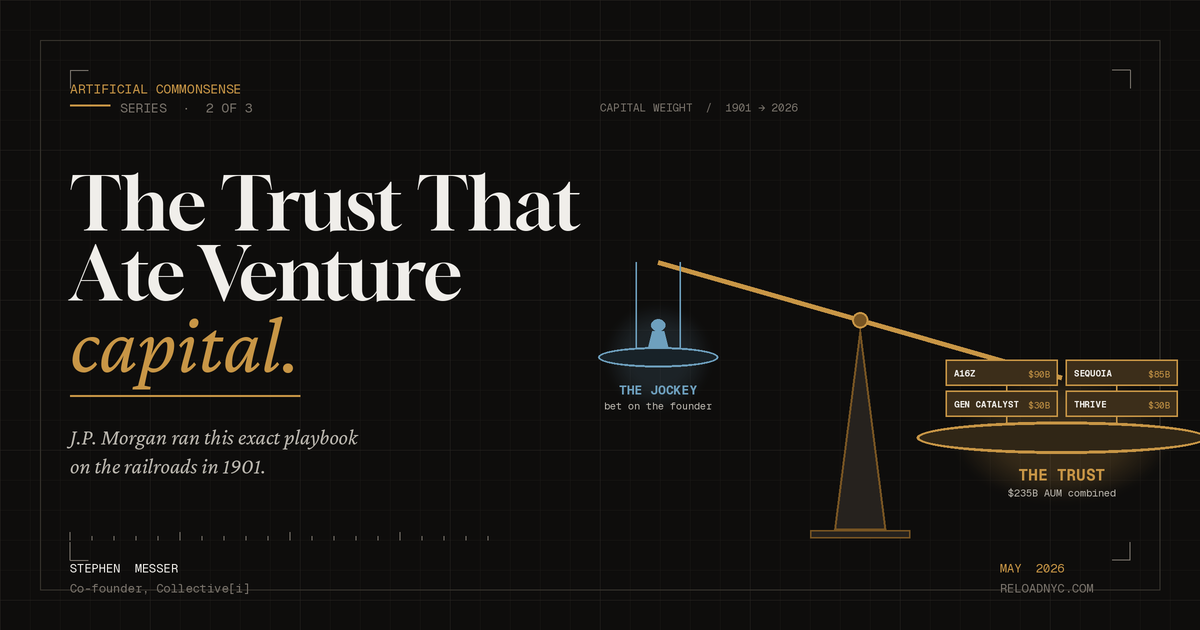
The oldest rule in venture was bet on the jockey, not the horse. Something changed. The biggest funds, now $235B in combined AUM, have quietly become investment trusts, paying up for access to founders who already made it, running the exact playbook J.P. Morgan ran on the railroads in 1901

J.P. Morgan Would Recognize Every Move. Their LPs Are About to.
Stephen Messer, Co-founder of Collective[i] and LinkShare (sold to Rakuten for $425M, 1996–2005). EY Entrepreneur of the Year/Deloitte Fast 50 winner. Board member, Spire Global (NYSE: SPIR). Building intelligence.com
The oldest saying in venture capital is: never bet on the horse, always bet on the jockey. Products change. Markets shift. What does not change is a founder who sees something nobody else sees and refuses to quit when the thesis is unclear. Bet on that person and the horse will find its way. Bet on the horse alone and you own an expensive animal with no rider.
That principle built the industry. Doug Leone spent years understanding founders before writing checks. Sequoia’s $12.5 million check into Google’s 1999 Series A became one of the largest venture returns in history. Benchmark’s $6.7 million into eBay in 1997 returned roughly $2.5 billion. Those returns came from the same place every venture return has ever come from. Recognizing a great founder before the consensus did.
Something has changed. This piece is the second in a three-part series on the end of simple venture capital as a financing model. The first, The Most Expensive Money in the Room, laid out the external threat. Ecosystem financing that runs at a fraction of a venture fund’s cost of capital. This one goes to the internal side of the same shift. The largest funds in the world have quietly stopped doing venture capital. They have become investment trusts, running the same concentrated-capital playbook J.P. Morgan ran on the railroads in 1901. The returns their LPs think they are paying for come from a source that will not survive the next fee cycle.
Something Has Changed. Look at Who Built the Real Companies.
The most important companies of the last twenty years were not in anyone’s fund thesis when they got built. That is not a rhetorical flourish. It is the empirical record.
Tesla. SpaceX. Neuralink. Elon Musk built all three with capital that came primarily from his PayPal exit and a small group of tech-founder allies. In 2002 no venture fund was writing checks into private rockets. In 2004 no fund had a commercial-EV thesis. SpaceX IPO’d in June 2026 at approximately $2 trillion. Tesla’s market cap has ranged between $500 billion and $1.5 trillion for the last four years. The PayPal proceeds gave Musk the independence to raise from whoever he wanted. A founder without that independence, building something equally unconventional, would have had nowhere to go.
Jeff Bezos started Blue Origin in 2000 and self-funded it for twenty-five years, selling roughly $1 billion of Amazon stock per year to keep it running. Total personal investment through mid-2026: approximately $30 billion. Blue Origin’s first outside funding round happened in July 2026, at a $130 billion valuation. Bezos put in another $2 billion himself. Zero venture capital across the entire run. In a 2018 interview with Axel Springer he said the quiet part out loud: “The only way that I can see to deploy this much financial resource is by converting my Amazon winnings into space travel.”
OpenAI is the case Wall Street keeps mis-narrating. It was founded in December 2015 as a non-profit with a $1 billion commitment. Look at who actually put the money in. Elon Musk (roughly $50 million actually deposited). Reid Hoffman. Peter Thiel. Sam Altman. Y Combinator. Amazon Web Services (compute credits). Infosys. That is not a venture round. That is a founder round. Vinod Khosla led the 2019 Series A when OpenAI transitioned to a for-profit structure. Khosla was one of the last old-school bet-on-the-jockey investors still operating the way Leone and Moritz did. Microsoft, a strategic corporate investor, followed with $1 billion the same year. The next meaningful venture check from a major fund came from a16z in 2023, at a $29 billion valuation, six months after ChatGPT launched. The largest AI company of the decade was funded from cradle to prime by founders and strategic corporates. The trusts arrived at growth-equity prices.
The pattern extends past AI. In 1996, when my sister Heidi and I started LinkShare, no major venture fund had a “performance marketing” thesis. We were building the infrastructure of what would later be called affiliate marketing and the sharing economy. We grew for years before the funds noticed. We sold to Rakuten in 2005 for $425 million. When we started Collective[i] a decade later, we built it on a thesis nobody in venture had published: that studying the demand curve could help the world understand changes in the global economy, from the macro level down to deal by deal. With Intelligence.com, we extended the same model to include relationships and their role in business and professional networking. Neither fit any published fund thesis.
The smart founders now stay away from the consensus categories on purpose. They know those categories become crowded, commoditized, and overpriced within twenty-four months of appearing on a fund’s thesis page. The biggest funds are increasingly not the funders of the next great companies. They are the payers-up for access after the founder has already done the hard work. a16z’s 2023 entry into OpenAI at $29 billion is one example. Its July 2026 lead of the $1.7 billion round into Atoms is another. Atoms is Travis Kalanick’s rebranded holding company (the former CloudKitchens plus Pronto). Ben Horowitz joined the board. Uber, the company that pushed Kalanick out in 2017, contributed $100 million to the round. a16z did not discover Kalanick. It paid a premium to write a large check into a known founder’s next act. That is not venture capital. That is late-stage access equity with a venture brand attached.
The biggest venture funds are no longer the funders of the next great companies. They are the payers-up for access after the founder has already done the hard work.
The Super Fund Problem
The structural cause of all this is size. Andreessen Horowitz manages $90 billion, up from $16.5 billion in 2020 and $42 billion in 2024. Sequoia manages $85 billion, most of it inside an evergreen fund structure launched in 2021. General Catalyst, once a modest Boston seed fund, manages over $30 billion. Thrive Capital is at $30 billion and rising. These are not venture funds. They are asset management platforms that write venture-branded checks.
CHART 1 · THE TRUST FORMATION, PRICED IN AUM
Four firms. $235 billion combined. Managing evergreen capital at asset-management scale, not venture scale.
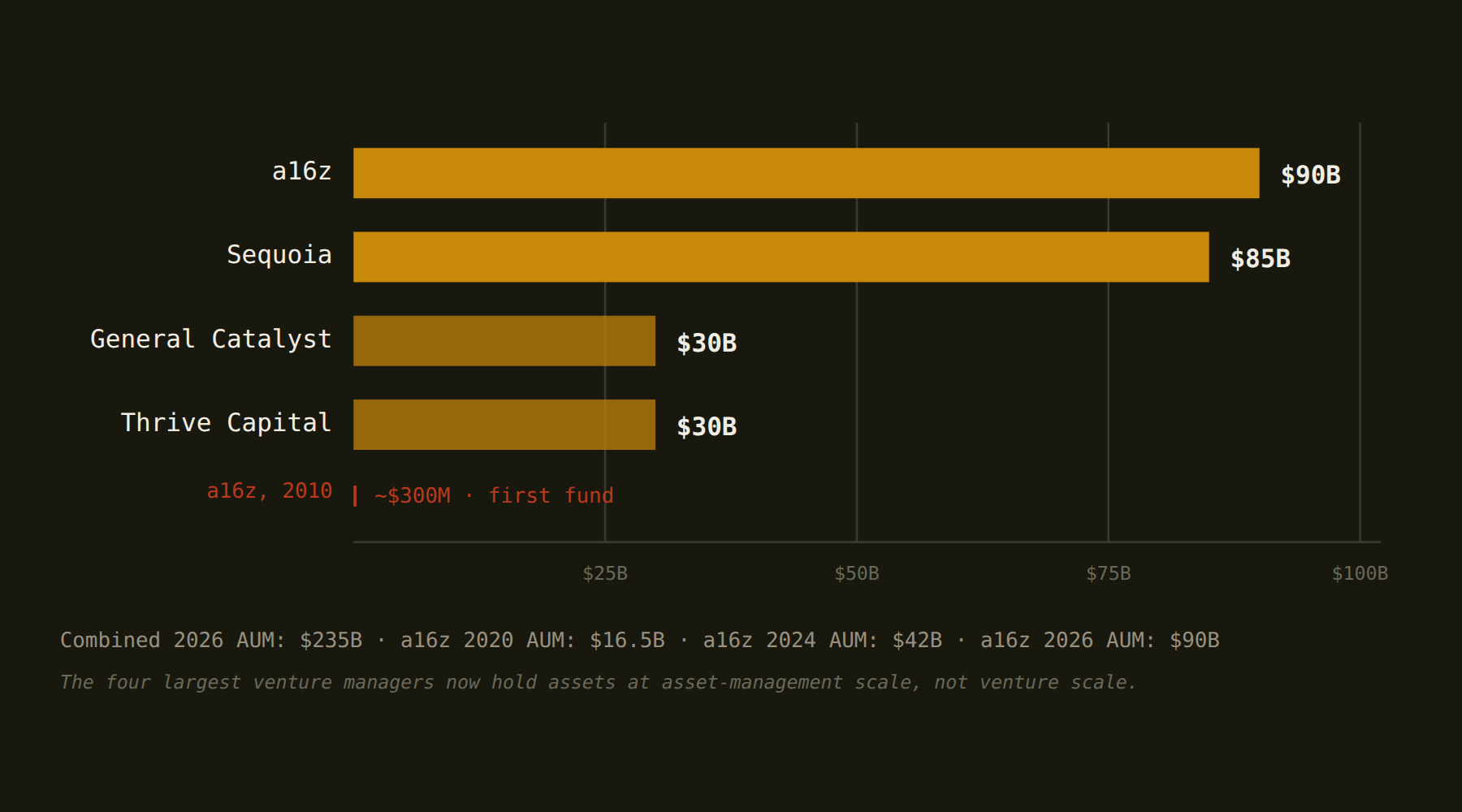
Sources: a16z Fund VII announcement, Jan 2026 (Newcomer, TechCrunch, Wikipedia). Sequoia AUM per SEC filings; evergreen fund launched 2021. General Catalyst, Thrive Capital AUM per Value Add VC 2026 tracking. Historical a16z figures: TechCrunch (Nov 2020, $16.5B) and Andreessen Horowitz Fund VII disclosure.
The 10-year closed-end fund was supposed to create alignment. Deploy over four years. Harvest over six. Return capital to LPs. Repeat. Sequoia called that model obsolete in 2021 and converted to an open-ended structure where exits replenish a permanent capital base. The logic is sensible. Forced selling of Airbnb or DoorDash to close a fund destroys value. Holding compounding positions the way Berkshire holds public equities produces better returns for LPs.
The consequence of that shift is the trust structure. A fund that needs to deploy $10 billion per vintage thinks differently about deal size than one deploying $200 million. You cannot put $10 billion to work by writing $500,000 seed checks into unknown founders. You need large checks into large categories. The fund size creates the thesis as much as the thesis creates the fund size. What Silicon Valley has always called hot tub investing (the major funds clustering in the same warm water, validating each other’s conviction) is now structural, not social. Orlando Bravo of Thoma Bravo, who has done more than 600 software acquisitions, put it plainly at Davos in January 2026. “Venture firms are just piling into any AI story they can. The FOMO of being in any AI deal as early as you can in the private markets is pretty remarkable.”
The Portfolio Blindness
The super funds do not just miss the unconventional winners. They also cannot see the risk to their own portfolios. That is the harder part of this story, and it is the one every LP should be running numbers on this quarter.
Between 2016 and 2022, the major venture funds concentrated an enormous share of their capital into SaaS. Sequoia, Bessemer, a16z, Insight Partners, and Tiger Global collectively wrote thousands of checks into per-seat software businesses. It was the highest-conviction, lowest-differentiation category in venture history. Then AI arrived, and the entire category began to reprice against a lower-cost substitute that arrived faster than the funds’ portfolios could adapt. I laid this out in Software Is Over and The Last Great Head Fake in Software History. The SaaS incumbents got airtabled in front of their investors’ eyes, and the funds could not see the risk to the aggregate value of their books.
The August 2026 Bending Spoons acquisition of Airtable is the print. $2.25 billion equity value. Airtable’s 2021 peak private valuation was $11.7 billion. That is an 89 percent haircut in five years. The late-stage cap table (Thrive Capital, Coatue, CRV, Salesforce Ventures, T. Rowe Price) is taking substantial losses. Bending Spoons is a newly public Italian holding company that buys tired tech assets at a discount and now owns Airtable, AOL, Eventbrite, Evernote, Vimeo, and WeTransfer. When the buyer of the SaaS category is a holding company specializing in dying tech, the aggregate signal for a decade of super-fund concentration in SaaS is legible. The trusts ignored the signal because their own portfolios required them to.
The blindness runs older than AI. Katerra, a construction technology startup, burned through more than $2 billion between 2015 and 2021 before filing for Chapter 11. SoftBank’s Vision Fund put in $835 million in a single January 2018 round, then two subsequent bailouts of $200 million each. Katerra was the most heavily funded construction tech startup in history. It shut down without paying severance to more than 2,000 employees. Byju’s, the Indian edtech, is the larger cautionary tale. Peak private valuation of $22 billion in October 2022. Investors included Peak XV (formerly Sequoia India), Tiger Global, BlackRock, the Chan Zuckerberg Initiative, Prosus Ventures, General Atlantic, and Silver Lake. BlackRock marked the position down in a series of steps: 50 percent, then 62 percent, then 95 percent. By October 2024, the founder acknowledged the company was worth zero. That is $22 billion of venture and growth-equity value written to zero in twenty-four months, across some of the biggest and most sophisticated funds in the world.
THE NUMBERS · WHAT THE TRUSTS MISSED
FTX Ventures / Alameda Research invested $500 million in Anthropic’s Series B in April 2022, taking 86 percent of the round at approximately an 8 percent equity stake. ChatGPT had not launched. The major venture funds were largely not participating in the AI model category at that price. The stake sold in the FTX bankruptcy for $1.3 billion in 2024. At Anthropic’s current $380 billion valuation, an intact 8 percent position would be worth roughly $30 billion. At the trillion-dollar valuation now discussed for Anthropic’s next round, the same position clears $80 billion. A crypto exchange run by a founder who ended up in federal prison saw more upside in AI than the trusts that publish AI theses did.
The Overfunding Playbook
When you cannot pick winners early, you manufacture them. Fund one company in a category so aggressively that the category consolidates around it. Out-hire, out-spend, out-market every competitor. Force the outcome.
Defense tech is the cleanest recent example. In 2024, defense tech startups raised a record $3 billion in total. Anduril alone raised $1.5 billion of that in a single Series F. In 2025, Anduril raised another $2.5 billion at a $30.5 billion valuation, led by Founders Fund’s largest single check in the firm’s history. The round was oversubscribed by eight to ten times. A reported $5 billion round at a $61 billion valuation is now in discussion. Cumulative funding: approximately $6 billion. Revenue doubled to $1 billion in 2024. The company won the US Army’s $22 billion IVAS program from Microsoft.
The capital structure around Anduril is now performing a second function beyond funding a good company. It is locking out competitors. A defense tech startup trying to raise a Series A in 2025 is raising against a comps set where the category leader has a $30 billion valuation and $6 billion in cumulative funding. Institutional investors who want defense tech exposure buy Anduril. The market for defense tech capital is, for practical purposes, Anduril’s market. That is the bet. One company, dominant, worth ten to twenty times what was invested. The fund math works if it happens. The risk is that a well-funded monopoly and a real product are not the same thing.
The Tech Trusts
The pattern this describes is not new. It has a name in American economic history. Trusts.
In 1901, J.P. Morgan formed the Northern Securities Company, a holding vehicle that combined the Northern Pacific and Great Northern railroads into a single monopoly across the American Northwest. The mechanism was simple. Morgan’s firm arranged financing at a scale no independent operator could match. Companies that accepted Morgan’s terms received capital advantages that let them expand faster than competitors could keep up. Companies that resisted found themselves cut off from the capital markets Morgan effectively controlled. Prices rose. Morgan’s clients earned outsized returns. The language of the moment described the outcome as rationalization rather than concentration. The Supreme Court broke the Northern Securities Company up in 1904.
The playbook of the modern super funds is structurally identical. They concentrate unprecedented capital behind a single company in each category. They use that capital advantage to crowd out competitors through hiring, marketing, and infrastructure. They coordinate their investments so that portfolio companies are reinforced rather than competed against. They mark up their own positions through rapid follow-on rounds, producing fund performance metrics that attract more LP capital, which enables larger concentrated bets. This is the venture trust model. The people running it are, in many cases, the same people who have published theses telling founders what to build.
The railroad trusts ran into one problem the trust operators did not anticipate. Railroads are physical infrastructure with high switching costs. Once a line was built, traffic had to move on it. The trust could control pricing because there was no alternative. Technology categories do not work this way. Switching costs in software are a function of integration depth, not physical infrastructure. Code can be rewritten. APIs can be changed. A competitor with a meaningfully better model, a lower cost structure, or a different architectural approach can displace an incumbent in months.
This is the exact dynamic I mapped in Peak Token and The Bear Case for the Model Makers. AI is dismantling per-seat SaaS. Open-source AI is dismantling the closed frontier labs the same way. DeepSeek trained a competitive frontier model for a small fraction of what the closed labs spent. Moonshot’s Kimi K3 and Zhipu’s GLM-5.2 have continued that pattern on a rolling basis at fractions of what OpenAI and Anthropic raised. If a Chinese lab operating on a fraction of the capital can match your product, the trust structure you built around your capital advantage is a liability, not a moat.
The railroad trusts were broken up by twenty years of political will and Supreme Court decisions. Tech trusts face a different and faster threat. The market itself. I laid out the orchestration-layer version of this same dynamic in The Only Fight That Matters in AI. The moat is not the model. It is what sits above the model. The trusts built moats around the wrong layer.
The railroad trusts used concentrated capital to manufacture category dominance. The venture trust model does the same. The difference is that railroads are physical infrastructure. Code can be rewritten. A Chinese open-source lab can match your product on a fraction of the capital. A better founder changes the whole equation.
Financial Engineering: The Fake Up-Round
There is a pattern in the current AI funding wave that deserves scrutiny. A company raises a round at a given valuation. A few weeks or months later, the same lead investors put in significantly more capital at a substantially higher valuation. The round is announced as a signal of extraordinary momentum. The existing investors book a paper markup on their original position. The fund’s TVPI rises. The LP statement looks better. The investors who set the new price are the same investors who most directly benefit from the markup they just granted themselves.
OpenEvidence, the medical-AI search platform for physicians, is the cleanest illustration. Four priced rounds in twelve months, valuation up 12x. Same investors leading and following.
CHART 2 · THE UP-ROUND MACHINERY, IN ONE COMPANY
OpenEvidence: $1B to $12B in eleven months. Same investors leading each doubling.
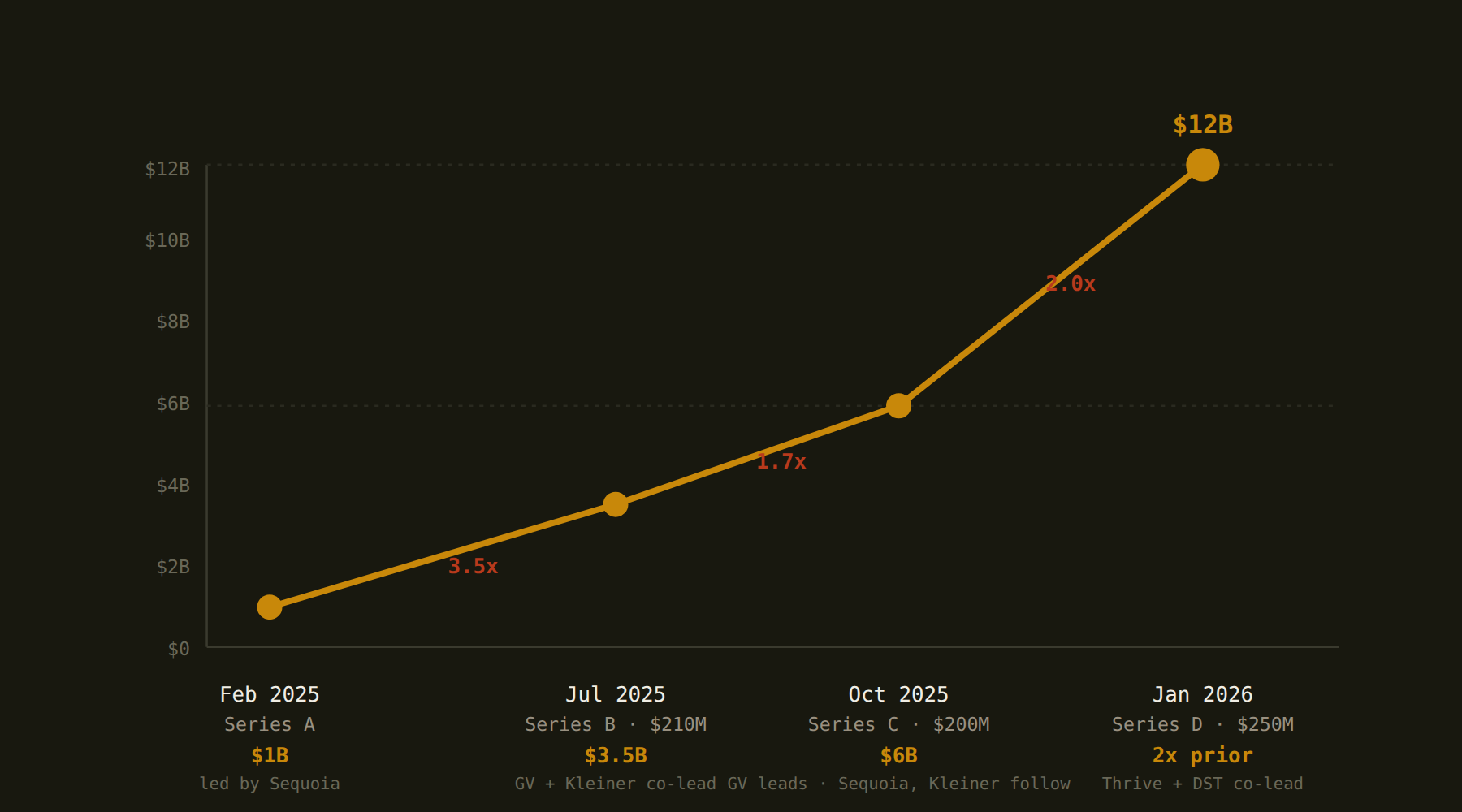
Sources: OpenEvidence press releases (July 2025, October 2025, January 2026); PR Newswire ($3.5B Series B); Fierce Healthcare (HLTH25 Series C coverage); MobiHealthNews (Series D at $12B); Sacra funding history. Series A round Feb 2025 estimated at approximately $75M at a $1B valuation.
OpenEvidence has real revenue. Roughly $100 million in annualized revenue by January 2026, up from $7.9 million the year before. Roughly 20 million clinician consultations per month. Real usage by more than forty percent of U.S. practicing physicians. The company may well grow into its valuation. The structural pattern is still worth naming. This is a rare case where the up-round machinery is visible in near-real time, executed by the biggest names in venture, all writing checks in a coordinated pattern that lifts the value of positions they already hold. The LP statements look extraordinary. The exit that would justify $12 billion has not happened. That gap is where the risk lives.
Corgi, an AI insurance startup, ran a compressed version of the same pattern in three weeks. Series A at one valuation, then Series B at roughly double, led by the same investors. TechCrunch flagged the sequence as “unusual enough to raise questions.” Nothing about the underlying business had materially changed in three weeks. The valuation had. These are not fraudulent transactions. They are legal, disclosed, and technically defensible. The concern is that they replicate the specific mechanics that made the railroad trusts profitable. Legal at the time, enormously profitable for the participants, and explicitly designed to manufacture category dominance rather than earn it through competition.
The Founders the Trusts Cannot Serve
Airbnb was funded by Y Combinator, but it was funded before Y Combinator published lists. It was a seed bet on a founder who had a weird idea that most investors explicitly rejected. Strangers renting their homes to other strangers. The standard venture response was that nobody would do that. Bitcoin had no venture funding at all. Satoshi Nakamoto did not pitch Sand Hill Road. The most consequential financial technology innovation in a generation was built entirely outside the institutional funding system. When the major funds finally arrived in crypto, they were not discovering the category. They were paying for the category that had already been discovered.
Spire Global was born from a Kickstarter campaign. The idea was a shoebox-sized satellite that could democratize space data. No traditional venture firm would have funded it at the outset. It found its way through unconventional capital, built the technology, and became a public company on the New York Stock Exchange. I told that story at length in The Shoebox That Changed Space. The jockey was there all along. The trusts arrived after the horse had crossed the line.
The pattern is not incidental. It is now the norm. I described the operating-side version of this shift in The Companies Winning at AI Are Playing a Different Game and the network-compounding version in Infinite Leverage. Great companies come from founders who see what the consensus cannot. The funding model that made venture great was the one built to recognize those founders. The trust model that replaced it is built to pay up for access after the founders have already done the work.
Access Is Not Alpha
Which brings us to the LP question. When a super fund tells its LPs it delivered a fund return of two-and-a-half times, where did that return actually come from? For most of the largest funds this cycle, the honest answer is late-stage access.
a16z’s OpenAI position was written at $29 billion in 2023, six months after ChatGPT made the outcome obvious. Its recent xAI participation came in at a $200 billion valuation. Its Atoms lead in July 2026 was $1.7 billion into a holding company Travis Kalanick had been building for eight years. Sequoia’s OpenAI position was written at the same $29 billion in 2023, and it added again at $86 billion, $157 billion, and $300 billion. These are all good investments. They will likely all return well. None of them is the kind of discovery-stage bet that produced Sequoia’s original stake in Google or Benchmark’s original stake in eBay. They are late-stage entries at prices that already reflected most of the risk.
The distinction matters to LPs because the fees are structured against the myth of discovery. The 2 and 20 fee, the ten-year lockups, the cross-fund dilution where a few winners have to carry a large book of losers, all of it was justified by the argument that only a venture fund had the access to write the check that mattered. That was true in 1996 when Hotmail was raising. It was true in 1998 when Google was raising. It was true in 1999 when Amazon was raising. Ordinary LPs and family offices could not get into those companies without paying a venture fund to do it for them.
That access moat is gone. Special-purpose vehicles now let sophisticated LPs and family offices write direct checks into the same companies the super funds are backing, at the same valuations, at the same time, without the diluting effect of a full portfolio. The average fee structure on a well-run SPV is broadly comparable to the fee structure on a fund vehicle. The difference is that the SPV lets the LP pick one company. If you can research a company well enough to know it is worth the check, why pay a super fund to put your money into that company plus fifty others you did not choose? The answer used to be access. The answer is no longer access. The answer, if the super fund model is going to survive, has to become discovery. The historical record of the last five years suggests the trusts have stopped doing that.
Corporate strategic capital is running the same displacement on the operating side. Ecosystem financing, which I laid out in The Most Expensive Money in the Room, is now the most efficient capital structure available at scale. Nvidia’s operating margin sits at roughly 75 percent. A sovereign wealth fund’s cost of capital for infrastructure is in the low single digits. A hyperscaler funding its own supply chain uses free cash flow that would otherwise sit in Treasuries. When you combine those cost-of-capital layers into a single deal structure, venture capital, at mid-teens cost of capital, becomes the most expensive money in the room. Founders notice.
The 2-and-20 fee was built on the argument that only a venture fund had the access to write the checks that mattered. That access moat is gone. SPVs give sophisticated LPs the same access at comparable fees, without the diluting effect of a full portfolio.
The Fee Revaluation That Is About to Happen
If access is no longer scarce, and if discovery is no longer what the super funds are actually doing, the fee structure has to change. That change is starting to move. Family offices, sovereign wealth funds, and corporate strategic vehicles are increasingly bypassing the super funds entirely and either investing direct or syndicating through SPVs. The largest LPs in the country are running the same math internally. If you can identify the founders who will produce the extraordinary returns, and if you can get into the deals at the same valuations the super funds are getting in at, why pay 2-and-20 for a diluted book when you can pay 2-and-20 for one pick, with better liquidity and more transparency?
The founder side runs the same calculation. Great founders now understand that a super fund’s participation on the cap table brings governance overhead, board dynamics, published-thesis pressure, and a peer group of portfolio companies that may compete for the fund’s attention. If the alternatives are strategic corporate capital at Nvidia margin, sovereign infrastructure vehicles at low-single-digit cost of capital, credit funds structured against specific revenue streams, and direct family-office capital with no governance overhead, the value proposition of a super fund has to be worth the friction. For a founder building in a consensus category the super funds have already published a thesis on, the answer is often yes. For a founder building something the consensus cannot yet see, the answer is increasingly no.
The systemic consequence is bifurcation. The trusts will produce steady, correlated, LP-defensible returns that look like private-market beta on the biggest visible technology categories. Those returns will be fine. They will not be extraordinary. The extraordinary returns, the fund-defining outliers, will accrue to whoever backed the founders the trusts could not serve. Some of that capital will still be venture. Most of it will not.
For boards and CFOs watching the AI shift, the corollary is what I argued in The Safest Move You Can Make With AI Will Cost You Everything. The window to move using ecosystem capital, at your own cost of capital, before the market forces the move on your terms, is closing. The super funds will not save you. The trusts are optimizing for their own return, not yours.
There is a version of this already trading. In June 2025 Coatue launched CTEK, the Coatue Innovative Strategies Fund, a continuously offered, non-diversified, unlisted closed-end vehicle organized as a Delaware Statutory Trust. The metaphor is now the legal structure. CTEK holds 50 to 80 percent public equities against 20 to 50 percent private companies, takes $50,000 checks from qualified clients, offers quarterly repurchases of up to 5 percent of net assets after a one-year soft lock, and reports on a 1099-DIV instead of a K-1.
It launched with a billion dollars in anchor commitments from Bezos Expeditions and Michael Dell's DFO Management. It now distributes through Merrill, Bank of America Private Bank, CAIS, and iCapital. The management fee is 1.25 percent. The incentive fee is 12.5 percent over a 5 percent hurdle with a high water mark. Coatue has priced access to Coatue at roughly half of two and twenty and gone looking for a different LP to sell it to. Total annual expenses still run 2.89 to 3.74 percent by share class. The carry came down. The bill did not.
The Voids the Trusts Abandoned
The trust-backed unicorns are becoming stranded assets. Public markets are unlikely to underwrite OpenEvidence at $12 billion, or Anduril at the $60 billion valuation now floated, or the next Kalanick vehicle at whatever the trusts eventually mark it. A traditional acquirer cannot bridge the gap either. Public SaaS trades at 5 to 8 times revenue in this cycle. Even at a rich AI-native premium of 20 to 30 times revenue, OpenEvidence’s roughly $100 million in ARR clears at $2 to $3 billion. The trust math needs $36 billion for its LPs to see a 3x return. The math does not close. Someone eventually holds the loss.
Meanwhile, the businesses the trusts refused to fund, or refused to fund at the price the founder needed, are getting funded anyway. Through the ecosystem structures I laid out in The Most Expensive Money in the Room. Corporate strategic capital at Nvidia margin. Sovereign wealth funds at low-single-digit cost of capital. Hyperscalers deploying free cash flow. Public SaaS incumbents with mid-single-digit blended cost of capital, using the same currency to partner with, invest in, or acquire the businesses that will help them transition to their next model. Not the trust-marked unicorns. The other ones. The ones the trusts did not concentrate capital on. The ones building the actual next thing.
The gap in multiples closes the loop. Lower SaaS multiples paired with artificially magnified trust valuations mean low-cost-of-capital acquirers will skip the trust-backed unicorns entirely and fund the founders directly. Every vacuum gets filled. The question is by whom and when. The vacuum around the trust-backed unicorns fills with write-downs, secondary sales at discounts, and eventual reset. The vacuum where the trusts stopped doing venture fills with ecosystem capital that never wanted the trust structure in the first place.
SPVs are one way to accelerate this, there will be many more new innovations. The special-purpose-vehicle market has been focused on hot access deals in AI, though that focus will not hold. If a sophisticated LP can write a $50 million check into a specific company through an SPV, that same LP can back a specific new fund manager, a specific corporate co-investment, a specific ecosystem play. The venture asset class fragments into a series of purpose-built vehicles that match the cost of capital and time horizon of the underlying opportunity. The 10-year blind pool becomes one of many options rather than the default.
For a smart board, this may be the best outcome they could have hoped for. New capital pools willing to partner at prices they can actually justify. New exit paths that do not depend on the trust ecosystem clearing its own inventory. For a mid-market VC, the world is eclipsing you: the trusts have eaten the top of the market, and the ecosystem plays are eating the middle. For a seed fund, this changes the exit playbook. The trust-led Series C buyer at a 4x markup may not exist in three years. The traditional VC model is about to experience the largest change since Sequoia and Kleiner Perkins were founded in 1972. Buckle up.
What Comes Next
The third piece in this series makes the argument this one and the last one both point toward. Traditional venture capital, as a structure, may no longer be the right vehicle for most of what gets called tech. When every serious company at scale is a technology company, when the cost of capital differential between an operating strategic investor and a venture fund is what it is, when the founders producing the extraordinary returns are increasingly finding capital outside the venture stack, the venture model has to change. It is changing already. Most of the market has not priced the shift yet. That piece is coming.
If you want it delivered when it publishes, subscribe at reloadnyc.com. Free. No paywall. No course at the end. Just the work.
If this piece changed how you are thinking about what venture capital has become, forward it to one person who needs to read it. A partner at your firm. An LP looking at their portfolio and wondering why the correlation feels wrong. A director on your board. A founder trying to decide whether to raise from a super fund or route around it. One specific decision-maker in your world. That is how the argument moves. One reader telling another.
If you are the person who just got this forwarded to you, welcome. Subscribe at reloadnyc.com. Two dozen pieces in the archive. Another two dozen in the queue.
Reply if you want to argue. Post it on X, tag @smesser, and let me know where I am wrong. Share it on LinkedIn if the boards or LP committees you sit on need to see it, and tag me at linkedin.com/in/stephenmesser. The pieces get sharper when readers push back.
RELATED READING · RELOADNYC
The Most Expensive Money in the Room
Part one of this series. Why ecosystem financing at Nvidia margin and sovereign cost of capital just made venture capital the most expensive money in the room.
The Only Fight That Matters in AI
The orchestration layer above the commodity model layer. Where the moat actually lives.
Peak Token
The commodity risk inside the LLM providers’ business model. Why open-weights competition is compressing the margin every quarter.
Software Is Over
Why the SaaS incumbents the trusts concentrated capital into are now the ones being airtabled at 89 percent discounts.
The Last Great Head Fake in Software History
Why the SaaS incumbents are being priced for a rebound that is not coming.
The Shoebox That Changed Space
The Spire story. How a Kickstarter-born satellite company became publicly traded without a traditional venture round.
The Companies Winning at AI Are Playing a Different Game
The recursive loop on the operating side of the same shift.
The Safest Move You Can Make With AI Will Cost You Everything
|The math on the responsible-caution position, for any board still thinking it can wait this out.
Stephen Messer
Co-founder of Collective[i] and Intelligence.com. Co-founder of LinkShare (sold to Rakuten for $425M). Board Member, Spire Global (NYSE: SPIR). Writes at reloadnyc.com.
Intelligence.com maps the relationships you actually have, not the connections you collected. Connect with me there and let us share our networks with each other.
Connect on intelligence.com →