The Shoebox That Changed Space
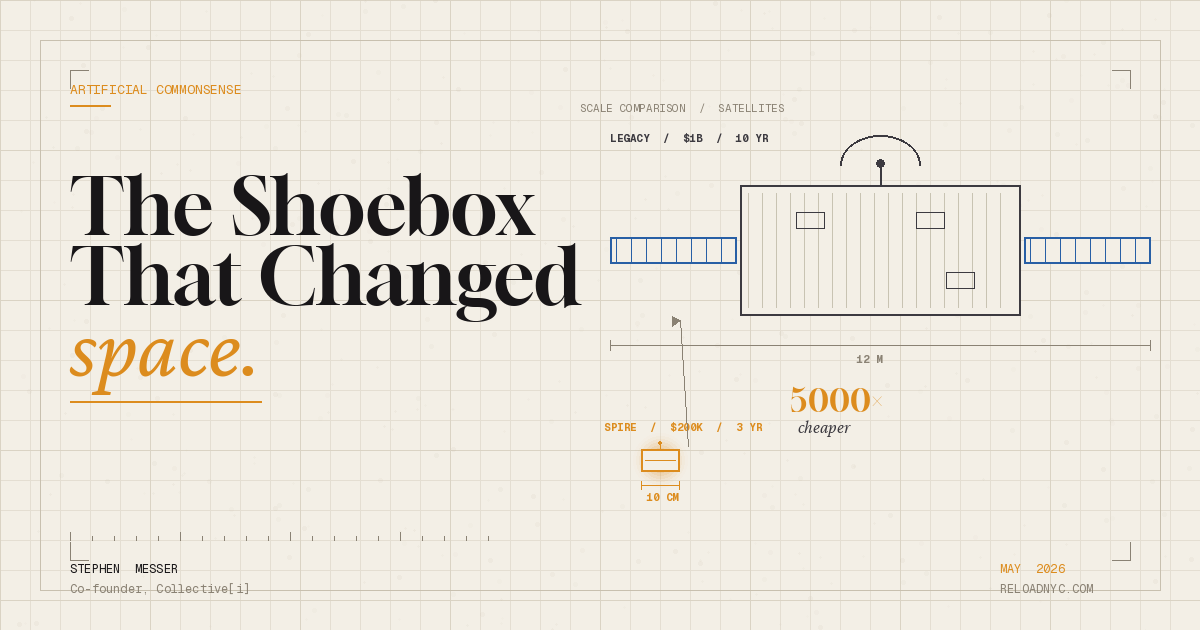
Spire Global started with a question most people in the satellite industry considered absurd. What if a satellite could be the size of a wine box, cost $200,000, and do more than the ones that cost a billion dollars? Here is what happened next.

Spire Global and the First Principles Bet That Opened a New Industry
Stephen Messer, Co-founder of Collective[i] and LinkShare (sold to Rakuten for $425M, 1996–2005). Entrepreneur of the Year/Deloitte Fast 50 winner. Board member, Spire Global (NYSE: SPIR). Growing intelligence.com
I have a disclosure to make before this article starts.
I was part of Spire Global from the very beginning. I am still on the board. This is not a neutral observer's analysis of a company I read about. It is a firsthand account of what it looked like when a small group of founders refused to accept the received wisdom of an entire industry and built something that changed it forever.
I want to share this story not to promote Spire, but because it is one of the clearest examples I have ever seen of first principles thinking at work. The same framework I wrote about in the last piece, the one that rebuilt the sales forecast, applies here at an entirely different scale. And the stakes were not a sales process. They were the future of the space industry.
What the Satellite Industry Looked Like in 2012
To understand what Peter Platzer, Joel Spark, Jeroen Cappaert, and Theresa Condor built, you have to understand what they were building against.
In 2012, a satellite meant one thing. A machine the size of a school bus, or a minivan at minimum, built over three to five years in a cleanroom, loaded onto one of a handful of rockets capable of lifting it, and placed into geostationary orbit roughly 22,000 miles above the equator. The cost of building and launching such a satellite ran between $300 million and $1 billion. For flagship military or scientific satellites, the number went considerably higher.
Sources: World Economic Forum; TE Connectivity; ScienceInsights; Thunder Said Energy
Every part of this equation fed every other part. The satellite was expensive to build, so it needed to last a long time. To last a long time in the harsh radiation environment of space, it needed to be pushed to geostationary orbit. Getting to geostationary orbit required a very large, very expensive rocket. A very large, very expensive rocket might fail. So you needed insurance. Insurance required space-proven technology. Space-proven technology meant components that had flown before. And the last major use of such components was the Space Shuttle, which first flew in 1981.
Read that again. The most sophisticated technology humans had ever put in orbit was routinely dependent on computing architecture that had not meaningfully evolved since the Reagan administration.
The most expensive machines humans had ever built were being powered by technology that had not meaningfully evolved since the Reagan administration. Not because it was the best option. Because the insurance required it.
The circular logic was airtight. And because it was airtight, nobody inside the industry questioned it. The result was a business that moved slowly by design, cost enormously by necessity, served a handful of governments and large corporations who could afford the entry price, and left most of the potential applications of space-based data completely unserved.
The Facebook Satellite That Burned on the Launchpad
Nothing illustrates the fragility of this system better than what happened on September 1, 2016, at Cape Canaveral.
The AMOS-6 satellite had been built by Israel Aerospace Industries at a cost of approximately $195 million. It was owned by Israeli operator Spacecom. Facebook had contracted to use it to provide broadband internet across sub-Saharan Africa as part of its Internet.org initiative, a mission to connect millions of people who had never had reliable internet access.
The satellite was sitting on a SpaceX Falcon 9 rocket during a routine pre-launch test. It never left the pad. The rocket exploded. The satellite, the years of work that produced it, the mission it represented, and the connectivity it would have provided to an entire continent, all of it gone in a single morning.
Mark Zuckerberg, who was in Africa at the time, wrote: 'I am deeply disappointed to hear that SpaceX's launch failure destroyed our satellite that would have provided connectivity to so many entrepreneurs and everyone else across the continent.'
The AMOS-6 story is not a story about a rocket failure. It is a story about concentration of risk. All of that capital, all of that time, all of that mission, concentrated into a single machine, sitting on a single rocket, on a single morning. The industry had structured itself in a way that made any individual failure catastrophic.
This is what method calcification looks like at planetary scale.
The Question Nobody Was Asking
Peter Platzer is a physicist who trained at CERN and the Max Planck Institute before spending nearly a decade as a quantitative trader on Wall Street. Joel Spark and Jeroen Cappaert were engineers. They met at the International Space University. Theresa Condor, who would become COO, had been a banker at Citi. None of them had built a traditional satellite. None of them had careers organized around the existing way of doing things.
That turned out to be the point.
They started with the first principles question: what does a satellite actually need to do? Not what have satellites historically done, or how have they historically been built. What is the actual goal? What do we know to be true about what is possible now, given what technology looks like today?
The answer to that second question had changed dramatically. And the industry had not noticed.
THE SMARTPHONE REVOLUTION THAT SPACE IGNORED
While the satellite industry was insisting on space-proven technology from the 1980s, the consumer electronics industry had been through the most extraordinary period of miniaturization and capability improvement in human history. The device in your pocket in 2012 was more powerful than the computers that ran the entire Apollo program. More powerful, in fact, than the Space Shuttle flight computer by a factor of hundreds.
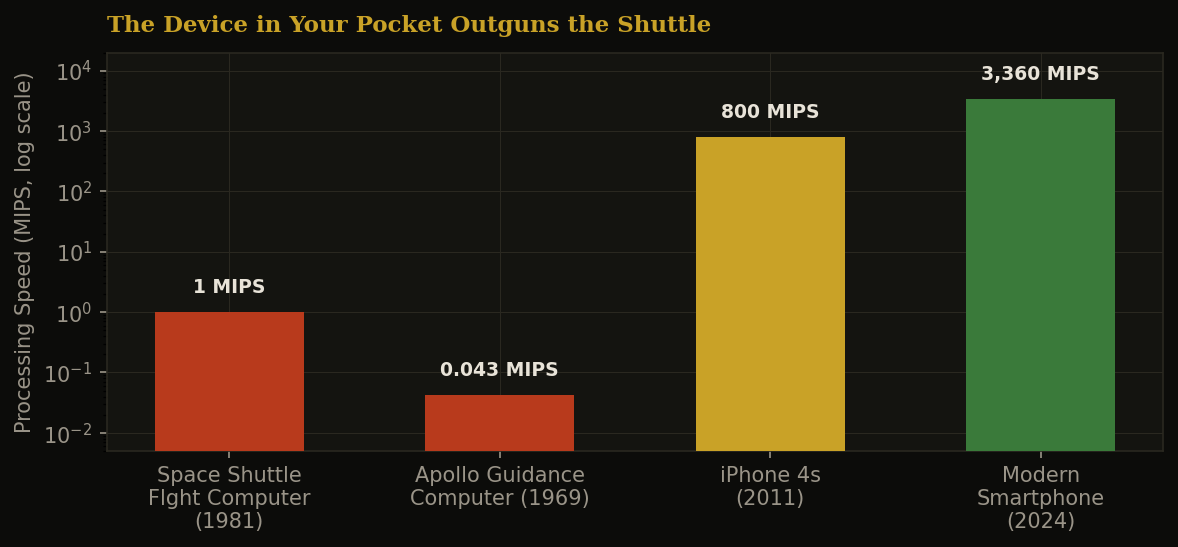
Approximate processing speed comparison. Space Shuttle used IBM AP-101 computers with ~1MB RAM; iPhone 4s had 512MB RAM and ~800 MIPS processing capability.
The Space Shuttle flight computer had 1 megabyte of RAM. An iPhone 4s, released in 2011, had 512 megabytes. The processing speed gap was measured in orders of magnitude. And the iPhone weighed grams, not tons.
Solar panels had also advanced considerably. More efficient panels meant more power from a smaller surface area. Which meant a smaller satellite could generate meaningful power. Which meant a smaller satellite could run meaningful instruments.
The founders asked: if we used modern smartphone-era components, how capable could a small satellite be? And what would it cost?
Rethinking Every Assumption
Once you start asking the first principles question, the dominoes fall quickly.
WHAT ORBIT ACTUALLY REQUIRES
Traditional satellites were pushed to geostationary orbit for one reason: to last 20 to 30 years. To earn back an investment of $400 million to $1 billion, you needed decades of operation. GEO orbit, at 22,000 miles up, is far enough from Earth's gravity well that a satellite can remain stable for that kind of lifespan.
But Low Earth Orbit, where the International Space Station lives, at roughly 250 to 1,200 miles up, is different. In LEO, Earth's residual atmosphere creates drag. A satellite will gradually lose altitude and re-enter the atmosphere, burning up as it does. Depending on the orbit, this takes two to five years.
In the traditional satellite model, this was a fatal flaw. An asset worth $400 million that self-destructs after three years is a catastrophe.
But what if the asset cost $200,000?
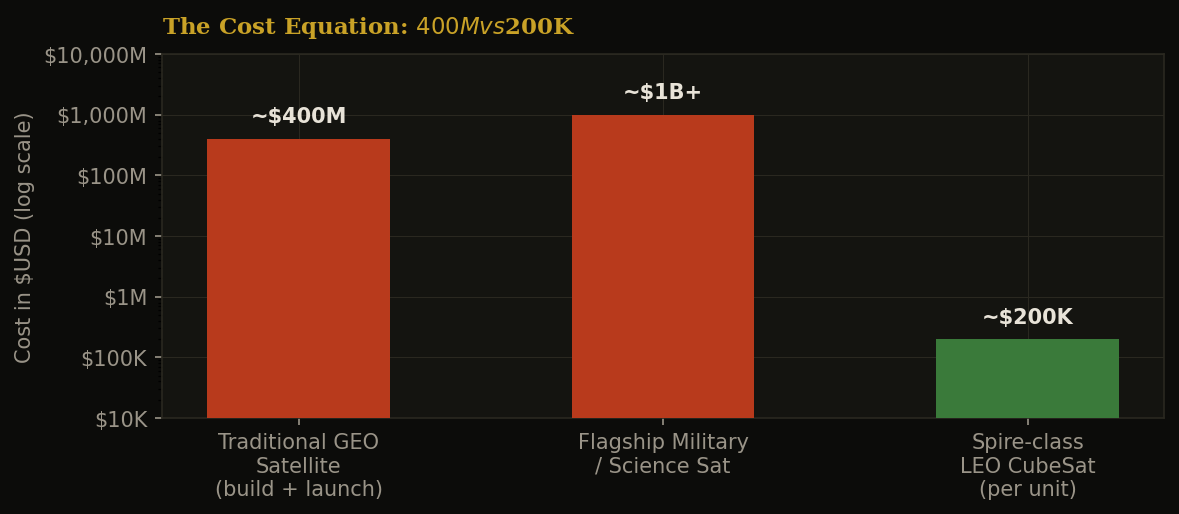
Per-unit cost comparison across satellite categories. Sources: World Economic Forum; ScienceInsights; TE Connectivity.
At $200,000 per satellite, a two-to-three year lifespan in LEO is not a flaw. It is a feature. Every two to three years, the satellite that was already making money re-enters the atmosphere and burns up cleanly — no space debris, no decommissioning cost — and a newer, better, cheaper satellite takes its place. The upgrade cycle that the consumer electronics industry had used to dominate global commerce could now apply to space.
THE INSURANCE LOCK-IN BREAKS
Once the cost drops from $400 million to $200,000, the insurance requirement changes entirely. You do not insure a $200,000 asset the same way you insure a $400 million one. You do not need to use 1980s space-proven components because the financial risk of losing the satellite is not existential. You can use modern, commercial off-the-shelf components — the same parts that power smartphones — because if something fails, you build another one.
The entire circular logic of the traditional satellite industry depended on the cost being catastrophically high. Reduce the cost and the logic dissolves. What had looked like an iron constraint was an artifact of the price point, not a law of physics.
PROBLEMS BECOME FEATURES
The traditional industry had a list of objections to small satellites in LEO. The founders worked through each one.
What They Built
Spire launched its first prototype in 2014. They called their satellites Lemurs — Low Earth Multi-Use Receivers. The name was deliberate. Multi-use. A single traditional satellite was built for a single purpose. The instruments were custom, the mission was fixed, the entire $400 million committed to one thing at launch that it would do for 30 years.
A Lemur carries multiple instruments. It can track ships using AIS. It can track aircraft using ADS-B. It can measure atmospheric conditions using radio occultation. One satellite, multiple missions, all from a platform the size of a wine box.
2012 — Founded
Peter Platzer, Joel Spark, and Jeroen Cappaert found NanoSatisfi (later Spire Global) in San Francisco. A $100,000 Kickstarter campaign funds the first academic mission. 116% funded in 40 days. They set up at hardware incubator Lemnos Labs.
2014 — First Launch
Lemur-1 launches on a Dnepr rocket. The first proof that the model works. They transition from 1U to 3U CubeSat format in seven months. The prototype is in orbit just two years after the company is founded.
2015 — Constellation Begins
First Lemur-2 satellites launch. Spire becomes the first US-based operator to launch from India. The first three satellites are named Joel, Peter, and Jeroen after the co-founders.
2021 — NYSE: SPIR
Spire goes public on the New York Stock Exchange. The company that started with $100,000 from a Kickstarter campaign is now a publicly traded global data company.
Today — 240+ Satellites
Over 240 satellites launched to orbit. Spire builds, owns, and operates a fully deployed satellite constellation that observes the Earth in real time using radio frequency technology. The data acquired provides global weather intelligence, ship and plane movements, and spoofing and jamming detection — helping predict how those patterns impact economies, global security, business operations, and the environment.
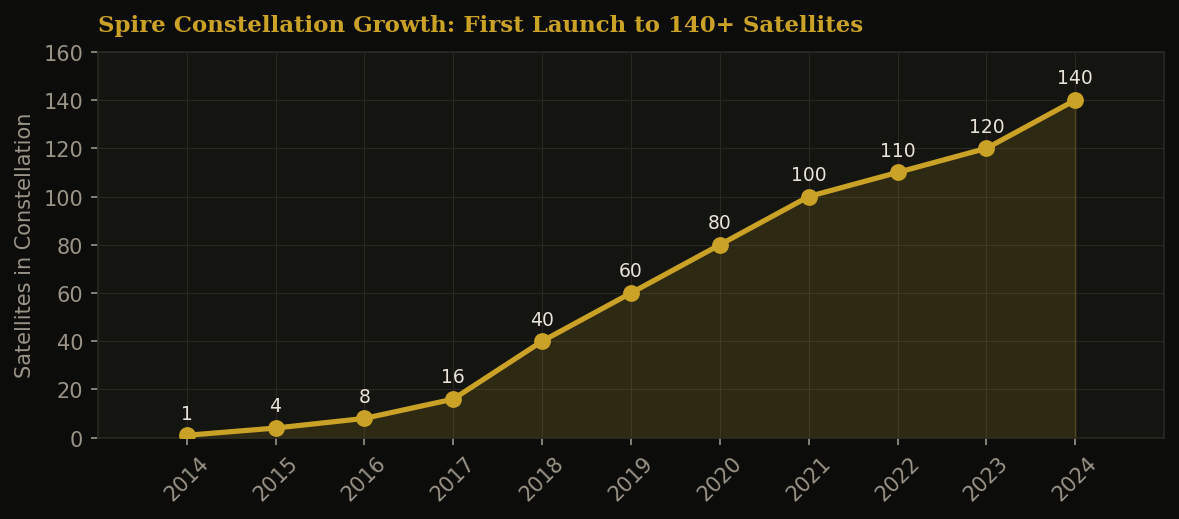
Satellites launched to orbit since inception. Source: Spire Global public disclosures; Wikipedia; eoPortal.
What the Model Unlocked
The Lemur is multipurpose by design. That single decision changes the economics of space data entirely.
A traditional satellite operator sells one type of data because the satellite was built for one mission. Spire sells weather data and aviation surveillance from the same hardware. The marginal cost of adding a data product is the cost of adding an instrument to a satellite that is already going up anyway. The upgrade cycle ensures that each new generation carries whatever the most valuable instruments are at that moment.
Traditional satellite operators were managing 30-year-old decisions. Spire is managing what it wants to sell next quarter.
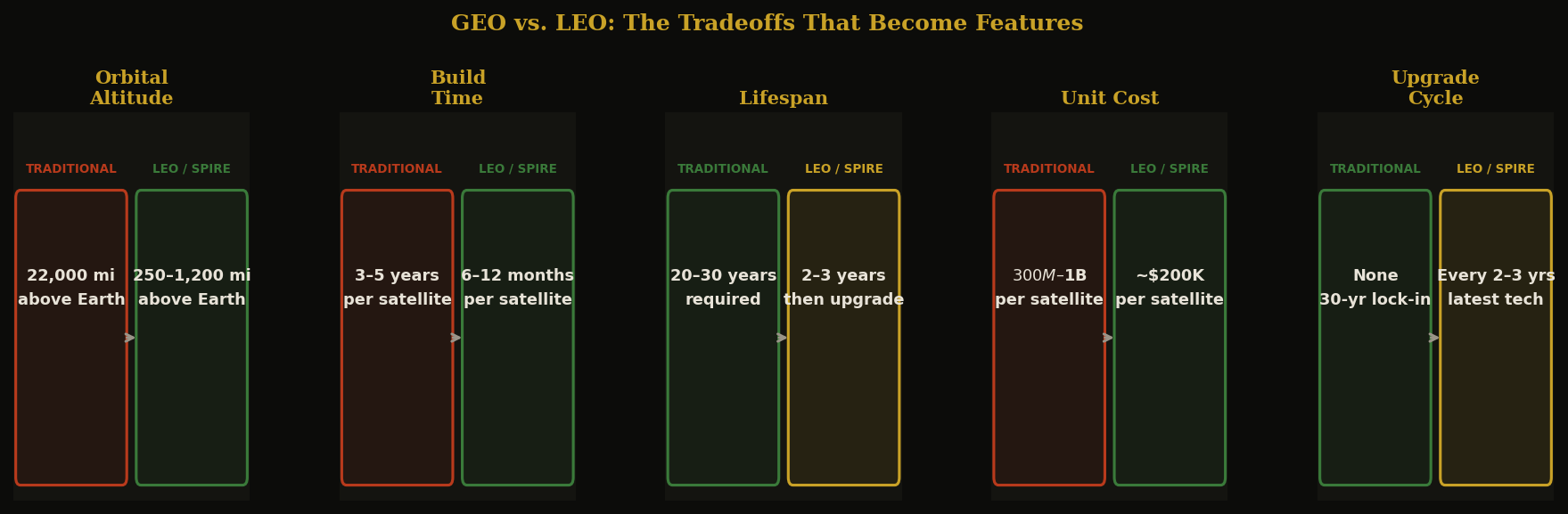
Comparative index across key dimensions. GEO baseline normalized to 100 for each dimension; LEO values reflect relative position on the same scale.
THE INDUSTRIES THAT EMERGED
By proving that small, inexpensive satellites in LEO could do meaningful work, Spire opened a door that had been closed to everyone.
Nobody questions SpaceX's Starlink today. Thousands of small satellites in LEO providing global broadband. Nobody questions Planet Labs, whose constellation provides daily imagery of the entire Earth's surface. These companies exist in the form they do because Spire, and a handful of other early pioneers, demonstrated that the model worked.
The industry consensus that 'real' space work required billion-dollar satellites and decade-long timelines was not a technical truth. It was a cultural artifact of the cost structure that had prevailed for fifty years. Once the cost structure changed, the consensus dissolved.
The industry consensus that 'real' space work required billion-dollar satellites was not a technical truth. It was a cultural artifact of the cost structure that had prevailed for fifty years. Once the cost structure changed, the consensus dissolved.
The Same Pattern, Macro Scale
In the last article I wrote about the sales forecast. Thirty years of drift. A goal that made sense, a method that calcified, a measurement designed to tolerate the failure, and a constituency that built careers around defending the process.
The satellite industry is the same pattern at planetary scale.
The goal was always data from space. The method was the billion-dollar GEO satellite. The measurement was designed to justify the cost. And an entire industry of launch providers, insurers, component manufacturers, and government procurement offices built around the assumption that the method was the only way.
Spire did not improve that method. They discarded it. They went back to the actual goal. They asked what we know to be true about what technology could do. And they built something new from what remained.
The founders started with a $100,000 Kickstarter campaign. They got their first satellite to orbit in two years. They went public nine years later. Today they run one of the world's largest commercial satellite constellations, selling data to governments, aviation operations and logistics companies, energy and agricultural firms, and financial institutions.
Not by building a better billion-dollar satellite. By asking whether the billion-dollar satellite should exist at all.
They did not build a better billion-dollar satellite. They asked whether the billion-dollar satellite should exist at all. The answer changed an industry.
What This Series Is Actually About
I chose the sales forecast and the satellite industry as the first two examples in this series because they sit at opposite ends of a spectrum. One is a process that happens inside every sales organization, every week, at the cost of a Friday afternoon. The other is a capital-intensive industry that moves on decade-long timescales and shapes national security and global commerce.
The pattern is identical in both.
Every industry has its version of the billion-dollar satellite. The thing that everyone builds because everyone has always built it. The constraint that feels like physics but is actually history. The measurement that was designed to tolerate the failure of the method rather than expose it.
First principles asks you to find that thing. To separate the goal from the method. To ask what you actually know to be true, stripped of the assumptions that have calcified around it. And to build from what you find.
This is what it means to be AI-first. Not to add AI to what you have. To look at what you have with clear eyes, delete what should not exist, and then — and only then — build something new.
There are more examples. I will keep writing them.
If you want the next piece delivered when it publishes, subscribe at reloadnyc.com. Free. No paywall. No course at the end. Just the work.
If this piece changed how you are thinking about the convergence of trends beyond AI, forward it to one person who needs to read it. The board member who has not thought about smart-specs policy. The CISO who has not started the post-quantum migration. The friend who has been asking why you are worried about all this. That is how the argument moves. One reader telling another.
If you are the person who just got this forwarded to you, welcome. Subscribe at reloadnyc.com. Two dozen pieces in the archive already. Another two dozen in the queue.
Reply if you want to argue. I read every one. The pieces get sharper when readers push back.