The Companies Winning at AI Are Playing a Different Game.
They're not buying more tools. They're not running more pilots. They're building something that gets smarter every single day. A recursive engine their competitors can't copy because by the time you see it, it's already three laps ahead. Here's exactly how they do it.

Stephen Messer, Co-founder of Collective[i] and LinkShare (sold to Rakuten for $425M, 1996–2005). EY Entrepreneur of the Year/Deloitte Fast 50 winner. Board member, Spire Global (NYSE: SPIR). Building intelligence.com
I've been around long enough to recognize a defining moment when I'm standing in one.
I built LinkShare from scratch, invented affiliate marketing, a model nobody had a name for yet. Watched it go from 'what is this?' to 'how did we ever sell without it?' I've spent the last decade at Collective[i] doing the same thing with AI models for predicting economic outcomes. And right now, in 2026, I am watching the same pattern unfold — but faster, and with higher stakes than anything I've seen before.
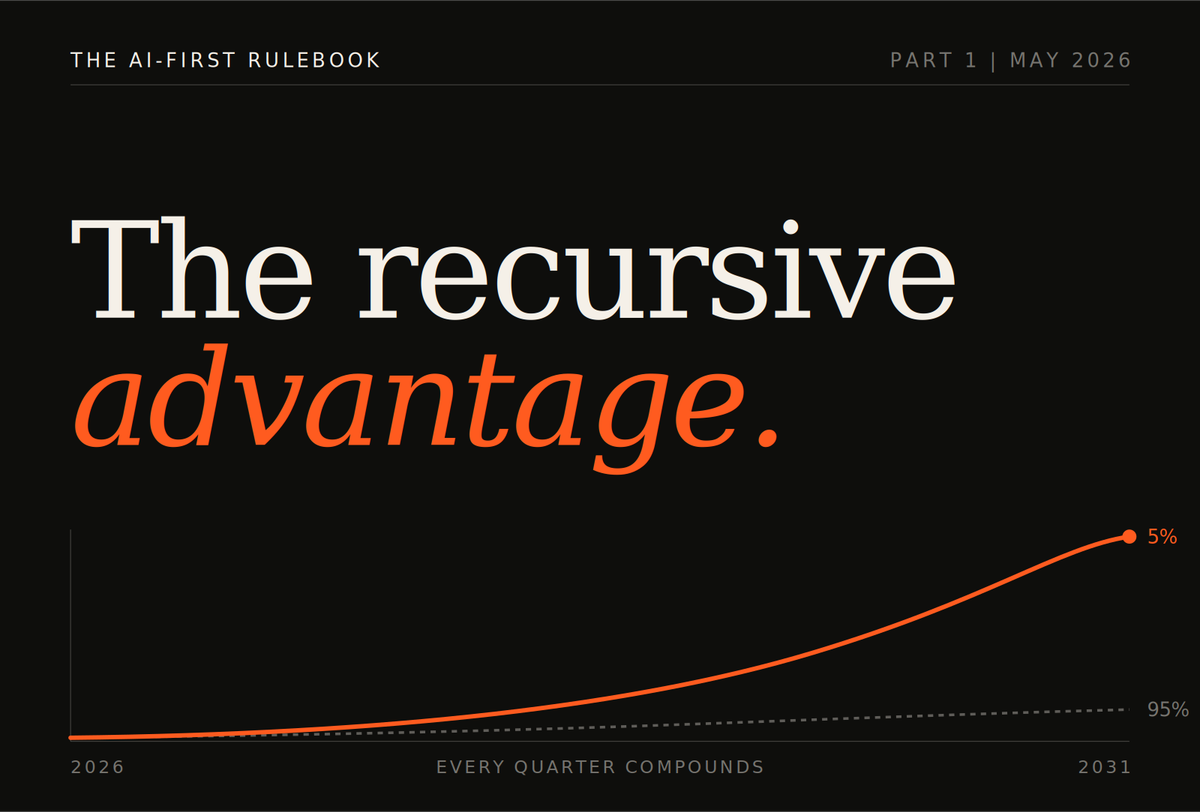
A small group of companies have figured something out. They're not using AI to do their old jobs faster. They're building organizations that learn. That compound. That get structurally harder to compete with every single quarter. MIT studied 300 enterprise AI deployments and found that 95% of companies deploying AI see zero measurable P&L impact. Not small returns. Zero. The 5% who are winning are outperforming the S&P 500 by 29%, growing revenue per employee at more than double the rate, and — in the sales organizations I work with most closely — eliminating entire software stacks within a year of going AI-first and watching revenue go up with every removal.
This post is for the people who want to be in that 5%. The playbook. Specific. Sequential. Grounded in what I've watched work across hundreds of companies over the last decade.
The theme running through all of it is one idea: the recursive advantage. The companies winning at AI aren't just more efficient. They're building organizations that improve automatically. Every day compounds on the last. That's not a feature. It's a new category of business.
THE GAP — AND HOW FAST IT'S COMPOUNDING
The window is open. The companies moving now are not fighting over the same ground as the ones standing still. They're building on entirely different terrain. Every quarter that compounds widens the gap. Which is exactly why right now is the right moment to move.
Rule One: Winners Pick One Outcome and Go All-In
Every company I've watched build a recursive advantage starts with one move that sounds almost too simple: they pick a single outcome and make it the only thing that counts.
Not 'AI transformation.' Not 'becoming AI-native.' One outcome — measurable, time-bound, owned by everyone from the CEO to finance to the people doing the work. Speed. Efficiency. Value creation. Scale. One.
I learned this building LinkShare. We'd sit with creative agencies and clients trying to figure out how to adapt their brands to affiliate marketing — a channel nobody had a mental model for yet. Every conversation hit the same wall: they wanted direct sales and brand lift simultaneously. Both always produced neither. The resource split guaranteed mediocrity in both directions. The winners were the ones who said 'sales first — prove it, then expand.' The companies who tried to win every game at once won none.
AI is the same. Winners define the outcome first. Everything else is downstream of that choice.
An AI-first company isn't a company with AI tools. It's a company that built a recursive improvement engine into how it operates — one that gets smarter without being asked, every single day.
For most organizations, efficiency is the right first outcome. Three reasons:
WHY EFFICIENCY FIRST
Rule Two: Start with Sales. Here's Exactly Why.
Revenue is the most important place to start. Not just because it matters most to the business, but because it makes the case for everyone else inside it. Efficiency gains in sales are immediate and visible. They change revenue per employee fast enough that finance notices in the first quarter. They free budget to fund the next move. And if your competitor deploys the same AI while you're deliberating, you lose market share and never understand why — because their forecast is getting more accurate every day and yours is still assembled in a Friday spreadsheet.
The average rep spends less than 30% of their week actually selling. Two hours a day. The rest goes to CRM updates, forecast prep, pipeline meetings, prospect research, inbox management. Salesforce measured this. HubSpot measured it. The number has not moved in five years despite billions spent on sales technology. The average rep uses eight systems to close a single deal. Gartner found sellers overwhelmed by their stack are 45% less likely to hit quota, which is why only 25% of B2B reps hit their number in 2024. The talent was there. The time wasn't.
THE SALES PRODUCTIVITY OPPORTUNITY — 2024-2025
Here's what we've learned watching this happen up close. When an organization deploys Collective[i]'s model for predicting economic outcomes, the first quarter goal is simple: get sellers from 30% productive to 80% productive. One metric. Everyone owns it.
Forecasting gets automated entirely, updated daily, zero human input. Logging disappears — the intelligence captures activity from the network automatically, so reps stop being data entry clerks. Pipeline reviews run through the AI, not through two-hour meetings where someone reads a spreadsheet out loud. Contact intelligence, relationship maps, paths to decision-makers — all surfaced automatically. Follow-ups drafted. Win-rate patterns from comparable deals surfaced before the call.
But here's what most people miss: it's not just the internal tools that disappear. The entire purchasing ecosystem around sales goes with them. Data vendors selling contact lists, outbound email cadence platforms, phone number databases, intent data subscriptions, enrichment tools, information brokers. Gone. Just as ChatGPT ate Word, PowerPoint, and IDE coding tools in a single year, a real intelligence model eats the entire category of tools that existed because intelligence didn't. Dollar for dollar, the spend that went to managing complexity, to buying data silos, to keeping a Jenga stack standing — that spend becomes revenue-generating investment instead.
CRM is now legacy. It was always the problem dressed up as the solution — a system designed to make salespeople enter data so managers could read it. Intelligence removes both the data entry and the meeting where it gets read back. That's not an upgrade. That's an elimination.
This is why Klarna killed Salesforce. Not as a cost-cutting move — as a logical consequence of deploying real intelligence. When the AI knows what's happening across the network in real time, the CRM has nothing left to do. The stack that ran B2B sales for thirty years isn't being replaced by better software. It's being made irrelevant by a fundamentally different kind of system. One that learns. One that doesn't need humans to feed it. One that gets more accurate every day.
WHAT WE CONSISTENTLY SEE — AND WHY IT MATTERS FOR ANY INDUSTRY
About 10% of our clients eliminate their entire sales stack within a year of going live. Not trimmed. Eliminated. The CRM, the forecasting tool, the engagement platform, the analytics layer — all of it, replaced by a single intelligence that learns from every deal, every relationship, every outcome across the network.
Think about what that company looks like from the outside. Its forecast updates itself. Its win rates improve from network patterns no individual seller — and no competitor — has access to. Its cost structure shrinks as the stack shrinks. And it gets harder to compete with every quarter — because the intelligence compounds while everything else stands still.
And then something else happens. The revenue intelligence stops being just a sales tool. It becomes a layer. Marketing agents pull from it in real time. Logistics agents use revenue predictions to get ahead of demand. HR agents use it to understand where to hire. Finance uses it to build forward-looking models that aren't based on what humans guessed last quarter. The revenue intelligence isn't a log of what your sales team did. It's a prediction engine — and predictions about economic outcomes are useful to every function in the company that has to make decisions about the future. Which is all of them.
This is what 'AI-first company' actually means. Not AI deployed in functions. AI as the nervous system. The difference between a company with electricity in some rooms and a company that runs on electricity.
Rule Three: Define Where Humans Stay in the Loop — Then Shrink That List
Define exactly where humans must stay in the loop. Make that list as short as possible. Then treat it as the ceiling, not the floor. The goal, over time, is zero.
At the start of any AI project, explicitly list the decisions that require human judgment. Legal exposure. Regulatory compliance. Irreversible actions above a certain risk threshold. Decisions that could permanently damage a client relationship. That's the list. Keep it brutally short. Everything not on it runs autonomously. You review outcomes, not decisions.
Klarna is the proof. They eliminated Salesforce. Killed Workday. Consolidated 1,200 SaaS applications into an AI-native stack. Revenue per employee went from $400K to $700K in a single year. They didn't move carefully — they moved decisively, defined what required human judgment, automated everything else, and let the intelligence run.
Rule Four: Five Mindset Shifts That Separate Builders from Buyers
McKinsey surveyed nearly 2,000 people across 105 countries. The companies actually moving the P&L with AI are nearly three times more likely to have fundamentally redesigned how work gets done rather than just automating what was already there. These are the five shifts that make redesign possible.
One — Process is where AI goes to die.
Every process your company runs exists for one reason: to manage human error. AI doesn't make the same errors. So when your team rebuilds a process in an agent — and they will, because it's the first instinct — they've spent real money to recreate the ceiling of what humans could do without it. Wrong question: 'How do we do this with AI?' Right question: 'What were we actually trying to achieve? And with intelligence, what can we achieve instead?'
Two — You don't need one AI. You need the right brains for the right problems.
Language models are AI for words. Outstanding at legal, coding, marketing, email, summarization — anything where input and output is language. But that's one category. One brain. AI models trained on narrow, proprietary data are a different thing entirely — super-intelligence within a specific domain. Collective[i]'s model for predicting economic outcomes is not a language model wearing a revenue hat. Those are structurally different tools solving structurally different problems. Gartner found 60% of AI projects unsupported by the right model type will be abandoned. Not underperforming. Gone.
Three — The first thing your team builds will be wrong. That's the curriculum.
Every agent your team builds for the first time will be a recreation of what they already do. They'll tell you it's not as good. They're right. And they're completely missing the point. The old process was designed around human limitations. Those limitations are gone. Cars were bad at being horses. The question isn't whether AI does the old thing perfectly. It's: now that the limits have changed, what becomes possible that wasn't before?
Four — If your agent isn't getting smarter, you built software and called it AI.
Software is rigid. Hard-coded. It relies on the human behind it to make every call. It doesn't learn. It doesn't improve. It just sits there getting more expensive and less relevant until someone replaces it.
Five — Find the edges of your AI first. Then build around them, not against them.
Every intelligence has limits. Language models hallucinate. Economic models have confidence thresholds. Vision models struggle with edge cases. The mistake: they hit one of these limits early, decide AI doesn't work, and walk away. Map the edges. Build guardrails there. Then maximize what the intelligence does in all the space where it's extraordinary.
Rule Five: Buy Intelligence, Not Stacks — The 8-Brain Company
Most leaders have the same mental model for AI they had for software: one stack per function. A sales stack — CRM, forecasting tool, engagement platform, analytics layer, conversation intelligence, plus five more things nobody remembers approving. An HR stack. A marketing stack. Each one a collection of point solutions doing narrow jobs, siloed from each other, requiring humans to translate between them.
A true intelligence for sales shouldn't sit alongside your CRM. It should make your CRM unnecessary. You can remove the stack piece by piece if you want to move carefully — but understand what you're keeping: every piece left in is a place where the old rigidity lives. You don't want AI plus your old stack. You want AI instead of it.
You don't hire someone who only knows accounts receivable and call that an accounting function. You hire someone who understands accounting — because breadth handles everything you haven't anticipated. Intelligence is the same. The question isn't 'what tool replaces this feature?' It's 'what intelligence replaces what this entire stack was built to do?'
And the goal isn't eight silos of intelligence — one per function. It's a system of intelligence. Brains that talk to each other, learn from each other, and together form something smarter than any one alone. Your revenue brain informs your marketing brain. Your marketing brain informs your product brain. The whole system compounds.
If your AI doesn't replace most of your old software stack, you didn't buy intelligence. You bought SaaS with a new label. The silo is still there. The rigidity is still there. You just paid more for it.
The average company runs 106 SaaS applications. Large enterprises run 130+. Klarna had 1,200. Every one is a silo. Every one has its own data model, its own update cycle, its own place where intelligence stops and rigidity begins. A truly AI-first company needs 8 to 10 intelligences to run the entire business. Revenue. Engineering. Finance and operations. Marketing. People. Legal. Product. Each one learns from every action it takes, improves over time, and connects to the others.
Rule Six: If Speed is Your Goal, Run an XPrize — Not a Hackathon
I've watched the hackathon playbook a hundred times. Leadership brings in LLMs. Teams show off demos. Everyone applauds. Two weeks later, nothing has changed. Same jobs. Same stack. Same bottlenecks.
There's a reason DARPA runs competitions, not workshops. The competitive format converts the most powerful thing in your organization — competitive DNA — from a force that resists change into one that drives it. Fear of AI becomes urgency to win. Define the target clearly. Form teams. Make it public. Invite your local university. Welcome outsiders. Give it a real prize. Make winning the outcome — not the coolest agent, not the best-presented idea, not who used the most tokens. The outcome.
Jensen from Nvidia can sell token leaderboards — he has GPUs to move. If you want your team to burn expensive compute and produce slop, they'll be happy to help. Don't build that incentive structure.
Rule Seven: What AI-First Leadership Actually Looks Like
The companies winning at AI share one thing in their leadership culture: the people at the top are using it themselves. Building agents. Testing models. Failing at things and learning from the failure. Not watching demos — doing. NTT Data found that organizations where leaders express genuine AI fluency achieve 2.3x higher transformation success rates. That fluency doesn't come from reading about it. And it can't be delegated.
At the same time, one in three workers is actively resisting their company's AI rollout — not out of fear of technology, but because nobody has answered the real question underneath: where do I fit? The leaders who are winning have addressed this directly. They've made the upside clear. They've elevated the people building things.
You're Early. That's the Whole Point.
When I built LinkShare, affiliate marketing had no name. The companies that understood it first didn't just get a head start — they built advantages that compounded so fast that by the time the rest of the market caught on, the architecture was already different. You couldn't close the gap by working harder. The structure was different.
That's exactly where we are right now. The companies going AI-first in 2026 — not AI-curious, not running pilots, actually building recursive organizations — are going to look in five years the way Amazon looked in 2003. Not just ahead. On a different curve.
The recursive organization doesn't just outperform its competitors. It outlearns them. Every deal closes with the intelligence knowing something it didn't know before. Every quarter the forecast gets more accurate. Every marketing campaign makes the revenue model smarter. Its competitors, meanwhile, are still running the same stack. Holding the same pipeline reviews. Logging the same activities into the same CRM that nobody updates accurately.
That's not a technology gap. That's a compounding gap. And it widens every single day.
The rules in this post are the pattern I've watched work — across industries, across company sizes, across every starting condition I've seen. Pick one outcome. Start with sales. Get sellers from 30% to 80%. Watch the old stack indict itself. Build agents that learn. Replace stacks with brains. Connect the brains into a system. Let the system improve itself. Then do it again in the next function. And the next.
That's the recursive advantage. It's not a strategy. It's an architecture. And the companies building it now will be the ones that look back on 2026 the way the internet pioneers looked back on 1996 — as the year the window was open, and they walked through it.
KEY METRICS