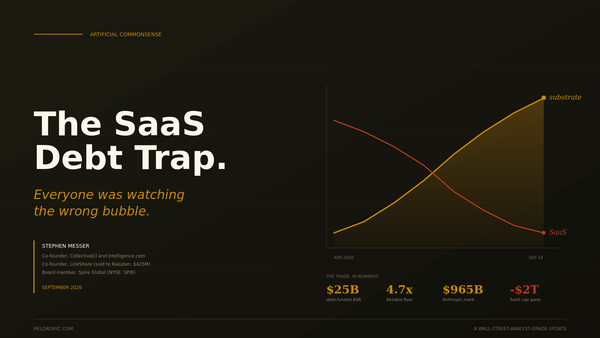
Stephen Messer, Co-founder of Collective[i] and LinkShare (sold to Rakuten for $425M, 1996–2005). EY Entrepreneur of the Year/Deloitte Fast 50 winner. Board member, Spire Global (NYSE: SPIR). Building intelligence.com
In Part 1 I made the argument that AI-first companies don't buy tools — they buy brains. That the right mental model isn't 'one tool per problem' but 'one intelligence per domain.' That a truly AI-first company runs on 8 to 10 intelligences, not 106 SaaS applications.
This post is the practical companion. A map of what's actually available — organized by type, with real examples and real proof points — and three sample intelligence stacks showing what this looks like inside different kinds of companies.
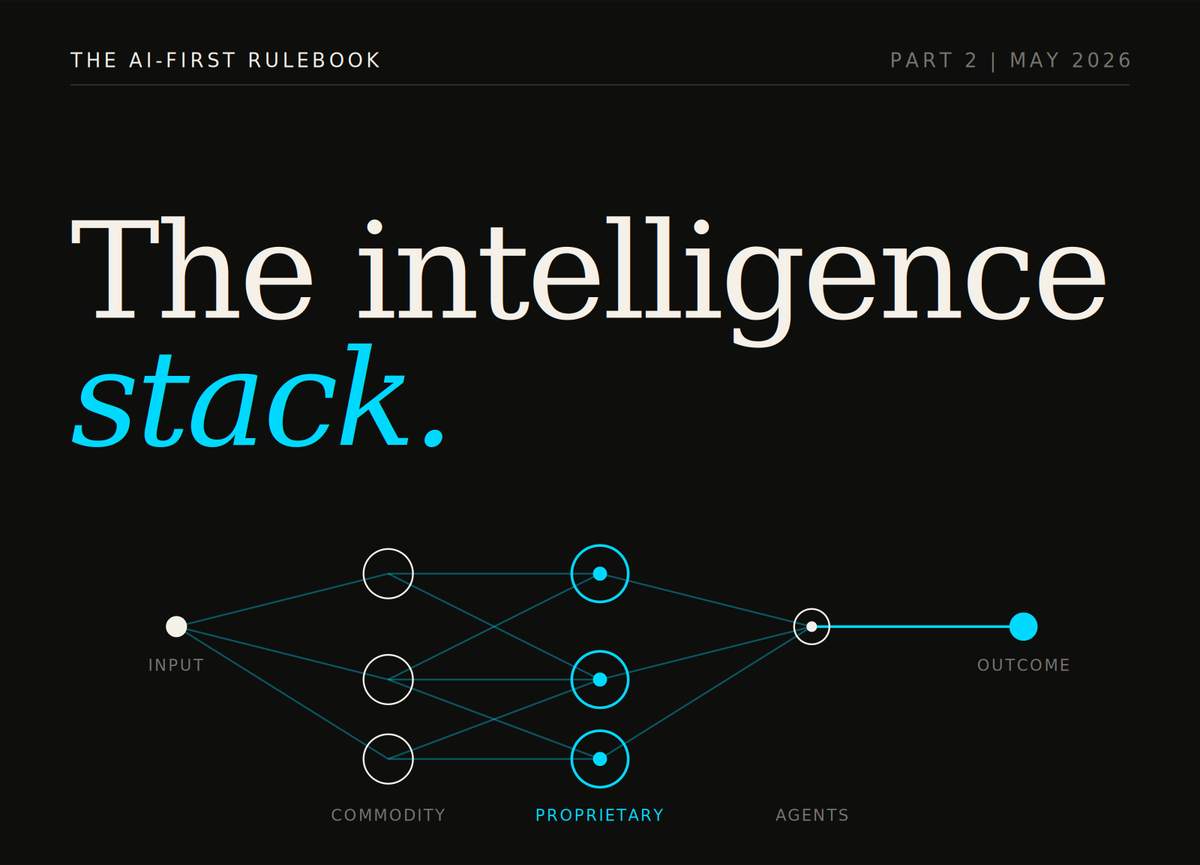
The landscape has two levels. Commodity intelligence — the brains that are rapidly becoming infrastructure, like electricity, available to everyone. And proprietary intelligence — domain-specific AI models trained on narrow, deep data that produce capabilities no general-purpose model can replicate. Commodity brains are the table stakes. Proprietary brains are the moat.
Commodity intelligence is what everyone will have. Proprietary intelligence is what nobody else can copy. Build your stack around both — but know which one is the advantage.
Tier One: Commodity Intelligence
These are the brains that handle language, images, voice, video, and code. They are commoditizing fast — price and capability are converging across providers. You will need all of them. You should not be loyal to any of them. Build your agents so the underlying model can be swapped without breaking anything above it.
This tier now has both proprietary (closed) and open-source options in every category. Open-source matters: you can run it on your own infrastructure, fine-tune it on your proprietary data, and never pay per-token costs or worry about data leaving your environment.
COMMODITY Language — AI for Words
Legal, marketing, email, summarization, code, customer support, internal knowledge — anything where input and output is primarily text. ChatGPT and Claude are eating every language-based software company. The question isn't whether to use one; it's making sure you can swap between them.
Claude (Anthropic) Proprietary · Long-form · Reasoning · Safety Best-in-class for long documents, nuanced reasoning, and code. Preferred for high-stakes writing where accuracy and tone matter. Anthropic leads on safety and compliance. | ChatGPT / GPT-4o (OpenAI) Proprietary · Multimodal · Agents 400M+ monthly users. Strongest for agentic workflows and multimodal tasks. Industry default. Broad plugin and integration ecosystem. |
Gemini (Google DeepMind) Proprietary · Long-context · Workspace 2M token context window. Deep integration with Google Workspace, Search, and enterprise data infrastructure. Best for organizations already embedded in Google's ecosystem. | OPEN SOURCE Llama 3 (Meta) Open Source · On-premise · Fine-tunable Run on your own infrastructure. No API costs, no data leaving your environment. Intuit fine-tuned Llama on proprietary financial data and outperformed closed models on domain tasks at a fraction of the cost. The open-source standard. |
OPEN SOURCE Mistral / Mixtral Open Source · Efficient · European French startup delivering some of the most efficient open-source models available. Mixture-of-experts architecture rivals GPT-4 on many tasks while running cheaper and faster. Strong for EU organizations with data sovereignty requirements. | OPEN SOURCE DeepSeek Open Source · Reasoning · Cost-efficient Open-source models that pushed the frontier on reasoning per dollar. DeepSeek R1 produces GPT-4-class reasoning at a fraction of inference cost. Demonstrated that frontier capability does not require frontier compute budgets. |
COMMODITY Images, Voice, Video, and Code
Midjourney / DALL-E 3 Proprietary · Image Generation Marketing assets, product mockups, brand concepting, UI prototyping. DALL-E 3 used by nearly 1 in 4 AI-adopting organizations. Best for quality and prompt adherence out of the box. | OPEN SOURCE Stable Diffusion / FLUX Open Source · Image Generation · Customizable Run locally, fine-tune on your brand, generate at scale with no per-image cost. Stable Diffusion is the open-source standard; FLUX is the newer generation pushing quality further. Best for organizations with high image volume or strict brand consistency. |
ElevenLabs / Whisper (OpenAI) Proprietary + Open Source · Voice ElevenLabs for hyper-realistic voice synthesis. Whisper for transcription — open source, runs locally, the standard for sales call analysis, meeting intelligence, and accessibility. | Sora / Runway / Kling Proprietary · Video Generation Text-to-video at production quality. Marketing campaigns, product demos, training content without a film crew. Kling (open-weights from Kuaishou) is the emerging open alternative. Moving faster than any other commodity category. |
GitHub Copilot / Cursor Proprietary · Code Intelligence Engineering productivity multiplier. Copilot users complete tasks 55% faster. Cursor adds full codebase context and agent-style editing. Already table stakes for any engineering org competing on build speed. | OPEN SOURCE StarCoder 2 / CodeLlama Open Source · Code Generation Open-source code models that run on your own infrastructure. StarCoder 2 covers 600+ programming languages. CodeLlama (Meta) is fine-tunable on your proprietary codebase. No code leaves your environment. |
Tier Two: Proprietary Domain Intelligence
These are the brains that matter for competitive advantage. AI models trained on narrow, deep, proprietary data — often the product of years of specialized research — that produce capabilities no general-purpose model can replicate. This is where the moat lives. And the range of domains now covered is wider than most people realize.
PROPRIETARY Life Sciences & Material Science
AlphaFold 3 (Google DeepMind) Protein Structure · Drug Discovery Predicted protein structures for virtually every known protein. Won the Nobel Prize in Chemistry in 2024. Now predicts interactions between proteins, DNA, RNA, and small molecules. The foundational intelligence for any organization in life sciences. Drug discovery that once took years now takes months. Standard practice in every serious pharma pipeline. | SPARROW (MIT) Drug Discovery · Synthesis Planning MIT's AI system for streamlining drug discovery and synthesis planning. Identifies viable synthesis routes faster than traditional screening by orders of magnitude. Exscientia's AI-designed OCD drug entered Phase I clinical trials in 12 months. A process that normally takes 4-5 years. news.mit.edu/2024/smarter-way-streamline-drug-discovery |
Insilico Medicine Drug Target ID · Clinical Candidate End-to-end AI drug discovery. Identified a novel target for idiopathic pulmonary fibrosis and advanced a candidate to preclinical trials in 18 months at $150K. A process that normally takes 4-6 years. Published positive Phase IIa results in Nature Medicine, June 2025. | Recursion Pharmaceuticals Phenomic Screening · Drug Repurposing Combines automated high-throughput imaging with deep learning to identify therapeutic targets and repurpose existing molecules. Acquired Exscientia for $688M in 2024 to build the largest AI drug discovery platform. |
PROPRIETARY Revenue & Economic Intelligence
Collective[i] Economic Outcomes · Revenue Intelligence Collective[i]'s model for predicting economic outcomes is purpose-built for B2B sales organizations. Not a language model with a revenue dashboard. A domain-specific AI model trained on network-scale commercial relationship data. Automates forecasting, removes CRM dependency, surfaces network intelligence on deals and contacts. 365 Data Centers: double-digit revenue growth in six months. 10% of clients eliminate their entire sales stack within one year. intelligence.com — free for individual sellers | Renaissance / Two Sigma / Jane Street Trading Intelligence · Quantitative Finance Proprietary AI models trained on decades of market data. Renaissance's Medallion Fund has averaged 66% annual returns before fees since 1988. Jane Street's 2024 revenue doubled, surpassing Morgan Stanley — largely from AI-driven trading. The financial markets have been running recursive AI for thirty years. Every other industry is catching up. |
PHYSICAL WORLD Engineering, Architecture & Physical Design
The most underestimated category. These models don't work with language or data — they work with the physical world. They design objects, structures, and systems that have never existed before. This is where AI stops being a productivity tool and becomes a creative engine.
Vitruvius / Ideal House (ICON) Architecture · Construction AI ICON's Vitruvius is an AI model trained on architectural principles and construction constraints that designs homes. Ideal House is the first home designed entirely by AI and built with ICON's 3D printing technology — from prompt to physical structure. Architecture that took months now takes hours. Construction follows. The building industry's software moment. ideal.house | Noyron (LEAP 71) Aerospace Engineering · Rocket Design AI model that autonomously designs rocket engines. The TKL-5 thruster — designed entirely by Noyron without human input — passed its first hot-fire test in June 2024, producing 5 kN of thrust on its first attempt. Printed from copper, designed as a single continuous piece. What an engineering team would spend months designing, Noyron produces in hours. Already working with aerospace companies across the US, Europe, and Asia. |
Hyperganic / Relativity Space Generative Engineering · Additive Manufacturing Hyperganic's AI designs complex mechanical parts from scratch — a rocket engine from a spreadsheet of performance specs. Relativity Space builds rockets with 1% the parts of a traditional rocket using AI-driven robotics. | Physical World Models (Google DeepMind) Physical Simulation · Robotics Foundation models for understanding and reasoning about the physical world — enabling robots and automated systems to interact with real environments. The intelligence layer for the next generation of physical automation. arxiv.org/abs/2511.07416 |
What Speed Looks Like Now
The best argument for building the intelligence stack isn't efficiency. It's velocity. Here's what happens to timelines when the right intelligence is applied to the right domain.
4-5 yrs 12 mo DRUG TO PHASE I TRIAL | Drug Discovery — Exscientia / Insilico Medicine AI-designed molecules cut the path from project start to clinical candidate from 4-5 years to 12-18 months. Insilico advanced an IPF candidate in 18 months at $150K. Exscientia's OCD molecule was the first AI-designed drug in human trials. Over 173 AI-discovered programs are now in clinical development. |
Months Hours ROCKET ENGINE DESIGN | Aerospace — LEAP 71's Noyron A rocket thruster designed autonomously by AI, printed in copper, passed its first hot-fire test producing 20,000 horsepower on its first attempt. What an engineering team would spend months designing, the AI produces in hours — and the design is more structurally integrated than anything humans would produce manually. 311institute.com/an-ai-just-designed-then-3d-printed-a-completely-new-form-of-rocket-engine |
12+ mo Hours HOME DESIGN | Architecture — ICON's Vitruvius Ideal House is the first AI-designed, 3D-printed home — from architectural brief to construction-ready design in a fraction of the time traditional design requires. ICON's Vitruvius applies decades of architectural and structural knowledge to produce buildings that can actually be built. ideal.house |
Quarters Real-time REVENUE FORECASTING | Sales — Collective[i] Forecasts that used to require weekly pipeline meetings and human input now update daily without anyone touching them. Win-rate patterns from network-scale data surfaced before every call. The quarterly review that was always wrong gets replaced by a daily intelligence that improves automatically. intelligence.com |
What an Intelligence Stack Actually Looks Like
Before the stacks, the proof that this isn't theoretical.
Klarna had 1,200 SaaS apps. They replaced Salesforce. Replaced Workday. Consolidated everything into an AI-native internal stack. Revenue per employee went from $400,000 to $700,000 in a single year. $40 million profit improvement. That's not a software story. That's what happens when you stop buying tools and start buying intelligence.
Here are three sample stacks assembled from what exists today. Each function gets one brain. Commodity intelligences are labeled by category — because the specific provider will change as the market commoditizes. Proprietary intelligences are named because the domain specificity is the point.
SAMPLE STACK A
B2B Revenue Organization — 200-2,000 employees
REVENUE | Collective[i] — Economic outcome prediction, automated forecasting, network intelligence Removes: CRM, forecasting tool, pipeline analytics, contact databases, data vendors, outbound cadence platforms, engagement platform |
LANGUAGE | LLM — Proposals, contracts, email, support, internal knowledge, summarization Removes: Content creation SaaS, proposal software, knowledge base tools, most writing workflows |
MARKETING | Image AI + Video AI — Campaign assets, video production, creative at scale Removes: Routine creative production agencies, most content tools, stock image subscriptions |
ENGINEERING | Code AI — Code generation, review, testing, documentation Removes: Manual documentation, parts of QA tooling, significant engineering overhead |
PEOPLE & OPS | LLM + Voice AI — Recruiting, onboarding, training content, meeting intelligence Removes: Training platforms, meeting summary tools, parts of HRIS workflow |
FINANCE | LLM + Collective[i] economic signal — FP&A, scenario modeling, board reporting Removes: Manual reporting cycles, Excel-based forecast modeling, lag between revenue signal and financial planning |
SAMPLE STACK B
Life Sciences Company — Drug Discovery Pipeline
DISCOVERY | AlphaFold 3 — Protein structure prediction, target identification, molecular interaction modeling Removes: Years of wet-lab screening for initial target validation |
DESIGN | SPARROW (MIT) — Synthesis planning, candidate design, route optimization Removes: Traditional medicinal chemistry timelines. 4 to 6 years becomes 12 to 18 months. |
CLINICAL | Clinical domain AI — Trial design, patient matching, adaptive protocols, regulatory documentation Removes: Months of manual protocol development, significant document preparation overhead |
COMMERCIAL | Collective[i] — Revenue forecasting, payer intelligence, launch pipeline prediction Removes: Traditional market access modeling tools, manual launch forecast prep |
LANGUAGE / DOCS | LLM — Regulatory filings, publications, clinical summaries, internal knowledge Removes: Significant manual medical writing overhead across the entire pipeline |
SAMPLE STACK C
Engineering & Manufacturing Company
DESIGN | Generative engineering AI — Component and system design from performance specs, geometry optimization Removes: Months of iterative CAD design cycles. LEAP 71's Noyron designed a working rocket engine autonomously in hours. |
SIMULATION | Physical World Model — Performance prediction, failure analysis, real-world optimization Removes: Physical prototyping cycles for initial validation |
PRODUCTION | Computer vision AI — Quality control, predictive maintenance, yield optimization Removes: Manual inspection bottlenecks, reactive maintenance programs |
REVENUE | Collective[i] — Economic outcome prediction, pipeline intelligence, customer network intelligence Removes: CRM, manual forecasting, disconnected sales analytics, data purchasing |
LANGUAGE / OPS | LLM + Voice AI — Engineering documentation, training, compliance, customer support Removes: Technical writing overhead, manual documentation, tier-1 support |
THE TEST FOR EVERY INTELLIGENCE PURCHASE One brain per function. If you have two tools doing the same job, one of them is SaaS wearing an AI label. If you deployed this intelligence and your SaaS bill didn't go down, something is wrong. The intelligence should eat the software. That's what tells you it's real. |
How to Wire Them Together: This Is Where Agents Come In
The stack is the intelligence. Agents are what make it move.
Think of each brain as a domain expert who knows everything about their area. Agents are the connectors — pulling a signal from revenue intelligence, carrying it into marketing, turning it into a campaign brief, passing the result back. Except agents don't sleep, don't lose context, don't forget what they were told in the last meeting, and they execute in seconds, not days.
Here's the practical architecture. Your revenue AI predicts that a deal in the healthcare vertical is at risk. An agent detects that signal, queries the marketing AI for relevant case studies and re-engagement content, drafts an outreach sequence through the language model, schedules it, and updates the forecast. No human involved. No meeting required. The system handles it because the agent knows which intelligence to ask and how to connect the answer to an action.
The agents define the outcomes you want. The brains provide the intelligence to achieve them. Build agents first by asking: what judgment call used to take a week, require three people, and still produced an inconsistent result? That's your first agent. Give it access to the right intelligence, define what a good outcome looks like, and let it run.
A few principles for building agents that actually work. Keep them interchangeable with the underlying models — an agent built on top of one LLM should be swappable to another without rebuilding the logic above it. Define the human checkpoints before you build, not after. And measure agents by outcomes, not by activity. An agent that makes 100 decisions isn't better than one that makes 10 better ones.
The intelligence stack is the infrastructure. The agents are the operating system that runs on top of it. Together, they form something that a 106-SaaS-tool company cannot replicate — not because the tools aren't available, but because a stack of software doesn't produce compounding intelligence no matter how many products you add to it.
That's the architecture of the recursive organization. Brains that know their domain. Agents that connect them. Outcomes that improve every day without being asked.