AI Adoption Is K-Shaped. Knowing Which Side You Are On Is the Job of a Leader.

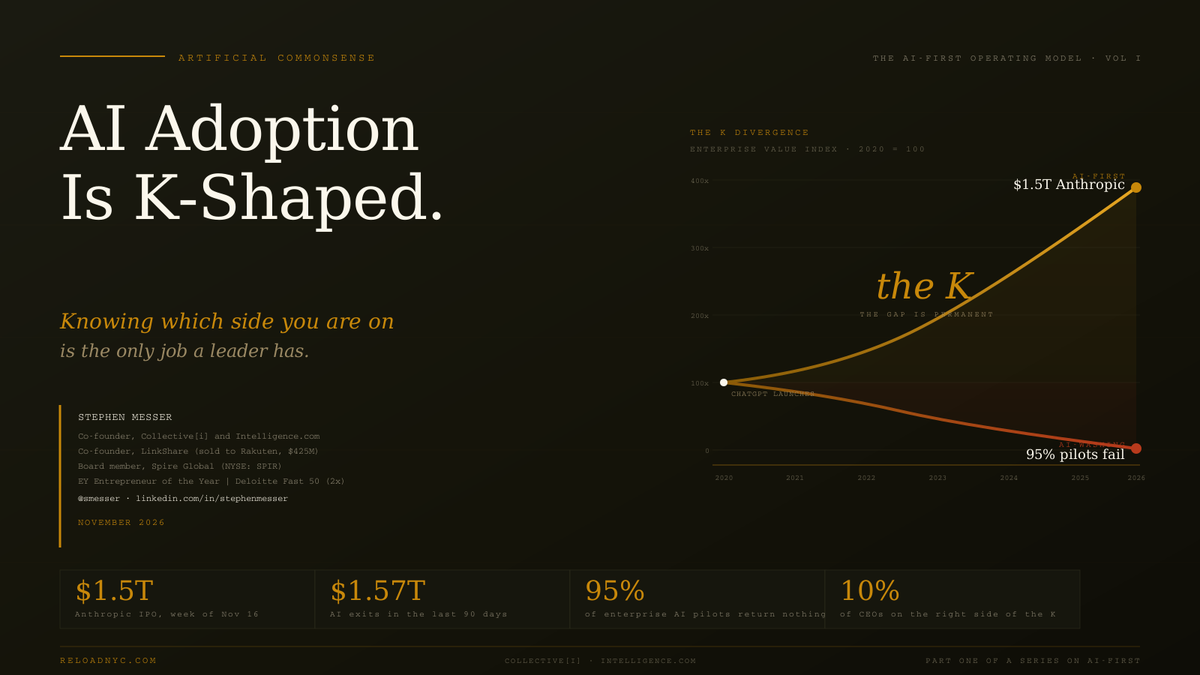
Anthropic prints at $1.5 trillion this month on a $68 billion run rate. Early employees walk into tens of millions each. Meanwhile 95 percent of enterprise AI pilots return nothing, and most S&P 500 boards are paying SaaS renewals with an "AI" sticker on the slide. One side of the K is a new substrate. The other side is AI washing.
By Stephen Messer
Co-founder, Collective[i] and Intelligence.com. Co-founder, LinkShare (sold to Rakuten, $425M). EY Entrepreneur of the Year / Deloitte Fast 50 Winner (2x). Board member, Spire Global (NYSE: SPIR).
Follow: @smesser on X · LinkedIn.
November 2026
Anthropic filed its public S-1 on October 26, 2026 to list on Nasdaq under ticker ANT. The roadshow started November 9. The debut is before Thanksgiving. The valuation is landing around $1.5 trillion, down from a $2 trillion target floated in October. That is a four-year-old company running a $68 billion annualized revenue rate, with $331 billion in stock awards on the balance sheet and about 1,500 employees. Early engineers walk into tens of millions each the day the stock prints.
It is the third major AI exit in H2 2026. SpaceX acquired Cursor for $60 billion in August. AMD bought Fei-Fei Li's World Labs for $8.2 billion in September. Anthropic goes public this month at $1.5 trillion. Roughly $1.57 trillion of AI value in ninety days, and the next tier has not filed. Every category where an AI model can eat the layer below it is funded, hiring, and shipping.
The median S&P 500 board is debating whether to renew Salesforce because the vendor added "Claudeforce" to the slide. That debate is the K. Economist Peter Atwater coined the term in 2020 for the pandemic recovery that split one economy into two. Six years later it is the cleanest frame for what AI is doing to corporate America. One side rebuilds the operating substrate. The other buys AI stickers and calls it done.
This piece pulls together a year of writing. The SaaS Debt Trap is the top eating the bottom. The Hypothesis Company is how an AI-first org thinks. 50x Faster is how it ships. Agent Swarm is how it scales. Own the Harness is what it owns. The Quiet Veto is why most leaders stall. The Anthropic IPO is the siren.
What the $1.5 trillion price is actually signaling
Ignore what Anthropic sells for a minute and look at what the price means. Nine-month revenue hit $33.2 billion at 85.5 percent gross margin. The September quarter alone was $17 billion, roughly $68 billion annualized. NRR near 900 percent. Customers paying $100,000+ a year went from about 950 to over 11,900 in twelve months. OpenAI sits right next to it at $1.25 trillion, with roughly 70 percent quarterly annualized growth. Neither is "bigger." Both carry the same bet.
The bet is not which model wins. It is that the operating substrate of every company that matters in ten years is being rebuilt on top of these models. A new substrate is worth $1.5 trillion. A chatbot seat is not. Those 11,900 enterprise customers in twelve months are the market telling you every corporate function is about to be rewritten against this substrate.
AI is a substrate. Not a subscription.
This is the single idea most leaders miss, and it is why they end up at the bottom of the K. A language model is one kind of brain. The new substrate is a stack of different brains, each pointed at a different problem, orchestrated together. Buying a ChatGPT or Claude seat is the easy part. Running the substrate is the work.
The proof sits on top of the market right now. Fei-Fei Li sold World Labs to AMD on September 28, 2026 for $8.2 billion. World models are the substrate for manufacturing, robotics, and anything that moves atoms. Yann LeCun left Meta and raised $1.03 billion for AMI Labs in March, twelve employees. Demis Hassabis's Isomorphic Labs raised $2.1 billion and is putting AI-designed drugs into human trials. Waymo and Tesla run driving models at freeway scale. At Collective[i] we have trained an economic model on the world economy for ten years, used by GTM teams, PE firms, VC funds, banks, and insurers predicting where the economy goes next, at ninety-three to ninety-five percent accuracy.
Buying a language model or coding copilot and calling it a strategy is the same trade as buying a SaaS seat and adding a chatbot button. It is the trade killing the SaaS stack right now. SaaS providers run a marketing story, borrow against the balance sheet to buy back stock before earnings, and press-release MCP and AI partnerships, as Adobe and Salesforce did this year, so the slide looks modern. The substrate under them is changing and they are decorating the old one. If your company runs the same playbook, it will fail for the same reasons.
I covered this in The SaaS Debt Trap. Curative canceled a $600,000 Salesforce contract and rebuilt in two months. Kirkland & Ellis committed $500 million to proprietary AI. Morgan & Morgan committed $1 billion. Salesforce authorized a $50 billion buyback and announced "Claudeforce" six months later. The buyback is a stock-price response. The AI announcement is AI washing. Neither is a substrate. Both are the bottom of the K.
The data on the enterprise side is already in
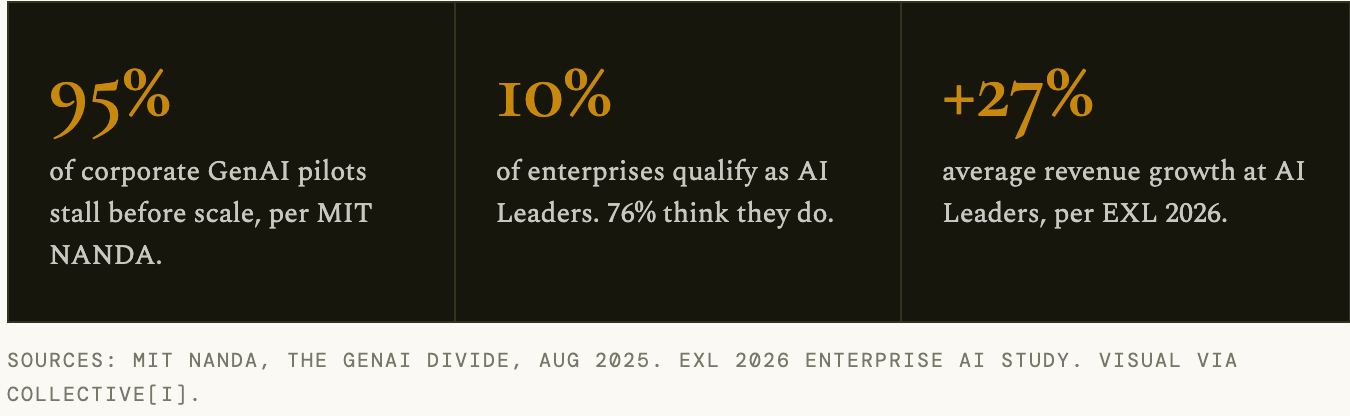
Three pieces of evidence sit on the table. The first is MIT's NANDA initiative, led by Aditya Challapally at the MIT Media Lab. Its August 2025 report The GenAI Divide covered 150 enterprise leaders, 350 employees, and 300 public AI deployments. Ninety-five percent of pilots stalled before scale. Challapally called it a "learning gap." Winners rebuilt the workflow around the tool. Losers wrapped the tool around the workflow.
The second is the EXL 2026 Enterprise AI Study. Of 322 senior decision makers, only 10 percent qualified as AI leaders. Those leaders showed 27 percent average revenue growth, 26 percent cost savings, and 22 percent margin improvement. Seventy-six percent believed they were in that group. The 66-point perception gap is the distance between a CEO who bought the company a ChatGPT, Anthropic, or Gemini subscription and a company that actually rebuilt the operating model.
The third is what AI-first CEOs are doing publicly. Tobi Lütke at Shopify sent a leaked memo in April 2025 requiring every team to prove AI could not do a job before any new hire. Luis von Ahn at Duolingo declared Duolingo AI-first the same month. Sebastian Siemiatkowski at Klarna said an internal agent was doing the work of 853 full-time CS agents, then partially reversed the next month. The reversal is the point. Even the poster child had to retune. Companies that have not started have no muscle to retune.
Why the laggard CEO cannot see it coming
Erik Brynjolfsson, Daniel Rock, and Chad Syverson published The Productivity J-Curve in 2020 for the NBER. General purpose technologies, the class that holds electricity, the computer, and now AI, require enormous intangible investment before measured productivity shows up. Process redesign, new business models, retraining, new management practice. National accounts do not count any of this as investment. Early on, the company building invisible capital looks like it is wasting money. Productivity drops. Then the capital compounds. Productivity rockets. The shape is a J.
The laggard sees only the first half of the J at the AI-first competitor. They are spending more, hiring builders, running pilots, and quarterly numbers do not move. The laggard tells the board, look at them, they are burning money and we are stable. Then the J bends. By then the intangible capital has been under construction for two or three years and the laggard has no time to build it. I wrote about why the GDP data lags in AI Is Everywhere Except in the GDP Numbers.
The K-shape has an older academic root. David Autor, Frank Levy, and Richard Murnane's 2003 paper showed how technology hollows out routine middle-skill work while compounding returns at the top. The same shape is running one level up. Middle companies get hollowed. Top companies compound. Enrico Moretti at Berkeley adds the geography. Seventy percent of US computer science patents come from ten metros. When Rochester's cluster collapsed with Kodak, invention per capita collapsed too. Talent concentrates at the metro level and the company level by the same mechanics.
Why this is a flywheel, not a step change
A step change would be survivable. An incumbent can match a one-time jump with a one-time jump of its own. This is not that.
The AI-first company is a flywheel. Fast companies attract builders who ship more in a quarter than slow companies ship in a year. Product improves, margins open, more builders show up. Each revolution is faster than the last.
The slow company runs the wheel in reverse. Change-makers leave. Hiring is harder than last quarter. The best candidates route to fast companies. The ones who stay did not want to change. The leader looks at a team of defenders and concludes the market is not ready. The leader is wrong. The team is. I covered the compression in The Arc of a Company's Life Now Fits Inside a CEO's First Term.
Talent flight is not a side effect of the AI shift. It is the engine. The slow company's best people are joining the fast company's flywheel. Every quarter the slow company's hiring pool is thinner and the fast company's agent fleet is bigger.
The talent race even at the top. Karpathy as the tell.
In December 2020, Dario Amodei, then OpenAI's VP of Research and co-lead on GPT-3, walked out with his sister Daniela and seven senior scientists. Tom Brown, lead author on the GPT-3 paper. Jared Kaplan, who wrote the scaling laws paper. Christopher Olah on interpretability. Sam McCandlish on architecture. Jack Clark on policy. Ben Mann on infrastructure. They founded Anthropic in 2021. That is the company now filing at $1.5 trillion.
On May 19, 2026, Andrej Karpathy, one of OpenAI's original six co-founders, announced he was joining Anthropic to lead pretraining. He left OpenAI in 2017, came back, left again in 2024 for Eureka Labs. Two years later he landed at Anthropic, not OpenAI. John Schulman, another original co-founder, joined Anthropic in August 2024, then left in February 2025 for Mira Murati's Thinking Machines Lab. Even Anthropic's bench is poachable. If the best researchers can be pulled across the Bay to a four-year-old competitor, the pull is not compensation. It is the team and the bet.
Now bring it home. Anthropic's $331 billion in stock awards, with $199 billion to founders, leaves roughly $132 billion for 1,500 employees. Per-head runs into the tens of millions. Every other hiring manager in AI competes against that number.
Would any top AI engineer work for a legacy SaaS company whose last platform shift was a cloud migration? Karpathy is not applying for head of AI at a payroll SaaS company. Neither is anyone on his tier. The best builders route to the frontier labs. The next tier routes to vertical AI companies. What is left for the SaaS incumbent is the tier that would not have been hired at all. The career side is in Your Job Is Dead. Long Live Your Career.
China is not slowing down. The second flywheel is running too.
Stanford's 2026 AI Index put the top US model, Anthropic's Claude Opus 4.6, at 1,503 Elo on the Arena Leaderboard. The top Chinese model, ByteDance's Dola-Seed-2.0 Preview, scored 1,464. A 39-point gap. Stanford described the race as "effectively closed." Alibaba's Qwen 3.7 Max is the highest Chinese model on the Artificial Analysis Index and now sits ahead of Gemini 3.5 Flash. Zhipu's GLM-5 Turbo and Alibaba's Qwen 3.6 Plus are recent releases the Western press largely ignored.
The hardware is moving the same way. Cambricon is targeting around 500,000 AI accelerators in 2026, more than triple its 2025 volume, with ByteDance taking over half and Alibaba close behind. Cambricon's revenue grew about fourteen times in the September quarter. Huawei's Ascend line is the backbone of in-country training, and Beijing is pushing Chinese AI firms off Nvidia and onto Ascend. SMIC's 7nm DUV runs at roughly 20 percent yield versus TSMC's 60-plus percent on 2nm. Chinese policy treats that as an engineering problem, not a reason to slow down.
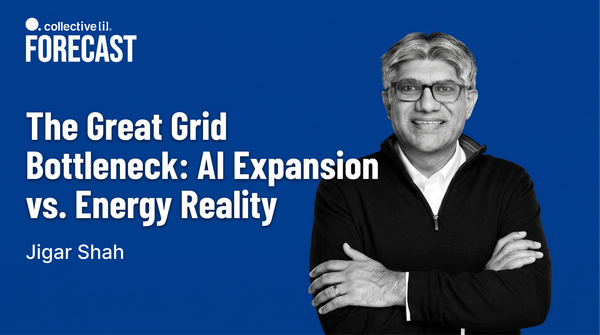
The US answer is the compute buildout, and the US constraint is the grid. I covered that in The Data Center Is Not the Problem. Jigar Shah, who ran the DOE Loan Programs Office, is on CI Forecast today at 3:30 PM ET on this topic. Free to watch after a one-time sign-in at Intelligence.com.
Two things matter for a Western CEO not building AI chips. First, the global AI stack is now a race between two fully funded national efforts, 2.7 percent apart at the top. Second, the trickle-down is extremely fast. A Chinese model at 97 percent of US frontier performance on Chinese silicon means every Chinese vertical AI startup has access to cheap, local, nearly-frontier compute. The AI-first manufacturer in Shenzhen does not wait for approval to buy H200s. It ships the agent today.
Trickle-down matters because each new class of model gets pushed into open source almost immediately, and the substrate spins faster every time a new capability lands. Language models are the obvious one. World models came next and power humanoid robotics, drone delivery, and the physical-AI stack. 3D printing is running on top of them.
Freeform raised a $67 million Series B in February 2026 with Nvidia as investor. It builds software-defined autonomous metal printing factories where AI runs the laser melting in real time and verifies every part digitally. The old metal part took weeks, a skilled operator, and hundreds of thousands in tooling. The Freeform part takes days, no operator, ships verified at a fraction of the price. A new factory on the substrate.
Freeform is not alone. Jeff Bezos raised $12 billion at $41 billion for Project Prometheus in June, an artificial general engineer for physical products. Travis Kalanick raised $1.7 billion in July led by a16z for Atoms, for industrial AI. Below the press names, vertical AI companies are rebuilding banking, insurance, investing, claims, underwriting, lending, logistics, anywhere decisions sit in software. Physical and paper economies are both being rebuilt on the substrate.
The pattern runs across every category. A language model goes open-source and a vertical SaaS replacement ships in a month. A world model goes open-source and a robotics startup folds it into a warehouse arm the same quarter. An economic model goes open-source and a hedge fund retrains it and reprices its book. Every release raises the floor for the next builder. The gap between a company that can absorb the next release and one that cannot is the K, widening every quarter.
The top of the K has two engines now. US frontier labs racing each other for talent and compute. Chinese labs racing to close the gap on homegrown silicon. Every open-source release of every new model class spins the flywheel faster. The laggard enterprise is not in the race. It is renting a seat from one of the runners.
Europe is the ten-year preview of what happens to a laggard
You have seen this at the scale of a continent. For forty years the best European builders have left for New York, San Francisco, Boston, and Seattle. Europe is educated, wealthy, and old. More PhDs per capita than the US. Trillions in pension and sovereign pools. No tech sector to brag about. SAP, ASML, and Spotify combined do not add up to one Nvidia.
Your company is a smaller version of Europe. The best builder on your team is already a flight risk, destination AI-first. Every departure makes the remaining team more comfortable with the current way. Culture calcifies. Hiring thins. The capital that used to chase your sector chases the people who left. The company looks fine on the P&L right up until the quarter it does not. Europe has looked like that for forty years, compressed to a few quarters inside a company.
Missing a substrate change costs you the company. Three examples.
The argument collapses to one line. When the substrate under your business changes and you do not, the company goes. Three cases from the last thirty years.
Time Warner launched Pathfinder.com on October 24, 1994. It put People, Time, Fortune, Money, Sports Illustrated and about eighty other properties under one portal. Each magazine lost its own URL. Time Inc.'s Don Logan called the site a "black hole." Pathfinder shut down in April 1999 after swallowing well over $100 million. Time Warner ported the magazine onto the web. Jeff Bezos built a different company around the medium.
In 2000, Blockbuster CEO John Antioco turned down the chance to buy Netflix for $50 million. Blockbuster had 9,000 stores and $5.9 billion in revenue. It filed bankruptcy in 2010. Netflix is now worth more than the rest of traditional cable combined.
Sears was the second-largest US retailer in 1993. Amazon incorporated in a Bellevue garage in 1994. Sears filed Chapter 11 in October 2018. Amazon's 2024 revenue was roughly $638 billion. The incumbent ports the old operation onto the new medium. The newcomer rebuilds around it. The ones who ported did not survive.
What AI-first actually looks like
I have been writing about the AI-first operating model for a year. The long versions are in AI-First Rivals Are 50x Faster Than You, The Hypothesis Company, An AI-First Framework for Responsible AI, and The Agent Swarm Just Killed Scale as a Moat.
The flat version. AI-first companies run a flattened hierarchy. Fewer layers, more builders, less approval. They are recursive, rebuilding their own processes every quarter with their own models. They run more agents than employees. Payroll goes down, the agent fleet goes up. They do not call a language model "AI." They talk about which brain is which, and senior people own the orchestration layer. Culture runs on hypothesis, not opinion. Responsible AI is a principle, not a kill switch. The goal is not to avoid the technology. The goal is not to go out of business while using it responsibly.
The leader problem, said plainly
Most leaders I meet on the wrong side are not bad. They know their industry and their people. They built the current machine for the old world, where software rollouts took a year, committees decided on gut, and the win was efficiency on the same process. That operating system does not run on AI.
The tell is the language. When a leader says "we have AI" and means "we have a Claude subscription," that is the tell. Treating AI as one tool is the same category error as saying "we have transportation" when you mean a bike. Transportation is a bike, a car, a plane, a train, a boat. In AI you have a language model, an economic model, a biology model, a vision model, a forecasting model, a code model. Calling all of it "AI" means your team will apply a language model to every problem. That is biking from New York to London.
The same category error shows up in AI governance. I wrote about it in An AI-First Framework for Responsible AI. The laggard writes one blanket "AI policy" that assumes a chatbot is the whole category. The AI-first company sets controls per model class, because training, retention, discovery, and third-party risk look different for a vision model than for a language model than for an economic model. One policy means one brain. One brain means the bottom of the K. Fear is a plan to survive one quarter. AI-first is a plan to compound for a decade.
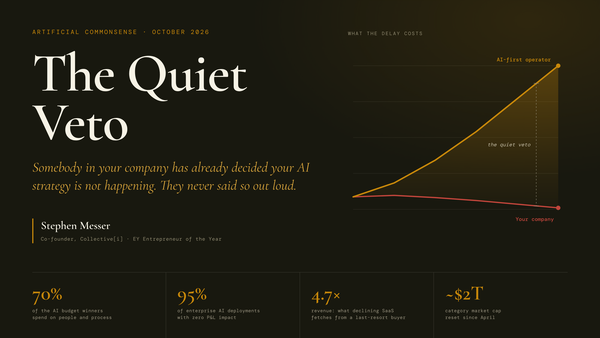
The people below these leaders see this. The ones who want more are asking a quiet question. Why am I working for this person. They do not stage a confrontation. They update their LinkedIn. I wrote about this quiet resistance in The Quiet Veto.
Score your company. Six benchmarks that tell you where you sit on the K.
Signs are soft. These are numbers to check. Each one has a target the top of the K hits and a bottom where the rest are stuck.
One. How many AI models are you running, and how many are not language models. Top of the K runs four or five model classes against the same flow. Bottom runs one language model against everything.
Two. How many digital agents are running, and in which departments. How many specific, named agents ship work every day, at what cost-to-performance ratio. Target is more agents than employees on every team.
Three. What percentage of your agents use recursive learning. Agents that improve from prior runs. Top companies are around 20 percent today and climbing. Most companies are at zero.
Four. How many layers of leadership, and what percentage of senior time is spent building. The AI-first shape is two or three layers with 90 percent of time on building and shipping. More than four layers means a 2015 operating model with a 2026 stack on top.
Five. Is cycle time declining every quarter. Idea to shipped product. Quote to cash. Claim to close. Fast companies show double-digit quarterly reduction. Slow companies measure OKRs and notice the drift a year too late.
Six. Is your team fluent in first principles. Can an engineer explain why they chose MCP over a direct API. Can a PM explain why a forecasting model beats a language model for the problem in front of them. If every answer is "we use Claude for that," the team learned a vendor, not a craft. The harness-ownership risk is in Rent the Model. Own the Harness. Own the Network.
If any of these six feel unfamiliar, you are at the bottom of the K. Not maybe. Not soon. Now.
The GTM example. What each side of the K looks like today.
Take go-to-market. At the bottom of the K, GTM in 2026 looks identical to GTM in 2010 with new logos on top. A CRM nobody trusts, a data provider bolted on, an agent built on a chatbot workbench. Pipeline data is people-driven and manipulated. Marketing runs through a legacy sequencer. Selling time per rep has declined every year. Quota attainment has fallen for fifteen years. The AI layer is a chat wrapper on a dashboard.
At Collective[i] the model sits on the other side. Agents forecast, research accounts, produce short client podcasts on a schedule, run daily network analysis per rep, and build other agents recursively. Data is built in the way Waze learns from every driver. Over six months the model produced 20 to 40 percent revenue growth for clients with fewer cost-center people. Rev ops gone. Sales stack gone. New roles as agentic engineers and digital CROs. The long version is in The Hypothesis Company.
One side is buying more tools. The other side is the tool, running itself. Multiply the delta across every function, every quarter.
Two ways to fix this
You are not going to rip and replace leadership. The cost is too high. Hiring an outside AI-first leader who does not know your industry is risky. Boards do not move that fast.
Option one is train the leaders on first principles, not on which subscription to buy. Start with the model taxonomy. Language, economic, vision, forecasting, code, biology, audio. What each one does. What it costs. What it fails at. Then put the leader in a room with a builder for a full offsite. Pick a process they know, a quote-to-cash, a claims triage, an underwriting decision. Rebuild it from scratch assuming AI-first. Make the leader write the connections, choose between MCP and a direct API, hit the endpoints, watch it fail, fix it. Do not let them delegate. The team is watching whether the leader can build. If the leader cannot, the team never will.
Option two is train every user, hands-on, on many models. There is a precedent. When GE wanted to change its operating model in the late 1990s, it made every leader learn Six Sigma. When Xerox wanted the same, it made its teams learn Lean. The shift was taught as a craft, in the room, with real work. Nobody earned a promotion by subscribing to the manual. They earned it by running a project.
The AI version is the same discipline applied to models. Every user learns the taxonomy. Every user builds something with a language model, an economic model, a vision model, a forecasting model. Every user connects the APIs themselves and ships one process to production. Nobody becomes a coder. They become fluent enough to rebuild their own function and see what the AI-first competitor is doing. Renting a vendor's forward deployed engineers skips the lesson and locks you into one harness, which I covered in Rent the Model. Own the Harness. Own the Network. Option two only works paired with option one.
If no one on your leadership team has refactored a core process from scratch to AI-first in the last ninety days, with their own hands, in a room with a builder, the K has already opened under you.
The Nokia clock
K-shaped economies are brutal for the bottom. In the AI-first world, the gap between winning and losing can open in one quarter.
Nokia saw the iPhone and did not change. BlackBerry saw the iPhone and did not change. Both failed. That was the version where the incumbent gets years. The cycle is not that long now. The flywheel of talent, agents, models, and process inside an AI-first company runs one revolution per week. A three-year lag is three hundred revolutions. You do not close that gap by adding a chatbot to the SaaS stack.
The ANT listing will make this concrete for every board in America over the next thirty days. A four-year-old lab priced at $1.5 trillion, engineers walking into tens of millions each. OpenAI next to it at $1.25 trillion. Every S&P 500 board between now and Thanksgiving has the same agenda item. CEOs with an honest answer are rebuilding. The rest are running a company that still looks fine on the P&L.
The question I would ask every slow-moving board today: who on your leadership team has refactored a core process to AI-first in the last ninety days, with their own hands, in a room with a builder. If the answer is nobody, your company is at the bottom of the K and the clock is running. Frontier labs are stealing each other's founders. Chinese labs are closing the stack. The chips are closing the compute. None are waiting for the mid-market SaaS CEO to renew a subscription.
Argue with me.
If you are an AI-first builder who left a slow company for a fast one in the last six months, write me. I am collecting the pattern.
If you are a leader on the wrong side and you think I am being unfair, show me the hands-on rebuild you ran last quarter where you connected the APIs yourself and shipped the result into production. If you have one, you are not on the wrong side.
If you are a board member reading this before Thanksgiving, read 50x Faster and The Quiet Veto. Then ask your CEO the ninety-day question and listen for the answer.
If you want to argue the top-of-the-K side of this in person, I am debating Toby Stuart of UC Berkeley Haas on CI Forecast on November 19 at 4:00 PM ET. The title is "Will AI End Humanity? Doomsday vs. The Best Century in Human History." The argument in this piece is one half of that debate. Sign in at Intelligence.com to watch, free.
Forward this to the member of your leadership team who most needs to read it. Share the stats grid above and tag me, @smesser on X or LinkedIn, with your take. Subscribe here for the next piece in the sequence.
Collective[i] has spent ten years building a verified relationship graph and an AI model for how the world actually does business. A real neural network, real time-series data, real forecasts running at ninety-three to ninety-five percent accuracy in production. An AI-first operating model built on multiple brains, not a chat wrapper.
Intelligence.com opens that same graph to anyone with a professional network worth using. If your capital calls, co-invest introductions, or direct deal flow depend on who you know, this is where the network gets real.
Related reading
- AI Is Everywhere Except in the GDP Numbers. The J-curve, and why the productivity data lags the reality.
- AI-First Rivals Are 50x Faster Than You. The operating gap, in detail.
- The Quiet Veto. The Tarzan effect and how leaders block AI without ever saying no.
- The Hypothesis Company. Why AI-first companies run on experiments, not opinions.
- An AI-First Framework for Responsible AI. Governance that does not put you out of business.
- Your Job Is Dead. Long Live Your Career. The career playbook under this shift.
- The Agent Swarm Just Killed Scale as a Moat. Why agents outnumber employees now.
- Rent the Model. Own the Harness. Own the Network. Why closed harnesses are a trap.
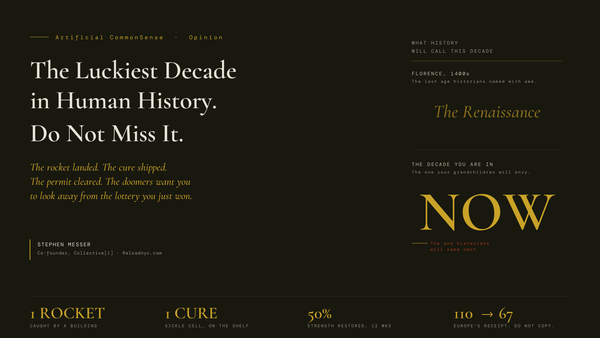
- The Luckiest Decade in Human History. Why slowing AI down is the most expensive policy error available.