AI Is Everywhere Except in the GDP Numbers.
The productivity data does not show the AI boom, and it will not until companies stop cost cutting and start building. That transition is the trade nobody is positioning for. It also happens to be measurable.


Here Is What Triggers the Break.
Stephen Messer, Co-founder of Collective[i] and LinkShare (sold to Rakuten for $425M, 1996–2005). EY Entrepreneur of the Year/Deloitte Fast 50 wibnner (2x). Board member, Spire Global (NYSE: SPIR). Building intelligence.com
About a year and a half ago, I was invited to an event abroad with some extremely well-known founders from around the world. Three days of conversations about technology and everything technology touches. It was great.
During one of the AI breakouts, a group of us started comparing notes. Most of the people in the room had known Collective[i] for years. Some as customers. Some as investors. Some as friendly skeptics who had watched us build something that did not fit the standard tech narrative until AI became the thing. Now we were at the start of the AI mass revolution, and everyone had questions. The scale of what we had been building, the speed of adoption, and the revenue growth were finally large enough that the skeptics were the ones asking how to participate.
Here is the thing about that room. Every one of them had missed AI at the front end. Every great VC and every great founder had. In tech circles, if you miss a revolution you are not in the know, so you fake it, hard, and you look for a way to have been involved early. Andreessen Horowitz's participation in the recent OpenAI rounds is a good example. Those rounds were priced at $150 billion in late 2024, then $300 billion in March 2025, then $852 billion in March 2026. That is late-stage private equity written on venture letterhead. I am not sure any of it counts as venture anymore.
The room was full of that energy. Everyone talking about how great AI was, and how fast it was going to change the world. I asked one question. If AI is what everyone in this room just said it is, why are we not seeing a drop in inflation? Why is GDP growth not spiking? Where is any of this in the numbers?
They looked at me like I was a traitor. Every person in that room was calling themselves an AI person by then, and every one of them nervously laughed when I asked. If you had been late to the party, cheerleading was the safest posture. Any hint of skepticism read like evidence you had been on the wrong side of the biggest shift in a decade. I had been building on what people now call AI for ten years at Collective[i], so I did not care how the question landed. I asked it anyway.
I think it is the exact question everyone should be asking. How fast the benefits of a truly life-changing technology flow through the economy is the actual measure of how fast it is being adopted. What the Collective[i] network sees says the answer is faster than almost anyone expects. Across the enterprises inside the network, we watch companies pick the wrong people, run the wrong approach, and still see the fixes land in weeks instead of years. I have written elsewhere on this blog, in The Trade-Off Nobody Is Making, about the millions of people who now have access to a doctor, a lawyer, or a tutor through a large language model who never had access to any of those before. That is a life-changing shift for a large share of the world's population, and it happened in twenty-four months.
The question that got laughed at is not a new one either.
In July 1987, the economist Robert Solow wrote one of the most quoted lines in the history of macroeconomics. "You can see the computer age everywhere but in the productivity statistics." It took another decade of computer investment before US productivity growth actually broke out of its long stall. The data did not show what everyone knew was happening.
We are living inside the same paradox now. AI is in every earnings call. It is in every board deck. It is in every job ad, every product roadmap, every consulting pitch. Enterprise spend on generative AI ran to $30 to $40 billion in 2025 alone. The productivity statistics show almost nothing.
One exception is worth naming. Data center construction is booming, and that capex shows up in GDP as private nonresidential fixed investment. It is meaningful to the headline number. In 2025 the hyperscalers alone poured more than $300 billion into data centers, chips, and grid capacity, and that spend is doing real work in the top-line growth figures. Strip it out and the underlying growth picture is even flatter than the headline suggests.
The right question is not why. The right question is when it changes. Because it does change. The trigger is measurable if you know what to watch for.
My prior piece, The Trillion-Dollar Trade Wall Street Isn't Seeing, argued that every adoption curve is getting shorter than the last. The AI break-out is not going to take the fifteen years computers took to show up in the productivity data. It is going to take five to eight, for the reasons I laid out there. That compression is what makes the phase three moment tradable inside every current fund horizon.
This piece is the case for the trigger, and for the trade that sits underneath it.
Phase One. Everyone Just Caught Up on the Backlog.
Across the Collective[i] network, we shipped more product in the first six months of 2026 than in the previous two years combined. That is a meaningful jump. It should feel like an advantage.
Except that unless you are living under a tree, so has everyone else.
The speed of software development jumped for every company at roughly the same time, which is exactly why it created no meaningful advantage for any of them. Every team had an endless backlog of features, integrations, edge cases, and quality improvements they had been putting off for years. AI-assisted development, agent workflows, and vibe coding all landed at once. The backlogs are getting worked down. That is a real gift to the users of these products. It is not new revenue for anyone building them.
The same pattern shows up in almost every function. It takes less time to write a marketing report. So leaders ask for more content in the reports. It takes less time to build a customer segmentation. So the segmentation gets rerun weekly instead of quarterly. It takes less time to draft a legal review. So legal reviews five more contracts a week. The output scales up. The bill for producing it goes down. GDP measures neither of those things very well, because national accounts were designed to count units of sale and hours worked, not the quality or richness of what got produced.
Net-net, this is a genuine improvement for the customers of everything. It is not a growth signal.
Phase Two. Cost Cutting Is the Default First Move.
The second phase looks the same as the first from ten thousand feet. Companies deploy AI. The stock analysts hear about it. Nothing shows up in the topline.
The difference is where the money goes. Agents are enabling more work to be done by fewer people, and almost every enterprise deploying them is aiming that saving at cost, not at growth. Why pay a CRM vendor when a small team can build a working version over a weekend in Claude. Why staff a Tier-1 customer support desk when an agent can resolve the same tickets at a quarter of the cost. Why pay for BPO contracts when internal automation handles the same volume.
Cost savings is the default first move for almost every leader. I have made this case in every piece I have written on the AI-first transition. In The Companies Winning at AI Are Playing a Different Game, I argued the winners rebuild. In What It Means to Be AI-First, I gave the operational playbook. In The Safest Move You Can Make With AI, I explained why the cautious position is the expensive one. The pattern is consistent. Most companies are in cost-cutting mode. A small minority is building something new.
The evidence is not soft. MIT's Project NANDA studied more than 300 enterprise AI deployments in 2025 and found 95% delivered zero measurable P&L impact. The other 5% is where the real money is being made. That distribution is not a temporary phenomenon. It is the standard shape of a General Purpose Technology transition.
Ninety-five percent of enterprise AI deployments deliver zero measurable P&L impact. The other five percent is where the money is.
The J-Curve Names the Pattern
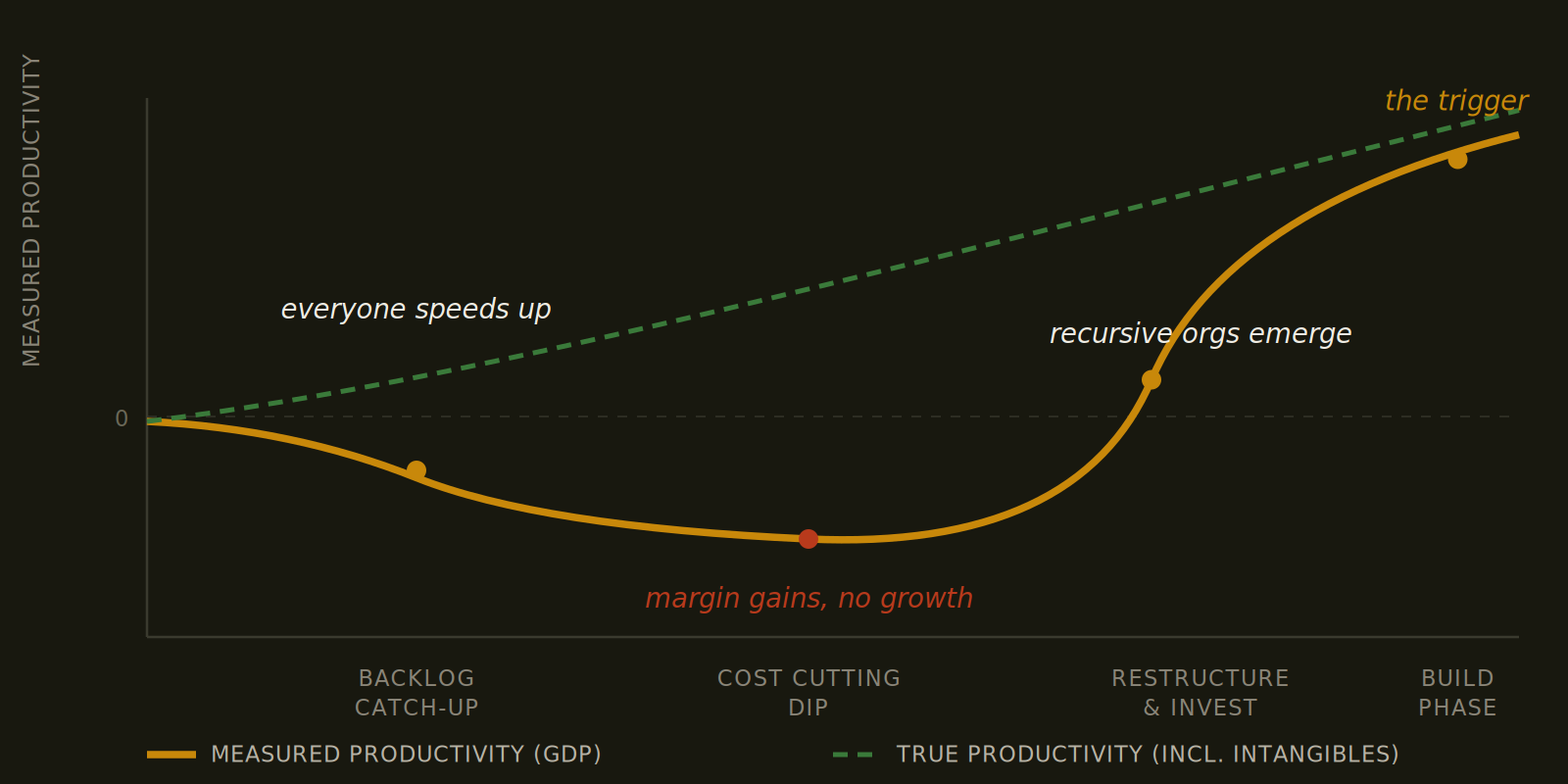
The economists have a name for what I am describing. Erik Brynjolfsson, Daniel Rock, and Chad Syverson formalized it in a 2018 NBER paper published as The Productivity J-Curve in the American Economic Journal in 2021. Their argument is precise and testable. When a general purpose technology arrives, companies pour money into complementary intangible investments that national accounts do not measure. Process redesign. Workforce retraining. Data infrastructure. Organizational restructuring.
Those investments are real. They are also invisible in official productivity numbers because they get expensed, not capitalized. So measured productivity looks flat or declining even while true productivity is compounding underneath. When the complementary capital finally lands, measured productivity spikes.
The paper's estimate for the computer age. Adjusting for intangibles related to hardware and software, US Total Factor Productivity was 15.9% higher than official measures showed by the end of 2017. In 2025, the Census Bureau confirmed the same J-curve pattern in early industrial AI adoption. Firms take productivity losses first as they restructure. They post gains later.
CHART 1 · THE PRODUCTIVITY J-CURVE
Measured productivity dips first. True productivity compounds underneath. Then the curve breaks.
Source: Brynjolfsson, Rock & Syverson, "The Productivity J-Curve: How Intangibles Complement General Purpose Technologies," American Economic Journal: Macroeconomics, 2021. US Census Bureau CES Working Paper 25-27, 2025, confirming the J-curve in early Industrial AI adoption.
Where we are on the curve today is the middle of the dip. Every company is speeding up its existing processes and cost cutting where it can. Almost none has completed the reorganization that produces the compounding gains on the other side.
The Same Curve, Every Time
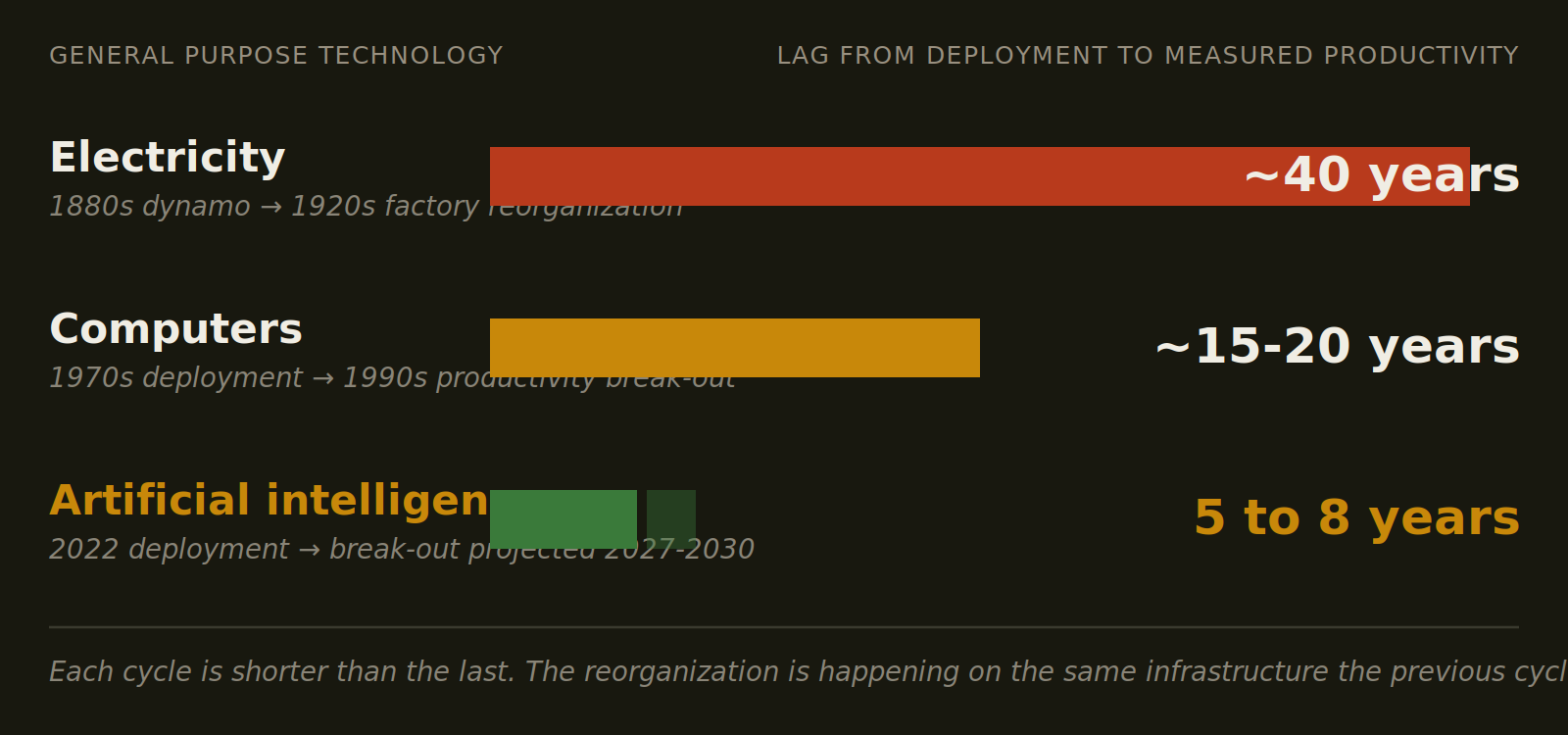
Skeptics have been telling this story for a hundred years. The economic historian Paul David wrote a paper in 1990 that anyone modeling AI productivity should read. Titled The Dynamo and the Computer, David traced how electricity took roughly forty years to show up in factory productivity. The dynamo was installed. The wires were run. The productivity did not arrive. What was missing was the physical reorganization of factories. Steam-powered factories were built around a central shaft with belts driving individual machines. Electric factories only work at their full efficiency if the whole floor is redesigned around distributed motors, one per machine, laid out for the actual flow of production. It took forty years for factory owners to reach that reorganization at scale. When they did, US labor productivity growth doubled for a generation.
Computers had the same lag. Solow wrote his line in 1987. Measured US productivity growth finally accelerated in the late 1990s. That is roughly a fifteen-year gap between the technology being everywhere and the productivity being visible.
CHART 2 · EVERY GENERAL PURPOSE TECHNOLOGY HAS HAD THE SAME LAG
The economics do not measure the reorganization. The reorganization is where the productivity actually lives.
Source: Paul David, "The Dynamo and the Computer: An Historical Perspective on the Modern Productivity Paradox," American Economic Review, 1990. Robert Solow, New York Times Book Review, July 1987. Brynjolfsson, Rock & Syverson (2021) J-curve estimates applied to current AI adoption cycle.
The lag is real. The lag is also getting shorter every cycle. I made this case in The Companies Winning at AI Are Playing a Different Game. Each new wave of infrastructure sits on top of the last, which means the reorganization does not have to build itself from scratch. If electricity took forty years and computers took fifteen, AI is likely closer to five to eight. The interesting question is when in that window the trigger fires.
The Breakaway Is Recursive. That Is What Makes It Different.
Every prior general purpose technology was linear. Electricity made every existing process a little more efficient, one machine at a time. Computers made every existing calculation a little faster, one department at a time. AI is different in one specific way. It compounds.
An AI system that helps engineers ship code faster is used to build the next AI system that helps engineers ship code faster. An AI agent that runs a sales workflow is used to build the next AI agent that runs a better sales workflow. The tools that build the tools are the tools. When an organization crosses the point where its own product is being built recursively by its own product, the productivity math stops looking like a J-curve and starts looking like a hockey stick.
This is not theoretical. It is happening at exactly one company at real scale right now, and it is worth studying carefully.
Anthropic Hit the Breakaway. On One Side of the House.
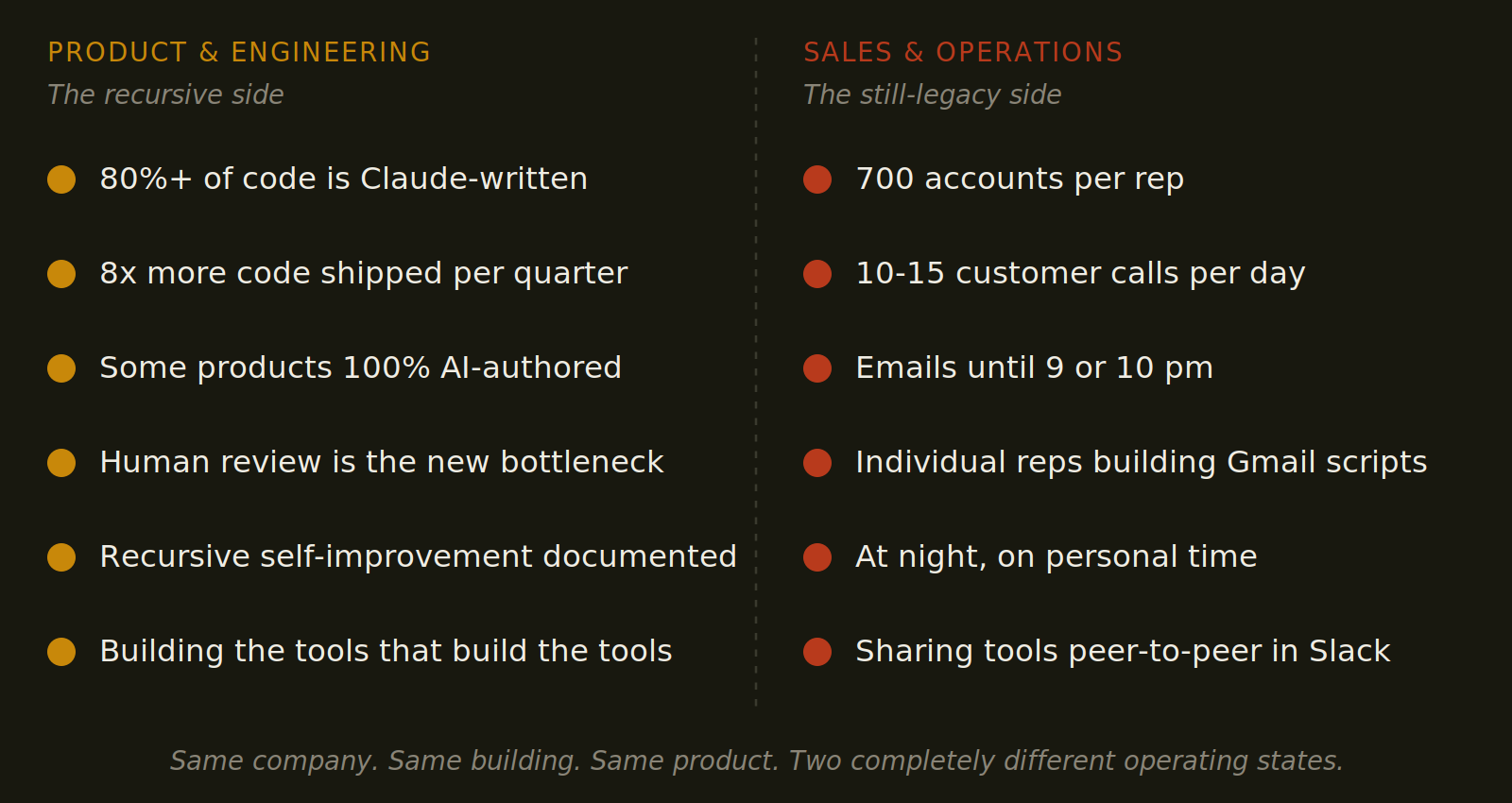
In May 2026, Anthropic disclosed that more than 80% of the code merged into its production codebase was written by Claude, up from single digits when Claude Code launched in February 2025. Engineers at the company now ship roughly 8x more code per quarter than they did in 2024. In a June 2026 paper titled When AI Builds Itself, Anthropic warned that the recursive loop has moved from science fiction to operational reality faster than the company itself expected. Boris Cherny, who built Claude Code, has publicly stated he has not written a line of code himself in five months.
Mike Krieger, Anthropic's chief product officer and an advisor at Collective[i], summed it up in a single line. Claude is now writing Claude. That is the breakaway moment on the product side. The AI is building the AI.
Now look at the rest of the company.
Anthropic's own customer blog profiles Jared Sires, a startup account executive who joined the sales team in 2024 with no coding background. His book grew to 700 accounts. His days ran ten to fifteen customer calls. His nights ran until nine or ten in the evening, working through inbound emails. He built a Gmail application called CLAFTS, short for Claude Drafts, that uses the Claude API to draft replies in his voice. It saves him two to three hours a day. Others in the sales organization picked it up within twenty-four hours of him sharing it in Slack.
This is the company that ships Claude. The company whose own product is 80% recursive on the engineering side. Its sales representatives are individually building personal Gmail scripts, at night, in Google Apps Script, to survive an inbox that the AI-first version of the same company would have automated a year ago.
There is a second lesson in this. To the man with a hammer, the world looks like a nail. Anthropic has one of the best hammers in the world, and they also happen to build it. That is exactly the trap. Its sales team is trying to solve every problem in front of them with the tool the company sells, and that tool is a language model. Language models are extraordinary at drafting text. They are not what you use to price 700 accounts against a book of pipeline data, and they are not what you use to model which of those accounts is most likely to close next quarter. A different kind of model does that. An economic model of how the world actually does business.
I have made this case in several prior pieces. In The Next Computer Is Alive, I argued that all AI is narrow intelligence and running one model for everything is the wrong architecture by definition. In The Intelligence Stack I laid out the equipment list. The winning architecture is a stack of narrow intelligences pointed at what each one is good at, coordinated through a harness that knows which one to use when. Anthropic's product side has one brain. That is enough for engineering, because engineering is largely a text-generation problem. Anthropic's revenue side needs multiple brains and does not have them yet. That is why its sales team is on Google Apps Script.
CHART 3 · THE RECURSIVE GAP INSIDE A SINGLE COMPANY
The product side is recursive. The go-to-market motion is still individual heroics on Google Apps Script.
Source: Anthropic Institute, "When AI Builds Itself," June 2026, for product-side metrics. Anthropic customer blog, "How one Anthropic seller rebuilt his team's workflows with Claude Code," 2026, for the Jared Sires CLAFTS story.
That gap is what a J-curve dip looks like from the inside of a single company. The product side has already broken through. The go-to-market side has not started. Both live under the same roof, on the same equity plan, using the same product.
A growing list of companies already runs the same recursion on the revenue side, and the list is growing fast. Every quarter, more organizations cross the same threshold, shifting attention from what AI can do inside engineering to what it can do across every other function. The Collective[i] network sits at the center of that shift, watching it happen in real time across a growing set of participating enterprises. The breakaway is no longer confined to engineering. It is happening inside revenue teams, finance teams, and operations groups at the same organizations. Any function whose work can be pointed at a proper model of its underlying business, instead of at a general-purpose language model, is starting to compound the same way Anthropic's engineering did a year ago.
The specifics inside those revenue teams matter. Large B2B organizations running this pattern today open each morning with a ranked list of accounts drawn from a live economic model of what buyers are doing across the market. The signal comes from millions of buying journeys observed in parallel. Their forecasts run against the same model, updated as the world moves. Their onboarding for a new AE takes weeks rather than quarters. Nobody in these organizations is writing personal Gmail scripts at night to survive their inbox.
The reason that revenue side looks so different from what Anthropic ships internally is architectural. Not a bigger language model. A different one, sitting inside a stack of narrow intelligences pointed at each part of the sales motion. The economic model is what tells the language model which of the 700 accounts is worth writing to today. Without it, the language model is a very expensive way to write faster emails to the wrong people.
None of this is a criticism of Anthropic. It is exactly what an early-breakaway company looks like. What matters for the trade is what happens once the same recursion moves out of engineering and into every other function.
The Trigger. What Actually Fires the Curve.
The trigger is not a single event. It is a change in what companies are aiming AI at.
Phase one is backlog catch-up. Phase two is cost cutting. Phase three, the one that fires the curve, is when leaders stop asking "how do I do the same thing cheaper" and start asking "what would I build if I could build ten times as much."
Ten times more customers. Ten times more products. Ten times more markets. Ten times more experiments. When the answer to any of those questions stops being "hire more people" and starts being "point more agents at it," the growth is in the topline, not in the margin. That is the moment measured GDP starts catching up to reality.
The MIT NANDA number is the tell. Ninety-five percent zero, five percent transformational. That five percent is the leading edge of phase three. What you want to track is whether the five percent grows to fifteen, then thirty, then fifty. When it does, the J-curve breaks.
My honest read on timing is that the five percent will be twenty percent by end of 2027, and fifty by end of 2029. That is inside every current fund horizon.
The Break Will Not Be Even
Once the trigger fires, the productivity break will not distribute evenly across the world. It will follow the compute, and it will follow the demographics.
The last piece in this series, The Trillion-Dollar Trade Wall Street Isn't Seeing, argued that a Taiwan disruption could concentrate global compute demand in the United States, the way the telecom industry consolidated in the US after the Second World War. Even without a Taiwan event, the compute buildout is already centering there. The United States and China are the two economies that have invested at the scale required. Everyone else is watching.
Between the two, the US is better positioned to convert the break into growth. China faces two structural headwinds the US does not. The first is demographic. The Chinese working-age population peaked in 2013 and has been shrinking every year since. AI productivity gains have to overcome an already declining labor pool before they translate into per-capita income growth. The second is the shape of the Chinese economy. Manufacturing, agriculture, and personal services take up a larger share of Chinese employment than of US employment, and AI moves slower in those categories than in knowledge work. China gets the productivity gains where its economy is smaller, and misses them where its economy is largest.
Europe is the leading indicator for what happens to an economy that misses a general purpose technology transition. Between 2008 and 2023, US GDP grew 87% in nominal terms while the EU grew 13.5%. On a per-capita basis, EU GDP per capita fell from 76.5% of the US level in 2008 to 50% by 2023. The Draghi report on European competitiveness identifies productivity as the primary cause. That gap opened during the second half of the computer productivity break-out, which the US converted more effectively than Europe did. If AI plays out on the same axis, the divergence gets faster, not slower. At current growth rates, output per person doubles in twenty years in the US and takes forty-three years in the EU.
For the trade, this changes the geography of the position. The best exposure to the phase-three break-out is US-listed companies operating on US compute, run by leaders willing to reorganize around agents rather than optimize their existing organization. That is a narrower list than the S&P 500 by a significant margin. It is not the market. It is a specific slice of it.
The Trade Nobody Is Positioned For
Investors currently price AI infrastructure on frontier lab revenue, as I discussed in the last piece, and price AI software winners on incremental margin improvement. Both of those framings live entirely inside phase one and phase two. Neither one prices the phase three break.
The trade is simple if you accept the argument.
Position for the companies that are moving from cost cutting into building. Position against the ones still stuck in backlog catch-up. Watch the internal metric of "what percentage of our new revenue comes from products built after we adopted AI." When that number moves above 20% at a real operating company, that company has crossed into phase three. The market has not priced that transition into any comparable I have looked at.
The 95% figure will not stay at 95%. When it moves, everything moves at once. The bubble-versus-real debate will end abruptly, and a different one will start.
Whether the trade works or not comes down to the same variable everything else in AI comes down to. Do you believe the ramp is going to compress, or do you believe it takes another twenty years. If you believe the compression, the phase three trade is the alpha that is currently priced at zero.
What Comes Next
Every piece in Artificial CommonSense takes something the market treats as consensus and shows what it is missing.
The next pieces in this series go into the specific mechanics. What phase three actually looks like inside a real company. How to spot the "moving into phase three" signal on a public earnings call. Why Anthropic's own gap between product and go-to-market is the template every enterprise will run through in the next thirty-six months. If you want them delivered when they publish, subscribe at reloadnyc.com. Free. No paywall. No course at the end. Just the work.
If this piece changed how you are thinking about the AI productivity gap, forward it to one person who needs to read it. A portfolio manager at your firm. Someone running your investment committee. A friend running a growth equity fund. One specific decision-maker in your world who is still trying to square the AI hype against the GDP numbers. That is how the argument moves. One reader telling another.
If you are the person who just got this forwarded to you, welcome. Subscribe at reloadnyc.com. Two dozen pieces in the archive already. Another two dozen in the queue.
Reply if you want to argue. I read every one. The pieces get sharper when readers push back.
RELATED READING · RELOADNYC
The Trillion-Dollar Trade Wall Street Isn't Seeing
Every data center is a free call option. Why the geopolitical hedge is the piece missing from the AI infrastructure trade.
The Companies Winning at AI Are Playing a Different Game
Systems of intelligence versus silos of intelligence. Why the winners rebuild instead of layer.
What It Means to Be AI-First. And How to Get There.
The operational playbook for phase three. Not philosophy. What the leaders are actually doing.
The Safest Move You Can Make With AI Will Cost You Everything
Why the responsible-caution position is the expensive one. The math on staying inside phase two too long.
The Trade-Off Nobody Is Making
The AI-and-jobs debate skips straight to UBI without asking what happens to the cost of everything. That answer changes the entire debate.
The Next Computer Is Alive
Silicon is running out of room at 1.5 nanometers. All AI is narrow intelligence. Running one model for everything is the wrong architecture by definition.
The Intelligence Stack
The equipment list. A complete map of the intelligences available right now, plus sample stacks for three different kinds of companies.
Stephen Messer
Co-founder of Collective[i] and Intelligence.com. Co-founder of LinkShare (sold to Rakuten for $425M). Board Member, Spire Global (NYSE: SPIR). Writes at reloadnyc.com.
Intelligence.com maps the relationships you actually have, not the connections you collected. Connect with me there and let us share our networks with each other.