The Conviction VC.

Three arguments in one piece. This is where the outsized returns in tech actually get made. This is where foundational American innovation actually gets funded. This is where Wall Street is about to break the boutique venture capital world open, because a hedge fund format catches the three-year arbitrage better than a traditional 10-year venture fund. Second piece in a series on venture styles.
By Stephen Messer
Co-founder, Collective[i] and Intelligence.com. Co-founder, LinkShare (sold to Rakuten, $425M). Board member, Spire Global (NYSE: SPIR).
October 2026. Join me at Intelligence.com
Venture capital is the most disruptable category of alpha in the investment world. Its moat is complexity. Preferred stacks, ten-year lockups, warm-intro networks, term sheets nobody who did not pass through one of five law firms can parse. The industry sold its LPs on all of that as craft. It was a wall around the deals, and the wall is coming down right now. The people taking it down are not venture capitalists.
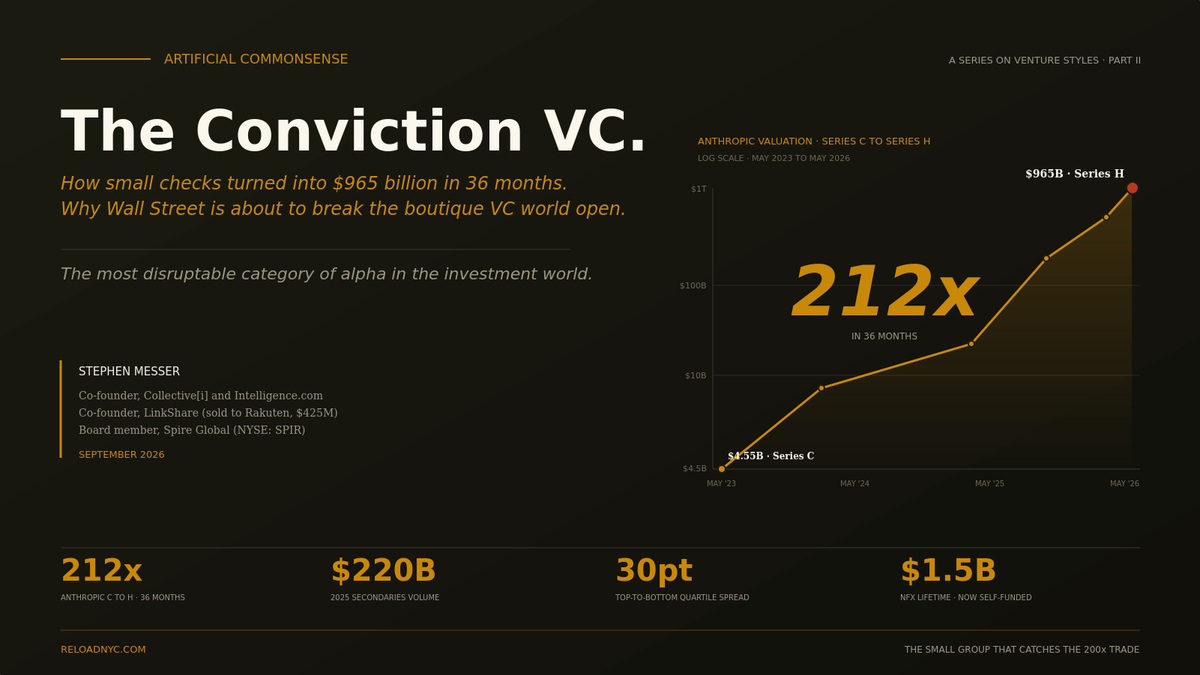
In May 2023, Anthropic's Series C closed at 4.55 billion dollars. In May 2026, Series H closed at 965 billion. 212x in 36 months. Same team. Same roadmap. Published in advance. Any institutional investor in the world could have run that math in the first half of 2023. Almost none of them wrote a check.
Anduril traces the same shape on a longer runway. Palantir ran it before them. SpaceX did the whole thing in slow motion from 2010 to the June 2026 IPO. Snowflake went from a 260 million dollar Series C in 2016 to a 70.4 billion dollar IPO in September 2020. Every three or four years the trade repeats in a different sector, a small group of investors catches it, and the rest of the industry watches.
Three claims to make here. The first is that this small group is where the real returns in tech are made, and the gap between them and the rest of venture is bigger than most LPs want to admit. The second is that this small group, together with DARPA, is where almost every foundational American technology of the last sixty years came from, and the consensus venture industry is not on that list. The third is that this group is the seam where Wall Street is right now breaking the boutique venture model open, because what they do fits a hedge fund balance sheet far better than it fits a traditional venture fund.
Last week I wrote about the Value Venture Capital problem. That is the guy at every dinner telling you the AI round is priced crazy and every SaaS company is priced crazy. He read Ben Graham cover to cover and applied the metrics to companies with no earnings and no comparables, then passed on every deal that ever worked. Forty years of those decisions compounded into bottom-quartile returns and a reputation for discipline the numbers never earned. This piece is the other side. I am going to call this style Conviction VC because concentrated is already spoken for in public markets. Seth Klarman at Baupost and Julian Robertson at Tiger ran the discipline in equities for decades. Buffett ran a version at Berkshire for sixty years. Venture never bothered to name it.
Why there are so few of them.
Every LP knows the type. Every founder can list three or four. The style produced most of the outsized returns in tech for forty years, and the population of investors running it fits in a small dinner. Why.
Start with where they came from, because the pattern is useful. Antonio Gracias grew up in Grand Rapids, Michigan, studied international finance at Georgetown, worked at Goldman, and bought his first manufacturing company while still in law school at Chicago. He had run factories before Valor Equity Partners existed as a name on a door. He met Elon through a mutual friend around 2000, five years before the Tesla Series B, and lent Elon a million dollars of his own money in 2008 to keep both Tesla and SpaceX alive. Peter Thiel co-founded PayPal, sold it to eBay, and ran Clarium as a macro hedge fund before founding Founders Fund. Matt Ocko ran software companies for two decades before starting DCVC. His partner Zach Bogue came in as a Silicon Valley tech lawyer at Wilson Sonsini and Virtual Law Partners, co-founded Founders Den as an invitation-only workspace for repeat entrepreneurs in SF, and had already angel-invested in Uber, Square, Kaggle, and Planet Labs before DCVC wrote its first institutional check. Steve Jurvetson trained at Stanford as an electrical engineer, worked at HP, and did a stint at Bain before DFJ. Brad Gerstner grew up in a small town in Indiana, started five companies himself, and launched Altimeter in November 2008 with three million dollars during the worst month of the financial crisis.
None of them came off the Ivy-to-Bain-or-McKinsey-to-HBS-to-junior-partner-at-Kleiner track. The funnel that produces the median VC partner selects for one skill, which is reading what the room is excited about quickly, and selects against the skill that matters here, which is holding a position the room disagrees with. Those two skills are opposites. You cannot be trained for the first and then expected to deliver the second.
Which gets you to the second part of why there are so few. Doing this work means being wrong in public for years. Anduril was described as a doomed political curiosity by most of the venture press for its first four years. Anthropic was one of a dozen AI labs, dismissed as too safety-focused to ship. Tesla was a punchline for a decade. If you held one of those positions through the middle years, you went to the industry dinner and half the room politely told you your position was going to zero. Your LPs emailed you about the mark. Your peers stopped returning your calls. That lasts three to seven years, and almost nobody can do it.
The ones who can tend to have one of three anchors. Some have an outside identity. Thiel had sold PayPal and did not need Sand Hill Road to take him seriously. Musk built his own gravity outside venture. Some have an operator anchor. Gracias had run manufacturing companies, been in real board fights, and been publicly wrong about things before. That changes what a dinner table feels like. Some have a technical anchor. Ocko, Bogue, Jurvetson, the technical partners at Founders Fund. The science tells them the trade is right, the industry says wrong, they side with the science. Without one of those three anchors, the gravitational pull of consensus wins. The anchors do not scale. Which is why the population stays small no matter how much money the LP community decides to allocate.
The barbell.
Buffett wrote a line in the 1988 Berkshire shareholder letter that frames this whole discipline: buy good businesses at fair prices set by an absent crowd. The first half is what everyone quotes. The second half is the actual trade. Find the good business in the sector the crowd has not shown up to. Pay the price an absent bidder sets. Hold through the years when nobody acknowledges the position. Klarman ran that move at Baupost on misunderstood public assets. Robertson at Tiger ran it on big-thesis equities. The conviction VC runs it on a founder building a new category. I have been writing versions of this argument on this blog for a year. The Shoebox That Changed Space was Spire. The Hypothesis Company was about how AI-first companies get built. The Arc of a Company's Life, with Mark Leslie, on how the company life cycle has compressed to the point where you can run this trade in three or four years instead of ten. The underlying move does not change. Look at first principles, ask what the object actually is, and price accordingly.
The arithmetic underneath sits in every LP database. Cambridge Associates publishes the US Venture Capital Index that institutional committees benchmark against. 25-year pooled net return: 12 to 15 percent. Median fund: 1.5 to 1.8x TVPI. Bottom-quartile: often negative. Top-decile: 27 percent net IRR and up. The spread between top and bottom quartile is over 30 percentage points in most vintage years, three times the dispersion in buyout and the widest gap in institutional finance.
US Venture Capital Returns Dispersion by Fund Quartile
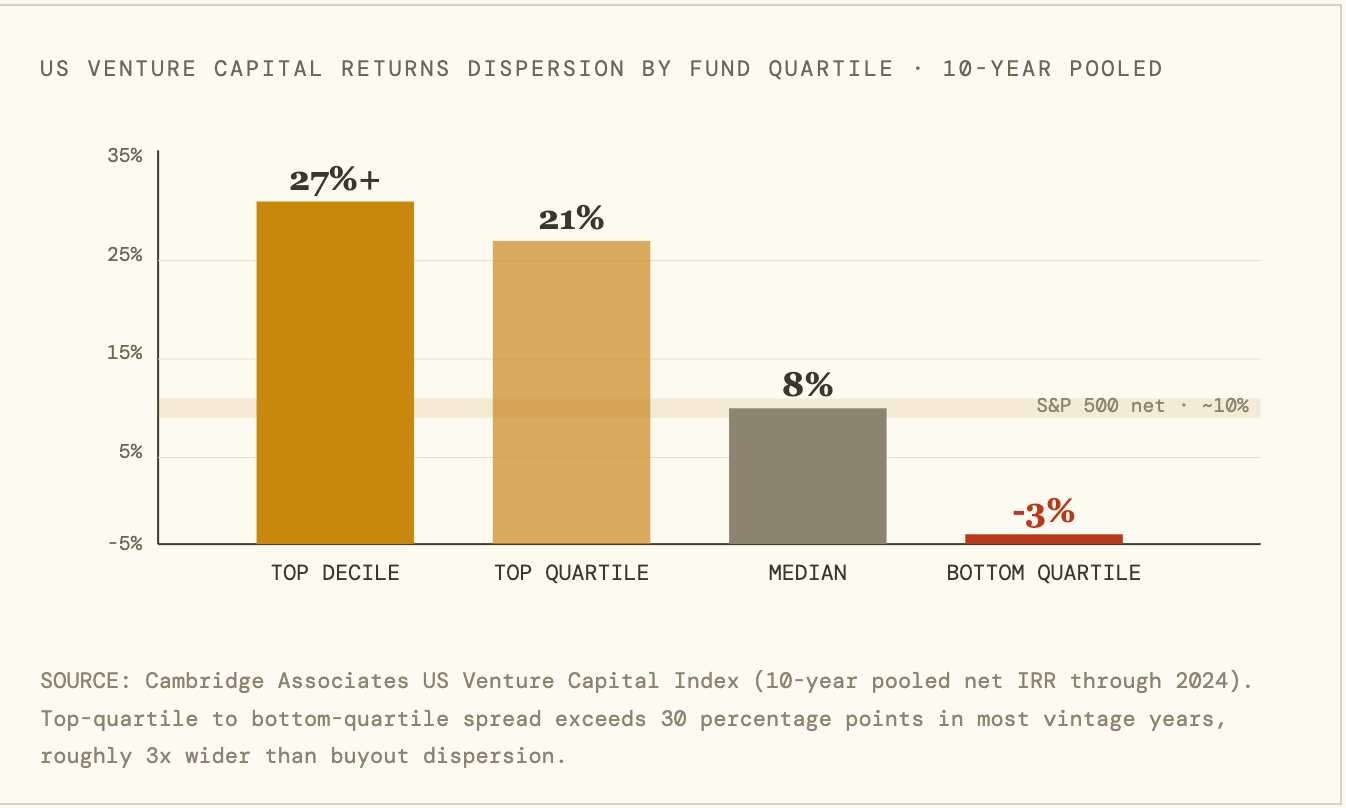
SOURCE: Cambridge Associates US Venture Capital Index (10-year pooled net IRR through 2024). Top-quartile to bottom-quartile spread exceeds 30 percentage points in most vintage years, roughly 3x wider than buyout dispersion.
Underneath the dispersion sits a power law. Correlation Ventures looked at 21,000+ US venture investments from 2004 to 2013 and 27,000+ from 2009 to 2018. 65 percent of deals returned less than the capital invested. 4 percent returned over 10x. 0.4 percent returned over 50x. Half of all industry returns came from the top 2 percent of companies. Horsley Bridge, which has backed venture funds since 1983, ran the same analysis across 7,000 investments over three decades. 6 percent of deals produced 60 percent of returns. PitchBook's 2025 benchmark shows that in a typical fund of 20 to 30 portfolio companies, 1 to 3 investments generate 50 to 80 percent of total return. Which means the math only works when the fund is concentrated around a fund-returner, and the fund-returner is disproportionately in a sector nobody was pricing at the time of entry.
Tech returns barbell. On one end sits Conviction VC entering the sector before it is legible. On the other end sits Access Capital, which is Sequoia, Andreessen Horowitz, Tiger, and Coatue, paying consensus prices but writing checks so large and carrying brands so powerful that a Sequoia-sized position in every serious deal is its own edge. I wrote about that one in The Trust That Ate Venture Capital. There is a third winner I covered in The Reason Prior Tech Bubbles Broke Just Got Fixed: ecosystem capital, which is Microsoft into OpenAI, Amazon and Google into Anthropic, Nvidia across the whole stack. Three winners at the ends. Everything else is the middle.
Here is the uncomfortable part. Consensus VC and Value VC together are the biggest slice of the industry by count, and they produce the worst risk-adjusted returns in it. Both feel safe from the inside. Consensus feels safe because the room agrees. Value VC feels safe because the discipline reads like your MBA program taught it. Both feelings are wrong. The middle of the barbell is the high-risk trade in the most respectable vocabulary available.
Three winners at the ends. Losers crowded in the middle. The fees that middle charges for underperforming a public index are the biggest wealth transfer running inside the LP community right now.
The five firms that have been running this trade.
Valor Equity Partners. Antonio Gracias founded Valor in 1995. Tesla Series B in 2005. The personal million-dollar loan to Musk in 2008 when both Tesla and SpaceX were weeks from bankruptcy. First SpaceX check in 2010, and every subsequent Valor fund went back in. At the SpaceX IPO in June 2026, the firm emerged with a 6.7 percent stake worth roughly 68 billion dollars, second-largest holder behind Musk. Valor manages about 59 billion today. In September 2026 it distributed 8.5 billion of SpaceX stock directly to LPs and still owned more than 60 billion of the company after the distribution.
Founders Fund. Peter Thiel wrote 500,000 dollars into Facebook in 2004 at a 4.9 million dollar valuation when most of the East Coast venture industry had passed. Founders Fund seeded Anduril in April 2017 when defense tech was culturally toxic in Silicon Valley, then led every subsequent round including the June 2025 Series G at 30.5 billion with a one-billion-dollar check, the largest single check in the firm's history. Anduril is worth 61 billion today, reportedly in talks at 100. Trae Stephens, the Founders Fund partner who co-founded Anduril and still runs it as chairman, is one of the clearer first-principles reads on where the next defense round is going.
DCVC. Matt Ocko and Zach Bogue started Data Collective in 2010 on the thesis that data-heavy deep tech was going to become a real venture category at a moment when it was a research grant. Two operators in the seat. The firm's page notes it has more published scientists than MBAs. DCVC was early into Oklo (small modular nuclear, IPO 2024), Rocket Lab before space was a category, Fervo Energy (geothermal, IPO May 2026), and Impulse Space (now 4.3 billion). The firm manages about four billion. It has been early in nuclear, geothermal, space, quantum, and biotech, all sectors consensus funds are now trying to enter at three times DCVC's entry price.
Altimeter Capital. Brad Gerstner started Altimeter in November 2008 in Boston with three million dollars during the worst month of the financial crisis. The firm was built from day one as a hybrid: a long-short technology hedge fund on the public side, a series of growth-equity funds on the private side, backing the same names across the public-private boundary. Altimeter led Snowflake's Series C in 2016 at a 260 million dollar post-money and held through the September 2020 IPO at 70.4 billion, the largest software IPO in history. Reported returns on that one position were roughly seven billion. AUM across the two books sits near 20 billion today. The public book alone has returned an average of 29.5 percent annualized since 2011.
Steve Jurvetson. Started at DFJ in 1995. Used the firm's "passionate minority overrules majority" carve-out on the investment committee to force SpaceX through in 2008 during the Falcon 1 failures, over a room that thought he was wrong. Same move for Tesla shortly after. Founded Future Ventures in 2018 with Maryanna Saenko. Current portfolio includes Commonwealth Fusion, Boring Company, D-Wave, Planet, Zoox, Mythic, and Nervana. Returned to the Forbes Midas List in 2026 on the back of the SpaceX IPO. The relationship he built with Elon a decade before Elon was Elon is still the engine of Future Ventures's deal flow.
None of these firms looked like consensus the year they wrote the winning check. All of them look like consensus the year the check paid off. The gap between those two years is where conviction gets paid.
Working for the founder.
The consensus VC does not work for the founder the way the founder expects. That is not laziness. A partner at a large firm sits on twelve boards. Each one is an hour a month. The scaling math of the fund does not let that partner be an operating co-founder. You get an email intro to a hiring pipeline once a quarter, a check in the follow-on round, and a spot at the annual portfolio dinner. The deal is honest. It is also limited.
The conviction investor's math forces something different. The fund holds ten positions instead of forty. Returns live or die on the fund-returner in your company. So they show up differently. Real intros where the partner sits in the room while you pitch. A call to the CIO the day before your meeting telling him to take you seriously. The partner on the phone furious with you at the situation when a rogue employee threatens the Series B. The partner on the call at eleven fifteen at night helping fix a client complaint that broke at eleven. When you win, the celebration is real.
Watch who talks to whom at a real founder event and you see this immediately. The conviction investor sits at the founder table. Founders treat them as one of their own. Founders send them deals, send them other founders, and tell them what is actually going to matter next. When the founder raises again, the conviction investor often gets the only call. Not out of favor. Out of trench history. The founder would rather do the round with the person who was there than with the person who was not.
Compare that to the VVC, who spent round one explaining why the valuation was wrong, missed round two because the price kept climbing, and is now at the same industry dinner telling anyone who will listen that the sector is a bubble. Founders remember which of the two was on the plane with them. When round three comes together at ten times round two, the first call does not go to the person who argued three years running that ten times was crazy.
My own story with a conviction fund.
When my sister Heidi and I raised the Series A for LinkShare in 1998, we picked Internet Capital Group over bigger names. ICG was the conviction pick.
ICG had been founded in 1996 by Walter "Buck" Buckley III and Ken Fox, both out of Safeguard Scientifics under Pete Musser. Safeguard was a publicly-traded operating company that took stakes in early tech and let public shareholders participate in venture upside long before crossover funds existed as a category. Buckley and Fox left Safeguard on a specific thesis: business-to-business e-commerce was going to reshape enterprise, and the venture format built for consumer internet was the wrong vehicle for it. Doug Alexander joined as president. The four of them raised twice their target on first close, forty million dollars, and started deploying.
LinkShare was one of ICG's earliest bets, and no version of us read as a consensus check. New York, not Silicon Valley. A network business with network effects, in a market that could barely spell "network effect" and thought all durable value in tech came from software. A brother-sister founding team, at a moment in venture history when that got read as an amateur signal. Young founders, in a market that defaulted to experienced operators. Affiliate marketing as the actual business, a category most of the industry thought was either a rounding error or a scam. The reasons to pass on us were everywhere. ICG wrote the check anyway because the market was huge and the system worked. Then they did the work. They sat in our retail-partner meetings. They introduced us to Fortune 500 CMOs. They helped us write the deck for the next round. They showed up when things were hard.
The B2B thesis was working across their whole portfolio. ICG went public in August 1999 at twelve dollars, doubled on day one, and rode the market up to a peak market cap north of fifty billion dollars by early 2000. At the top, Buckley, Fox, and Musser were paper billionaires. Then the crash. The publicly-traded VC structure that scaled the model up on the way in amplified the drawdown on the way out. Portfolio companies could not raise follow-on in a frozen market. ICG restructured, renamed itself Actua, and spent the next several years running the portfolio for cash the right way, returning more than five hundred million dollars to shareholders through disciplined exits. Procurian to Accenture for 375 million in 2013, Channel Intelligence to Google, GovDelivery in 2016, VelocityEHS and Bolt Solutions to CVC for 328 million in December 2017, FolioDynamix to Envestnet for 195 million in January 2018. The picks were real. The vehicle at that moment was not survivable. If the crash had arrived three years later, ICG would today be one of the most important investment platforms in the world.
Ken Fox has a second act worth pulling in. In 2008 he founded Stripes in Manhattan. Same conviction discipline, this time in a private-fund format, without the public-market amplifier that broke ICG. Stripes manages roughly seven billion dollars today across more than eighty portfolio companies. Monday.com, On Running, GrubHub, A24, Databricks, Snyk, Ramp, GoFundMe, Pleo, Vuori, Reformation. Buck Buckley runs SEMCAP on similar principles. Neither of them lost the discipline. They swapped the vehicle for one that suited the moment better.
When conviction wins big, does the discipline survive?
Sequoia is the paradigm case of conversion. It started in 1972, backed Apple, Cisco, Google, YouTube, and WhatsApp in their earliest rounds, and ran the discipline for four decades. Somewhere past 2010, as the fund complex crossed 20 billion in AUM on its way to roughly 90 billion, the early check stopped moving the needle. The firm reorganized into what I wrote about in The Trust That Ate Venture Capital. Andreessen Horowitz followed the same arc. Both firms still do real conviction work inside a larger platform, but a new LP dollar going in today is buying something else. The access brand, the platform, a piece of the deal flow. not the small early check that produced the historical returns.
Founders Fund is the exception that proves the drift is not automatic. Thiel cut the eighth flagship fund from 1.8 billion down to 900 million in March 2023 because, in his words, venture was due for a slimdown. That is a GP actively refusing to let the fund outgrow the discipline. Growth III closed at 4.6 billion in April 2025 and went into just seven companies at an average check of around 600 million each, including 1.25 billion into Anthropic and one billion into Anduril. Growth IV closed at six billion in May 2026 with 1.5 billion of that coming from the partners' own pockets. GPs writing a quarter of the fund out of their own capital are not spraying and praying.
The Santé Ventures work on PitchBook data captures the drift risk statistically. Only 17 percent of funds larger than 750 million dollars beat 2.5x TVPI. 25 percent of funds under 350 million did. Fund size is not what predicts returns. Concentration around a fund-returner is, and staying small enough to concentrate is a discipline most firms lose once they close the next mega-fund. The emerging-manager cycle keeps the pool refreshed because ex-brand partners spin out to run the discipline at smaller scale. Katherine Boyle at Founders Fund national security. A long list of ex-Sequoia and ex-a16z partners running smaller vehicles right now. The next paradigm firm is being built by somebody whose name is not on any LP shortlist.
Why Wall Street is breaking venture open.
Every LP allocating to venture is paying for something called the illiquidity premium, which is the extra return above a public index that supposedly compensates for a ten-year lockup on their capital. Venture as a field has not delivered that premium consistently. Cambridge Associates' 25-year pooled net return sits at 12 to 15 percent, which after fees and the illiquidity is close to what a passive Nasdaq allocation returned over the same period. The 2022 and 2023 vintages actually printed negative. The ten-year lockup, which is the entire reason venture exists as a separate asset class, is not getting paid for on the current math. That is the crack, and hedge funds have been walking through it for two years.
Here is a thing nobody says out loud about the modern cap table. A software engineer at Anthropic today can sell her Anthropic common on the secondary market at some discount, but she can sell. The investor holding preferred stock cannot exit as easily, because of conversion mechanics, ROFRs, tag-alongs, and other structural blockers, and the LP behind that investor has zero access to their capital for another six vintages. The employee, who is supposed to sit at the bottom of the cap table hierarchy, has better liquidity than the institutional LP paying two and twenty at the top. Think about that for a second. The least sophisticated participant in the cap table has better market access than the most sophisticated one. In any other market, that inversion gets corrected. In venture it has sat there for a decade because the industry was happy to leave it alone. The industry is about to stop being happy about it.
What a hedge fund wants from a private position is the opposite of what venture offered. Liquidity, so the position can be exited when the thesis breaks. Mark-to-market, so the book has a daily value and money can be borrowed against it. The compressed arbitrage cycle rather than the ten-year hold. A three-year Anthropic trade from Series C to Series H is the exact shape they want to run. Enter private, ride the re-rate, exit into public markets on the same balance sheet, no decade of lockup required.
Which is why common stock is going to become the norm in tech financings. Preferred stacks are what venture funds took for forty years because preferred protected them in a down round. Liquidation preference, anti-dilution ratchets, participating provisions, ROFRs, tag-alongs, drag-alongs, forced conversion. Every one of those clauses is complexity built to protect capital from the founder. Common stock is what the employees already hold. When a hedge fund shows up willing to take common, the direction of trust reverses. The hedge fund is extending trust to the founder, sitting alongside the employees. Every preferred-holding VC in the room is doing the opposite, building legal armor against the founder in case things go wrong. Founders can tell which investor did which.
The reason preferred stacks got so complicated is a thing nobody in venture writes about plainly. Long-only investors, without meaning to, want the complexity. Complexity depresses the price by excluding bidders. Complexity limits the field of competitors who can even parse the terms. Complexity gives insiders an information advantage that lets them buy at a discount to the price the round would clear at in a more transparent market. Complexity looks like a market feature from the inside. It is actually a moat the incumbent built. An arbitrage investor arriving with common stock and a simple term sheet eliminates the moat. The deal clears at real value, every serious bidder can enter, and the incumbent's edge disappears.
The private markets are getting liquid regardless of what the venture industry wants. The secondaries market went from a rounding error a decade ago to a record 220 billion dollars in transaction volume in 2025, with VC secondaries alone at 152 billion in 2026. SPV structures are getting easier to open and easier to trade. Late-stage crossover funds that used to wait for the Series F are moving to the Series C. There is no market in history where more liquidity made returns worse, and venture is not going to be the exception.
NFX capitulating two days before I wrote this piece is the clearest tell. NFX is one of the stronger seed brands in San Francisco, run by James Currier, Pete Flint, and Gigi Levy-Weiss, with 1.5 billion dollars raised across five funds and a portfolio of multiple unicorns. On September 26, 2026, Currier posted that NFX is moving to a self-funded model. No more external LPs after Fund IV. The four managing partners will invest their own capital, checks of 100,000 to 3 million dollars, and in his exact words, they do not need to lead rounds, take board seats, or meet ownership targets. Those three items are the entire operational complexity of institutional venture capital. One of the strongest seed brands in the industry just publicly walked away from all three. The model is breaking.
Brad Gerstner built the paradigm vehicle in November 2008. Altimeter was a hedge fund plus a growth-equity partner platform from day one, and the public book alone has returned 29.5 percent annualized since 2011. Leopold Aschenbrenner's Situational Awareness is the most recent case study. The fund launched in September 2024 with about 225 million dollars, returned 439 percent net through the first half of 2026, peaked at roughly 45 billion in AUM, then watched both legs turn against it in late July 2026 when the market pivoted on AI capex and rewarded the software names he was short. Margin calls landed. He had to sell his levered public book to Citadel at a discount. AUM dropped to roughly 10 billion in days. The public book blew up. The private positions in Anthropic, Fluidstack, and MatX are still there and the original investors are still up multiples of their capital. Every hedge fund in New York watched that happen. Every one of them is now looking for a conviction VC to lock down.
Point72, Jon Abbey's Adakin Capital, Tiger Global, Coatue, Insight Partners, Blackstone Growth, Seligman Ventures (which doubled to a billion dollars in September 2026), BDT & MSD Partners (which hired Darren Cohen out of Goldman in July 2026 to build this book), all New York, all moving into what used to be a San Francisco monopoly.
Look at venture as an industry the way an outside analyst would look at any other alpha category. Barriers to entry. Moats. Venture's moats are complexity, network, brand, and information asymmetry. Common stock kills the complexity moat. Hedge funds with real balance sheets and real Rolodexes make the network moat replaceable. Arbitrage capital does not need brand to win a deal. The secondaries market prices private positions in close to real time, which eliminates the information asymmetry. All four moats are eroding at the same time, and the industry that was built on them is being disrupted by the exact structural features that used to protect it.
Altimeter did this first, in 2008, from Boston with three million dollars. Everyone else is now converging on the same structure. The venture industry that emerges from this decade will not look like the one that started it, and the conviction investor is the piece that ties the old model to the new.
The DARPA question.
Nearly every foundational American technology of the last sixty years came from one of two places. Either DARPA funded it directly as a small high-risk bet inside a Pentagon research budget, or a conviction VC funded it as a small high-risk bet inside a private partnership. DARPA built the internet, GPS, drones, stealth, voice interfaces through the Siri and CALO lineage, the self-driving car through the DARPA Grand Challenge, and much of what became modern AI research. The conviction VC list runs through Intel, Cisco, Amazon, Google, Facebook, Tesla, SpaceX, Palantir, Anduril, and the earliest institutional checks into Anthropic and OpenAI. Every one of those companies now sits inside the American economic base. Every one of them was a small check at a moment when the mainstream capital market would not touch the category. The consensus VC industry is on neither list. It scales technology that has already been proven, prices access to the scaling, and collects fees for the trip.
Israel is the cleanest international proof of what this pool can do at national scale. A country the size of New Jersey, with a population under ten million, has produced Waze, Wiz, Check Point, Mobileye, Wix, Fiverr, and a chip and cybersecurity ecosystem that punches so far above its weight it is almost comic. That did not happen because Israel has more capital than anyone else. It happened because Israel married DARPA-style research through Unit 8200 and the Weizmann Institute with a small, aggressive conviction-capital ecosystem that finds the founders coming out of those programs before anyone else does. Same pattern. Different country.
The economic argument sits on top of all that. Conviction VC produces the winners that make venture math work as an asset class. Strip out the fund-returners that the top decile of conviction funds delivered over the last thirty years, and the rest of venture underperforms the S&P 500 net of fees and illiquidity. The wins carry the whole industry benchmark, not just the losses inside the fund that caught them. The LPs backing conviction funds are getting paid for the innovation the country runs on, and the country is getting the innovation as a positive externality on top of that. Everybody wins, which is why the trade keeps happening. Every serious tech policy question over the next twenty years should include a line about whether this pool is still healthy. Nobody in policy is asking it yet. They should be.
For my money.
For my money, the VVC is the polite name an industry that stopped producing returns gave itself. The consensus VC is the polite name for the industry that showed up after the work was already done. The conviction investor is the only part of venture where the math has consistently worked, the only part a serious founder wants on their cap table, and the only part that has produced the companies the American economy actually runs on. Everything else sits in the middle of a barbell and charges fees for underperforming a public index.
If you allocate, your real question is how to find the next Gracias or Gerstner or Ocko or Bogue before they are on the shortlist. If you are raising, your real question is which of the people in your data room will stay in the trench with you. If you work in policy, your real question is whether the country still has a healthy pool of this kind of capital, because the companies that will fund the next generation of American technology either come out of it or do not come out at all. If you run a hedge fund or a family office, your real question is who you can lock down first, because the move is already underway. The math is the same for all four.
The next piece is Access Capital.
Access is what Sequoia, Andreessen Horowitz, Tiger, and Coatue actually run today. Real style, real edge, and not what most readers assume it is. Piece drops next week.
Argue with me.
If you are a conviction GP and I got your firm wrong or missed one I should have named, tell me. If you are running one of the New York crossover platforms and I miscalled the direction, tell me that too. This series has a few more pieces to run and I want the next one to reflect what the people actually doing the work are seeing.
If one LP, one founder, or one first-time GP in your world should read this, send it to them. Subscribe here for the rest of the series.
Collective[i] has spent ten years building an AI model trained on how the world actually does business. Real neural network. Real time-series data. Real forecasts running at ninety-three to ninety-five percent accuracy in production.
Intelligence.com opens the verified relationship graph underneath it to anyone with a professional network worth using. If you are a conviction investor trying to find the founder before the consensus arrives, this is the network you want.
Related reading
- Value Venture Capital. The style this piece is in dialogue with.
- The Trust That Ate Venture Capital. What Sequoia and Andreessen Horowitz quietly became.
- The Shoebox That Changed Space. How Spire was built on a first-principles question the industry considered absurd.
- The Arc of a Company's Life Now Fits Inside a CEO's First Term. Co-authored with Mark Leslie.
- The Reason Prior Tech Bubbles Broke Just Got Fixed.
- Tech Is Not an Asset Class Anymore.
- The Hypothesis Company.
- The SaaS Debt Trap.