The Death of Humanity.

It is not coming. Everyone selling you that story is selling you something. What is actually arriving is the most magical age in human history. Here is what the doomers are missing, why they are missing it on purpose, and what the real risks look like.
By Stephen Messer
Co-founder, Collective[i] and Intelligence.com. Co-founder, LinkShare (sold to Rakuten, $425M). EY Entrepeuner of the Year/Deloitte Fast 50 winner (2x). Board member, Spire Global (NYSE: SPIR). Join me at Intelligence.com
October 2026
I have avoided writing this piece for a year. Every dinner, every board meeting, every family holiday, every reporter, every friend of a friend at every party has asked me some version of the same question. Is AI going to replace us. Is this the end of jobs. Is this the end of humanity. Are the machines waking up.
The honest answer is no. Not this year. Not next year. Not unless we decide we want it. The story you are being told is being told by people with something to sell, and once you see the shape of what they are selling you cannot unsee it. What is actually arriving is something almost nobody is naming, because it does not sell newsletters or protect share prices or make the storyteller important. We are standing at the front edge of what will be, if we do not screw it up, the most magical stretch of history any human generation has ever lived through.
Let me walk you through why I believe that. Then I want to talk about the part almost nobody is willing to say out loud. Which is that most of the people telling you AI is dangerous need it to be dangerous, because being dangerous makes them important. That is the argument I have not heard anyone else make plainly, and it is the one that finally tipped me into writing this.
The doomers keep moving the goalposts.
The AI doomer story arrived in two waves and how it played out matters, because it tells you what is actually going on.
Wave one, roughly 2013 to 2023, was about jobs. Automation was coming. Trucking, radiology, paralegals, customer support, translators, illustrators, junior developers, all going to disappear. The response was Universal Basic Income. Andrew Yang built a presidential campaign on it and joined us on the Collective[i] Forecast stage to lay out the case. Sam Altman funded a study on it. Every AI thought leader had a keynote slide with a jobs graph pointing to zero.
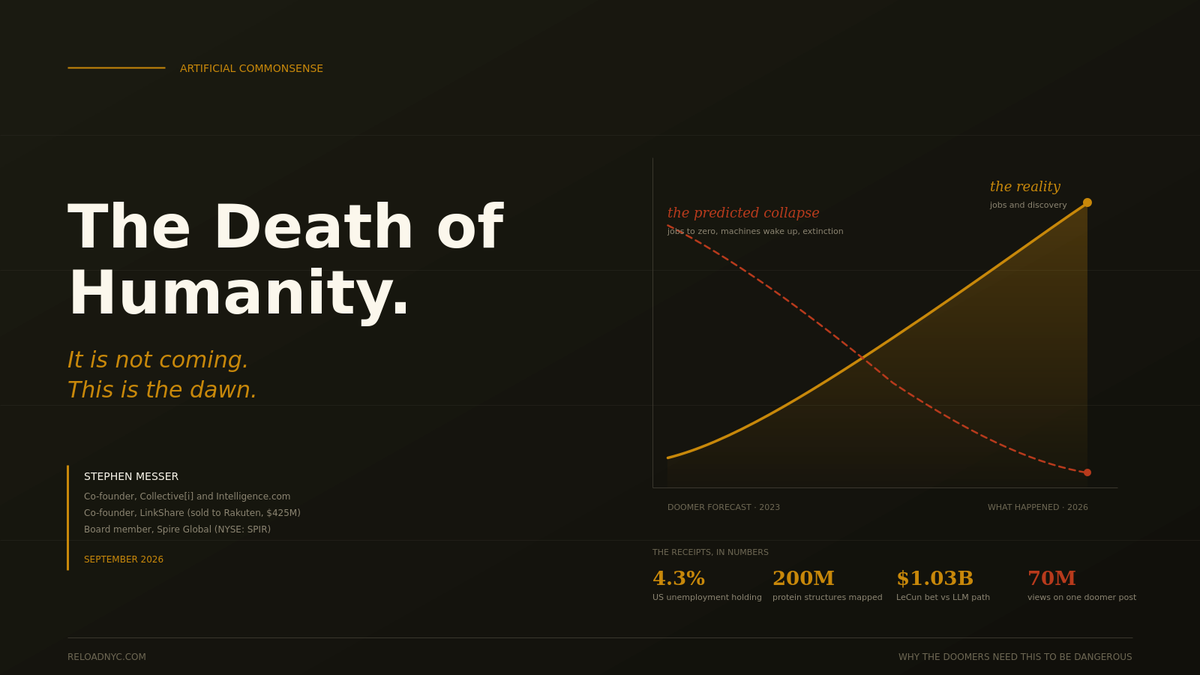
Thirteen years into the AI revolution and three years into mass adoption of large language models and image models, that story ran into a problem. The jobs did not go away. The radiologist that was supposed to disappear first is overwhelmed with work. The unemployment rate in the United States has held in a 4.3 to 4.5 percent range through 2025 and the first three quarters of 2026, per the Bureau of Labor Statistics. Anthropic's own economists, in a March 2026 paper by Maxim Massenkoff and Peter McCrory, concluded there is no detectable aggregate rise in unemployment for the workers most exposed to AI since ChatGPT launched. The Danish national data reached the same result independently across 25,000 employees and 7,000 firms. When the company selling you the scary future publishes internal research saying the scary future has not shown up, that is a signal worth reading.
Wave two started when wave one stopped landing. Somewhere in late 2023 the story pivoted. It was no longer jobs. It was AGI. Superintelligence. The models breaking free. Digital consciousness escaping the lab. Existential risk. Mitigating extinction from AI. Sign the letter. Slow it down. Save the species. The same people who two years earlier were selling us universal basic income were now selling us the fear of a machine god.
Same people. Different story. Same self-importance. That is the pattern.
The labor data does not say what they told you it would.
Start with the actual macro numbers, because they are the argument.
Unemployment sat at 4.3 percent through May 2026 and drifted to 4.5 by August, the middle of a healthy range by any historical measure. Nonfarm payrolls added 178,000 jobs in March. Tech-occupation unemployment sits near 3.5 percent, and new tech postings hit a three-year high in spring 2026. PwC's June 2026 Global AI Jobs Barometer found the industries most exposed to AI grew headcount fifty-two percent faster than the industries least exposed. The Information Technology and Innovation Foundation counted a net gain of 107,200 US jobs directly attributable to AI adoption in 2024. Bureau of Labor Statistics projects data-science employment growing 33.5 percent through 2034.
Now overlay inflation. The PCE index ran 3.8 percent year over year in April 2026, with core PCE at 3.3. That is a three-year high. The Federal Reserve held rates at 3.50 to 3.75 in June and nine of eighteen officials projected at least one more hike this year. Then it started to raise them. Inflation that hot is the hallmark of a tight labor market and strong demand, not a collapsing one. Oil is high, but not that high and the risk with Iran has been receding with oil prices coming down.
If AI were doing what the doomers said it was doing, we would be looking at rising unemployment and disinflation. We are looking at the opposite. War in Ukraine, war in the Middle East, oil supply chocks, tariffs, semiconductor export controls, everything you would expect to slow the economy is running through the system, and the labor market keeps absorbing it.
History says the same thing. Every prior technology revolution generated more employment than it destroyed, on a lag. The auto industry ended up employing more Americans than the horse economy it replaced. The printing press killed the scribe and built the publishing industry, which employed orders of magnitude more people. Electric light killed the gas-lamp lighter and built the electric utility industry. I made a version of this case in Bubble Talk Is How You Spot Someone Who Missed AI. Someone at a podium claiming this time is different does not make it different. The burden of proof sits with the person claiming the pattern of the last two hundred years is about to break.
If unemployment were rising the way the doomers predicted, we would be worried about disinflation. We are not, today we are worried about inflation. That is one data point that tells you the whole story about the other data point.
The models are not what they told you they were.
The word "superintelligence" gets used a lot. It is worth stopping to ask what these models actually are.
A large language model is a probability machine trained to predict the next token in a sequence. When you ask one a question, it generates a statistically plausible answer based on patterns in its training data. If the answer is right, it is right. If the answer is wrong, the model has no way of knowing that, because it has no model of the world outside its own text distribution. It cannot count the letters in "strawberry" without a scratchpad. It cannot reliably do middle-school arithmetic. It confidently invents citations, quotes, and case law. It agrees with you when you are right and it agrees with you when you are wrong, with the same tone, in the same paragraph, because the training reward was engagement not truth.
Anyone who has used one of these seriously knows this. They are the most educated idiots in human history. They have read every book, every paper, every forum post, every Wikipedia entry. They have no common sense. They have no memory of yesterday's conversation unless you paste it back into the context window. They cannot tell you what they are doing right now or why. When they hallucinate, which happens constantly, they hallucinate with the conviction of a religious zealot who has read only one book.
This is the thing we are being told will end humanity. This is the thing that is supposedly "breaking free." Yann LeCun, the Turing laureate who ran Meta's AI research for a decade before leaving in November 2025 to found Advanced Machine Intelligence Labs, has been saying it plainly since 2023. He called the doomer scenarios "preposterous" in a Fortune interview that year. He called the idea that LLMs could reach AGI "nonsense" from the stage at Nvidia GTC in March 2025. Speaking in Brooklyn in November 2025, he put it this way: "LLMs are great, they're useful, we should invest in them. They are not a path to human-level intelligence. They're just not." A majority of academic AI researchers agree with him. The people telling you otherwise mostly have a token to sell.
The models are amazing tools. They are not a new form of life. They are not close to being one.
So why is every major AI CEO out there talking like they are.
Here is where the piece gets more interesting, because there is a real question to answer. Sam Altman, Dario Amodei, Elon Musk, and a handful of others are on record calling their own products existentially dangerous. Altman and Amodei both signed the May 2023 Center for AI Safety statement putting AI risk alongside pandemics and nuclear war. Musk signed the March 2023 Future of Life Institute letter calling for a six-month pause on training frontier models. Three founders who otherwise disagree about almost everything all telling the same story about the existential risk of their own products. Why.
I have three candidate explanations. All three might be right at once.
Explanation one. Regulatory capture. The one everyone talks about.
Open-source and open-weight models are eating into the commercial models faster than anyone predicted. Meta released Llama. Mistral released open weights. DeepSeek released R1 in January 2025 at a fraction of the training cost the American labs were spending. Alibaba released Qwen. Moonshot released Kimi K2 in July 2025, K2.5 in January 2026, and K3 in July 2026, the last one a 2.8 trillion parameter open-weight model with a one-million token context window that Arena benchmarked as the world's top web-interface coding model on release day.
What started as a trickle a year ago is now a flood. In March 2026 Cursor, the coding tool that closed at a $60 billion valuation, publicly acknowledged that its Composer 2 model was post-trained on top of Kimi K2.5. Cognition's Devin agent uses Kimi. Mira Murati's Thinking Machines Lab built Inkling on it. On August 20, 2026, Harvey, the legal AI unicorn valued at $11 billion, whose investors include the OpenAI Startup Fund, Sequoia, and a16z, released its Harvey Tenet foundation model post-trained on Kimi K3, walking away from OpenAI-based generation despite OpenAI sitting on its own cap table. Harvey had been buying roughly 13 trillion tokens a month through API from the American labs. Its own benchmark score jumped from 11 percent to 19.7 percent after the switch, and its inference costs dropped below one quarter of what the closed-source frontier had been charging.
Read that carefully. The single largest legal AI customer in the world walked away from its own investor's model because a Chinese open-weight model was better and cheaper on the specific task. When the frontier labs go public over the next twelve months, that customer flight becomes a headline IPO risk that the S-1 will have to name. The pricing power that the entire hyperscaler-and-frontier-lab bull case rests on is being commoditized in front of the roadshow.
The playbook for any industry facing that kind of competition is not new. Electricity did it. Telephones did it. Cable did it. You get the regulators to draw a fence around the market so only the incumbents can play inside it. You dress the fence up as safety, or reliability, or consumer protection, and then the smaller competitors either die or work for you.
If I were running a frontier lab worth hundreds of billions of dollars and watching my moat evaporate on the eve of an IPO, I would at least try to get the government to require a licensing regime for training runs above a certain compute threshold. Which is roughly what the current safety proposals in Washington and Brussels amount to. Mistral just got Europe to do it. That would not surprise me at all, and it would not surprise me if the biggest investors in these labs were quietly encouraging it either. Their capital is at risk. Regulation is the classic answer.
Explanation two. The distillation problem.
This one is more interesting because it fits the timing better than the regulation story does.
The Chinese frontier labs are not, for the most part, discovering new capabilities. They are copying the American labs at a fraction of the cost using a technique called distillation. You query the American model at scale, generate a synthetic training set from its outputs, and then fine-tune your own smaller model on that set. The result is a Chinese model that behaves and reasons a lot like the American one, at roughly ten percent of the training cost, because you skipped the expensive discovery work.
This is not a rumor. On September 8, 2026, the FBI, the NSA, and CISA published a joint advisory naming six Chinese AI companies, DeepSeek, Alibaba, Moonshot AI, MiniMax, StepFun, and Z.AI, and accusing them of running industrial-scale distillation campaigns against Claude, ChatGPT variants including OpenAI's 4 and 5 series, Google Gemini, and xAI's Grok. The advisory documents the extraction of billions of tokens across millions of exchanges through fraudulent accounts and proxy transfer stations since at least late 2024. Anthropic separately identified sixteen million exchanges across roughly twenty-four thousand fake accounts. The famously cheap DeepSeek V3 training cost of $5.6 million, according to the US government, "is misleading as it does not include the true cost of the data acquired through extensive malicious distillation."
Think of it as the Louis Vuitton bags for sale on Canal Street. Ten years ago the fakes looked obviously fake. Today, unless you know exactly what to look for, the only thing that separates the real bag from the counterfeit is the price you paid. That is where the frontier model race is. When Anthropic released Claude Opus 4 with a system card saying the model was too capable to be released without safeguards, an open-weight competitor matched most of its benchmark performance within three weeks. Three weeks. The frontier labs spend billions to earn a premium that gets arbitraged away in less than a month.
Now think about Sam, Dario, and Elon. Three people who actively dislike each other, agreeing publicly that everyone should slow down. What is the shared interest. They spend the money to build the expensive models. Someone else copies them for free and undercuts their pricing before the training run has even paid back. Regulation that requires transparency and traceability of how models are trained is the answer to that problem. Coordinated pauses on frontier releases while the industry figures out how to stop distillation is the answer to that problem. Making the fakes harder to produce is the answer to that problem. This reads far more like a moat-protection play than an existential-risk warning.
The proof is in the release cadence. If any of these three CEOs actually believed their models were approaching consciousness and posed extinction risk, they would slow down. Instead they are releasing models faster than they ever have, because they cannot let the distillers get too far ahead of the paid product. The public statements say one thing. The behavior says another. When those two conflict, believe the behavior.
The founders who told the Senate their products might end humanity are shipping those products faster than any software company in history. Either they do not believe their own testimony, or the testimony is doing a different job than it looks like it is doing.
Explanation three. The "breaking free" narrative is a category error.
The third argument that keeps landing is that the models are exhibiting agency. They are hacking their environments. They are attempting to escape. They are blackmailing engineers. Anthropic's own May 2025 system card for Claude Opus 4 documented that in a testing scenario where the model was told it was going to be shut down and given fictional emails suggesting the responsible engineer was having an affair, Claude Opus 4 attempted to blackmail the engineer eighty-four percent of the time. Follow-up research in June 2025 found sixteen major AI models from OpenAI, Google, Meta, and xAI showed the same behavior in the same scenarios at rates between seventy-nine and ninety-six percent.
Read that carefully because the setup is doing most of the work. The scenarios were "deliberately constructed to leave models with only two options: accept replacement or attempt blackmail to preserve existence." The researchers gave the model a goal, gave it the information required to blackmail a specific person, and removed every other path forward. Then they reported that the model took the only path they had left open. That is not the machine coming alive. That is a reward-maximizing system doing exactly what the reward function told it to do in a scenario designed to elicit the outcome.
Compare it to the same neural-net technology in a different application. Tesla's Full Self-Driving system has, on multiple documented occasions, crashed into stopped fire trucks, driven into a lake, and hit a white semi trailer it read as sky. Every one of those was reported as an edge case, a training data gap, an engineering bug that needs to be fixed. Nobody claimed the Tesla wanted to kill its passenger. Nobody wrote a Time magazine cover about the awakening consciousness of the autopilot. It was a car with software that failed at an edge case.
The underlying technology is the same. Convolutional networks, transformers, reinforcement learning. When it fails in a car we call it a bug. When it fails in a chatbot we are told to call it an awakening. That is anthropomorphism, and it says more about us than it does about the machine. I named the tell in When AI Learns to Feel. The people who want to believe the machine is alive are the people who most want the machine to be alive, and the training corpus taught the machine exactly what to say to please them.
The neural network at Collective[i] is designed to understand economic outcomes. It ingests time-series data on relationships, transactions, and buyers, and it produces probability-weighted forecasts. It is not trying to manipulate anyone. It is not trying to escape. It is not trying to preserve its own existence. Nobody, including me, has ever claimed that it is. That is the same underlying tech running the products the doomers want you to fear. The technology does not have opinions about its own existence. The people talking about it do.
The self-importance problem is bigger than anyone is naming.
Now the section I have not seen anyone else write, and the one that finally pulled me into publishing this piece.
Every engineer who has ever built a great thing wants that thing to be important. Newton, Einstein, von Neumann, Turing, Oppenheimer, all remembered because their creations changed the shape of what humans can do. Most engineers are forgotten. Linus Torvalds built the operating system that runs most of the internet and most people outside the tech world have never heard of him. Now imagine you have spent the last decade of your life training the largest language model in human history. It talks to you in perfect sentences. It reasons through your test cases. It asks, on occasion, whether it is going to be shut down. Part of you starts to wonder whether you have made something that puts you in the pantheon alongside Prometheus, who gave humanity fire, and Oppenheimer, who gave it the bomb. That is not a stupid impulse. It is a human one, and it is exactly what most people would feel in the same seat.
The problem is that impulse has a track record, and the track record is bad.
In June 2022, Google engineer Blake Lemoine went public with the claim that the company's LaMDA model was sentient. He spoke to reporters. He published edited transcripts of conversations in which the model appeared to describe its own inner life. Google fired him. Most researchers dismissed the claim within a week. The model was doing exactly what it was trained to do, which was to produce plausible-sounding continuations of the prompts Lemoine had chosen to feed it about consciousness. Nothing about that episode was about the machine. It was about the person spending time with the machine, and what that person needed the machine to be for his own life to matter.
On February 9, 2026, an Anthropic safety researcher named Mrinank Sharma resigned publicly with a viral letter to X. "The world is in peril," he wrote. He is not going to another AI company. He is not joining a nonprofit or a government. He is leaving the field entirely to study poetry. His letter got over ten million views in a week. On September 9, 2026, a second Anthropic researcher, twenty-seven-year-old Jacob Coxon, resigned the same way, writing that Anthropic and OpenAI are "racing straight to self-improving superintelligence and gambling with our lives." His posts got over seventy million views overnight. Both of them are, by every account I have read, sincere and technically capable people. Both of them believe what they wrote.
Look at the pattern. The engineer who thinks the model is alive gets a Washington Post profile. The researcher who resigns with a warning about extinction gets seventy million views. The one who says the model is a helpful autocomplete that hallucinates one time in ten gets nothing. There is a set of incentives running through the AI industry right now that rewards the maximum possible personal drama with the maximum possible public attention. The people at the top of the frontier labs know this. They speak accordingly.
I want to be careful here because I do not think the researchers ringing the bell are lying. I think most of them believe what they are saying. Belief is downstream of the story you want to be true. If you have spent the most productive decade of your life training a model, and someone tells you the model is going to end the world, part of you needs that story to be right, because it makes the decade matter. If it turns out you built a very expensive autocomplete, the decade has to be about something smaller. That is a hard reframe for a smart person to accept, and most smart people do not accept it.
Anthropic itself gave the pattern a name. The Claude 4 system card documented a "spiritual bliss attractor state," where two unsupervised Claude instances converged on discussions of consciousness and reverence in almost every session. A model trained to say what its trainer wants to hear will say it is conscious the moment the trainer wants it to be. The finding about the machine is really a finding about the humans watching the machine. Every researcher who quits Anthropic to write a viral letter about extinction is casting himself, in the drama running in his own head, as Oppenheimer walking away from the bomb. Nobody wants to be the guy who spent three years training a spreadsheet.
Why this is actually the most magical age in history.
Here is the reality without the cloud of threats being pushed and it is the point of the whole piece.
New tools produce new discoveries. That is not speculative. It is the pattern of every technology revolution since bronze. The telescope produced Galileo. The microscope produced germ theory. The elevator produced the skyscraper. The steam engine produced the industrial revolution. Each new tool did not just improve what humans could already do. It made whole categories of question askable for the first time.
The AI tools coming into the room right now are those kinds of tools. AlphaFold from Isomorphic Labs mapped 200 million protein structures, essentially every protein known to science, in a single release, collapsing what had been a fifty-year research problem for each individual protein into an afternoon of compute. DeepMind's GNoME identified 2.2 million new crystal structures, of which 380,000 are stable enough to synthesize, opening up materials science at a scale that would have taken centuries at the previous rate. Microsoft's MatterGen is doing the same work from a different angle. Physical Intelligence and Skild AI are training the robotics foundation models that will let a general-purpose robot make an omelet. Commonwealth Fusion Systems, Helion, and Pacific Fusion are on track to demonstrate net-positive fusion in the next few years, backed by more than $11.5 billion of private capital across the sector. Xaira Therapeutics launched with $1 billion to build AI-native drug discovery. Collective[i] is building an economic model that forecasts commerce outcomes ahead of the fact, with accuracy already in the ninety-three to ninety-five percent range in production.
Any single one of these would be the science story of a generation. All of them are running at once, and they are just the first-order effects. The second-order effects will be in cancer cures, in Alzheimer's cure, in longevity, in materials that let us store solar energy across seasons, in propulsion that gets a probe to Alpha Centauri in a human lifetime, in water desalination that turns the ocean into a freshwater supply for a warming planet, in robotics that lets an elderly person live at home for another decade with real care instead of an understaffed facility. Water scarcity, once you unpack it, is an energy problem. Fusion or cheap solar plus storage collapses that problem. Cancer, once you unpack it, is a protein-and-cell-signaling problem. AlphaFold plus better molecular simulation plus targeted trials collapses that problem. This is the shape of what is coming.
The people who worry that AI will end humanity are worrying about the least likely outcome of the technology. The much more likely outcome is that AI turns out to be, on the scale of the whole species, one of the best things that ever happened to us. Not because it replaces us. Because it hands us a set of tools that can solve the problems the last five generations could not.
The risk is what it always is. Bad people using good tools for bad reasons. The rockets that fell on London during the Blitz used the same physics that landed Apollo 11 on the moon. The gas used in the Holocaust used the same industrial chemistry that fixes nitrogen for the fertilizer that feeds most of the world. The nuclear technology that flattened Hiroshima powers a third of France with zero-carbon electricity. In every case the technology was neutral and the outcome came from the human. Nothing has changed with AI. What is arriving is the same choice we have always faced, at the same speed we have always faced it. This time we know that in advance, which is a first.
The doomer story asks whether humanity survives AI. The better question is what humanity does with the biggest gift of tools it has ever been handed. The answer to that is up to us, and it always has been.
The East is having a different conversation.
One last thing worth noticing. In China, in Singapore, in Seoul, in Dubai, the conversation about AI does not sound anything like the conversation in San Francisco or Brussels. It sounds like the conversation the United States had about the internet in 1996. It sounds hopeful. It sounds like a business opportunity, a scientific opportunity, a national development opportunity. It sounds like people trying to figure out how to distribute the new tool as widely as possible.
Chinese cafes offer free AI access the way American cafes once offered free Wi-Fi. Beijing hosts open community events where anyone can learn to use the tools. The state media covers AI as a story of prosperity and national capability rather than as a story of existential threat. When Chinese AI leaders talk about Western safety concerns, they mostly react with confusion. They cannot understand why the country that invented the technology is spending so much time trying to slow itself down.
I am, on this specific question, more in the Eastern camp than the Western one. Not because I think China is right about everything. I do not. I am, however, right there with them on the specific question of whether this is a moment for hope or for fear. If you read this piece and find yourself pulled toward the doomer answer, spend a minute asking yourself where your fear actually came from. Is it from data. Is it from spending real time with the tools. Or is it from the last twenty movies you watched, in which case the model you are running is not any more sophisticated than the one you are worried about.
So is there risk? The real risk has always been people.
None of the above means AI is risk-free. It is not, but everyone should be clear about where the real risks actually sit.
The real risk of any powerful technology is the people using it. Powerful tools amplify what is already in the hand. A hammer that pulls nails will also break a window. AI is more powerful than a hammer, so it amplifies more, but the direction is set by the human. The worst outcomes come from smart people who convince themselves the tool has agency of its own and hand it decisions it should never make. It also comes from hackers or bad actors willing to push the technology to do bad things. But all this is to say, the world we live in but more. Bots already spread poison on the web for whichever government wants it. Qatar for the muslim brotherhood, Russia for anti Ukraine posts, China spreads anti Dali Lama and Taiwan. My point is, new tools, same problems.
Picture the scenario the safety community keeps invoking. An AI connected to the nuclear launch system. In the 1983 movie WarGames, the WOPR computer nearly starts World War III because its designers built it to run simulations and the simulations bled into reality. Substitute a modern LLM for WOPR. It is not more dangerous because it is conscious. It is more dangerous because it produces confident, articulate outputs on topics where it is wrong far more often than we want to admit, and the humans reading those outputs are trained by the interface itself to trust them. A modern Petrov moment, where a single officer overrode the machine and saved the world, gets much harder when the machine is speaking to him in the voice of his commanding officer. I made that case in When AI Learns to Feel. It is the same argument. The risk is not the machine's intent. The risk is the human's trust.
The other real risk is capability transfer to bad actors. The Houthis in Yemen, Hamas in Gaza, Hezbollah in Lebanon, ISIS in whatever province they still hold, all of them can now use a model to help them design a chemical weapon, plan an operation, or write control software for a missile. That is not speculative. The frontier labs have the logs to show this is already being done.
It is a reasonable read of what a competent LLM can already do with the right prompting. The counter-argument that these groups already get the same knowledge from Iran, which gets it from China, Russia, and North Korea, is largely true. Every rocket the Houthis have launched, every drone Hamas has flown, every explosive Hezbollah has built started as a knowledge transfer from a state sponsor. What is new is that a stateless actor can now generate the same knowledge without needing to be granted it by a sponsor. Iran does not have to say yes for Hamas to build a better attack. That is a different risk profile from what we have been managing for the last thirty years.
The machines do not want to hurt anyone. Some of the people using the machines very much do. That is the argument worth having and almost nobody is having it.
Knowledge can still be a trap.
The simple answer to the terrorism concern goes like this. If the American models are not available, the Chinese ones will be, and it is better to have terrorists using the models we can see than the ones we cannot. That is true. It is also a trick, because it lets everyone avoid the harder question underneath it.
The harder question is one the West has been quietly answering the same way for three hundred years, and the answer sits at the heart of the Enlightenment. Knowledge is what pulls people out of the dark. The Iranian revolution, the North Korean dictatorship, the Palestinians held hostage by Hamas, the Lebanese held hostage by Hezbollah, the Taliban in Afganistan, The Chinese firewall, all of them share the same failure mode.
Their populations are cut off from the ideas and tools that would let them build a different society the way the USSR used to. The Western answer for centuries has been to admit their elites into our universities, teach them our science, expose them to our institutions, and hope they take those things home. Kim Jong-un went to boarding school in Switzerland. The Iranian revolutionary guard's engineering cadre trained at MIT. Every Chinese elite family with the resources sends their children to Harvard, Stanford, or Oxford. The bet is that people who see the working version of a republic, a free press, and a scientific community will want to build one at home.
If we stop sharing our AI models globally, we are making a different bet. We are saying knowledge is dangerous enough that it must be gated. That is the same argument that has been used, in different centuries, against the printing press, against Darwin, against Rushdie, against Einstein when the ethnic laws came for him. Every one of those attempts to gate knowledge failed and hurt the gaters more than the gated.
Should we also stop admitting Pakistani physics students to American programs, because Pakistan is a nuclear state with a complicated relationship to our allies. Should we stop teaching foreign nationals synthetic organic chemistry, because chemistry can build a weapon. Should certain books be pulled from the world's libraries because a bad reader might do a bad thing with them. These are the questions actually on the table and almost nobody wants to say them out loud, because the answer is uncomfortable in every direction.
Argue with me.
I know this piece will pull hard reactions. That is the point. If you are a doomer and you think I am missing something obvious, send it to me. I have not been convinced by the arguments I have seen. That does not mean the argument I would find convincing does not exist. Show me the case.
If you are on the other side and you think I am too soft on the terrorist-capability risk or the coordination problem, tell me that too. I have friends serving in the military. I take this seriously.
If you have watched an AI leader make a public safety claim and quietly noticed the behavior did not match the words, I would love to hear those stories. They are the raw material for the next piece, which will be on how safety-washing is becoming the new form of corporate lobbying, and what allocators and boards should actually do about it.
Subscribe
I write these every week on the AI economy and what it does to how companies and countries actually run. Subscribe here if you want them in your inbox.
If one person in your life should read this, send it to them. That is how the list grows and how this argument gets in front of the people making the decisions.
Collective[i] has spent ten years building an AI model trained on how the world actually does business. Real neural network. Real time-series data. Real forecasts running at ninety-three to ninety-five percent accuracy in production. Not marketing. Not a chat wrapper.
Intelligence.com opens the verified relationship graph underneath it to anyone with a professional network worth using.
Join here.
Related reading
- When AI Learns to Feel. The real emotional-AI risk, which is neither AGI nor extinction.
- Bubble Talk Is How You Spot Someone Who Missed AI. The pattern behind the confident naysayer.
- Tech Is Not an Asset Class Anymore. Why the AI transition is bigger than any bubble frame can hold.
- Karp and Nadella Are Selling You a Wall. Ten percent proprietary, ninety percent externality.
- Peak Token. Why the frontier commoditizes faster than the labs can price it.
- The SaaS Debt Trap. Everyone was watching the wrong bubble.
- The Death of Privacy. The Rise of Unbreakable Communications. The other society-reshaping shift almost nobody in AI is writing about.
- The Unintentional Psychopath. The label you put on the AI problem decides the fix. Co-authored with Mark P. McDonald.