$65 Billion in Revenue. Seven Times Bigger Than a Year Ago. The Bubble Debate Is Over.
Anthropic Just Crossed $65 Billion in Annualized Revenue, up Sevenfold in a Year. AI Works. Bubble Talk Is What Missing a Revolution Sounds Like. This Is the Planning Tool for People Who Have to Allocate Real Capital Before Consensus Catches Up.

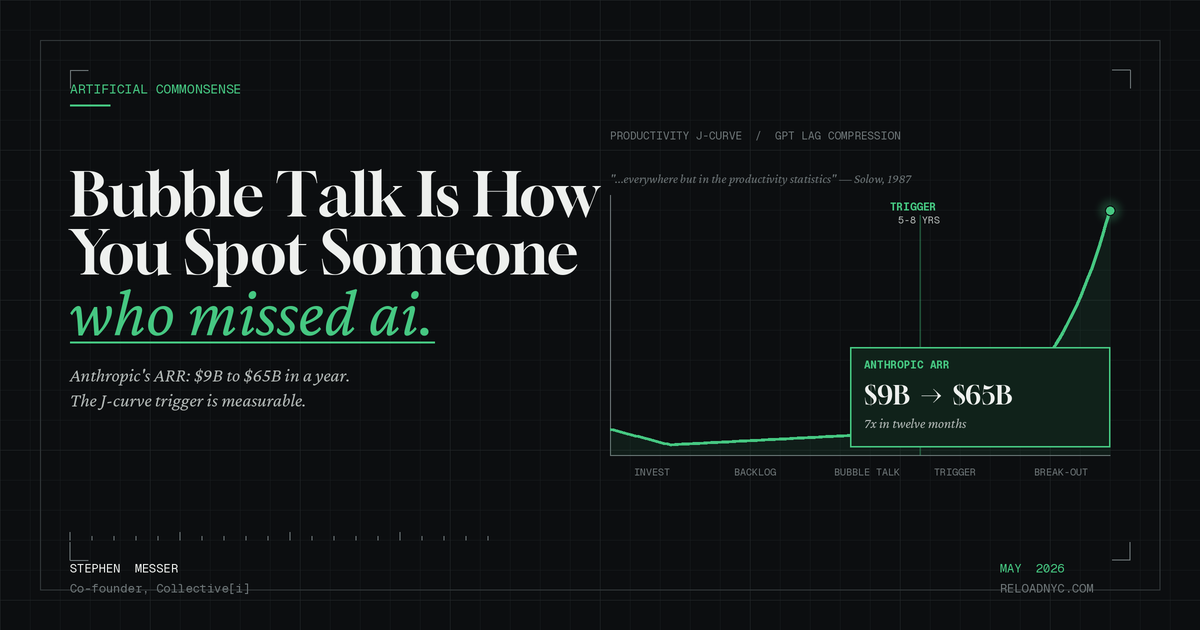
Every earnings call names AI. Every board deck names AI. Every consulting pitch names AI. The productivity statistics show almost nothing. That gap is not a sign the technology is failing. It is the exact pattern the last three general purpose technologies followed on the way to the productivity break. The J-curve is measurable. The trigger for the break is measurable. What matters for anyone allocating capital right now is when the trigger fires, where the productivity lands when it does, and how that changes the trade. This piece is the math, the mechanism, the case study inside one specific company that has already crossed the recursive line, and the trade nobody I have talked to is currently positioned for.
Stephen Messer, Co-founder of Collective[i] and LinkShare (sold to Rakuten for $425M, 1996–2005). EY Entrepreneur of the Year/Deloitte Fast 50 winner (2x). Board member, Spire Global (NYSE: SPIR). Building intelligence.com
Every serious conversation about AI right now sounds like some version of the bubble debate. Is this over investment. Is OpenAI worth $852 billion. Are the hyperscalers building too much. Is Anthropic's revenue real. Who wins the model layer. Who loses the application layer. Is Nvidia priced correctly. It is a coherent conversation with a specific tell. It never asks whether AI actually works, where it works and where the value will accrue.
AI works in more places than people are paying attention. Anthropic disclosed to investors this month that its annualized revenue run rate crossed $65 billion at the end of July, up from $47 billion in May and just $9 billion at the end of 2025. That is a sevenfold jump in a year. Q2 2026 revenue alone was $11.5 billion, a fourteen-fold jump year on year, and the company posted its first quarter of positive operating income. Anthropic added more than $18 billion in annualized revenue in the ten weeks between the two disclosures. That is roughly a Snowflake plus a Palantir, added to the run rate of one company, in ten weeks. That is not a bubble. That is a business.
The interesting question in 2026 is not whether AI is real. It is how the productivity flows through the economy from here as it moves beyond language models and coding. When some enterprises stop spending because the returns take longer to show up than they expected, and miss the shift. When other enterprises overspend because they misread the shape of the curve or invested on hype versus data, and end up building the bubble everyone keeps predicting. Where the returns actually land, when they land, and who is positioned to catch them.
The reason the debate stays stuck on the bubble question is that most of the people in it were not building on AI two years ago. When you miss a revolution and cheerleading is the only safe posture, the debate you can hold in public is about valuations. It is not about mechanics. That is what produces token-maxing as a signal of AI belief, chip-bubble talk as a signal of AI skepticism, and endless "who wins the model layer" arguments in place of the harder question of what any of these companies actually run on. Superficial understanding that lead to wrapper companies and turns a gut feeling into a stated position. In tech, that has always been the death of legacy.
Look at the OpenAI cap table for a clean picture of what late participation looks like. The March 31, 2026 round closed at $122 billion of committed capital and an $852 billion post-money valuation, up from $150 billion in late 2024 and $300 billion in April 2025. SoftBank co-led with Andreessen Horowitz and D.E. Shaw Ventures. Amazon anchored at $50 billion. Nvidia added $30 billion. SoftBank added another $30 billion on top of the lead. Microsoft continued its participation. MGX (Abu Dhabi), TPG, T. Rowe Price, Coatue, Altimeter, Dragoneer, Fidelity, Insight, and Sequoia all rounded out the round. When Andreessen Horowitz and Abu Dhabi's sovereign wealth fund write the same check, the check is not venture. It is a bond with equity upside. I made the full case in Tech Is Not an Asset Class Anymore.
Vinod Khosla is worth naming as the counterexample. Khosla was the first institutional VC into OpenAI in 2019, wrote a $50 million check at a $1 billion valuation when everyone else passed, and holds a stake worth billions today. That was conviction. Everything else on the cap table above showed up after ChatGPT was already the fastest-growing consumer product in history. Even Khosla is not the earliest example. FTX Ventures wrote a $500 million check into Anthropic in early 2022 (and Sequoia was an investor in FTX but still missed Anthropic and the chance to buy that position cheaply when they blew up), well before the current AI wave of venture capital moved.
Trading and prop shops were ahead of the VCs. Bitcoin miners were ahead of the hyperscalers. CoreWeave started as a crypto-mining operation. Crusoe started monetizing stranded natural gas by mining bitcoin, then converted its footprint into the Stargate campus in Abilene. The people and the capital that moved first were not from the categories the industry expected. This is the argument I ran through the three VC pieces at the top of this series: Tech Is Not an Asset Class Anymore, The Trust That Ate Venture Capital, and The Circle of Capital. Together they tell one story about how capital is being reshaped underneath AI. This piece is the operating-economy version of the same story.
To be clear, I am not writing to position. I have been on the front end of most of the tech revolutions of the last thirty years. I co-founded LinkShare in 1996 and helped invent affiliate marketing. I sat on the board of Spire Global as the CubeSat category redefined access to space, which I wrote up in The Shoebox That Changed Space. I co-founded Collective[i] ten years ago to train AI models on real economic activity, long before anyone was calling AI the critical category it is now. I do not need to establish where I sit on this. I need to lay out what I actually see, so anyone running a company or managing a major position has a planning tool instead of the two clickbait extremes the discourse currently offers.
The two clickbait extremes are easy to identify. Elon Musk says money will not matter in a post-AI world. Dario Amodei and Sam Altman say nobody will have a job. Both are compelling. Both drive usage and keep the companies telling them in the news, which is what they are designed to do. Neither is a planning tool. If you have to allocate real capital, you need the shape of the curve between now and the far horizon. What returns to expect. When. What to do while you wait. What to build. What to stop building.
If you are a leader or investor, misreading the curve is expensive in both directions. Pull back on spending because the returns have not arrived, and you miss the shift. Overspend because you assume linear payback, and you build the bubble everyone keeps predicting. I laid out the same failure mode in The Last Great Head Fake in Software History, where SaaS is running a dead-cat bounce anyone treating as recovery will walk straight into. My argument is not that we should be spending less. Close to the opposite. Given Taiwan risk and the physical-AI demand ramp I cover later, we should be overbuilding compute now while we still can. I made the compute-and-geopolitics case in The Trillion-Dollar Trade Wall Street Isn't Seeing. This piece is the demand-side companion.
The paradox itself is not new. In July 1987 the economist Robert Solow wrote one of the most quoted lines in the history of macroeconomics. "You can see the computer age everywhere but in the productivity statistics." It took another decade of computer investment before US productivity growth actually broke out of its long stall. The data did not show what everyone knew was happening. We are living inside the same paradox now. Enterprise spend on generative AI ran to $30 to $40 billion in 2025 alone. The productivity statistics show almost nothing. The critical difference this time is speed. Each revolution has compressed the lag versus the one before it. That is the section that follows.
One exception is worth naming. Data center construction is booming, and that capex shows up in GDP as private nonresidential fixed investment. It is meaningful to the headline number. In 2025 the hyperscalers alone poured more than $300 billion into data centers, chips, and grid capacity, and that spend is doing real work in the top-line growth figures. Strip it out and the underlying growth picture is even flatter than the headline suggests. The right question is not why. The right question is when it changes. It does change. The trigger is measurable if you know what to watch for. My prior piece, The Trillion-Dollar Trade Wall Street Isn't Seeing, argued that every adoption curve is getting shorter than the last. The AI break-out is not going to take the fifteen years computers took to show up in the productivity data. It is going to take five to eight. That compression is what makes the phase-three moment tradable inside every current fund horizon.
Phase One. Everyone Just Caught Up on the Backlog.
Across the Collective[i] network, we shipped more product in the first six months of 2026 than in the previous two years combined. That should feel like an advantage. Unless you are living under a tree, so has everyone else. The speed of software development jumped for every company at roughly the same time, which is exactly why it created no meaningful advantage for any of them. Every team had an endless backlog of features, integrations, edge cases, and quality improvements they had been putting off for years. AI-assisted development, agent workflows, and vibe coding all landed at once. The backlogs are getting worked down. That is a real gift to the users of these products. It is not new revenue for anyone building them.
The same pattern shows up in almost every function. It takes less time to write a marketing report, so leaders ask for more content in the reports. It takes less time to build a customer segmentation, so the segmentation gets rerun weekly instead of quarterly. It takes less time to draft a legal review, so legal reviews five more contracts a week. The output scales up. The bill for producing it goes down. GDP measures neither of those things very well, because national accounts were designed to count units of sale and hours worked, not the quality or richness of what got produced. Net-net, this is an improvement for the customers of everything. It is not a growth signal.
Phase Two. Cost Cutting Is the Default First Move.
The second phase looks the same as the first from ten thousand feet. Companies deploy AI. The stock analysts hear about it. Nothing shows up in the top line. The difference is where the money goes. Agents are enabling more work to be done by fewer people, and almost every enterprise deploying them is aiming that saving at cost, not at growth. Why pay a CRM vendor when a small team can build a working version over a weekend in Claude or better yet Kimi at a fraction of the price. Why staff a Tier-1 customer support desk when an agent can resolve the same tickets at a quarter of the cost. Why pay for BPO contracts when internal automation handles the same volume.
Cost savings is the default first move for almost every leader. I have made this case in every piece I have written on the AI-first transition. In The Companies Winning at AI Are Playing a Different Game, I argued the winners rebuild instead of layer. In The Safest Move You Can Make With AI Will Cost You Everything, I explained why the cautious position is the expensive one. In an upcoming post, What Jobs Become When the Overhead Is Gone, I lay out what actually happens to the org design underneath the cost cutting. The pattern is consistent. Most companies are in cost-cutting mode. A small minority is building something new.
The evidence is not subtle. MIT's Project NANDA studied more than 300 enterprise AI deployments in 2025 and found 95 percent delivered zero measurable P&L impact. The other 5 percent is where the real money is being made. The 5 percent outperform the S&P 500 by 29 percent on revenue-per-employee growth, and are eliminating whole software stacks in the process. That distribution is not a temporary phenomenon. It is the standard shape of a general purpose technology transition.
Ninety-five percent of enterprise AI deployments deliver zero measurable P&L impact. The other 5 percent outperform the S&P 500 by 29 percent. That distribution is not a temporary phenomenon. It is the shape of every general purpose technology transition on record.
The J-Curve Names the Pattern, and how to plan for it
The economists have a name for what I am describing. Erik Brynjolfsson, Daniel Rock, and Chad Syverson formalized it in a 2018 NBER paper published as "The Productivity J-Curve" in the American Economic Journal in 2021. Their argument is precise and testable. When a general purpose technology arrives, companies pour money into complementary intangible investments that national accounts do not measure. Process redesign. Workforce retraining. Data infrastructure. Organizational restructuring. Those investments are real. They are also invisible in official productivity numbers because they get expensed, not capitalized. Measured productivity looks flat or declining even while true productivity is compounding underneath. When the complementary capital finally lands, measured productivity spikes.
The paper's estimate for the computer age. Adjusting for intangibles related to hardware and software, US Total Factor Productivity was 15.9 percent higher than official measures showed by the end of 2017. In 2025, the Census Bureau confirmed the same J-curve pattern in early industrial AI adoption. Firms take productivity losses first as they restructure. They post gains later.
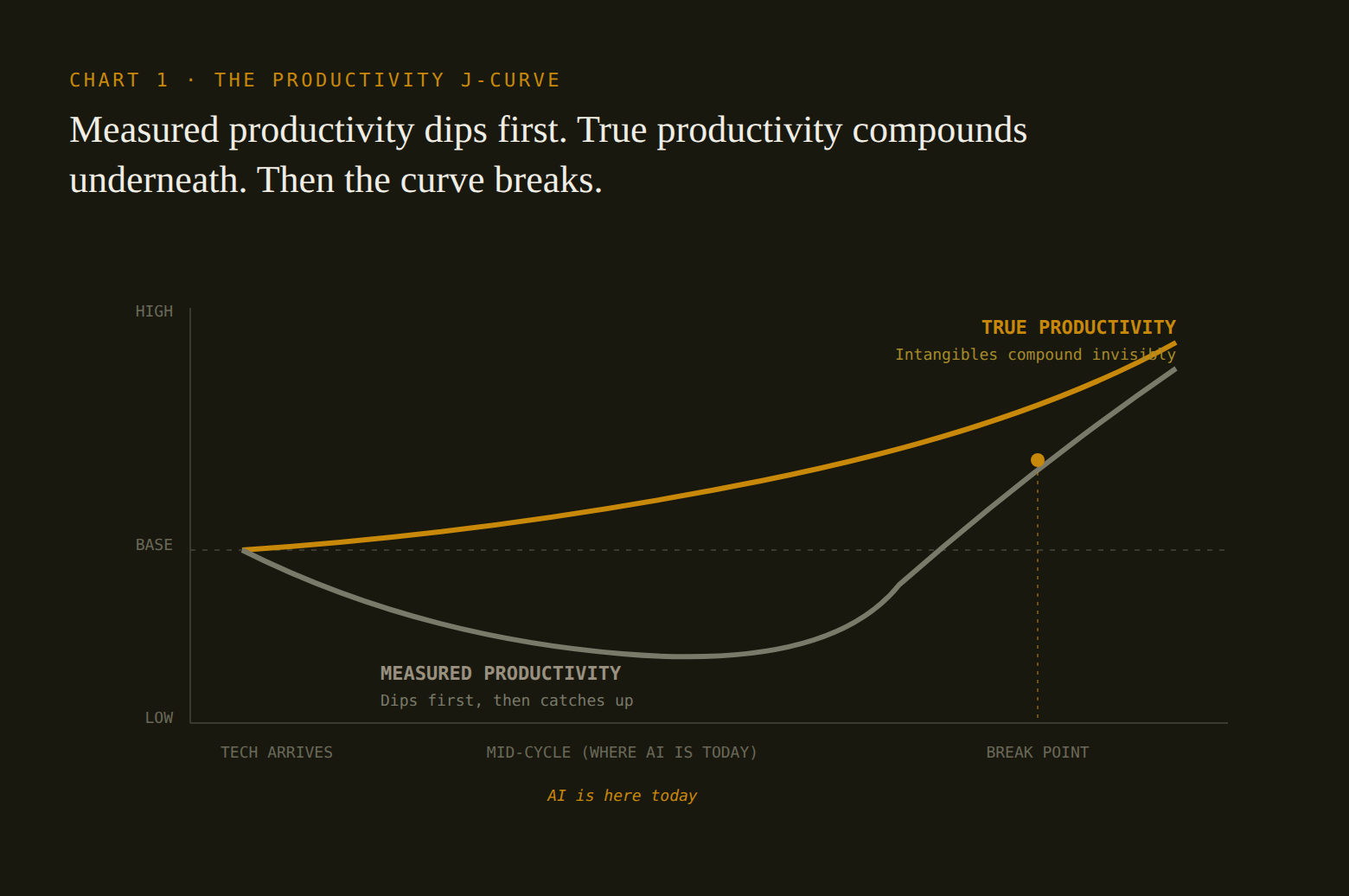
Where we are on the curve today is the middle of the dip. Every company is speeding up its existing processes and cost cutting where it can. Almost none has completed the reorganization that produces the compounding gains on the other side. This is the structural expression of the exact organizational argument I made in The Oldest Trick in Management Just Stopped Working and in The Weakest Link. The organizations that finish the reorganization first are the 5 percent MIT is measuring. The rest are still layering AI on top of the old design.
The leading signal that I pay attention to ID the start of the reorganization is public rejection of legacy SaaS. Sebastian Siemiatkowski at Klarna announced in 2024 that the company had shut down Salesforce and would shut down Workday, replacing both with a consolidated internal system built on Neo4j plus in-house AI tooling, with Cursor as the interface layer. He later clarified that the replacement was not a language model with a Salesforce logo on it, and that the point was consolidation and the removal of siloed data. The move eliminated roughly 700 contractors and saved approximately $40 million a year.
And since then each month more and more early adopters are doing the same and for good reason. Matthew Prince at Cloudflare cut roughly 20 percent of the workforce at record revenue, using the builder/seller/measurer framework I will unpack in an upcoming post called What Jobs Become When the Overhead Is Gone. Brian Armstrong at Coinbase has been cutting management layers quietly for two years. Jack Dorsey at Block has been flattening engineering and management. Andy Jassy at Amazon has been doing the same. Each of them is stating out loud that the old operating model is coming out.
That is the phase-three ignition signal on the org side. We see it at Collective[i] every day. On Intelligence.com, we see the same pattern from the individual side. People are not waiting for their companies to change. They are using AI to rewire how they work, who they know, and what they get paid for, ahead of the org chart catching up. When the individual side moves faster than the company side, the pressure to reorganize becomes structural. This bottoms up is what threw off all the analysts calling into CIO's with the LLM models. We see it now with our economic model following the same pattern.
The Same Curve Runs Through Every General Purpose Technology
Skeptics have been telling this story for a hundred years. The economic historian Paul David wrote a paper in 1990 that anyone modeling AI productivity should read. Titled "The Dynamo and the Computer," David traced how electricity took roughly forty years to show up in factory productivity. The dynamo was installed. The wires were run. The productivity did not arrive. What was missing was the physical reorganization of factories. Steam-powered factories were built around a central shaft with belts driving individual machines. Electric factories only work at their full efficiency if the whole floor is redesigned around distributed motors, one per machine, laid out for the actual flow of production. It took forty years for factory owners to reach that reorganization at scale. When they did, US labor productivity growth doubled for a generation.
Computers had the same lag. Solow wrote his line in 1987. Measured US productivity growth finally accelerated in the late 1990s. That is roughly a fifteen-year gap between the technology being everywhere and the productivity being visible.
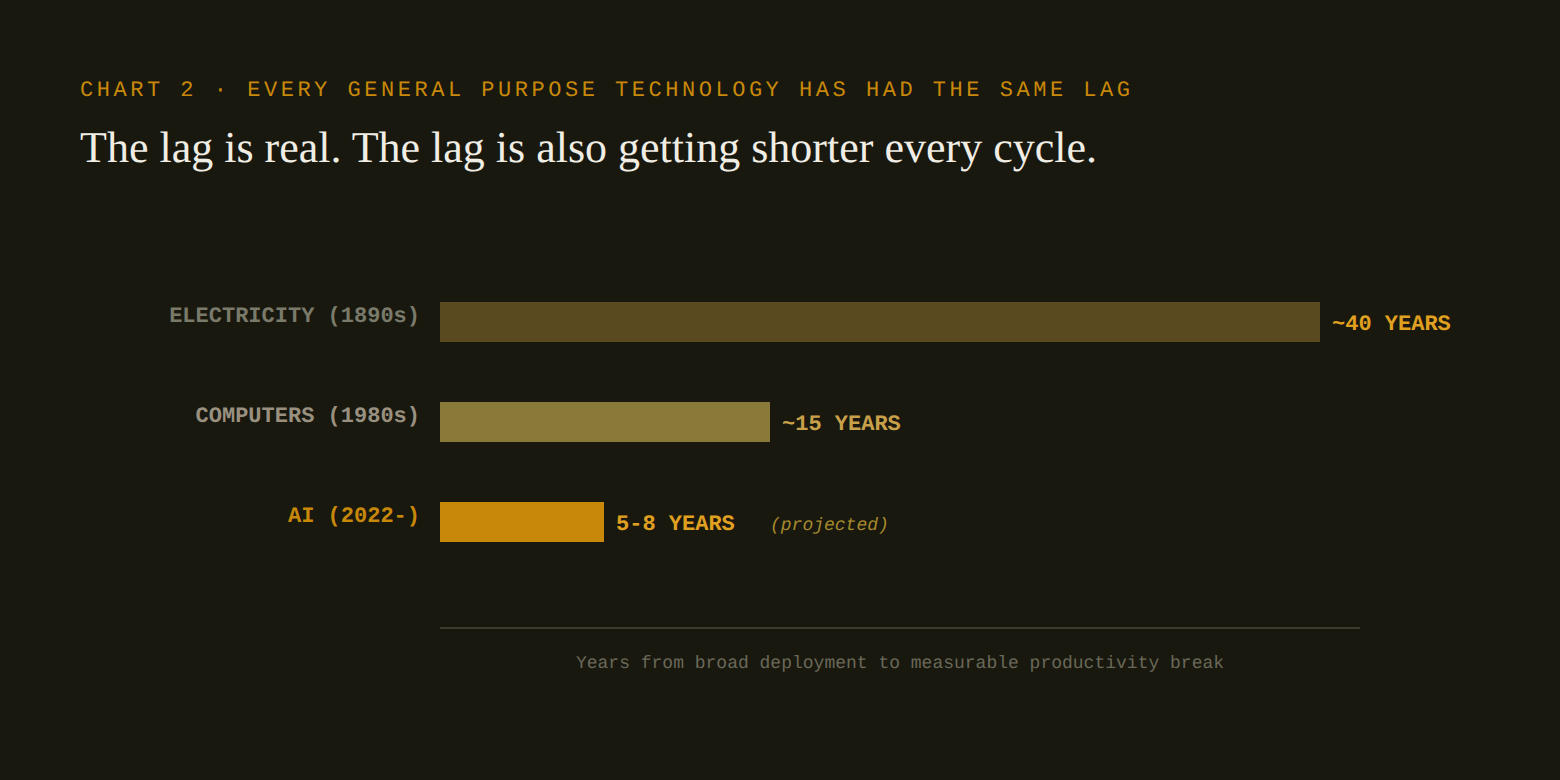
The lag is getting shorter every cycle because each new wave of infrastructure sits on top of the last. The reorganization does not have to build itself from scratch. If electricity took forty years and computers took fifteen, AI is likely closer to five to eight. The interesting question is when in that window the trigger fires.
Each Revolution Is Faster Than the Last. AI Is the Fastest Yet.
Anyone modeling AI on the timeline of prior tech waves is going to be too slow, and that will cost you. Every general purpose technology since the steam engine has broken through faster than its predecessor. The pattern is consistent enough to plan against. Steam took about eighty years from Watt's engine to visible productivity in the aggregate industrial data. Electricity took about forty years, as Paul David documented. Computers took about fifteen. The commercial internet took eight to ten. Mobile compressed further, cloud further still. AI is on track to break in three to five years from broad enterprise deployment, and the leading edge of that break is already happening at the 5 percent MIT is measuring.
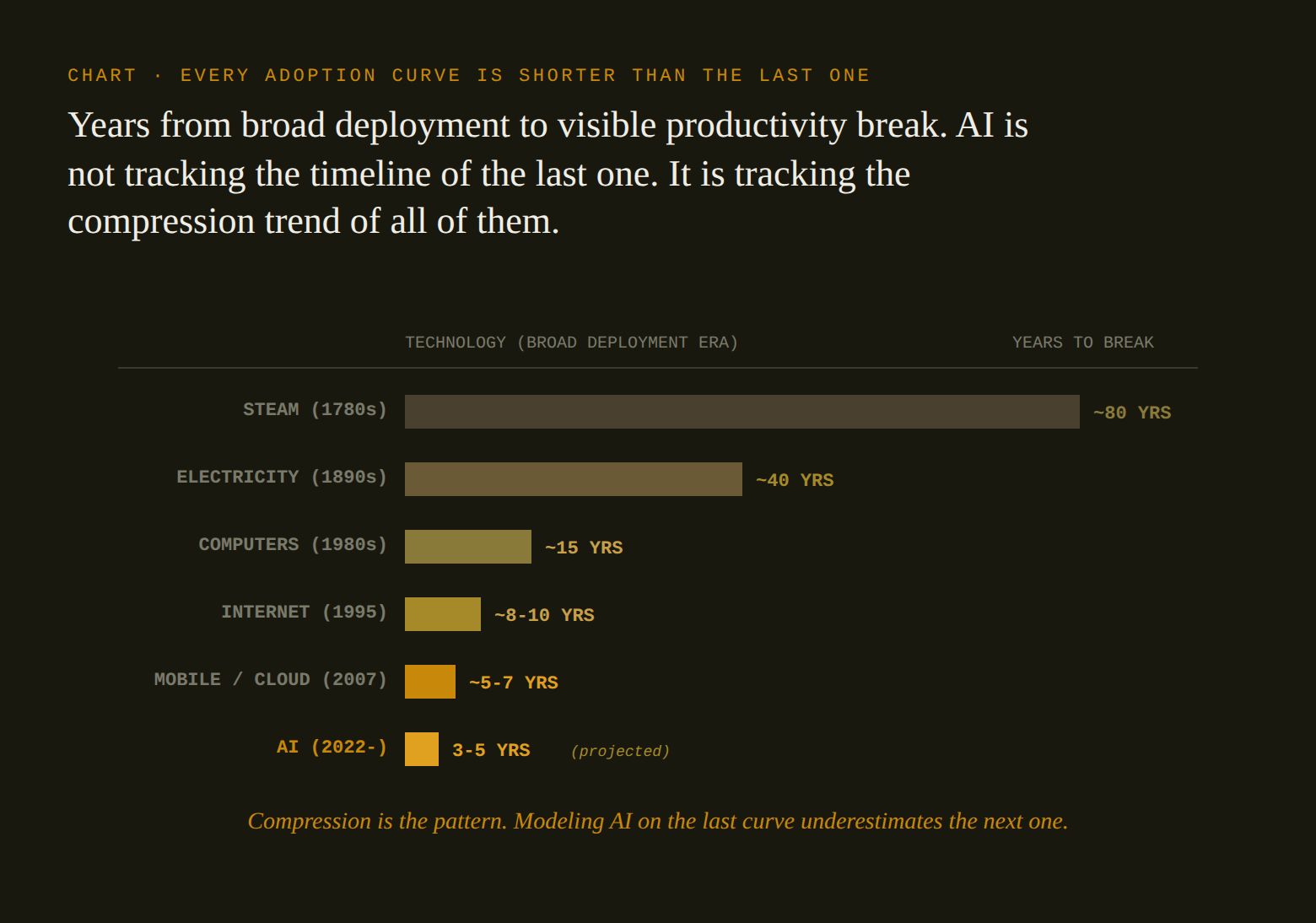
Two things drive the compression. The first is stacking. Every new wave sits on the infrastructure of the previous ones. AI does not have to lay fiber, build data centers from scratch (expand maybe but not build), or teach people how to log in. All of that is already done. The second is that the tools of the new wave are used to build the new wave. This is the recursive point I return to in the next section. Together, stacking and recursion collapse the time-to-productivity that used to require a generation of physical reorganization. My honest read on where AI lands in that range is closer to five years (of which we are already in year two of that) than eight, and my read on why is that the recursive loop is already visible at the leading edge. What comes next in this piece is how you spot it.
THE FRAMEWORK · Brynjolfsson and McAfee on the J-Curve
Erik Brynjolfsson and Andrew McAfee named this pattern more than a decade ago. Their work at MIT and Stanford, across Race Against the Machine, The Second Machine Age, and Machine, Platform, Crowd, put the language of the productivity J-curve, the great decoupling, and the reorganization lag into the mainstream. Brynjolfsson's 2021 paper with Daniel Rock and Chad Syverson formalized the specific shape this piece runs on. Both are speakers at the Collective[i] Forecast, both are friends, and both will be right about AI before the consensus catches up. If you want to join go to ciforecast.com, it is free and you can watch all the past sessions by joining intelligence.com.
The Breakaway Is Recursive. That Is What Makes This One Different, meaning you should expect a bigger impact than past patterns.
Every prior general purpose technology was linear. Electricity made every existing process a little more efficient, one machine at a time. Computers made every existing calculation a little faster, one department at a time. AI is different in one specific way. It compounds. An AI system that helps engineers ship code faster is used to build the next AI system that helps engineers ship code faster. At Collective[i], anyone using Telli Assistants knows the same recursion runs through the revenue side. A model that surfaces the right accounts to work on today is used to train the next version, which surfaces better ones tomorrow. The tools that build the tools are the tools. When an organization crosses the point where its own product is being built recursively by its own product, the productivity math stops looking like a J-curve and starts looking like a hockey stick.
This is not theoretical. It is happening at exactly one company at real scale right now, and it is worth studying carefully.
Anthropic Hit the Breakaway. On Only One Side of the House and thats an issue in maximizing the J-curve.
In May 2026, Anthropic disclosed that more than 80 percent of the code merged into its production codebase was written by Claude, up from single digits when Claude Code launched in February 2025. Engineers at the company now ship roughly 8x more code per quarter than they did in 2024. In a June 2026 paper titled "When AI Builds Itself," Anthropic warned that the recursive loop has moved from science fiction to operational reality faster than the company itself expected. Boris Cherny, who built Claude Code, has publicly stated he has not written a line of code himself in five months.
Mike Krieger, Anthropic's chief product officer and an advisor at Collective[i], summed it up in a single line. Claude is now writing Claude. That is the breakaway moment on the product side. The AI is building the AI. Now look at the rest of the company.
The same recursion is visible on the infrastructure side, from a different angle. GitHub was down for roughly seven and a half hours on August 17, 2026, the latest in a string of thirteen outages in seventeen days. Error rates hit 20 percent on the web and API, 50 percent on raw repository content. The immediate cause GitHub published was network saturation on Central US load balancers, an autoscaling policy that failed under peak load, and a latent retry bug in Visual Studio Code that amplified traffic roughly tenfold. Behind those specifics is a scale problem. GitHub CTO Vladimir Fedorov wrote in April 2026 that the company had set out to expand capacity ten times over, then concluded within months it needed thirty times. AI-agent pull requests went from four million in September 2025 to seventeen million in March 2026, a 325 percent increase in six months, and have kept growing. The most heavily used piece of software infrastructure in the world is buckling under the weight of AI-written code that the industry is telling itself has not yet arrived. It has. GitHub's outage log is the leading indicator the productivity statistics have not yet processed.
At the same time this is happening Anthropic's own customer blog profiles Jared Sires, a startup account executive who joined the sales team in 2024 with no coding background. As the blog explained his book grew to 700 accounts. His days ran ten to fifteen customer calls. His nights ran until nine or ten in the evening, working through inbound emails. He built a Gmail application called CLAFTS, short for Claude Drafts, that uses the Claude API to draft replies in his voice. It saves him two to three hours a day. Others in the sales organization picked it up within twenty-four hours of him sharing it in Slack. Now compare these two use cases to see the problem.
The same company that ships Claude, whose own product is 80 percent recursive on the engineering side has a sales person automating emails and thinks this is the same kind of benefit. Its sales representatives are individually building personal Gmail scripts, at night, in Google Apps Script, to survive an inbox that the AI-first version of the same company would have automated a year ago. This is the specific pattern I will lay out in What Jobs Become When the Overhead Is Gone and already did in Workflows vs Outcomes. The job Jared Sires was hired to do is buried under the tool overhead that his employer's own product could not remove. On one hand a recursive engineering model improving itself and on the other slop.
There is a second lesson in this. To the man with a hammer, the world looks like a nail. Anthropic has one of the best hammers in the world, and they also happen to build it. That is exactly the trap. Its sales team is trying to solve every problem in front of them with the tool the company sells, and that tool is a language model. Language models are extraordinary at drafting text, code. They are not what you use to price 700 accounts against a book of pipeline data, and they are not what you use to model which of those accounts is most likely to close next quarter.
That work needs a different kind of model. An economic model of how the world actually does business, like the one Collective[i] has spent a decade building on top of a network of pooled enterprise data. Imagine trying to drive a car with a language model. Imagine using a language model to run a factory robot, or to price options on a book of derivatives. Those things need world models, physics models, and economic models, trading models built for the specific job. We are so early in the AI adoption curve that a lot of very sophisticated organizations are pointing language models at problems that need a completely different model architecture and calling the result AI. It is not. It is category error at scale, and its changing fast.
I have made this case in several prior pieces. In The Next Computer Is Alive, I argued that all AI is narrow intelligence and running one model for everything is the wrong architecture by definition. The winning architecture is a stack of narrow intelligences pointed at what each one is good at, coordinated through a harness that knows which one to use when. Anthropic's product side has one brain. That is enough for engineering, because engineering is largely a text-generation problem. Anthropic's revenue side needs multiple brains and does not have them yet. That is why its sales team is on Google Apps Script.
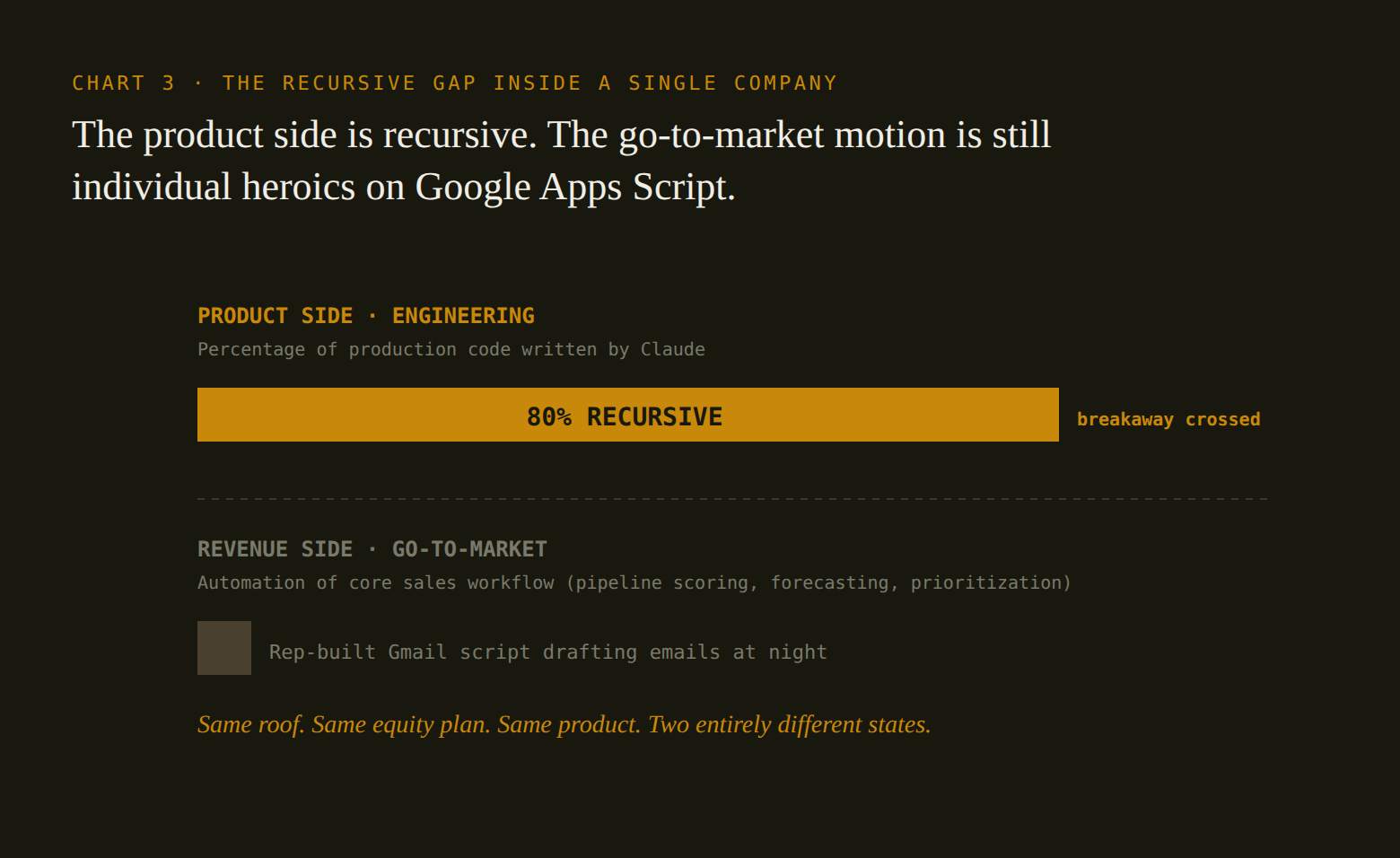
That gap is what a J-curve dip looks like from the inside of a single company. The product side has already broken through. The go-to-market side at Anthropic has not started. Both live under the same roof, on the same equity plan, using the same product. A growing list of companies already runs the same recursion on the revenue side, and the list is growing fast. Every quarter, more organizations cross the same threshold, shifting attention from what AI can do inside engineering to what it can do across every other function. The Collective[i] network sits at the center of that shift, watching it happen in real time.
The specifics inside those revenue teams matter. Large B2B organizations running this pattern today open each morning with a ranked list of accounts drawn from a live economic model of what buyers are doing across the market. The signal comes from millions of buying journeys observed in parallel. Their forecasts run against the same model, updated as the world moves. Their onboarding for a new AE takes weeks rather than quarters. Nobody in these organizations is writing personal Gmail scripts at night to survive their inbox. This is the buyer-signal architecture I laid out in The Buyer Has a Process and in Infinite Leverage.
None of this is a criticism of Anthropic. It is exactly what an early-breakaway company looks like. What matters for the trade is what happens once the same recursion moves out of engineering and into every other function.
The Trigger. What Actually Fires the Curve.
The trigger is not a single event. It is a change in what companies are aiming AI at. Phase one is backlog catch-up. Phase two is cost cutting. Phase three, the one that fires the curve, is when leaders stop asking "how do I do the same thing cheaper" and start asking "what would I build if I could build ten times as much."
Ten times more customers. Ten times more products. Ten times more markets. Ten times more experiments. When the answer to any of those questions stops being "hire more people" and starts being "point more agents at it," the growth is in the top line, not in the margin. That is the moment measured GDP starts catching up to reality. The MIT NANDA number is the tell. Ninety-five percent zero, 5 percent transformational. That 5 percent is the leading edge of phase three. What you want to track is whether the 5 percent grows to fifteen, then thirty, then fifty. When it does, the J-curve breaks. My honest read on timing is that the 5 percent will be twenty percent by end of 2027, and fifty by end of 2029. That is inside every current fund horizon.
Where the Break Shows Up in the Real Economy
The break does not happen everywhere at once. It shows up first where AI is the operating substrate for something that could not have existed without it, not a wrapper on existing software. A handful of categories are already visible.
Dark factories. Fanuc has been running lights-out robotic assembly since the 1980s. Siemens' Amberg plant reports a 99.99 percent quality rate on largely autonomous production. What is new in 2026 is that the software layer running the factory is a general model rather than a hand-coded control system. Jeff Bezos raised $12 billion at a $41 billion valuation for Prometheus in June, an "artificial general engineer" for the physical world backed by BlackRock, Goldman Sachs, and JPMorgan. Prometheus is not a chatbot. It is an AI system for designing and manufacturing physical products, and it is one of the largest early-stage AI checks ever written. That is where the smart money is starting to move now that the pure-software side is played out.
Self-driving, commercial and residential. Waymo runs 500,000 paid rides per week across ten US metros, with 3,700 robotaxis in service and 200 million autonomous miles logged. In February 2026 Waymo deployed a world model built on Google's Genie 3 that simulates edge cases like tornadoes and elephants for training. Every one of those rides is revenue that did not exist five years ago. The commercial-truck version of the same category is where the industrial productivity break lives, and I laid out the mechanics in The End of Car Ownership. You Just Don't Know It Yet.
3D-printed sneakers. Zellerfeld's fully 3D-printed shoes ship in weeks from Germany direct to the customer. The unit economics look nothing like Nike's, and neither does the supply chain. When one person can iterate a new shoe design in a weekend and have paying customers by month-end, the barrier to entering an industry that took decades to build a brand in collapses to almost nothing. The next Nike is not going to look anything like Nike.
3D-printed homes. ICON prints livable homes in about twenty-four hours of print time. The Texas developments they are shipping into now are not demonstrations. They are competing with conventional builders on price and delivery. Anyone modeling the US housing crisis around lot availability and interest rates is missing the input cost that is about to fall by an order of magnitude.
Onshoring. The permitting bottleneck is what has kept US manufacturing offshore for a generation. I made the case in Time Kills All Deals. America's Permitting Process Is Killing Yours and in The American Dream Has a Permitting Problem. AI Can Fix It Today. AI does not just accelerate the paperwork. It removes the labor-cost gap that made offshoring rational in the first place. Prometheus, Base Power, CoreWeave, and Crusoe are all onshore. The capex is landing here rather than being routed through Guangdong.
The common thread across all of these is that AI is the operating substrate, not a wrapper on old software or an add-on to the old operating model. I made the same argument at the microeconomic level in The Real Disruption. If you can spot the difference between "AI-powered version of the old thing" and "new thing that could not have existed without AI," you can run toward the second and away from the first. It is the best investment and hiring signal available in 2026. Wrapper companies carry legacy risk regardless of how new they look. Substrate companies are the 5 percent MIT is measuring. Run to those. Run away from the software vendor telling you their existing product now has AI features.
Commodity Language Models Are Not the Story so stop making every discussion about them (from bubble to build outs of data centers)
Sam Altman told TIME in mid-August 2026 that it was a good time to slow down. Separately, the Wall Street Journal reported that OpenAI's revenue grew only 18 percent from Q1 to Q2 of 2026, off previously stated internal targets, and Altman himself said publicly at a June 2026 industry event that customer token spend was becoming "a huge issue" with enterprises reporting they had burned their entire 2026 budgets in Q1. The market read those statements as evidence that the AI wave is topping out.
The correct read is different. What is topping out is the specific commercial model of commodity language-model access sold by token. Chinese open-weight models like DeepSeek and Qwen are undercutting frontier pricing at a rate that no proprietary model can sustain. The natural workload for a language model turns out to be code generation, which is the one enterprise use case where the value is high enough to absorb high token costs. Everything else compresses toward the open-weight floor.
The framing "OpenAI versus Anthropic" is the wrong lens. Both are commodity language-model producers competing on the same substrate. The differentiation is not who has the better model at any given token price. It is who owns proprietary data and proprietary model architecture pointed at problems language models cannot solve. Economic models. World models. Physics models. Biological models. The Next Computer Is Alive piece covered the substrate shift. Karp and Nadella Are Selling You a Wall covered why leaning on a single vendor is a defensive posture that does not survive contact with the next model architecture. Language models are one product category inside a much larger stack. They may end up being remembered as the first mass-market interface that made neural nets legible to non-technical users, which is a real achievement. They are not the ceiling of AI. Calling them AI at all is the same category error covered above. It is the equivalent of calling a keyboard the computer.
What this means for the trade is simple. A commodity price collapse in language models is a headwind for anyone whose valuation is based on token-margin economics. It is a tailwind for adoption of everything downstream. The two effects move at once. If you are pricing OpenAI on a growth curve that assumes token pricing power holds, you are pricing the wrong asset. If you are pricing the underlying adoption of what runs on top of commodity model access, you are pricing the actual curve. This is the same misread that produced the SaaS dead-cat bounce I covered in The Last Great Head Fake in Software History. Different asset class. Identical pattern.
The Fastest Way to Understand AI Is to Say You Do Not (its ok to do it)
Bubble talk, token-cost talk, jobs talk, Karp-versus-Satya talk, and every other superficial position circulating in the AI conversation share one feature. They come from people who felt like they were supposed to have an opinion, so they produced one. Volume is what the market rewards, not accuracy. Certainty signals competence, even when the certainty is misplaced. Certainty is the tax you pay for having missed the front end.
Alex Karp at Palantir argues the hyperscaler buildout is overinvestment. Satya Nadella at Microsoft argues the opposite. Both are reasonable inside each person's frame. Both are incomplete. To hold Karp's position with confidence, you have to actively ignore Taiwan risk, the demand ramp from self-driving, robotics, and physical AI, and the historical pattern that every prior compute buildout was overbuilt right up until it was undersupplied. Three simultaneous ignorances is not a market call. It is willful blindness. Charlie Munger used to say he would not allow himself to hold an opinion on anything unless he could argue the other side better than the person defending it. Anyone who has watched an LP walk into a room with a hot take on data-center capex and no answer to Taiwan understands the point.
The most useful thing a real allocator can do inside a debate like Karp-versus-Satya is say "I do not have an opinion yet." That is not weakness. That is the fastest way to learn. Once you take a public position, you have to defend it. Once you are defending, you have stopped learning. Every argument the other side makes becomes something to counter, not something to absorb. The number of times I have watched a CEO or an LP publicly change their mind after staking out a position is very close to zero. The number who kept optionality and quietly adjusted is high. Karp and Satya had to stake out positions. You do not.
This is first-principles thinking, the discipline that runs through the three VC pieces at the top. Ask the question the consensus is unwilling to ask. On data centers, the consensus says pick Karp or Satya. The first-principles question is different: what is the total demand for compute across every current use case plus every use case that will exist because the compute exists, over the ten years the buildout has to earn its capital cost? Can a data center hedge its risk via futures contracts? Answered with any rigor, that question does not produce a bubble read. It produces the picture inside The Trillion-Dollar Trade Wall Street Isn't Seeing.
The willingness to say "I do not know yet" is the tell of someone building conviction. A strong opinion in the first three seconds of a conversation is the tell that they are performing. The loudest opinions on AI in 2026 are coming from the people who missed it in 2023 and were investing in the SaaS market that AI now is eating. That is not an accident. That is exactly how markets make mistakes, and that is exactly the mistake we are watching now.
The Trade Nobody Is Positioned For
Investors currently price AI infrastructure on frontier lab revenue, as I discussed in the last piece, and price AI software winners on incremental margin improvement. Both of those framings live entirely inside phase one and phase two. Neither one prices the phase-three break. The trade is simple if you accept the argument. Position for the companies that are moving from cost cutting into building. Position against the ones still stuck in backlog catch-up. Watch the internal metric of "what percentage of our new revenue comes from products built after we adopted AI." When that number moves above 20 percent at a real operating company, that company has crossed into phase three. The market has not priced that transition into any comparable I have looked at.
The 95 percent figure will not stay at 95 percent. When it moves, everything moves at once. The bubble-versus-real debate will end abruptly, and a different one will start. Whether the trade works or not comes down to the same variable everything else in AI comes down to. Do you believe the ramp is going to compress, or do you believe it takes another twenty years. If you believe the compression, the phase-three trade is the alpha that is currently priced at zero. If you want the deeper argument for why the ramp compresses, Peak Token makes the case on the model-cost side, and The Next Computer Is Alive makes it on the compute-substrate side. Both are trending down faster than the consensus forecasts assume.
What Comes Next
The signs that the economy is actually changing show up first in the two places closest to how capital moves. First is finance itself: what gets funded, how it gets structured, and how private companies get to liquidity. When financing becomes debt-financeable against GPU contracts, gets bundled into ecosystem funds, or gets structured as an operating trust, the transition is telling you it is real. When BlackRock, JPMorgan, and Goldman anchor a physical-AI round like Prometheus, the transition is already priced into the smart end of the capital stack. The dumb end is still arguing about whether it is a bubble. Second is the rise of ecosystem companies above the language-model layer. World models. Economic models. Biological models. Physical-AI stacks. Vertical intelligence targeted at problems language models will never solve. Every month the ecosystem grows past the current commodity substrate is another month the transition is compounding.
Next week the series turns to war. Time compresses faster inside a conflict cycle than inside a productivity cycle. Everything in this piece about the J-curve and how fast the phase-three break arrives gets a hard second derivative from the war framing. Not the topic the people who know me best expect me to write about. It is the one that most changes how I think about every allocation decision I make.
My goal with every one of these letters is to explain the logic and save you from doing all the underlying work yourself. I use this framework to run my company, to advise the ones I sit with, and to keep my friends from missing the ups and downs of each economic wave. The underlying goal is to stop you from letting a gut feeling turn into a stated belief. In tech that has always been the death of legacy. Each wave now moves faster than the last, and tech is now the economy. Error toward speed. This wave is not a bubble. It is already changing the real world at speeds no one would have dreamed of even four years ago. What the productivity statistics show three years from now will not be a debate anyone is still having.
Subscribe at reloadnyc.com. Free. No paywall. No course at the end. Just the work.
If this piece changed how you are thinking about the AI adoption curve, forward it to one person who needs to read it. A portfolio manager at your firm. Someone running your investment committee. A CFO trying to explain to a board why the AI spend has not shown up in earnings yet. One specific decision-maker in your world. That is how the argument moves.
Post it on X, tag @smesser, and tell me where I am wrong. Share it on LinkedIn if the investment committees or corporate boards you sit on need to see it, and tag me at linkedin.com/in/stephenmesser. Tag the people who should be in the argument. Erik Brynjolfsson and Andrew McAfee, whose J-curve and decoupling work this piece runs on. Nouriel Roubini, Collective[i] advisor, whose macro read on this cycle is one worth watching. Kai-Fu Lee, who called the US-China split seven years early. Mike Krieger and Dario Amodei at Anthropic. Sam Altman. Alex Karp. Satya Nadella. Larry Fink. Jamie Dimon. Ken Griffin. This is the conversation the market needs to be having in public.
Sources - Stats and reporting cited above
1. Robert Solow, "We'd better watch out," New York Times Book Review, July 12, 1987 (review of Cohen and Zysman's Manufacturing Matters, containing the "you can see the computer age everywhere but in the productivity statistics" line); enterprise generative AI spend estimates for 2025 of $30-40B: Menlo Ventures State of Generative AI in the Enterprise 2025, IDC Worldwide AI Spending Guide 2025, Bloomberg Intelligence AI outlook
2. Anthropic annualized revenue run rate of $65B at end of July 2026, up from $47B in May 2026 and $9B at end of 2025; Q2 2026 revenue of $11.5B representing 14x year-on-year growth and first quarter of positive operating income; disclosed to investors mid-August 2026 (Bloomberg, CNBC, TechCrunch, Financial Times); Snowflake trailing-twelve-month revenue approximately $5B (Snowflake earnings disclosures); Palantir trailing-twelve-month revenue approximately $5.2B (Palantir earnings disclosures)
3. Data center and AI infrastructure capex 2025 exceeding $300B across hyperscalers (Microsoft, Meta, Alphabet, Amazon, Oracle): Bloomberg reporting on Q4 2025 earnings; BEA private nonresidential fixed investment data 2024-2025; Dell'Oro Group data center capex tracker
4. OpenAI $122B round closed March 31, 2026 at $852B post-money; co-led by SoftBank, Andreessen Horowitz, and D.E. Shaw Ventures; Amazon $50B anchor (of which $35B contingent on IPO or AGI), Nvidia $30B, SoftBank additional $30B, Microsoft ongoing participation, MGX (Abu Dhabi), TPG, T. Rowe Price, Coatue, Altimeter, Dragoneer, Fidelity, Insight, Sequoia (Sacra, Bloomberg, CNBC, TechCrunch, Reuters coverage March-April 2026); $150B and $300B prior valuation milestones from late 2024 and April 2025
5. Khosla Ventures $50M initial check into OpenAI in 2019 at $1B valuation for approximately 5% stake, before ChatGPT (Fortune, The Information, TechCrunch); Vinod Khosla's public commentary framing the check as an ideological bet on democratizing AI and a geopolitical hedge; current KV stake worth roughly $1.5B-$8B depending on dilution assumptions (StartupHub.ai cap table analysis at $852B round)
6. FTX Ventures $500M into Anthropic in early 2022 (later recovered by the bankruptcy estate and sold at substantial gain, ultimately delivering approximately $884M to FTX creditors); Spark Capital and Salesforce Ventures led Anthropic Series C in early 2023; Google and Amazon strategic investments followed later (SEC filings, Wall Street Journal, Financial Times, Bloomberg)
7. CoreWeave founded 2017 as Atlantic Crypto Corporation, a cryptocurrency mining operation, pivoted to GPU cloud computing for AI in 2019 (company disclosures, S-1 filing, Bloomberg); Crusoe Energy Systems founded 2018 to monetize stranded natural gas via bitcoin mining, pivoted infrastructure to AI compute, currently building 1.2GW Stargate Abilene campus for OpenAI-Oracle-SoftBank Stargate program (Bloomberg, The Information, company disclosures)
8. MIT Project NANDA, "The GenAI Divide: State of AI in Business 2025," reporting 95 percent of enterprise deployments with zero measurable P&L impact; the 5 percent that produce results outperforming the S&P 500 by 29 percent on revenue-per-employee growth: nanda.media.mit.edu
9. Erik Brynjolfsson, Daniel Rock, Chad Syverson, "The Productivity J-Curve: How Intangibles Complement General Purpose Technologies," NBER Working Paper 25148 (2018); published in American Economic Journal: Macroeconomics 13(1), January 2021, pp. 333-372: nber.org/papers/w25148
10. US Census Bureau, Center for Economic Studies Working Paper 25-27 (2025), confirming the J-curve pattern in early industrial AI adoption; firms take productivity losses first during restructuring, then post gains
11. Klarna CEO Sebastian Siemiatkowski August 2024 earnings-call announcement shutting down Salesforce and Workday (Seeking Alpha, Financial Times); March 2025 clarification on X that the replacement was consolidation onto internal tech stack built on Neo4j graph database plus in-house AI tooling with Cursor as interface layer (Diginomica, TechCrunch); Klarna disclosed 700 FTE contractor reduction and approximately $40M annual savings tied to AI-powered customer support
12. Paul David, "The Dynamo and the Computer: An Historical Perspective on the Modern Productivity Paradox," American Economic Review 80(2), May 1990, pp. 355-361; the forty-year electricity productivity lag and the physical reorganization of factories from central-shaft to distributed-motor layouts
13. Anthropic, "When AI Builds Itself," Anthropic Institute paper, June 2026; Boris Cherny public statements on Claude Code adoption; Anthropic engineering productivity disclosures May 2026: anthropic.com/news
14. GitHub outage August 17, 2026 lasting approximately 7 hours 47 minutes with 20% web/API error rates and 50% raw repository content error rates; 13 service-degrading incidents between August 1 and August 17, 2026; The Register, GeekWire, Engadget, DevOps.com, GitHub Status Page (githubstatus.com); GitHub CTO Vladimir Fedorov April 2026 note that capacity target moved from 10x to 30x expansion; AI-agent pull request growth from 4M in September 2025 to 17M in March 2026 (Business Insider, GitHub May 2026 availability report)
15. Anthropic customer blog, "How one Anthropic seller rebuilt his team's workflows with Claude Code" (2026), profiling Jared Sires and the CLAFTS Gmail application
16. China working-age population peaked 2013: World Bank data; UN Population Division projections; National Bureau of Statistics of China; Chinese employment composition data from ILO and NBS 2024
17. Mario Draghi, "The Future of European Competitiveness," European Commission report, September 2024; US vs EU nominal GDP growth 2008-2023 from World Bank and Eurostat; EU GDP per capita relative to US from OECD comparative data
18. Prometheus $12B Series B at $41B valuation announced June 11, 2026 (CNBC, TechCrunch, Semafor); backers include Jeff Bezos personally, JPMorgan Chase, Goldman Sachs, BlackRock, DST Global, Arch Venture Partners; Bezos and Vik Bajaj as co-CEOs; Siemens Amberg 99.99% quality figure from Siemens Digital Factory reporting; Fanuc lights-out history from company disclosures dating to the 1980s
19. Waymo operating metrics as of 2026: 500,000 paid rides per week, 3,700 robotaxis, ~200 million autonomous miles, ten US metro areas (Waymo company disclosures, Reuters coverage); Waymo World Model built on Google's Genie 3 deployed February 2026 (Ars Technica, PCMag)
20. Sam Altman interview with TIME (Alex Heath), August 18, 2026, on OpenAI slowing model development ("I think it is a good time to slow down"); Wall Street Journal reporting August 18, 2026 on OpenAI's Q1-to-Q2 2026 revenue growth of 18 percent versus internal targets; Altman comments at Intelligence at Work event June 4, 2026 on customer token spend becoming "a huge issue" with enterprises reporting they had burned entire 2026 budgets in Q1 (Tom's Hardware); Chinese open-weight model pricing pressure from DeepSeek and Qwen documented across Semianalysis, Artificial Analysis, and Bloomberg coverage 2025-2026