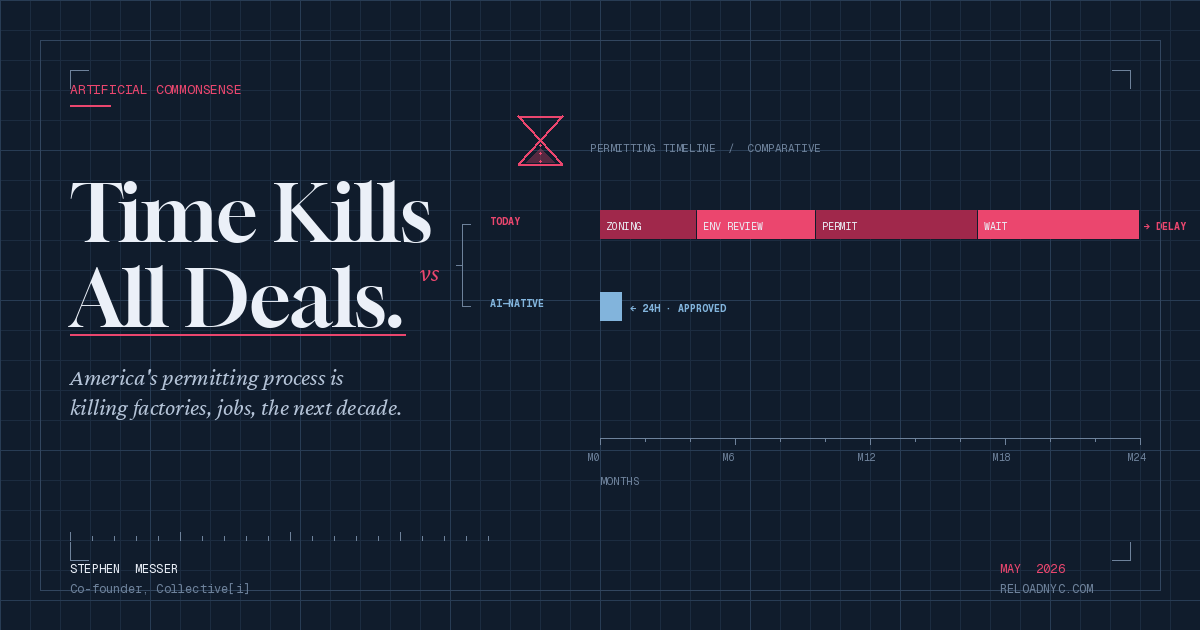
Time Kills All Deals. America's Permitting Process Is Killing Yours.
The same AI-native permitting that makes homeownership affordable again can bring manufacturing, industrial, and commercial development back to America without cutting wages, reducing protections, or handing out tax breaks. The only thing it takes away is delay.

Stephen Messer, Co-founder of Collective[i] and LinkShare (sold to Rakuten for $425M, 1996–2005). EY Entrepreneur of the Year/Deloitte Fast 50 winner. Board member, Spire Global (NYSE: SPIR). Building intelligence.com
Part 1 made the case for families: AI-accelerated permitting can make homeownership affordable again without changing a single law. This part makes the case for businesses, for governors competing for factories, for mayors competing for jobs. The argument is the same because the problem is the same. Affordability. When it costs too much and takes too long to build anything in America, whether a home or a semiconductor fab, the cost lands somewhere it shouldn't and the deal goes somewhere else.
Time Kills All Deals. Here's What It's Costing the Country.
Tesla broke ground on Gigafactory Berlin in March 2020. It opened in March 2022. Two years. Most of that time wasn't spent building. It was spent in sequential reviews across German federal, state, and local agencies, environmental challenges, public comment periods, and legal disputes that forced construction to pause. Elon Musk flew to Germany, drove a Tesla through the forest that would become the factory, and turned it into a public spectacle to pressure the process forward.
Gigafactory Austin came online in roughly the same two-year window. The difference: Texas spent most of those two years building. Germany spent most of them waiting. That gap is a jobs decision. Every month a factory sits in permitting limbo is a month the state loses to the country that moves faster.
The United States has a version of this problem in almost every jurisdiction. A semiconductor fabrication facility, a logistics hub, a pharmaceutical manufacturing plant, a data center, a warehouse. Every one enters a permitting process that was not designed for speed or certainty and accumulates cost with every week it runs.
WHAT DELAY COSTS AT EVERY SCALE
The Pre-Permitting Idea: Know What You're Approved to Build Before You Buy the Land.
The most actionable idea I want government leaders to take from this post is one that no economic development playbook currently offers.
Under the current model, a company buys the land, enters a permitting process with no guaranteed timeline and no guaranteed cost, and waits. Carrying costs start on day one. Surprises mid-process add months. The risk is entirely on the developer, priced into every project decision, which means projects get abandoned, scaled back, or sent to jurisdictions that offer less uncertainty.
Under an AI-native model, the company submits the building design and site description to a state pre-permitting portal before writing a check for the land. The AI reviews it against every applicable code, zone classification, environmental regulation, structural requirement, and local amendment simultaneously, in minutes. It returns a pre-authorization: exactly what you're approved to build, on what conditions, on what timeline, with what projected tax structure. The company selects the site with full information. The day they close on the land, the permit is ready. Construction begins on day one.
THE SAME LOCATION DECISION, TWO DIFFERENT WORLDS
Every regulation still applies. Every safety standard still applies. The AI didn't eliminate the rules. It read all of them simultaneously and returned the answer before the money was committed. That's not deregulation. That's competence.
The same logic applies to modifying existing facilities. Markets shift. A manufacturer needs to retool a production line, add a loading bay, or reconfigure a warehouse floor for new automation. Every change requires a permit. The company that can retool in 60 days, including approval, responds to market signals that its competitors, waiting six months for permission to move a wall, simply cannot. Speed isn't just about what you build new. It's about how fast you can adapt what you already have.
The Competitive Argument That Neither Side of the Aisle Should Fight.
Economic development policy has been stuck in a false choice for decades. Cut taxes and reduce regulations, or protect workers and enforce standards. Both sides are partly right. Both miss the point.
The most powerful thing a state or city can offer a business isn't cheap land or low taxes. It's certainty. The ability to know, before committing capital, exactly what you're approved to build, exactly when you can build it, and exactly what compliance will cost. Uncertainty is the real tax on development. It inflates budgets, deters investment, and disproportionately favors large incumbents who can absorb multi-year carrying costs over smaller competitors who can't.
The left can support this because it maintains every protection and standard. The right can support this because it removes government friction without spending government money. Business supports it because carrying costs drop. Workers support it because more facilities built faster means more jobs sooner. The only constituency that loses is the one whose business model depends on complexity.
Affordability Is the Flywheel. For Families and for Economies.
Affordability isn't just a housing problem or a business problem. It's a demographic problem, a fiscal problem, and an economic competitiveness problem, all driven by the same root cause: it costs too much and takes too long to build in America. Fix that constraint and the effects compound in every direction.
When homes are affordable, young families stay. When they stay, they have children. Schools grow. Local businesses grow. The tax base expands. That growth makes a jurisdiction attractive to employers. Employers bring jobs. Workers follow jobs. More workers need more homes. The cycle accelerates. That's Austin over the last twenty years. That's every Sunbelt city that figured out how to keep building costs from outrunning what people could pay.
When homes become unaffordable, young people leave. Population stagnates. The tax base contracts. The business case for locating there weakens because the workforce is shrinking. That's Japan. That's South Korea, with the lowest birth rate ever recorded for a developed nation. That's every American city that lost population for thirty years while telling itself the market would correct.
Affordable homes. Families staying. Children born. Workers available. Businesses locating. Jobs created. Tax base growing. More homes needed. The flywheel spins, and it started with a permit that took days instead of years.
For politicians focused on population and congressional representation: housing affordability is the most direct lever on the birth rate and migration. If people can afford to build a life where they are, they build one.
For politicians focused on economic development: the factory workers buy the homes, send children to the schools, and vote in the elections. The governor who can tell a car manufacturer or semiconductor company to submit their design today, have pre-authorization in 30 days, and break ground the day they close — that governor wins the factory, the 5,000 jobs, and the congressional seat in the next reapportionment. And those workers can afford homes in the community they're building because the same system that approved the factory approved the neighborhoods they'll live in.
The residential and commercial arguments aren't separate problems requiring separate solutions. They are the same flywheel. Fix the permitting process and you move both.
Why the First Mover Wins More Than the First Project.
Texas built a reputation for permitting speed over twenty years by consistently being faster than California. That reputation is now self-reinforcing. Site selection consultants put Texas on every industrial short list automatically. The state no longer has to fight for every deal because the deals come to it.
AI-native permitting can compress that twenty-year process into five, because the results are measurable within the first twelve months. Permit approval times. First-submission approval rates. Average review days for commercial and industrial projects. These are verifiable numbers, persuasive to every CFO evaluating a location decision.
One fix. Faster homes. More affordable homes. More families. More workers. More factories. Bigger tax base. More homes needed. The loop closes and starts again.
The technology exists today. The political argument is available to every ideology. The window to be first is open right now.
The only thing that kills this deal is time.
KEY NUMBERS