The Trillion-Dollar Trade Wall Street Isn't Seeing.
The debate over the AI data center buildout has been about whether OpenAI, Anthropic, and Oracle can generate enough revenue to justify what they are building. That is the wrong question. The right one is what a stockpile of general-purpose GPUs is worth if one island stops shipping chips.

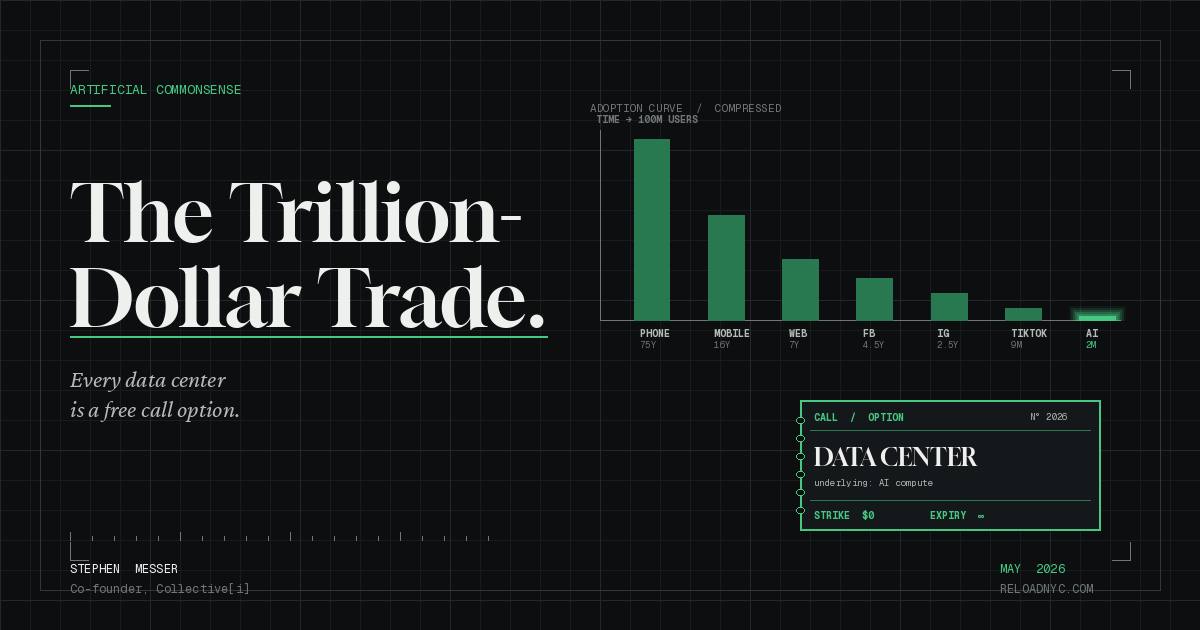
Every Data Center Is a Free Call Option.
Stephen Messer, Co-founder of Collective[i] and LinkShare (sold to Rakuten for $425M, 1996–2005). EY Entrepreneur of the Year/Deloitte Fast 50 winner. Board member, Spire Global (NYSE: SPIR). Building intelligence.com
Every serious conversation about AI infrastructure right now runs into the same wall. Is the buildout real, or is it a bubble? OpenAI's revenue against its costs. Anthropic's revenue against its compute bill. Oracle's spending against its other lines of business. Microsoft, Google, and Meta each running the same calculation with the same numbers.
The debate is fine. It is also not the interesting one.
Where you land depends mostly on how fast you believe AI adoption will happen. I have made the case in The Companies Winning at AI Are Playing a Different Game, in Peak Token, and in The Safest Move You Can Make With AI that adoption is running faster than consensus assumes and that the cautious position is the expensive one. Reasonable people can disagree on the ramp. I am not going to relitigate that argument here.
What I want to point at today is different. Something that changes the risk calculus even for the skeptics.
The data center buildout is not a bubble or a bet on frontier lab revenue. It is a hedge. Nobody in the market is pricing it that way. Once they do, the whole framing of the debate changes.
Every Adoption Curve Is Getting Shorter
Look at the history of new technology reaching mass scale. Telephone took roughly 75 years to reach 100 million users. Mobile phones took 16. The internet took 7. Facebook took about 4 and a half. Instagram took 2 and a half. TikTok, 9 months. ChatGPT, 2 months.
The curve is not linear. It compresses every cycle. Each new mass technology arrives on top of the last one's infrastructure, so it needs no ramp. AI arrived on a world already saturated by mobile, cloud, and app stores. There was no highway to build. There was only a signup screen.
That compression is why every SaaS incumbent is misreading the clock right now. They benchmark AI-first competitors against how long it took SaaS to displace on-premise software. Nothing in the adoption data supports that comparison. They are betting the entire business on the wrong reference curve, and they will lose the whole market before they notice.
CHART 1 · TIME TO 100 MILLION USERS
Every new mass technology arrives on the last one's infrastructure. The runway keeps getting shorter.
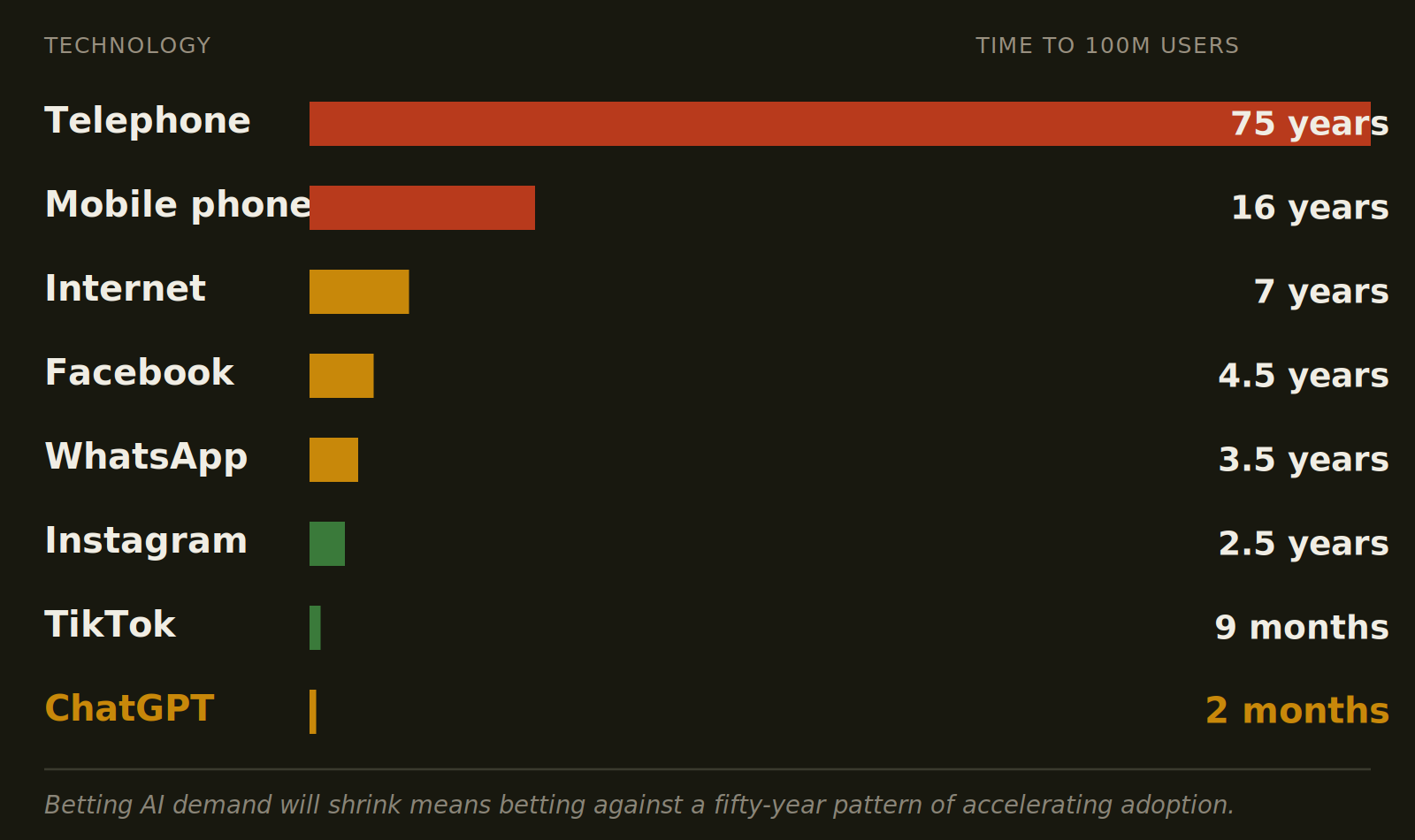
Source: UBS analyst estimates via Similarweb; Statista technology adoption timelines; OpenAI (ChatGPT MAU milestone January 2023). Telephone figure uses US household penetration to 100M subscribers.
If AI compute demand is going to shrink because the labs cannot generate revenue, it has to buck a fifty-year pattern of accelerating adoption. Bettors picking that side of the trade have a lot to explain.
One Island. Essentially All the Chips.
Every serious conversation about AI compute skips over the most important fact in the room. The chips that power the industry come from one island in a disputed strait, with a superpower openly planning to take it over.
Nvidia's H100, H200, and GB200. Google's TPU. Amazon's Trainium and Inferentia. AMD's MI300. Broadcom's custom silicon for the hyperscalers. Every leading-edge accelerator in the AI industry is fabricated by TSMC. TSMC has one leading-edge fab complex on Earth, in Hsinchu, Taiwan.
The concentration is not a rounding error. It is the entire industry.
I wrote in The Next Computer Is Alive about how the industry is approaching the physical limits of silicon at around 1.5 nanometers. Each additional generation costs more capex, more R&D, and more scarce EUV lithography equipment. TSMC is the only company that has consistently executed at the frontier at scale.
TSMC has an Arizona plant. Two things about it matter for this argument. First, it currently produces 4nm silicon at 92% yield. That is two full generations behind the 2nm process TSMC runs in Taiwan. Second, TSMC's stated internal policy is that Taiwan-based fabs must remain two generations ahead of overseas ones at all times. The frontier stays on the island by design. Even in the best-case buildout plan, only about 30% of TSMC's sub-2nm capacity is projected to sit outside Taiwan by 2030.
CHART 2 · WHERE THE WORLD'S LEADING-EDGE CHIPS ARE ACTUALLY MADE
Arizona is not the answer this decade. The frontier stays on the island by design.
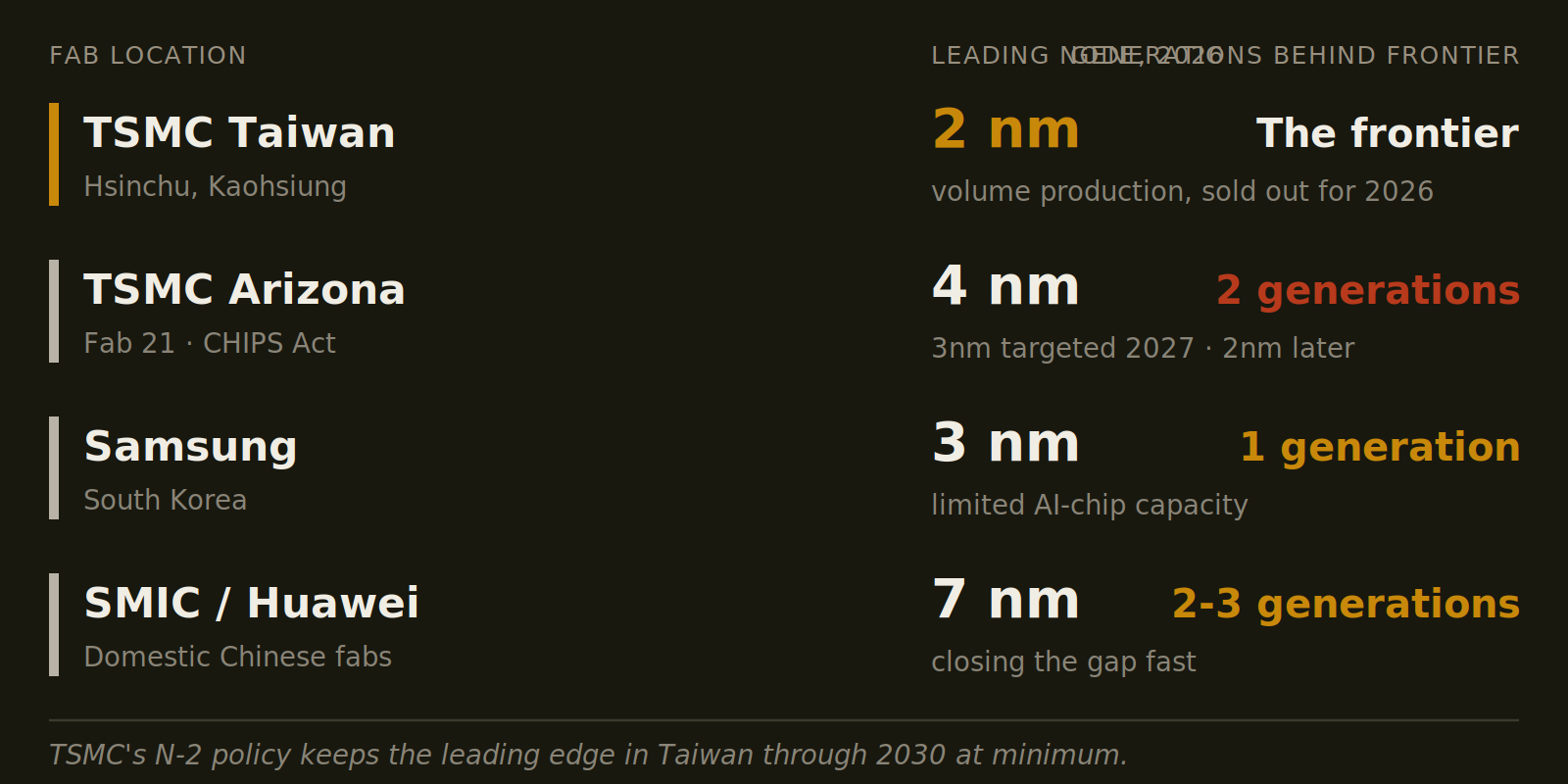
Source: TSMC public roadmap and earnings calls Q3 2025 and Q1 2026; Trendforce and Nikkei Asia reporting on Arizona fab timelines; SMIC and Huawei public disclosures on 7nm production. Node names use TSMC marketing convention.
The Arizona fab is not the answer. Not this decade.
China Just Changed Its Own Math
For a long time, the working assumption in Washington was that China would never move on Taiwan because China needed the same chips. That assumption is out of date.
In June 2026, Meituan released LongCat-2.0. A 1.6-trillion-parameter model trained end-to-end on a 50,000-chip cluster of domestic Chinese silicon. Performance comparable to Google's Gemini 3.1 Pro. It is the first model of its scale to be trained on a fully domestic Chinese stack. Zhipu AI did the same in February on Huawei Ascend chips. Cambricon booked its first full year of profit in 2025 and grew Q1 revenue 160% year over year. Baidu announced an inference chip for early 2026 and a training chip for 2027. Alibaba's T-Head unit is pushing the Zhenwu M890 GPU as a domestic accelerator.
None of these match the best from TSMC yet. That is not the point. The point is that the Chinese domestic chip industry is now close enough to functional that the calculus has changed.
The corollary is what should keep Western analysts up at night. If TSMC becomes unreachable for any reason, Chinese chips do not need to match TSMC's best. They need to be the best chips still shipping. When the fastest runner twists an ankle, the second-fastest wins by default. That is not a strong incentive for the second-fastest runner to hold back.
Every time Washington restricted access to advanced Nvidia chips, it accelerated the domestic Chinese market for domestic Chinese chips. The unintended consequence is a Chinese chip industry that is far more capable in 2026 than most Western analysts expected in 2023.
The math on a Taiwan crisis used to look like this. If China moves, China also loses access to the chips it needs. Both sides get hurt. Mutual assured disruption.
That math has changed. If China moves now, China loses less than the West does. This is not a case that has to be argued. It is a case the data quietly confirmed twelve months ago and nobody has updated their asymmetric-risk models to reflect.
The Numbers Serious People Have on This
Prediction markets and think tanks have been pricing Taiwan risk for a while now. Polymarket puts the near-term chance of an invasion by end of 2026 at roughly 11%. Manifold traders price it at about 22% by end of 2027, and 37% by 2030. The CSIS wargame set in 2026 concluded that a Chinese attempt would fail, at catastrophic cost to both sides. Recorded Future's Insikt Group calls the 2025-2026 window unlikely but says risk rises sharply starting 2027. Dmitri Alperovitch, chairman of Silverado Policy Accelerator and author of World on the Brink, opens the book with a hypothetical invasion set in the days after the 2028 US presidential election.
Xi Jinping used his 2026 New Year address to call reunification with Taiwan "indestructible" and the historical trend "unstoppable." China spent the year running the largest live-fire drills in strait history and continuing an unusually deep purge of senior military leadership. This is not signaling. This is preparation.
The pressure at home matches the rhetoric abroad. Youth unemployment in China peaked at 18.9% in August 2025 by the current methodology, and closer to 21% by the previous one. The property market is in a five-year slow-motion collapse that has evaporated the primary store of wealth for every Chinese citizen. GDP growth in Q2 2026 was the weakest in three years. Domestic demand is deflating. Xi has publicly reshuffled key military and party positions repeatedly over the last eighteen months.
A leader with a shaky domestic hand and a nationalist project to sell has one traditional move available. Rally around the flag. Distract. Redirect anger from the home country onto the historic wrong. Taiwan has been that project for the CCP for seventy-five years, and it is more useful now than it has been at any point in the last twenty.
None of this proves anything about timing. It is a case for taking the tail risk seriously. Not a case that it will happen.
For a much deeper analysis than I can give it here, watch Dmitri Alperovitch's conversation on Intelligence.com. Free to join, free to watch. Search AI and China: Is the World on the Brink? or use this direct link.
The Telecom Rerun
Here is the historical parallel that matters most for the finance audience.
After the Second World War, Europe and Asia had to rebuild almost every piece of national infrastructure at once. National telecom systems were state-owned and cash-strapped. To fund reconstruction, most national telecoms invented an instrument called an interconnect fee. A per-minute charge whenever a phone call crossed a national border. Small per call, massive at scale, and it funded a generation of rebuilding across the continent.
The United States, whose infrastructure had been untouched by the war, did not need the money. It charged zero interconnect fees. Its market was the largest in the world, so it could negotiate the best international rates.
Within a decade, the arithmetic overwhelmed every alternative. It was cheaper to route a call from London to Tokyo through the United States than to send it direct. Then it was cheaper to route Paris to Frankfurt through the United States. Then most of the calls in the world routed through the United States because the routing math never resolved any other way. The United States became the backbone of the global telecom industry not because it planned to. Because it had capacity and everyone else did not.
The United States became the backbone of the global telecom industry not because it planned to. Because it had capacity and everyone else did not.
Look at where AI infrastructure is being built right now. Latin America. Southeast Asia. Africa. Europe. None of these regions are building at anything close to the scale of the United States. They are barely building at all. Europe is still arguing about permits.
If a Taiwan disruption of any severity occurs, the compute those regions need to run their economies has to come from somewhere. In that scenario, the US data center overbuild stops looking like slack capacity and starts looking like the global compute backbone. Same shape as the telecom rerun. Same arithmetic.
That is not a small business.
General-Purpose Is What Makes It a Hedge
The strongest case against my argument is that overbuild is still overbuild. Pets.com bought custom warehouse robots that had zero value the day Pets.com went under. Every capex bust in modern history has a story like that.
Data centers are not that. The chips inside them are general purpose. The same GPU that trains a frontier model can run a hospital's billing system, a bank's fraud detection, a country's power grid optimization, or a small company's email. The GPU Anthropic uses to train Claude today can be sold to a South African bank tomorrow to run analytics. There is no equivalent to Pets.com's warehouse robots in this build cycle.
The optionality is exactly what makes it a hedge. In the boring scenario, the buildout serves the AI adoption ramp I described at the top of this piece. In the tail-risk scenario, the same buildout serves as the compute backbone for a world routing around Taiwan. The chips are worth serious money in both branches. The buildout wins in every scenario.
That is the definition of a hedge. The market is not pricing it as one.
Compute Futures Are Already Being Written
You do not have to imagine what a compute futures market looks like. It exists. The contracts are already being signed.
For anyone who has not encountered them before, a futures contract is a commitment to deliver a specific quantity of something at a specific price on a specific future date. Oil, wheat, currency, and interest rates all trade on futures markets. Buyers use them to lock in supply against price shocks. Sellers use them to guarantee revenue against demand shocks. The exchange in the middle handles settlement. Both sides win when the world stays predictable, and one side wins big when it does not.
In May 2026, Anthropic signed a deal with SpaceX to lease the entire compute capacity of the Colossus 1 data center in Memphis. Two hundred and twenty thousand Nvidia GPUs. Three hundred megawatts of power. $1.25 billion a month through May 2029. Total contract value above $40 billion. In June, Google followed with a SpaceX deal of its own. $920 million a month for 110,000 GPUs from October 2026 through mid-2029. Anthropic separately signed a multi-gigawatt TPU commitment with Google and Broadcom for capacity starting 2027.
CHART 3 · COMPUTE FUTURES, ALREADY EXECUTING
Multi-year, multi-billion-dollar commitments locking in future compute delivery. That is a futures market with a different name.
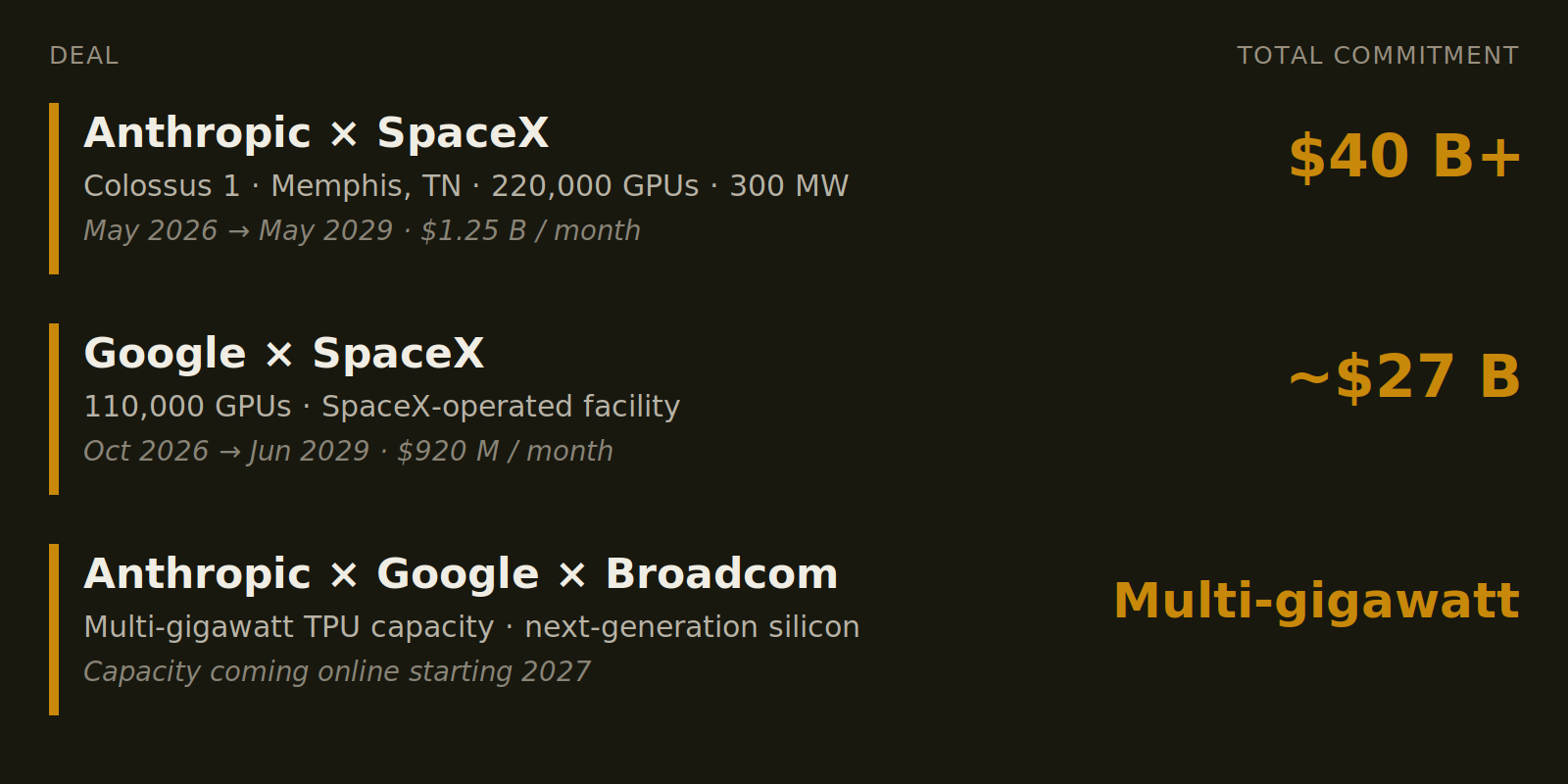
Source: SpaceX S-1 filing with SEC (May 2026) for Anthropic contract terms; SpaceX SEC filing (June 2026) for Google contract; Anthropic official press release April 2026 for Google/Broadcom TPU deal.
That is not a spot market. That is a futures market with a different name. Buyer commits to a delivery schedule, seller commits to a delivery volume, pricing is fixed for years, cancellation windows are set. Every element of a real futures contract, executed bilaterally rather than through an exchange.
Now imagine the buyer is a European sovereign fund, a Saudi wealth fund, a Southeast Asian government, or a Latin American bank consortium. In a world where any Taiwan disruption could take AI compute offline for years, forward contracts on US compute look like insurance policies. Insurance policies are exactly what serious buyers pay for even when the covered event is low probability. That is what insurance is.
None of that demand is priced in the current market cap of these buildouts. The market is still measuring "will OpenAI generate enough revenue to justify its compute purchases." It is not measuring "what would sovereigns and multinationals pay to lock in future US compute against Taiwan risk." That is a repricing waiting to happen.
What Nobody Is Pricing
Take the argument to its economic conclusion.
The market currently prices the US data center buildout on expected revenue from Western frontier labs. Call this scenario A. Reasonable assumptions, reasonable analysis, mostly what the bubble-versus-real debate is arguing about.
Scenario B is a Taiwan chip disruption of any severity over the next five years. Even at a 3% probability, the same GPUs command a scarcity premium of many multiples of their spot price. The West cannot produce equivalent volume domestically for years. Alperovitch, Recorded Future's Insikt Group, and CSIS all argue the underlying risk is higher than 3%, and rising through the second half of this decade.
Even at 3%, the expected value of the compute stockpile is materially higher than what analysts are baking in. Move the probability to 10% and the math is not close. The overbuild stops looking like a bubble and starts looking like a call option the market gave away for free.
I laid out this argument in more detail on Marc Baumann's 51 Insights podcast. Marc's own summary was that "even at a 3% probability, those chips are worth gold." That is the exact math the current bubble-versus-real debate does not include.
If you are an investor, a family office, a private equity firm, or a sovereign wealth allocator running the AI infrastructure trade, the geopolitical hedge is the piece missing from your model. It is asymmetric upside for capital that is currently priced on symmetric downside. The overbuild is a hedge. Whether it is also a bubble is almost a side question at that point.
What Comes Next
Every piece in Artificial CommonSense takes something the market treats as consensus and shows what it is missing.
The next pieces in this series go deeper on the mechanics. How a compute futures exchange actually clears. What sovereigns are quietly buying today. Where the LPs are three moves ahead of their GPs on this trade. If you want them delivered when they publish, subscribe at reloadnyc.com. Free. No paywall. No course at the end. Just the work.
If this piece changed how you are thinking about the AI infrastructure trade, forward it to one person who needs to read it. A partner at your firm. Someone on your investment committee. A friend running an AI fund. One specific decision-maker in your world who is still stuck in the bubble-versus-real debate. That is how these pieces get to the right rooms. One reader telling another.
If you are the person who just got this forwarded to you, welcome. Subscribe at reloadnyc.com. Two dozen pieces in the archive already. Another two dozen in the queue.
Reply if you want to argue. I read every one. The pieces get sharper when readers push back.
RELATED READING · RELOADNYC
We're Complaining About the Wrong Thing
AI's energy demand is the forcing function that finally justifies the power grid America needed a decade ago.
The Next Computer Is Alive
Silicon is running out of room at 1.5 nanometers. What replaces it, and why the transition matters for compute.
Peak Token
Why the frontier labs are losing pricing power at the same moment the buildout is accelerating.
The Companies Winning at AI Are Playing a Different Game
Why the adoption ramp is faster than consensus assumes, and why the leaders keep pulling further ahead.
The Jobs Nobody Has Heard of Yet
Major infrastructure buildouts always create entire job categories nobody sees coming. This one will too.
Marc Baumann · 51 Insights Podcast
I sat down with Marc for a long conversation on token pricing, forward-deployed engineers, and the hedge argument in this piece.