Tech Is Not an Asset Class Anymore. It Is the Economy.
Andreessen's fund raised $15B in January — 18% of all US venture dollars that year. BlackRock manages 767 times more. Blackstone, 1,000 times more. Every sector these giants touch is now a tech sector. This is what happens when a small niche called venture capital collides with the whole economy.


Stephen Messer, Co-founder of Collective[i] and LinkShare (sold to Rakuten for $425M, 1996–2005). EY Entrepreneur of the Year/Deloitte Fast 50 Winner (2x). Board member, Spire Global (NYSE: SPIR). Building intelligence.com
Consider what happened six weeks ago. On July 30, Leopold Aschenbrenner's AI hedge fund Situational Awareness went from $45 billion in assets to roughly $10 billion in six trading days. Margin calls from every major Wall Street lender. Fire sale of his entire public book to Ken Griffin's Citadel at a steep discount. A near-total wipeout of the levered public portfolio.
Six days later, Aschenbrenner closed a $400 million private investment in Source Foundry, a chip-tools startup, bringing his position in that single company to $500 million. He still holds a substantial stake in Anthropic. From the wreckage of a public hedge fund came a check that most Series B venture rounds would kill for, plus a private tech book worth more than what most venture funds ever raise. That is not a story about one hedge fund. It is a preview of what happens when the line between public and private capital finally dissolves, and every capital allocator in the world starts operating across the whole stack. This piece is about why that line was always artificial, why venture capital was always a small niche pretending to be a whole industry, what founders and hedge fund managers are already building to replace it, and why that expansion is good for founders, LPs, and the world.
Before making the argument, I want to be clear about where I sit. I have been a founder, an LP, an investor, and a beneficiary of the venture capital ecosystem for thirty years. I have raised money from VCs, invested in VC funds, and sat across the table in both directions more times than I can count. I am not writing this to burn down something that gave me a great deal. I am writing it because the honest read of what is happening is that VC was never the story. Tech was the story. Tech has now become the whole economy, and the small niche called venture capital is being absorbed into the much larger capital pools that always sat next to it.
Look at Where the Money Actually Sits
Every conversation about venture capital starts with the assumption that VC is a big industry. It is not, and it never was. Global venture capital assets under management sit at roughly $1.3 trillion. That number is smaller than a single alternative-asset firm. Blackstone alone manages $1.3 trillion. BlackRock manages $11.5 trillion, roughly nine times the entire global venture industry. The US private equity industry sits at approximately $8 trillion, six times VC. The hedge fund industry sits at $4.5 trillion, three and a half times VC. Sovereign wealth funds globally hold over $12 trillion. Fidelity alone manages roughly $5 trillion.
Even inside the venture category, concentration is extreme. The three largest VC firms (Andreessen Horowitz, Sequoia, and Insight Partners) each manage around $90 billion. Andreessen's January 2026 $15 billion fund raise accounted for more than 18 percent of all US venture dollars allocated in 2025. The rest of the industry (thousands of funds) fights over the remaining scraps. This is not a large asset class. It is a small asset class with a few very large players and a very long tail of small ones. The whole thing depended for decades on a single specialist bank (Silicon Valley Bank), a small group of general partners, and a small number of founders who all knew each other by first name.
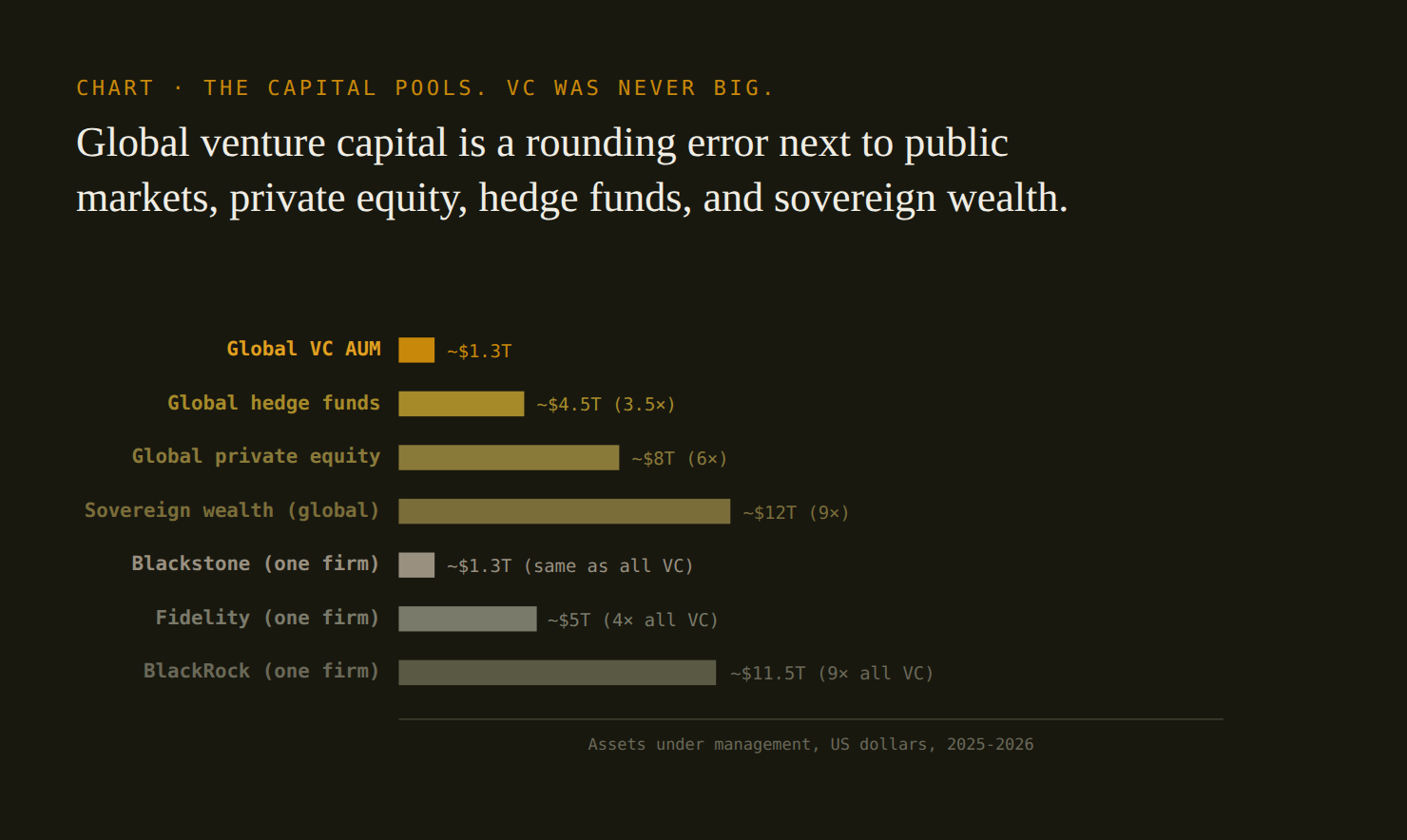
Global venture capital is smaller than Blackstone. It is a rounding error next to BlackRock. It is a fraction of Fidelity. VC was always a small bank pretending to be a whole industry.
Tech Was Once a Sector. Now It Is Every Sector.
The reason VC feels like it should be a big industry is that the technology it funded is now everywhere. Every serious VC firm's published thesis this year names the same categories. AI agents. Defense tech. Physical AI. Crypto infrastructure. Robotics. Energy. Space. You could swap the logos on any of these theses and most readers would not notice. This is a category error dressed up as consensus. It also tells you exactly what happened. Tech stopped being a sector. It became the economy.
Look at what I have written about in this publication over the last year. Real Disruption covered dark factories, drug labs, and autonomous aircraft. The Shoebox That Changed Space covered space infrastructure at a fraction of legacy cost. The American Dream Has a Permitting Problem and Time Kills All Deals covered housing and infrastructure permitting. The End of Car Ownership covered self-driving. The upcoming two-part Battlefield series will cover defense, satellites, drones, and the industrial base. Every one of those pieces was, in effect, about tech. None of them was about a "tech sector" the way a Wall Street analyst still uses that phrase. They were about the substrate of the whole economy being rebuilt on a technology stack that was invented in the last twenty years.
If tech is now in every industry, then investing in tech is just investing. It is not a niche. It is not an alternative asset class. It is the direction of the water. The framing that treats VC as a specialized capability serving one sector was always partly true. It has now become mostly false. What was a specialty is becoming a general skill, and the capital that funds it will come from wherever capital normally comes from. Which is everywhere except a $1.3 trillion niche run by two hundred general partners on Sand Hill Road.
What the Biggest Pools Are Actually Doing
The largest capital allocators have already noticed, and they are moving. Larry Fink's BlackRock named private tech as a strategic growth priority in its 2026 Private Markets Outlook. Steve Schwarzman and Jonathan Gray at Blackstone have been the anchor lender in every major CoreWeave debt facility since 2023, participating in a $17 billion consortium alongside Magnetar, Coatue, Carlyle, PIMCO, and DigitalBridge Credit. Marc Rowan's Apollo and Doug Ostrover's Blue Owl are both building private-credit platforms explicitly targeted at technology, healthcare, and financial-services borrowers (exactly what venture debt used to cover at much higher cost). Fidelity has been leading and participating in late-stage private tech rounds for over a decade. David Solomon's Goldman Sachs acquired Hans Swildens' Industry Ventures in 2024, folding one of the original secondary-market pioneers into the largest bank on the planet. That single transaction was the loudest possible signal that tech-private-secondary is now investment-grade Wall Street territory, no longer boutique venture territory.
Steve Cohen's Point72 announced in early 2026 that it is raising a $1 billion+ private credit fund with an explicit focus on lending to technology, healthcare, and financial services companies. Cohen also split Point72 into two equities units, Point72 Equities and Valist Asset Management, both designed to move faster on technology-driven opportunities. Two Sigma, at $70 billion AUM, runs quant strategies whose largest exposure is tech (public and, through affiliated vehicles, private). Coatue's evergreen crossover fund, which I described in The Most Expensive Money in the Room, is a hedge fund structure applied to what used to be venture territory. Sovereign wealth funds are doing this at even larger scale. Mubadala, Saudi Arabia's Public Investment Fund, Singapore's GIC, and Norway's Norges Bank all now hold direct positions in private tech that dwarf most traditional VC funds. Corporate strategics do it even more directly. Nvidia into OpenAI into Oracle back into Nvidia is the visible tip of a much larger pattern of ecosystem financing I detailed in that same Most Expensive Money piece.
The specific pattern to watch is hedge funds moving down the stack from public equities into direct private positions. Aschenbrenner is the extreme case, and it deserves attention on its own terms. Situational Awareness ran a levered public book (400% leverage at its peak) built around the same AI infrastructure names every VC growth fund was chasing. When that book collapsed and the fund lost 78 percent of its assets in one week, the surviving structure was not a defeated hedge fund. It was a $10 billion private-tech investment vehicle with a substantial Anthropic position and enough dry powder to close a $400 million check into Source Foundry in six days. The public loss did not remove Aschenbrenner from the game. It moved him decisively into venture territory.
This is not new behavior in principle. FTX Ventures deployed roughly $2 billion into early-stage tech before its parent collapsed, and its most famous investment was a $500 million stake in Anthropic that the estate later sold for $884 million. Whatever else you think of FTX, the pattern was clear even then: hedge-fund-style capital moving into traditional VC territory, at scale, because the returns were better. Today most of these deals are late-stage, where the risk-reward math is cleanest for a hedge fund's underwriting model. Expect that to change fast. Small dollars deployed into high-yield (and high-risk) private tech is one of the very few remaining sources of true alpha in a market where public equity, private credit, and traditional PE have all been arbitraged down to institutional norms. Every serious hedge fund, family office, and sovereign wealth manager will move down the stack toward earlier and earlier stages over the next five years. That is where the yield is. That is where the alpha is. That is where the return premium sits.
The public loss did not remove Aschenbrenner from the game. It moved him decisively into venture territory. Every serious hedge fund manager is about to make the same trade, at every stage, at every scale.
THE DIAGNOSTIC · WHERE ANY LP SHOULD LOOK RIGHT NOW
For any fund in your portfolio, run this three-part test. First, ask what the fund's median 2021-2023 vintage IRR and DPI actually are, and how those compare to the fund's own case. Second, ask what percentage of the fund's active portfolio is in categories that have re-priced downward more than 50 percent since 2021. Third, ask what the fund's decision cycle from first meeting to term sheet actually is, and how that compares to the cycle at the top operator-led seed funds, hedge-fund crossovers, and secondary specialists. If the answers are ugly on any two of the three, the fund is a candidate to be absorbed by a larger capital pool that runs the same asset class more efficiently. That is not a bet against the people running it. It is a plain reading of what happens when a $1.3 trillion niche gets absorbed into a $30 trillion adjacent pool.
Why the Venture Model Was Always Structurally Inefficient
Most VCs will not say the next part out loud. The venture model, taken on its own terms as a piece of financial engineering, is inefficient in ways that would embarrass any competent hedge fund manager.
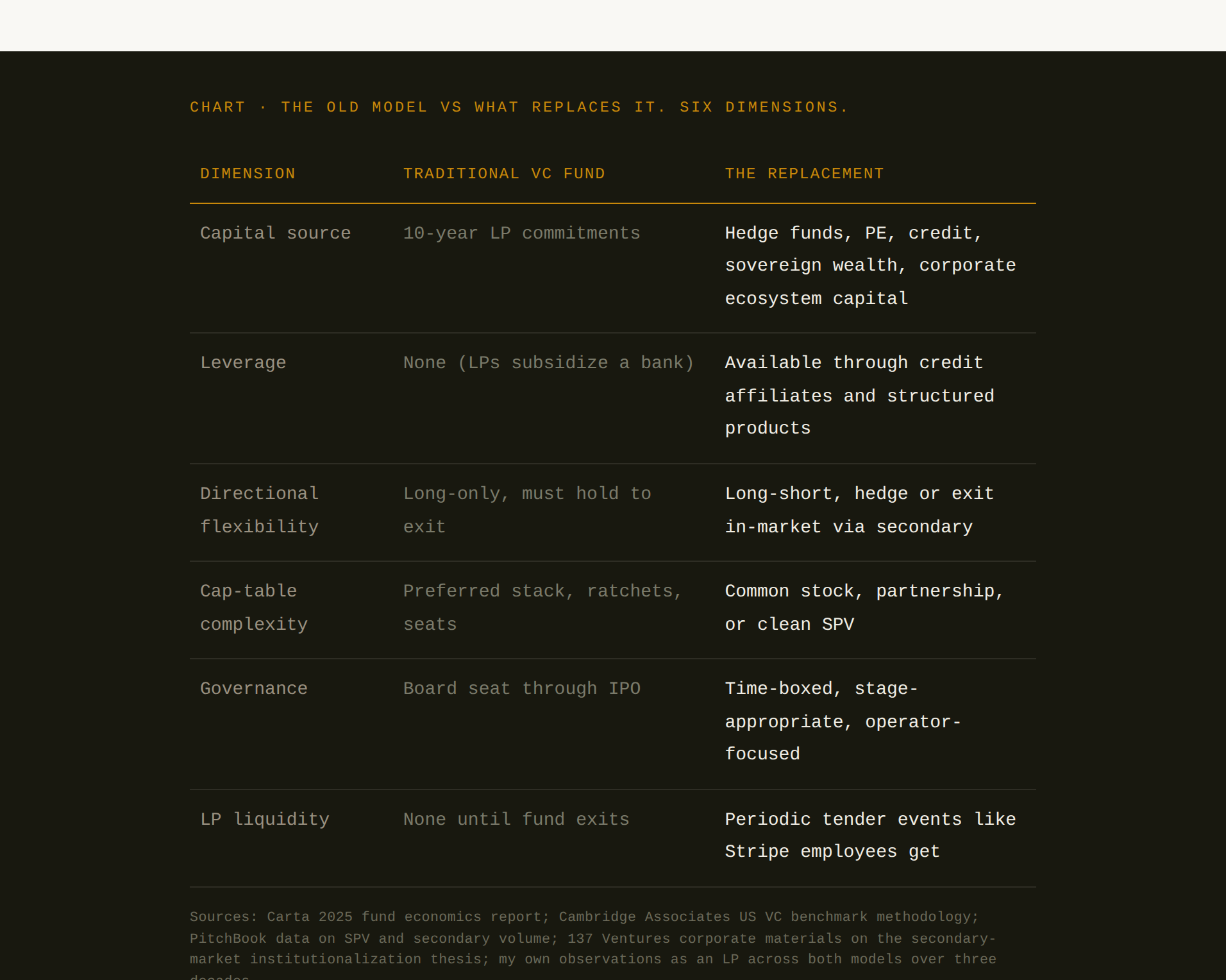
The first inefficiency is leverage. Venture funds do not use it. This is one of the reasons Silicon Valley Bank became so profitable for so long. SVB was providing debt to venture-backed companies at rates that were extraordinary relative to the risk (once you controlled for the equity cushion sitting behind the debt), because no one else was doing it and the venture funds themselves could not. A hedge fund investing in the same portfolio would have used leverage to magnify returns. Venture LPs never got that magnification. The fee income that should have accrued to the fund's LPs instead accrued to a bank that happened to sit in the same physical zip code as the venture firms.
The second is directional flexibility. Venture funds are long-only. They must stay in every deal for the life of the fund. Selling early is treated as a signal of no confidence and hurts the fund's reputation with founders and other VCs. A hedge fund would hedge in a hot market. A venture fund cannot. When SaaS multiples were at 18.5x in 2021, no venture fund could take secondary liquidity at the peak without paying a social cost. When those multiples collapsed to 3.8x by early 2026, the venture fund still held. Time is the largest input to internal rate of return. Every year of forced holding is a compounded drag on the fund's math.
The third is complexity. Preferred stock. Liquidation preferences. Anti-dilution ratchets. Board seats. Information rights. Pay-to-play provisions. Every one of these was invented to solve a real problem in a specific era. Together they now produce an asset that is difficult to value, difficult to trade, and difficult to distribute. Any serious investor knows that the easier an asset is to value, the more easily it trades and the more valuable that asset becomes. An entire industry of secondary specialists (Industry Ventures, now inside Goldman Sachs; 137 Ventures at $15 billion AUM; StepStone; Coller Capital) has grown up specifically to comb through these preference stacks and produce clean valuations at scale. Their existence is a tax on the complexity the venture industry created.
The fourth is governance mismatch. A Series A VC often ends up with a board seat that lasts through Series D, Series E, and beyond. In the same way most CEOs do not scale from Series A to public company, most VCs do not either. Their contractual rights lock them in place anyway. Post-Series A, does a company actually need a venture partner on the board more than it needs a growth-stage operator, a public-markets veteran, or a customer? Rarely. The rights sit anyway, because they were written when the fund made its first check and no one has renegotiated them.
The fifth is LP illiquidity. Employees at Stripe, SpaceX, Databricks, and other large private companies now get periodic secondary tender events. OpenAI just complete a $7 billion employee secondary alone. LPs in the venture funds that own the same shares do not. The rigidity blocks capital from cycling back into the ecosystem faster. It also means that in most cases, the LP has less liquidity than a $150,000-salary engineer at the same company they are indirectly funding. That is not a defensible structure. It is a leftover from an era when there was no secondary market to speak of.
What Actually Improves in the Next Model
Each of the inefficiencies above is a specific engineering problem with a specific fix. Leverage becomes available when banks, hedge funds, and private credit shops (Point72, Apollo, Blue Owl, Ares) take on the underlying exposure. Long-short flexibility becomes normal when hedge fund structures start deploying at scale into what used to be venture territory (Coatue's evergreen fund, Two Sigma's tech long-short book, Tiger's opportunistic secondary buying). Simpler cap tables become the norm when large capital pools refuse to write checks with the preference-stack complexity that made the assets hard to value. Time-boxed board seats become negotiable when founders have real alternatives to traditional venture money. Regular LP liquidity becomes possible when secondary specialists like 137 Ventures and Industry Ventures institutionalize the tender-event pattern Stripe and SpaceX pioneered for their employees, and extend it to the fund LPs who own the same underlying assets. Every one of these fixes is already visible in specific deals happening right now.
The pattern extends beyond mega-cap tech. PE firms are running a parallel play at the smaller end of the market. Firms like Roark Capital, Bain Capital, and every mid-market rollup shop are consolidating fragmented, antiquated industries (pool-service companies, HVAC contractors, dental practices, accounting firms, veterinary chains) and using technology as the operational lever to strip out cost the way the 1980s LBO shops used financial engineering. Tech in these deals is a means, not an end. The rollup thesis works because a modern software stack, applied to a hundred-location service business that ran on paper and spreadsheets for forty years, produces margin expansion that would have required a corporate transformation project in the pre-cloud era.
We see this at Collective[i] daily where PE firms bring us in the day they close a transaction and see a 20-40% growth in revenue in 6 months. Tech is now a lever, not a standalone business. That is the deepest form of the argument in this piece. If tech is a lever, then the capital allocators who understand how to apply it (PE at the mid-market, hedge funds at the growth stage, sovereigns at scale) can absorb what venture used to own by simply picking up the tool.
The risk-management side of this is where it gets interesting for LPs. Bundling private tech exposure across many small positions (through index-like vehicles, syndicated SPVs, and ETF-adjacent structures for accredited investors) spreads the risk of the underlying category the way high-yield indexes eventually spread the credit risk that Milken originated on individual balance sheets. New products from firms like ARK Venture, Destiny Tech100, Fundrise Innovation Fund, and the crossover public/private funds run by Cathie Wood, Chase Coleman, and Philippe Laffont are early prototypes of this. Most of them are imperfect. Some will fail. The category itself is inevitable. Private tech at the fund-of-funds level, at the index level, at the retail-accessible level, opens capital to sources that never had access to the asset class. It spreads the risk further. It covers more parts of the market where opportunity spreads are still large. That is a growth-positive outcome for the whole ecosystem, not a threat to it.
The Void Fills Itself. Junk Bonds Are the Precedent.
The clearest historical analog for what is about to happen to venture capital is what happened to high-yield debt in the 1970s and 1980s. Before Michael Milken and Drexel Burnham, high-yield debt was a small niche market for fallen-angel investment-grade bonds that had been downgraded. Milken did the analysis that showed the risk-adjusted returns were extraordinary if you understood the underlying credit properly, and he built a market around originating new high-yield issuance rather than trading downgrades. That market did not exist. He built it. The junk bond market grew from a fringe activity to a $1.7 trillion asset class over three decades. The specific inefficiencies of an old model got fixed by structural entrepreneurs, and the market that resulted was many times larger than the niche it replaced.
The same pattern is running through venture capital right now. 137 Ventures at $15 billion AUM is the Milken analog for the secondary market. Coatue's evergreen crossover fund is the analog for long-short flexibility in growth equity. Point72's private credit initiative is the analog for structured lending against tech assets. Nvidia's ecosystem capital deployments are the analog for strategic direct investment. Every one of these is a structural entrepreneur solving a specific inefficiency of the old model. The resulting market will be larger than what came before, not smaller. This is a growth story dressed up as a disruption story.
Junk bonds went from a niche activity to a $1.7 trillion market by fixing the structural inefficiencies of an old model. The same thing is about to happen to what used to be called venture capital. The market gets bigger, not smaller.
The mistake most industry commentators make is treating the current turmoil in venture as an ending. It is not. It is a resegmentation. The activity that VC used to own (funding high-risk, high-growth technology companies before they can be priced by public markets) will keep happening. It will just happen through more capital structures, with more participants, at better efficiency, and probably at much larger scale. The venture firms that survive will look like specialized wings of larger asset managers, or they will look like the operator-led seed funds Carta's data shows are growing fastest. The mega-fund model that dominated 2015-2022 is the one that gets absorbed. Every VC that concentrated capital and tried to become a trust (the pattern I laid out in a companion piece on venture trusts) is now positioned as the smallest player in a much larger space. If tech was already the whole economy, the trust move was the wrong end-state. The scale is not with the concentrated venture firms. The scale is with the Goldmans, the JPMorgans, the BlackRocks, the Blackstones. The concentrated venture firms are dwarfed by the pools they were trying to become.
Every Real VC Innovation Came from a Founder
Look at the last twenty-five years of actual improvements to the venture model. Every single one came from a founder who saw a gap and built the fix. Naval Ravikant built AngelList in 2010 and gave founders access to syndicate capital that traditional VC could not efficiently deliver. Hans Swildens built Industry Ventures in 2000 and created the secondary market that Goldman Sachs eventually acquired. Paul Graham built Y Combinator in 2005. David Cohen built Techstars in 2006. Josh Kopelman built First Round Capital in 2004 and standardized the term sheet plus the decision speed that founders had been begging for. Perry Chen built Kickstarter in 2009/Slava Rubin built indiegogo and opened equity-adjacent funding to individuals. YC introduced the SAFE note in 2013 to strip complexity out of early rounds. The SPV as a category grew from a handful of ad hoc deals into a multi-hundred-billion-dollar annual flow, driven by platforms that founders and operators built to serve founders and operators. Every one of these was tiny at inception. Every one of them magnified growth in the aggregate. Every one of them was built by a founder-operator who felt the friction personally and refused to accept that the friction was inherent to the asset class.
The ecosystem capital concept I laid out in The Most Expensive Money in the Room is one more entry in that lineage. It is not the last. The next ten years will pull in far more innovation than the last twenty-five. Some of it will be better. Some of it will be worse. All of it will grow the total pool of capital available for high-risk, high-growth technology companies. The change is already filling the void. That is the pattern to bet on.
Founders Are Now Building Their Own Capital Structures
The most interesting version of this trend is founders skipping the traditional venture stack entirely by designing their business model around a non-venture capital structure. Look at what Zach Dell (Michael Dell's son) is doing with Base Power. Base is a residential battery-and-electricity company operating in Texas and Illinois. It installs whole-home batteries, charges customers a flat $19 monthly membership fee plus a modest install fee, uses the fleet as a virtual power plant to arbitrage grid electricity prices, and sells excess capacity back to the grid at peak times. The company has raised $2.5 billion at a $13 billion valuation from a mix of Andreessen, Ribbit, Addition, Valor Equity, and JPMorganChase Strategic Investments. What is unusual is not the round size. It is the capital structure. Base is at its core an infrastructure company. The unit economics finance a large fraction of the build-out through customer subscriptions and grid arbitrage revenues, not through venture equity. The equity is there to accelerate expansion, not to fund the underlying business. That is a hybrid the traditional VC framework was never designed to price.
Look at CoreWeave. In March 2026 it closed an $8.5 billion delayed draw term loan facility (DDTL 4.0), the first investment-grade rated financing ever secured by HPC infrastructure and its associated customer contracts. The facility is non-recourse to the parent company. The collateral is the GPUs plus the customer contract itself, which is a five-year weighted-average take-or-pay commitment from a leading AI enterprise. That structure is a securitization in everything but name.
CoreWeave is monetizing forward contract revenue at investment-grade rates (S+225 basis points) to fund infrastructure it has already committed to build. The Blackstone-anchored consortium behind DDTL 1.0 through 4.0 (Magnetar, Coatue, Carlyle, PIMCO, BlackRock, DigitalBridge Credit) is a Who's Who of the largest alternative asset platforms on Wall Street. Crusoe is doing something adjacent, having built its business by monetizing stranded energy for compute and now operating a 1.2 gigawatt Stargate campus in Abilene, Texas. Every one of these financings is essentially a founder inventing a capital structure that traditional venture never provided, because traditional venture was designed for Series A through Series D equity checks and nothing beyond.
The point is not that Base and CoreWeave are unique. The point is that they are the leading edge of a pattern about to become industry-standard. Founders who understand their unit economics deeply enough to know which parts of the growth curve to finance with equity, which parts with contract-backed debt, which parts with customer subscriptions, and which parts with strategic ecosystem partners will systematically outperform founders who default to a single-instrument venture raise. VC was designed to underwrite the first four rounds of a company's life. Everything past that (growth capital, infrastructure debt, forward-revenue securitization, ecosystem partnership) is now being reinvented by founders themselves, in partnership with capital sources that historically did not participate in venture territory at all.
Why This Is Good for the World
There is a democracy argument here worth making explicitly. Open capital markets, where individuals and institutions can back individuals with disruptive ideas outside of state channels, are a specific structural advantage of Western economies. In China, in Russia, and in much of the world where governments maintain tight control over capital flows, venture-style investing is either illegal or actively suppressed. The state tolerates small businesses. China sets a five year plan and overfunds an industry till a winner emerges. If you missed John McNeill (former president of global sales, marketing, policy, and services at Tesla at our CIForecast event you can click here to listen to him describe this in greater detail. It does not tolerate companies that accumulate the kind of power that disrupts industries or challenges the existing order. Ask Jack Ma what happens when a Chinese entrepreneur builds something that makes the state uncomfortable.
The ecosystem capital model I described in The Most Expensive Money in the Room only works when participants can choose to enter based on their own economic interest. When investors, suppliers, customers, and infrastructure providers all have structural reasons to want a company to win, capital compounds faster than any single investor could produce alone. Take that choice away and the model becomes a procurement process. The state decides which companies get favorable terms. Every one of those decisions slows the loop and extracts from it. Absorbing venture capital into the broader capital markets, with more participants and more efficient structures, extends the democracy advantage rather than concentrating it. It lets more people participate in funding the future. It lets more founders access capital. That is a good outcome, whatever it does to the current fee structure of the current incumbents.
I could go on and on. Tech is not located in the valley anymore, New York, Boston, Austin, Miami, Tokyo, Singapore... When you look at all these aspects the changes taking place becomes clearer.
What This Looks Like From Where I Sit
The parallel to what I have watched inside enterprise sales is worth drawing directly. For twenty years the enterprise CRM ran on the logic of a concentrated hierarchy. Priced per seat. Layers of middle management to preserve central control. Built for a world in which a few large vendors served a few large buyers through a few authorized channels. That model is being replaced by something structurally different. A network of buyer signals aggregated across accounts. Priced against outcomes rather than seats. Decision at the edge, not at the manager two layers up. This is the pattern I laid out in The Buyer Has a Process, in Workflows vs Outcomes, and in an upcoming two-part Battlefield series on how one person with a hundred AI agents beats a hundred people with none. It is what my team at Collective[i] and Intelligence.com has been building for over a decade.
The reason I bring this up is that the mechanism is identical to what is happening to venture capital. A concentrated hierarchy priced against scarcity is being replaced by a distributed network priced against outcomes. In enterprise sales, that means the seller with a fleet of AI agents beats the sales team of a hundred. In venture capital, it means the operator-led seed fund with a specific network, plus the hedge fund crossover with directional flexibility, plus the secondary specialist with a clean cap-table view, plus the corporate strategic with ecosystem alignment, together beat the $10 billion mega-fund with a partnership vote and a ten-year lockup. Same doctrine. Same math. Different industry. Once you see it in one category, you can see it in your own.
The Jockey Line, Applied to Capital Itself
In my upcoming Battlefield piece on how the agent swarm just killed scale as a moat, I made the argument that leaders who run cheap, distributed, network-based operations outperform leaders who run centralized, expensive, hierarchical ones. That doctrine applies to capital allocation as directly as it applies to enterprise sales. The venture partnership vote is a hierarchical decision. The hedge fund crossover check written by one PM is a distributed one. The strategic corporate investment approved by the CFO because it locks in a customer is a distributed one. The SPV closed in a week is a distributed one. Every one of these is doing to venture capital exactly what agent swarms are doing to legacy enterprise sales teams. Same doctrine. Same math. Different industry.
The next great company probably does not fit any current fund's published thesis. The investor who finds it is probably not at a fund with $10 billion to deploy. The capital structure that funds it is probably something we do not have a name for yet. That capital might come from a hedge fund with directional flexibility. From a corporate strategic with ecosystem alignment. From a secondary specialist with a clean view of the cap table. From a family office with the authority to move in a week. From an operator-led seed fund that finds the founder before the category is legible. From a rolling fund with continuous capital raise. From a sovereign wealth fund with a fifty-year time horizon. From a founder building the financing directly into the business model, the way Zach Dell built Base and Michael Intrator built CoreWeave. Every one of these is now a plausible source. None of them needs to look like a traditional VC fund. That is not the end of venture capital. It is the end of venture capital as a small niche. What replaces it is much larger.
Tell me what you see. I want to hear from LPs who are staring at their DPI numbers and asking what to do next. I want to hear from GPs who are trying to figure out what their fund looks like in five years. I want to hear from founders who are choosing between a traditional term sheet and a hybrid structure with a hedge fund crossover or a strategic corporate check. I want to hear from hedge fund PMs, private credit shops, family offices, and sovereign wealth allocators who are moving down the stack and want to compare notes. Reply to this. Argue with it. Post it and tag me if you disagree. The pieces get sharper when readers push back.
If you want the next piece delivered when it publishes, subscribe at reloadnyc.com. Free. No paywall. No course at the end. Just the work.
If this piece changed how you are thinking about the fund structure you are running, allocating to, or raising from, forward it to one person who needs to read it. An LP who is about to write another check. A GP staring at a DPI number. A founder deciding between two term sheets. A hedge fund partner sizing the private-tech opportunity. A PE partner running a services rollup. One specific decision-maker in your world. That is how the argument moves. One reader telling another.
If you are the person who just got this forwarded, welcome. Subscribe at reloadnyc.com. Two dozen pieces in the archive. Another two dozen in the queue.
Post it on X, tag @smesser, and tell me where I am wrong. Share it on LinkedIn if the LP committees or investment boards you sit on need to see it, and tag me at linkedin.com/in/stephenmesser. If you want to name names of the folks whose approach you think proves or disproves the argument, tag them too. Larry Fink. Marc Rowan. Marc Andreessen. Ken Griffin. Josh Kopelman. Naval Ravikant. Chase Coleman. Philippe Laffont. Zach Dell. This is the conversation the industry needs to be having in public.
SOURCES · STATS AND REPORTING CITED ABOVE
1. Leopold Aschenbrenner and Situational Awareness LP: AUM collapse from $45B to ~$10B in six trading days (late July 2026); 400% peak leverage; forced sale of public book to Citadel; $400M follow-on private investment in Source Foundry closing August 5, 2026 (total position $500M); substantial Anthropic stake retained. Bloomberg, Wall Street Journal, Yahoo Finance, CNBC, Motley Fool coverage August 2026: bloomberg.com
2. Global venture capital AUM approximately $1.3 trillion (AlphaMaven, Preqin, PitchBook fund economics data): alpha-maven.com
3. Blackstone Q1 2026 investor disclosures ($1.3T total AUM); BlackRock January 2025 filings ($11.5T AUM); Praxis Rock top-100 PE firms analysis (global PE ~$8T, hedge funds ~$4.5T); SWF Institute (sovereign wealth globally ~$12T); Fidelity corporate disclosures (~$5T): praxisrock.com
4. Andreessen Horowitz January 2026 $15B raise accounting for over 18% of all US venture dollars deployed in 2025 (Visible.vc analysis): visible.vc
5. Analyst commentary on thesis convergence across major VC funds 2024-2026 (multiple industry sources); Point72 January 2026 announcement of $1B+ private credit fund and split of equities arm into Point72 Equities and Valist Asset Management: hedgeco.net; Two Sigma AUM $70-75B (Wikipedia, Bloomberg 2026)
6. BlackRock 2026 Private Markets Outlook naming private tech as strategic growth priority: blackrock.com
7. CoreWeave debt facility syndicate 2023-2026 including Blackstone Tactical Opportunities, Magnetar Capital, Coatue, Carlyle, PIMCO, BlackRock, DigitalBridge Credit, CDPQ, Eldridge, Great Elm Capital (CoreWeave SEC filings, MTS documentation): datacenters.mts.now; Goldman Sachs acquisition of Industry Ventures 2024 (Fund Momentum, TechCrunch coverage)
8. FTX Ventures deployed approximately $2 billion into early-stage tech before FTX collapsed November 2022; FTX $500M investment in Anthropic Series C (2022) sold by FTX estate for approximately $884M (2024); Aschenbrenner briefly worked at the FTX Foundation before OpenAI (multiple sources including WSJ, Bloomberg, CNBC 2022-2026)
9. Base Power founded 2023 by Zach Dell (son of Michael Dell) and Justin Lopas; raised total $2.5B including August 2026 round at $13B valuation, led by Addition with Andreessen, Ribbit, Lightspeed, Valor Equity, JPMorganChase Strategic Investments participating; Costco-model residential battery-and-electricity offering ($695 install + $19/mo membership, virtual power plant grid arbitrage): fortune.com, texasmonthly.com
10. CoreWeave DDTL 4.0 Facility ($8.5B, closed March 2026): first investment-grade rated financing (A3 by Moody's, A(low) by DBRS) secured by HPC infrastructure and customer contracts; non-recourse to parent; effective cost S+225bps; weighted-average five-year take-or-pay customer contracts as collateral: coreweave.com, sec.gov filing; Crusoe 1.2 GW Stargate campus in Abilene, Texas (Yahoo Finance 2026 coverage)
11. SaaS Capital Index (peaked at 18.5x ARR in 2021, stood at 3.8x by March 2026); Cambridge Associates VC benchmark methodology (top-decile funds target 3x+ net TVPI; time is the dominant input to IRR); Carta Q3 2025 VC Fund Performance report
12. Industry Ventures founded 2000 by Hans Swildens, acquired by Goldman Sachs 2024; 137 Ventures $15B AUM as of mid-2026 (Fund Momentum reporting, TechCrunch, VCsheet); Coller Capital and StepStone as institutional secondary specialists: fundmomentum.vc
13. Michael Milken and Drexel Burnham Lambert as the original architects of the modern high-yield debt market; SIFMA high-yield issuance data showing growth from a fringe category to a $1.7T+ asset class over three decades: sifma.org
14. Jack Ma and Ant Financial IPO cancellation (November 2020); ongoing constraints on private capital formation in China, Russia, and other state-controlled economies; Bloomberg, FT, and Wall Street Journal coverage 2020-2026