Value Venture Capital.

The loudest style at the dinner table. The worst returns in tech. Venture just got big enough that this matters to your LPs. If you are a family office, a hedge fund, a PE firm, or an LP writing checks to venture for the first time, read this before you write another.
By Stephen Messer
Co-founder, Collective[i] and Intelligence.com. Co-founder, LinkShare (sold to Rakuten, $425M). EY Entrepeuner of the Year/Deloitte Fast 50 Winner (2x). Board member, Spire Global (NYSE: SPIR). Join me at Intelligence.com
October 2026
Every party I have been to for the last thirty years has the same guy. He runs a venture fund. He is telling you the market is overvalued. He passed on the hottest deal because the founder asked for a crazy price at the last minute. He is worried about a bubble. He wants you to know he thinks Sequoia paid too much for the round that just marked up ten times. He believes he is the smart money in the room and every other person at the table is the sucker who is about to learn a lesson.
What he is missing is what every real growth investor already knows. When the deal is a rocket ship, the price you paid at entry does not matter, because growth closes the gap inside a round or two. It does not matter about the stage or check size anymore. This year's overpriced ticket is next year's deal nobody saw. Yuri Milner's DST wrote a $200 million check into Facebook in 2009 at a $10 billion valuation that half of Silicon Valley called a bubble. Facebook went public three years later at $104 billion. That single trade made DST. It is what a16z did to become a16z. Early and aggressive checks into GitHub, Coinbase, Airbnb, and Anduril, each priced at what the dinner-table skeptic called insane. The Coinbase Series B a16z led in 2013 was a $25 million check into a company most institutional investors would not touch. At Coinbase's direct listing in April 2021, that stake was reported to be worth more than $11 billion.
The other half of what he misses is the downside side of his own thesis. If he is right and the market blows up, his fund is not spared. The dot-com bust wiped out venture books value-disciplined and otherwise. Low entry prices and preferred stock did not save the funds sitting on private-only marks in 2001. What saved careers in that generation was writing the one check that mattered. So by refusing to pay up when it counts, the VVC gets neither the upside when the rocket runs nor a meaningfully better downside when the correction lands. He gets both sides of the same trade wrong.
This is also not a story about small funds. It is a story about a discipline that shows up at $200 million funds, at $2 billion funds, and inside $10 billion firms where a partner or two runs the same play out of pride. Some of these firms have been going for twenty-five years with returns somewhere between fine and not really. The majors that broke away did not do it by being disciplined about Facebook's price in 2009 or Coinbase's price in 2013. They did it by writing the ticket at whatever the round cleared at, letting the winner pay for everything else, and using that win to earn the next ticket. Every LP allocating to a fund today should ask which of those two philosophies the GP is actually running.
He is a value venture capitalist, and the venture business has gotten big enough that I need to write about him, because he is now competing for allocation with hedge funds, PE funds, and family offices who read his pitch and think, this sounds like our discipline. It is not. It is the discipline dressed up in the wrong asset class, and the returns say so.
This is the first piece in a loose series on venture styles, why they matter, their return profile and why seeing the style matters for where disruption is coming from. Access capital, momentum capital, ecosystem capital, and secondary capital each get their own piece. Today is the one I have been thinking about longest, because it is the one that keeps showing up at my dinners and demanding I take it seriously.
Venture is not a stage business anymore. It is a style of investing.
For most of the industry's history, you described a venture firm by the stage it wrote checks at. Seed and incubator, Series A and B Growth. Crossover. The stage was the identity, because the check size was the constraint, and the constraint was the strategy. Fund size, sector, number of deals per partner, all of that flowed from the stage the firm played at.
That framework broke this year, quietly, while everyone was writing about bubbles and while AI put the spotlight on it, it is now happening across this asset class.
Mira Murati raised $2 billion in seed capital for Thinking Machines Lab in July 2025 at a $12 billion post-money valuation, with no product, no revenue, and five months of company history. Ilya Sutskever's Safe Superintelligence raised $1 billion in September 2024 as a seed, then another $2 billion in early 2025 at a $30 billion valuation, still shipping nothing. Yann LeCun's AMI Labs closed a $1.03 billion seed in March 2026 at a $3.5 billion pre-money, four months after founding. Fei-Fei Li's World Labs raised $1 billion in the same window. In 2015 the largest seed round in the industry was $50 million. A decade later the largest was forty times that.
The scale shift is not an AI story, as I said. It is a "tech-is-now-the-economy" story, and the numbers say the same thing in every sector where disruption is moving. Anduril closed a $5 billion round at a $61 billion valuation in May 2026 and is reportedly in talks for a fresh round at $100 billion, three years after being valued at $8.5 billion. Shield AI raised a $1.5 billion Series G at $12.7 billion in March 2026. Defense venture funding crossed $12 billion in the first half of 2026, more than the entire year 2025. Founders Fund led Anduril's June 2025 round with a $1 billion check, the largest single investment in the firm's history. Pacific Fusion closed a $900 million Series A, one of the largest first rounds in venture history. Commonwealth Fusion Systems raised $863 million in a Series B2 with Nvidia and Google Cloud participating, taking total capital past $3 billion.
Helion Energy raised $465 million at a $15.5 billion valuation in June 2026, on top of a Microsoft power-purchase agreement targeted for 2028. The fusion sector as a whole has now raised over $11.5 billion across 50-plus private companies. PsiQuantum raised $1 billion at $7 billion in September 2025 led by BlackRock with Nvidia's NVentures, then another $1.5 billion at $10.5 billion in May 2026, building utility-scale quantum computers in Chicago and Brisbane. Xaira Therapeutics launched in April 2024 with $1 billion committed, the largest initial funding commitment in Arch Venture Partners' history. Altos Labs is still deploying the $3 billion it emerged with in 2022. Joby Aviation trades at a $13.2 billion public market cap and holds $2.3 billion in cash. Archer sits at $5.9 billion and just absorbed Wisk and Insitu from Boeing. Beta Technologies is public. Every one of these sectors was a boutique corner of finance five years ago. All of them are mainline venture markets today.
Stage is a fiction now. A $2 billion seed check does not sit on the same continuum as a $2 million seed check. It is not the same product. It cannot be underwritten with the same tools. It cannot be won by the same firms. What replaced stage as the underwriting variable is style. How the fund manager thinks about price, growth, downside, timing, ownership, and follow-on. Two firms both writing "growth" checks into fusion, defense, quantum, or AI today can be running entirely different deal styles, on entirely different assumptions, headed for entirely different outcomes. Outcomes that their styles will end up imposing on the investment.
I made the fuller argument in Tech Is Not an Asset Class Anymore. Venture used to be small enough that stage was the whole conversation. It is now the primary funding vehicle for defense, energy, healthcare, transportation, quantum, biotech, and everything that runs on software, which by now is everything. Every kind of capital pool is writing checks into this category. Hedge funds, PE, sovereigns, family offices, corporates. The people running those pools grew up in different disciplines. They are trying to translate what they know into what is in front of them. Some of that translation works. Some of it produces value venture capital.
Venture used to be small enough that stage was the whole conversation. It is now large enough that style is what needs to become whole conversation. Confuse the two and you will underwrite the wrong deal for the next twenty years.
I love value investing. Just not for venture.
I want to be careful here, because value investing done well is one of the most rigorous frameworks in finance. I am a lifelong understudy of Warren Buffett, Charlie Munger and Paul Graham. Buffett/Munger taught the world that if you buy quality assets that the market has mispriced, hold them long enough, and let compounding do the work, you win over decades. Graham taught founders the version that translates to early-stage building. Both frameworks share a discipline. Underwrite the underlying, ignore the crowd, wait for the market to catch up.
That discipline works in public markets, where the underlying is a mature business with a cash flow you can model. It works in mature private markets, where you can buy a company running below its potential and fix it. It works in secondary venture, which I will get to in a minute.
It does not work at the venture stage. That is not an aesthetic complaint. It is a mechanical one. At the venture stage the underlying asset is not a business. It is an unformed growth trajectory. Underwriting that trajectory as a value investor produces a systematic set of bad calls, over and over, because the framework was built for a different animal. In venture, if you take value investing principles literally you miss what the objectives of value investing are and how to translate them to the realities of venture.
How to spot one.
Value venture capitalists are easy to identify. They tell you who they are within about ten minutes of any dinner.
They have a story about the deal they passed on. The founder asked for a crazy valuation at the last minute. One of the big firms was willing to pay something insane. They walked because the price did not make sense. In their telling the story ends there. In real life the deal marked up three times inside eighteen months and they missed it. The story is always framed as discipline. It is almost never framed as a miss. These are people with no real conviction, and no imagination in a part of investing that requires both.
They lecture founders on the danger of taking a hot round. They will explain to a twenty-eight-year-old CEO how hard it will be to raise the next round at a lower step-up if this round prices too high. They mean it. They believe they are being helpful. The founder hears it as a signal that this investor is looking for reasons to markdown the company later. The founder sees someone who will slow their growth down with their conservatism.
They talk about bubbles. All the time. At every party. In every LP letter. In the LinkedIn post. They have been talking about the bubble since 2011. Occasionally the market corrects and they get a quarter of vindication. The other fifty-nine quarters of the last fifteen years they were wrong, and the returns of the funds that ignored them are twenty times their own. That does not enter the story. The story is always about the discipline.
I wrote about the shape of this thinking in Bubble Talk Is How You Spot Someone Who Missed AI. Reading the tell in real time is a form of self-defense for anyone allocating capital.
What the trade actually is at the venture stage.
Here is what the sophisticated venture investor already knows and the VVC keeps trying to talk him out of.
At the venture stage you are buying growth. Not price. Growth. The math of the fund runs entirely off the winner. One out of ten deals returns the fund. Sometimes it returns three funds. The other nine can go to zero and you still win. That single fact is the reason valuation at entry matters less than almost everyone outside the business assumes it does. It also explains the large rounds you are seeing and the speed those rounds happen. I will discuss this when we talk about conviction capital in a later article.
Downside is not unprotected either. Every professional venture investor today negotiates a preferred stock structure with liquidation preferences, ratchets, participation rights, sometimes interest, sometimes board seats. If the company misses, the preferred structure gives the investor the first dollars out. It also gives them the standing to reset ownership if the next round comes in below the last mark. The downside on any single deal is capped in ways a public-market investor does not have. That asymmetry is the whole reason the asset class exists.
So what does the smart money do with all of that. It pays whatever the winning deal costs to get into. It uses speed as the primary weapon. If the founder wants super-voting stock, fine. If the founder wants secondary sold at the round, fine. If the founder does not want a board seat sold, fine. The ticket into the hottest company is worth almost any structural concession, because the deal that wins pays for every other deal, and the deal that wins also brings you the next deal that wins. Founders talk. The founder of the last hot company sends the next hot founder your way if you were good to them.
a16z closed its Fund VII at $15 billion in January, the largest single VC fundraise in history. Its AUM is above $90 billion. Sequoia sits around $85 billion, has invested $6 billion into xAI, and holds a Stripe stake worth roughly $21.5 billion. Both firms are running the same trade. Get into every serious AI lab. Do not pick one horse. a16z is in OpenAI, xAI, Mistral, Databricks, Cursor, and ElevenLabs. Sequoia is in Anthropic, xAI, and OpenAI. The trade is not to be right about which lab wins. The trade is to hold a ticket to whichever one wins. That is not value investing. It is access investing, and I will cover it in detail in the next piece.
For a founder, the VVC who argues that the market is frothy is telling the founder (without realizing it) that on the board they will be conservative and that translates to slow growth. They will review every investment with downsides in mind, every capital raise as needing more of a discount. They are the brake on the growth the founder knows is the difference between wealth creation and becoming the next serial founder I discused last week.
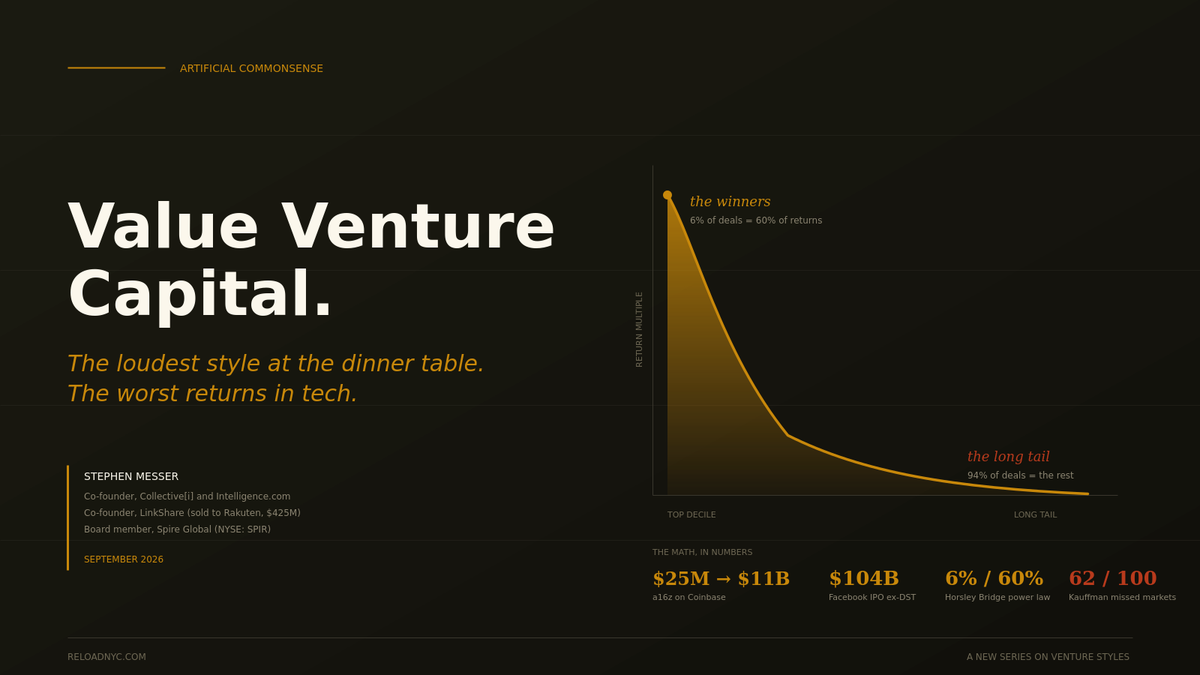
The math is not a Silicon Valley folk story. It is peer-reviewed and it has been consistent for forty years. Correlation Ventures ran a deal-level analysis on more than 21,000 US venture investments made between 2004 and 2013, and a second study on over 27,000 deals from 2009 to 2018. Sixty-five percent of individual venture deals returned less than the capital invested. Four percent returned more than ten times. Zero point four percent returned more than fifty times. Roughly half of all industry returns came from the top two percent of companies. Horsley Bridge, an LP that has backed venture funds since 1983, ran the same analysis on 7,000 of its portfolio investments across three decades. Six percent of deals produced sixty percent of returns. Same shape. Same answer. Different data set. This is why paying the winning price on the winning company is the whole discipline. Refuse to pay the winning price and you either do not get in at all or you get in at a smaller ownership stake that the winner does not compensate for.
At the venture stage the trade is growth. The downside is engineered by the term sheet. The upside is engineered by the deal you got in. Overpaying to be in the right deal is the whole discipline. The VVC calls it recklessness. The returns say it is math.
The VVC is arguing with a Nasdaq shareholder, it sounds insane to anyone in finance.
Think about what the VVC is actually doing when he lectures the founder on valuation. The founder is being told by five other investors that his company is worth a billion dollars. The market has cleared. That is what the term "market" means in the phrase "market valuation." The VVC is walking into that market and telling the seller, please take less than what everyone else is offering, because I am wiser than the crowd.
That is the same conversation as walking onto the floor of the Nasdaq and telling a shareholder holding Nvidia at the open of trading that he should sell it to you at yesterday's close because the current price is unreasonable. He is going to laugh. He is going to sell to someone else. The VVC then goes back to the office and writes a blog post explaining why the price was wrong, hoping some LP will read it and agree.
One of my closest friends loves to say "you can fix anything but stupid", and sometimes that is what talking to a VVC can feel like. They are not dumb people, but they can not look past their belief to what the data is telling them. I say this without frustration. I have not had one of these people on any of my deals, and my sister and I ran that gauntlet from LinkShare through the last acquisitions we did. I have plenty of friends who did have them. Every story ends the same. Slower rounds. Smaller checks. A board seat spent arguing about cost of revenue when the meeting was supposed to be about international expansion. Endless diligence. A term sheet three weeks after the founder asked for one, by which point the founder has already signed with someone who moves at real speed.
The one version of value venture capital that actually works incredibly well.
There is a legitimate way to run a value investor's mind against private technology. The people who did it well did not run venture funds. They ran secondary funds. They told their LPs upfront that this was the deal.
Hans Swildens started Industry Ventures in 1999 with two co-founders. It was a normal venture fund at first. When the dot-com market broke in 2000, Hans watched every corporate venture arm on the map try to unload its holdings at any price. Cisco, and dozens of others, wanted the assets off their balance sheet, and their CEOs did not want to deal with it any longer than they had to. Hans started buying those secondary positions. He bought them at the price forced sellers were willing to accept, which is how Buffett bought Coca-Cola in 1988 and Goldman in 2008. That is the actual value trade. It requires a market where discipline is not popular and forced sellers exist.
Twenty-five years later, Industry Ventures had roughly $7 billion in assets under management, an 18 percent net IRR and a 2.2 times money-on-money multiple across a thousand investments in 800 venture funds. Goldman Sachs announced the acquisition of the firm in October 2025 for $665 million cash and equity at close, plus up to $300 million contingent through 2030, totaling $965 million. The deal closed in the first quarter of 2026. Hans and two senior partners are now inside Goldman's External Investing Group as partners, a 45-person team joining a $450 billion platform. I am proud to say I was an investor in Hans's very first fund. He is one of the best investors in tech I have ever met.
Alex Jacobson at 137 Ventures runs a version of the same idea from a different angle. 137 was started in 2010 to buy private-company stock from founders and early employees who needed liquidity ahead of an IPO. SpaceX. Stripe. Palantir. Airbnb. Flexport. The firm structures loans and direct secondary purchases, plays both sides of a hot company's late-stage life, and generates returns that most primary venture funds cannot match. Alex is also a friend, and 137 is another version of the discipline the VVC keeps saying they run but do not.
What Hans and Alex have in common is what makes the model work. They built the fund structure around the strategy. They told their LPs, in the pitch, that this was counter-cyclical or off-cycle work, not primary rounds against hot companies. Their LP base is comfortable with the drawdown timing. Their team is optimized for the model. They can sit out when nothing is on sale, and they can move fast when the sale hits. That is the discipline the VVC claims and does not have.
Real value investing in tech looks like buying forced sellers at a discount. It does not look like arguing with a founder about his hot Series B. Confuse the two and you get the returns of the second, not the first.
What the VVC does in the moment the discipline calls for.
Here is the test. If you claim to be a value investor in tech, then the moment prices collapse should be the moment you write more checks. That is what Buffett does, it is what Charlie Munger did. It is what Hans does. It is what Alex does. The whole framework depends on being active when the market is on sale.
Look at what the actual VVC does during a downturn. Go back to the correction of 2022 and read the LP letters. What they said was that they were focusing on their winners. What they meant was that they were doing no new deals and were letting most of their portfolio starve. The very founders they had lectured about capital discipline in the good years were the ones they abandoned in the bad ones. They did not see the hypocrisy of it. They did not see themselves as the value investor who missed the sale. They saw themselves as the disciplined manager preserving optionality. Their LPs saw the same thing I did. A fund that could not do what its own philosophy required at the only moment the philosophy was supposed to earn its keep.
The excuse I hear at those dinners is always the same. My LPs would not let me call more capital. The market timing was bad. We wanted to but we could not. If that is true, and I believe it is, it means the strategy does not work as a fund format. The right response is to build a Hans Swildens fund and market it as a hedge. The wrong response is to keep running the primary vehicle while telling the world you are the disciplined one.
There is no VVC version of Sequoia. There is no VVC version of a16z. Name one that scaled. Name one that returned twenty times a fund on a single deal. The answer is that the model does not produce those outcomes, because the framework is wrong for the asset class, and no amount of discipline compensates for that mismatch.
Where the newer pools of capital should actually play.
If you are a family office, a PE firm, or a hedge fund thinking about entering venture, here is my read. And I am aware most of you will not enjoy hearing this.
Family offices. Most family office staff are trained for capital preservation. That is the mandate. The CIO is excellent at avoiding losses and compounding safely. The VVC pitch is going to sound exactly like the discipline you already know, and want. Ignore that comfort. Also ignore what I would have told you six months ago, which was to write late-stage SPVs into the largest AI names at whatever the round cleared at. That trade has thinned.
Ask any OpenAI investor how they feel today versus a year ago. Late-stage SPV pricing at current valuations leaves modest upside against real drawdown risk, and the checks are large enough that the arithmetic starts to matter to a family balance sheet. The better version of the same instinct is to move earlier, into companies already in hot markets, with proven founders and starting to see any real traction, where the entry multiple still leaves room for a markup on the next round.
Smaller checks. Earlier stage, meaning how obvious the win is rather than what letter the round carries. Ask for common stock rather than preferred where you can, because what you want next is liquidity, and preferred stacks slow it down. If your operating principle is capital preservation applied strictly, the LeFrak family model is worth studying. For most family offices, the honest answer is that early-stage tech is not the right pool for you at all.
PE firms. You know how to buy a mature business, cut expenses, run it for cash, and sell it. That is a real skill and it does not translate to seed or Series A tech. What it does translate to is the Bending Spoons model, which I get to below. PE firms should think about roll ups to bring public of their legacy SaaS investments. PE firms are also now running a tech play where they buy large legacy companies with the goal of partnering with an AI first company to scale faster. This is a strong play.
Hedge funds. This is your sweet spot, and the smart hedge funds already see it. The trade is small dollars into privates for outsized alpha, hedged in the public book. Small dollars to you are massive bets for VC's who have tiny fund sizes compared to you.
Leopold Aschenbrenner is the paradigm case, and worth studying carefully. Situational Awareness launched in September 2024 with about $225 million. Through the first half of 2026 the fund returned 439 percent net. AUM peaked around $45 billion. Then in late July 2026 the market turned on AI capex and rewarded the software names Aschenbrenner was short. Both legs of the book went against him, margin calls landed, and he was forced to sell his levered public book to Citadel at a discount. AUM dropped to roughly $10 billion in days. The public book blew up. The private positions, which include Anthropic, Fluidstack, MatX, and others, are still there. His investors, who came in at $225 million, are still up multiples of their original capital even after the correction. That is the model. Small dollars into privates with real upside asymmetry, hedged with liquid public markets and debt. A hedge fund can survive a full public wipeout and still print for its LPs on the private book alone.
The refinement I would add now is where on the curve to buy and how to think about the exit. Late-stage SPVs into the biggest names have thinned, for the same reason the family office version has. Better trades sit earlier, in companies that already show traction in a hot market at prices that still leave room for a markup on the next round. Take common stock instead of preferred where you can. What you want is liquidity. Preferred stacks slow it down. Cap tables a new investor cannot value at a glance slow it down. Mark-to-market becomes harder.
Do not underwrite an IPO exit as the only path either. If you buy at a $1 billion mark and the next round clears at $5 billion, why wait five years for a public listing to realize the return? Stripe has stayed private for over a decade and still trades. Every company where private secondary is now functional is a company where a hedge fund can enter, mark, and exit without the traditional venture liquidity ladder. The new game is risk-adjusted return per dollar of exposure, priced across a real spread. Whoever prices that best will run circles around the funds still waiting for an IPO gong.
The flow of capital from hedge funds into privates will accelerate over the next twenty-four months. My friends in the space see the same thing. The relative dollars are small enough that having no exposure is now the negligent trade. The VVC pitch, told to a hedge fund partner, lands the way it should. Politely, and with a pass.
If you actually want to run value in tech, the new value game, be Bending Spoons.
There is one legitimate way to run a value-investor mindset against tech from the primary side, and Bending Spoons is doing it. I wrote about them in The SaaS Debt Trap. They roll up mature software assets. They buy Airtable for $1.285 billion enterprise value at what works out to a 2.68 times revenue multiple, run 70 percent layoffs, cut everything that is not the core product, and run the asset for cash. They are public now. They trade at $18 billion. Their revenue doubled from $671 million in 2024 to $1.31 billion in 2025.
That is a value operator running the value playbook on tech assets in the format the playbook actually needs. It is a rollup vehicle with public equity, not a venture fund. It buys assets the market has abandoned. It runs them the way private equity runs mature businesses. Its returns come from operating discipline on companies past the growth stage, not from stock-picking against a hot Series B.
I have had this exact conversation with a general partner at one of the largest venture firms in the world. I told him what he should do is stop trying to reinvent his fund and instead take some of his best mature portfolio companies, roll them into a Bending Spoons style vehicle, and take that public. That is the format that fits the strategy he claims to want to run. It is not the venture fund. I do not know if he will do it. They already missed very chance over the last 3 years to hedge their declining value investments in SaaS so who knows. What I know is that if you want the value discipline against tech to work, this is roughly what it has to look like.
The data, because I know the VCs reading this will ask.
The performance data is public. It is not close.
The Kauffman Foundation published We Have Met the Enemy… and He is Us in May 2012, a twenty-year study of the 100 VC funds it had actually invested in as an LP. Sixty-two of those 100 funds failed to exceed public market returns after fees and carry. Only twenty beat a public market equivalent by more than three percentage points annually, and half of those twenty started investing before 1995. Only four of the thirty funds in the study with committed capital above $400 million beat a small-cap public index. Cash returned to Kauffman since 1997 was less than the cash Kauffman put in. When one of the most sophisticated institutional LPs in the country runs the numbers on itself over twenty years and publishes the results, that is not opinion. That is math.
Cambridge Associates' most recent US venture capital benchmark, which now tracks 2,699 funds representing $591 billion in value across vintage years 1981 to 2025, puts top-quartile fund returns at 3.0x TVPI or higher and 25 percent net IRR or higher by year ten. The median fund returns roughly 1.5 to 1.8 times invested capital. The spread between top and bottom quartile in any given vintage is over thirty percentage points of IRR, roughly three times the dispersion you see in buyout and the widest gap in institutional finance. That single fact is why manager selection matters more in venture than in any other asset class an LP touches.
Santé Ventures, running PitchBook fund performance data across vintages, found that only seventeen percent of funds larger than $750 million have delivered more than 2.5x TVPI, compared to twenty-five percent of funds under $350 million. Preqin's 2020 vintage cohort shows an overall median VC IRR of 20.9 percent, versus 36.5 percent for first-time funds, which tend to run smaller and hunt harder. Fund size does not predict returns. What predicts returns is whether the fund got into the winner and held enough of it. That comes back to style, which is why I wrote this piece.
None of this data supports the VVC pitch. It does not say value discipline outperforms in tech venture. It says the opposite. Most funds do not beat public markets. The ones that do are sitting on one or two enormous winners. Those winners were bought at the winning price, which is the whole point.
If your fund's returns disprove any of this, publish them. Not the gross-of-fees number you use in the first LP meeting. The net-of-fees number your investor sees in the annual audit. Match it against the Cambridge quartile benchmark for your vintage and against a public market equivalent. If your fund is top quartile against both, I owe you a public correction and I will run it. That is a fair trade, and I would love to see the data.
What this all means, and why it matters now.
Venture used to be small. It used to fit inside a boutique corner of the capital markets. That world is over and VC is being disrupted in a massive way, yet no one is talking about it. I wrote in The Trust That Ate Venture Capital about the change. Andreessen Horowitz raised 18 percent of all US venture dollars last year and is now managing north of $90 billion. Sequoia is at $85 billion. Both firms have quietly become investment trusts, paying up for access to the founders who already made it, running the exact playbook J.P. Morgan ran on the railroads in 1901.
Around them, corporates are running ecosystem plays that magnify returns in ways no venture fund can match. Microsoft with OpenAI. Amazon with Anthropic. Salesforce trying its version with Claudeforce, which I unpacked in The SaaS Debt Trap. Each of these is a value creation vehicle at a scale a single fund cannot replicate.
Big Tech spent $725 billion on AI infrastructure in 2026. That is more than four times what all of venture capital deployed in the same year. I made the case for what that means for the bubble argument in The Reason Prior Tech Bubbles Broke Just Got Fixed. This is the world every new capital pool is walking into.
Every fund is competing across styles now. Access. Momentum. Ecosystem. Secondary. Growth. Conviction. Value. Each of them has a different edge, a different fund structure, a different LP expectation. The winners over the next decade will be the ones who pick the style that matches their capital and stop pretending they can run a different one. The losers will be the funds that keep insisting the market is wrong and their framework is right.
So if you are the guy at the dinner table telling everyone the market is overvalued, you might be right at some point. You will also be Debbie Downer at Disneyland. It is a real character, from a real SNL sketch, and it is the exact reaction founders and other investors have to your bubble monologue in real time. You are the brake on a roller coaster nobody asked you to slow down.
If your returns proved you right, I would say run the framework harder. Your returns do not prove that. Your returns prove the framework belongs somewhere else.
Argue with me.
I am publishing this knowing the comments will include every version of why I am wrong. If you are running a VVC fund and you think your returns disprove my point, send me the numbers and I will read them. If you are an LP who has been happy with a value venture fund for a decade, tell me why and I will consider whether I am generalizing from the wrong sample.
What I will not accept is the same argument I have been hearing at every dinner for twenty years. Prices are too high. Founders are unreasonable. Sequoia is out of its mind. Those are not arguments. Those are complaints, and the market has priced them for what they are.
If you want the next piece when it drops, subscribe here. If you have dealt with the VVC in a deal and have a story, reply with it. Those stories are the best raw material for the series. If you are a founder wondering whether the investor across the table is a VVC, forward this piece to your two smartest board members and see if it lands.
Collective[i] has spent ten years building a verified relationship graph and an AI model for how the world actually does business. Not a workflow tool with intelligence bolted on the side.
Intelligence.com opens that same graph to anyone with a professional network worth using. If your LP calls are only as good as your network, this is where the network gets real.
Join here.
Related reading
- Tech Is Not an Asset Class Anymore. It Is the Economy. The context for why venture style now matters more than stage.
- The Trust That Ate Venture Capital. What Sequoia and a16z quietly became on the way to $90 billion each.
- Bubble Talk Is How You Spot Someone Who Missed AI. The tell, in real time.
- The Reason Prior Tech Bubbles Broke Just Got Fixed. Why $725B in Big Tech AI spend ends the bubble argument.
- The Most Expensive Money in the Room. Nvidia to OpenAI to Oracle. The circle of capital is not a bug.
- The SaaS Debt Trap. Bending Spoons and the correct format for value investing against tech.
- Karp and Nadella Are Selling You a Wall. Ten percent proprietary, ninety percent externality.
- The Only Fight That Matters in AI. The orchestration layer that decides who wins.