The Agent Swarm Just Killed Scale as a Moat.
One Person Plus a Hundred AI Agents Beats a Hundred People Plus None. That Is How Ukraine Took the Eastern Front. It Is How Wiz Reached $32 Billion in Five Years. Here Is the Playbook. And the One-Question Test That Reveals Whether Your CEO Gets It. Part Two of Two.


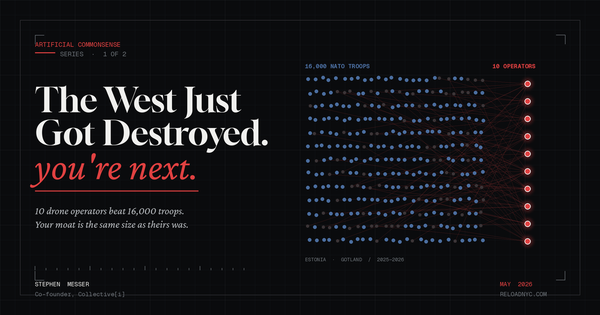
Part one of this series showed what has already happened. Ten Ukrainian drone operators mock-destroyed 16,000 NATO troops in half a day. Every industry you invest in is being rebuilt on the same doctrine. This piece is the practical playbook. Cheap beats expensive. Small beats large. One human plus a fleet of AI agents beats a hundred humans plus none. Why authoritarian regimes cannot copy it. Why Yevgeny Prigozhin was killed for coming close. And the specific one-question test every board and investor should run this quarter on the person at the top of the company they oversee.
Stephen Messer, Co-founder of Collective[i] and LinkShare (sold to Rakuten for $425M, 1996–2005). EY Entrepreneur of the Year/Deloitte Fast 50 (2x). Board member, Spire Global (NYSE: SPIR). Building intelligence.com
There is one sentence that captures the entire shift. The cheap beat the expensive. That is it. The $400 drone destroys the $4.5 million tank. The $2 laser shot defeats the $800 rocket. The four-person team hits $32 billion faster than any incumbent can hold a board meeting. Every industrial assumption built after WW2 was that scale, capital, and installed base were protective moats. Every one of those assumptions has flipped. What follows is the specific doctrine the winners are running, the specific one the incumbents cannot adopt, and the specific test you should apply to your own company before the market applies it for you.
The Cost Curve Just Collapsed
For eighty years, defense economics ran on one assumption. Better weapons cost more. The country with more capital produced more sophisticated platforms and won. That assumption gave us the F-35 fighter at $80 million per unit, the Ford-class aircraft carrier at $13 billion per ship, and the Patriot PAC-3 MSE interceptor at approximately $4 million each. The logic was that these platforms were so capable that no reasonable adversary could afford to defeat them at scale.
Iron Dome quietly broke that assumption on the defensive side, and the same cost-collapse mechanism is now running through every technology category with a demand curve. I laid out the model-layer version in Peak Token. The rocket-and-tank version is here. Israel's short-range air defense system has intercepted rockets at above a 90 percent success rate since 2011. A single Tamir interceptor costs between $40,000 and $100,000. The Qassam rockets it intercepts cost $300 to $800 to build. The ratio was grotesque enough that Iron Dome was defensible only because Israel had a small population, high stakes, and American co-funding. Anywhere else, the defender ran out of money before the attacker ran out of rockets.
Then came Iron Beam. Rafael's directed-energy laser began transitioning to operational deployment in 2025. Cost per shot: approximately $2 in electricity, against the same $300 to $800 Qassam rocket. The economic model that made Hamas, Hezbollah, and the Houthi rocket campaigns rational (spend $500 to force the enemy to spend $50,000) is over. On the offensive side, Ukraine flipped the same math the other direction. A first-person-view drone that destroys a Russian T-90 tank costs approximately $400. The tank costs approximately $4.5 million. Cost asymmetry: 11,000 to 1 in favor of the attacker. By late 2025, drones were engaging 80 to 85 percent of Russian frontline targets. In the summer of 2025 alone, Ukrainian forces conducted at least 215,000 unmanned strike operations.
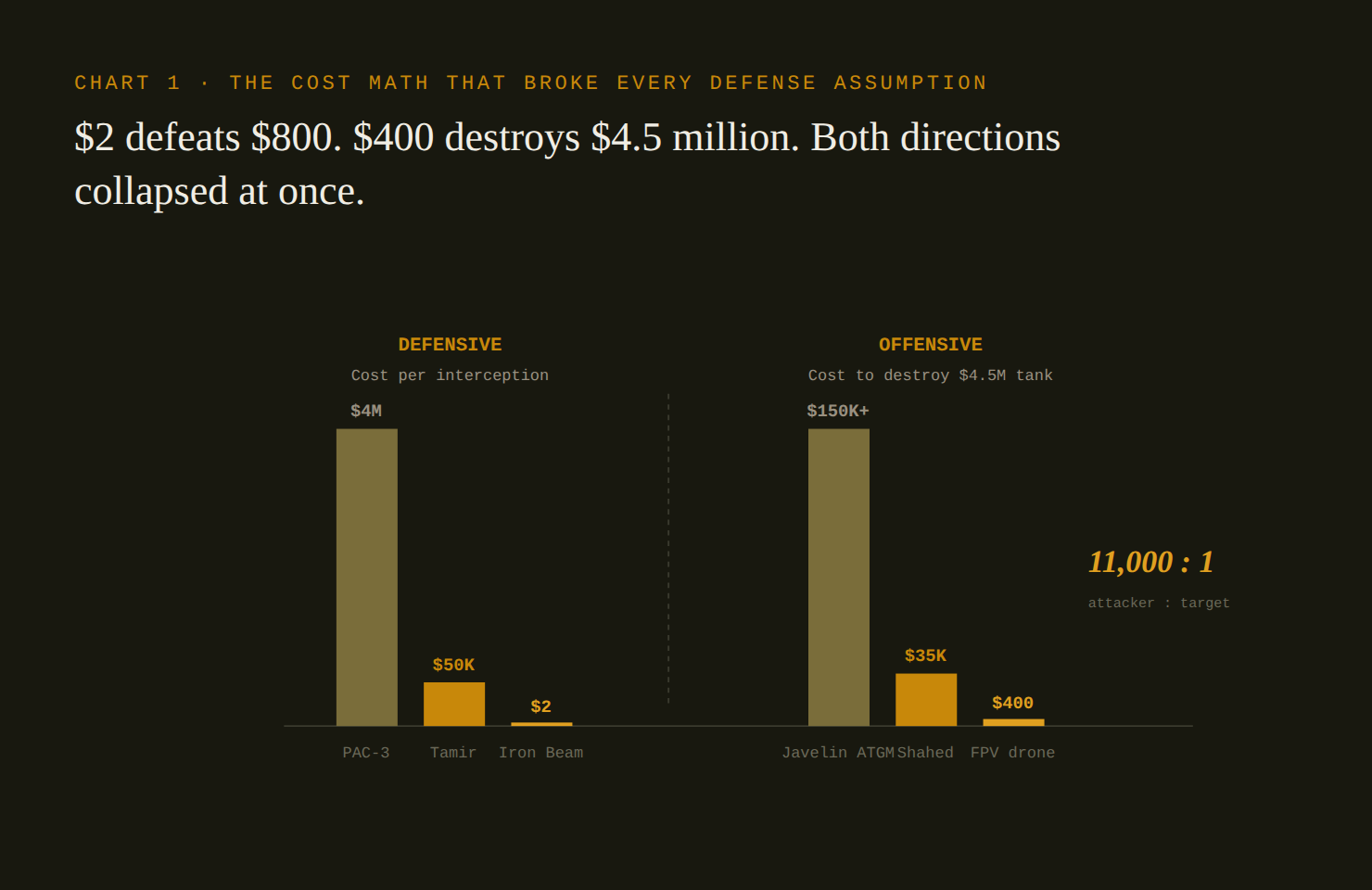
What this means for you. Any business built on the premise that installed capital is a moat is now looking at a competitor whose entry cost is a rounding error of yours. Field-service businesses defended by expensive fleets. Manufacturers defended by expensive tooling. Logistics companies defended by expensive warehouses. Enterprise-software incumbents defended by expensive integrations. If a $400 unit can destroy a $4.5 million unit at scale, a small AI-native competitor with a lower cost base can displace an incumbent with a larger one. The math does not care about your history.
The math does not care about your history. If a $400 unit can destroy a $4.5 million unit at scale, a small AI-native competitor with a lower cost base can displace an incumbent with a larger one. Cost asymmetry is the whole game now.
Speed Is the New Weapon
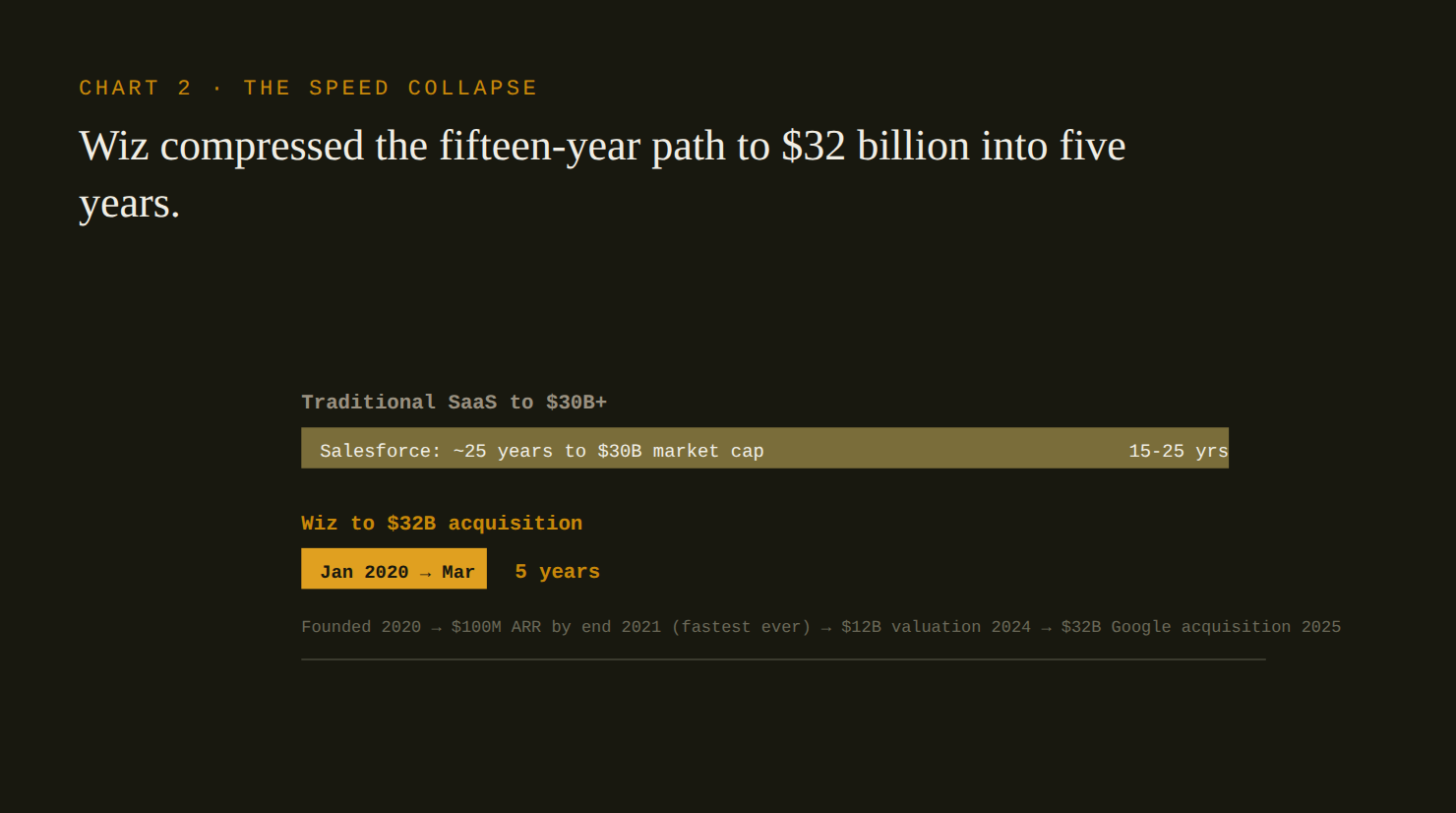
The commercial version of the same shift produced the fastest company-to-mega-exit story in software history. Wiz was founded in January 2020 by four Israeli veterans of Unit 8200: Assaf Rappaport, Ami Luttwak, Yinon Costica, and Roy Reznik. All four had already sold one company (Adallom, to Microsoft for approximately $320 million in 2015). They started Wiz to build cloud security infrastructure. By the end of 2021, roughly eighteen months in, they had reached $100 million in annualized recurring revenue. The fastest any software company had ever hit that mark.
By August 2024, Wiz had reached $500 million in ARR at a $12 billion valuation. In March 2025, Google announced its acquisition of Wiz for $32 billion. The largest software acquisition ever recorded. Five years from founding to $32 billion. Four founders. The traditional path to $32 billion in software runs through fifteen years of quarterly revenue milestones, product line expansion, IPO, and post-IPO growth. Wiz compressed that timeline by two-thirds.
The mechanism is worth naming, because it is the same one running in Ukraine. Wiz's founders had learned in Unit 8200 how to move faster than the adversary. They shipped features against real customer feedback in weekly cycles. They hired experienced enterprise sellers from day one instead of trying to build a market-education motion. They positioned against the incumbent (Palo Alto Networks) directly rather than slotting into an existing category. Every decision they made compressed the time from problem identification to deployed solution.
What this means for you. Speed is now the primary weapon in competitive markets, and speed compounds. A team that ships what customers want in weekly cycles will out-execute an incumbent that ships quarterly, even if the incumbent has more capital, more customers, and more brand equity. Every founder who is not organizing their company around this principle is optimizing for the wrong century.
How the Winners Actually Fight
Two doctrines are producing all the interesting outcomes right now. One is Ukrainian. One is Israeli. Both are worth studying in detail because the operating principles map directly onto commercial decisions your board is making this quarter.
The Ukrainian doctrine is what Aerorozvidka built. Aerorozvidka was a volunteer group of drone hobbyists, engineers, and reservists that operated outside the traditional defense establishment. They repurposed commercial DJI Mavic drones for reconnaissance. They designed the R18 attack drone, which played a decisive role in the defense of Hostomel Airport in the opening days of the 2022 invasion. They built the digital platforms (Delta, GIS Arta, Kropyva) that turned individual drone teams into a mesh network of intelligence and fires. They ran on Starlink because the pre-war military communication system was compromised. Manufacturing runs across hundreds of small workshops, private homes, and repurposed garages, using consumer-grade 3D printers to produce drone frames on demand. A Russian missile strike on any single workshop takes out a fraction of a percent of output. The manufacturing base is un-targetable. The scaling model is a network.
How Ukraine counts what it destroys deserves specific attention because it is the operational difference between now and every prior war. In Vietnam, kill counts were estimated by field officers, aggregated up through command, and famously fabricated at every level. In Ukraine, every FPV drone carries a camera. Every strike is recorded. Every hit produces a video file that gets uploaded to the DOT-Chain Defense platform, geolocated, timestamped, and cross-referenced with target databases. The drone manufacturer gets frontline reviews the way an Amazon seller gets product reviews. What works gets scaled. What does not improve gets dropped. The feedback loop from combat to manufacturing runs in days, not the five-to-seven-year cycle of traditional Western defense procurement.
The Israeli doctrine is different in kind. Israel does not have the population depth for a war of attrition. What it built instead is a talent pipeline that fuses intelligence, technology, and rapid iteration into a single institution. Unit 8200 identifies mathematically and technically gifted teenagers in high school, sometimes earlier, and places them at eighteen into work that most Western intelligence services would reserve for people twice their age. The alumni network is what makes it a management story. Unit 8200 graduates founded Check Point, Wix, Palo Alto Networks, Waze, NSO Group, and hundreds of others. The September 2024 operation against Hezbollah, in which thousands of pagers rigged years earlier detonated simultaneously across Lebanon, is what happens when that kind of institution runs a decade-long project.
What both models share is the single feature that matters for business. The distance between the person who sees the problem and the person who authorizes the response is short. In Ukraine, one drone operator and one comms link. In Israel, one Unit 8200 team and one commander's intent. In both cases, the middle management layer that the WW2-era corporation calibrated to preserve central control is absent. The friction it produced is gone.
One Human. A Hundred Agents.
The commercial version of the Ukrainian drone unit is already being built. Every account executive, banker, investor, doctor, or engineer will soon operate a fleet of AI agents that magnify what one person can do. Not one agent. Not five. Hundreds. Each one specialized for a specific task, each one running in parallel, each one reporting to the human at the center of the network. This is the pattern I laid out in Infinite Leverage and in What an AI-First Company Actually Does. It is also the commercial version of what Ukrainian drone teams are running against Russian armor.
Think of a salesperson. Not the way she works today. The way she will work in eighteen months. She has an agent that continuously researches every account in her territory. Another that reads every buyer signal in real time. Another that drafts outreach in her voice. Another that briefs her before each call on what changed since the last one. Another that maintains relationship history across every stakeholder at every account. Another that monitors news, funding events, hiring changes, competitive moves. Another that follows up on every open thread. Another that reviews her calendar for opportunities she missed. A hundred agents, one seller, working in coordinated formation. The seller is the commander. The agents are the fleet.
The math on the incumbent side of this equation does not work. A traditional enterprise sales team of a hundred sellers, each supported by a manager, each supported by an operations layer, each rolled up through a district and regional structure, is the WW2 corporation. High fixed cost. Slow feedback. Layers of middle management to preserve central control. The AI-native competitor runs ten sellers with a hundred agents each. Lower cost, faster iteration, direct line from the field to the decision-maker. Same pattern as the ten Ukrainian drone operators against the sixteen thousand NATO troops. Same outcome.
At Collective[i] we build these agents, and we call them Telli Assistants. The product is not the point of this piece. The pattern is. Every knowledge-work function is about to be reorganized around this architecture. Sales. Marketing. Finance. Consulting. Recruiting. Investor relations. Legal. Every one of them. The companies that adopt the pattern win. The companies that bolt "AI agents" onto their existing hierarchy do not, because they are still running the WW2 doctrine underneath. This is the same divide I mapped out in The Weakest Link and in The Oldest Trick in Management Just Stopped Working. Adding technology to a broken structure produces a faster broken structure.
One human plus a hundred AI agents beats a hundred humans plus none. That is the arithmetic of your next hiring cycle, your next org chart, your next competitive threat. The math has already flipped. Most boards have not caught up.
Why Authoritarians Cannot Copy It
The obvious question is why Russia, China, Iran, and North Korea (all of whom face the same technological environment) have not adopted the same doctrine. The answer is political, not technological. Mission Command requires trust in the person on the ground. Authoritarian regimes cannot afford to trust the person on the ground, because the person on the ground could turn on them. The Russian military entered Ukraine in February 2022 with an order of battle that assumed centralized command would function on Day 3 the way it had functioned in paper exercises. It did not. Russian junior officers with no authority to adapt drove into Ukrainian ambushes their sergeants could see forming.
The Russian state understood the weakness. The Wagner Group was created in 2014 specifically to break out of it. Wagner was built as an entrepreneurial private military company, outside the formal chain of command, with authority to hire, fire, contract, and improvise. By 2023 it was the only Russian formation making progress in Ukraine, and Wagner finally took Bakhmut in May 2023 after nine months of grinding combat the regular Russian army could not close out. Then on June 23, 2023, Wagner's entrepreneurial founder Yevgeny Prigozhin did what the central command had always feared. He turned the effective fighting force on the dictator. His convoy marched toward Moscow. The mutiny collapsed inside 36 hours. Prigozhin was dead in a plane crash two months later. Authoritarian systems cannot escape this trap. The only way to make top-down doctrine effective is to allow autonomy at the edge. The moment you allow autonomy at the edge, the edge can turn on the center.
If your portfolio company or your own leadership team cannot allow autonomy at the edge, this is the pattern you should study most carefully. Most Fortune 500 companies are running some version of the Russian model with a thin layer of Mission Command painted on top. The paint job does not save you. The pattern I laid out in Find Your Builders. Or They'll Leave and Start Without You is exactly this trap in commercial form. Talented operators leave centralized companies because centralized companies cannot let them build.
The Decision Speed Gap
The single fastest diagnostic for which doctrine your company actually runs is the speed at which your teams can buy and integrate new technology. A wartime organization can identify a tool, evaluate it, procure it, and integrate it in weeks. A WW2-doctrine organization takes fifteen months and requires sign-off from procurement, security, legal, IT, finance, and two levels of executive review. If you think you have fast teams, but the approval process for a $50,000 tool takes 90 days, you do not have fast teams. You have fast individuals trapped in a slow structure.
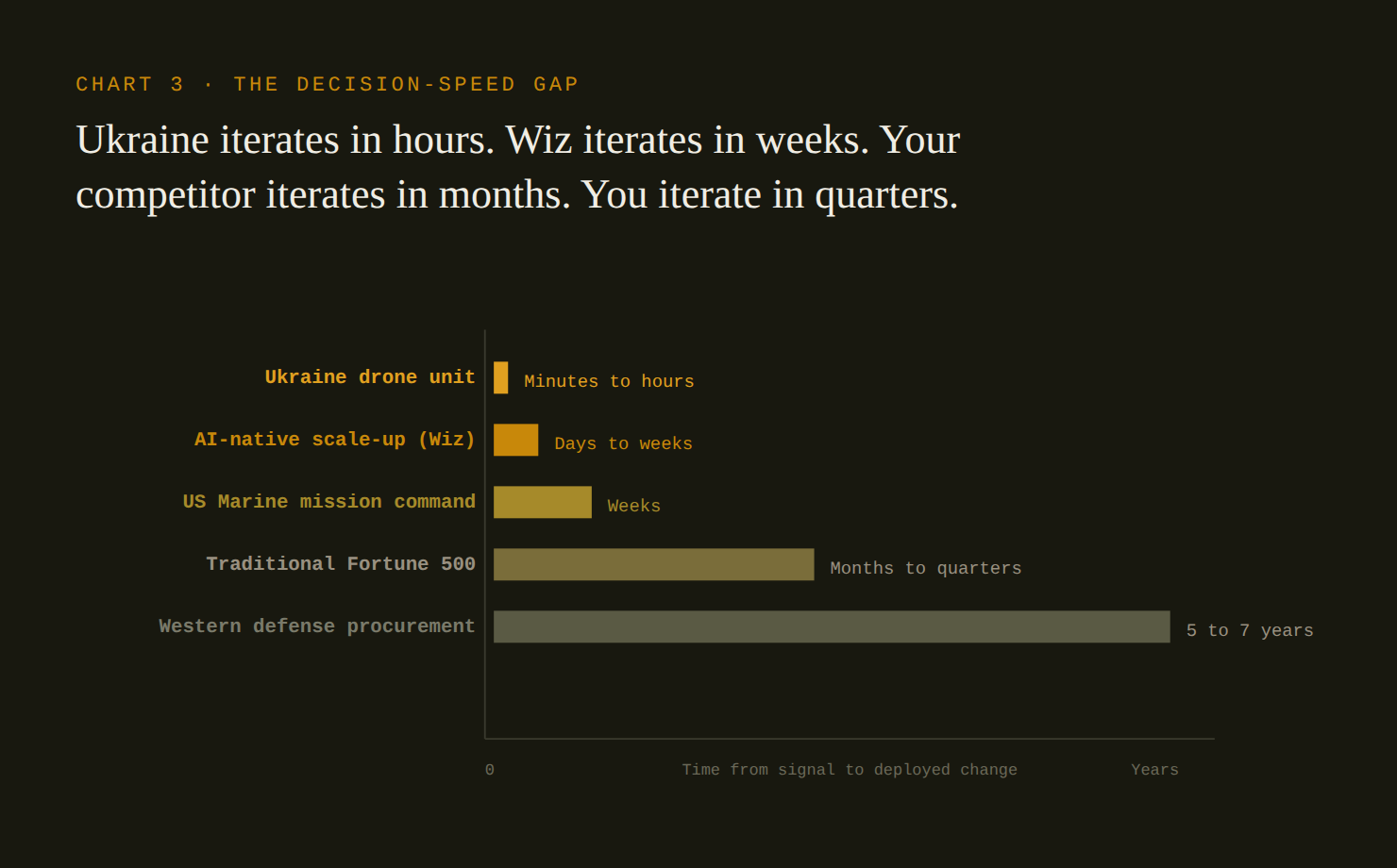
What this means for you. The safe-looking bureaucracy is the losing move. What you are calling "responsible AI adoption" or "due diligence on new tools" is what an outside observer would call "cannot move." I laid this out in The Oldest Trick in Management Just Stopped Working and in The Safest Move You Can Make With AI Will Cost You Everything. Slow is not caution. Slow is death.
The Contractor Model Is Dying Too
Every generation of American defense contractors has run on cost-plus contracting, in which the contractor gets reimbursed for what it spends and takes a margin on top. The model is a WW2 artifact. It made sense when the government needed a specific weapon system that only one or two firms could build, and it was more important to get the weapon than to control the price. In 2026, when a startup like Anduril can build a new autonomous system in months and ship it at commercial-margin pricing, cost-plus is a category-level extinction risk for Lockheed, Raytheon, and Northrop Grumman.
The commercial analog is Spire Global, which I laid out in detail in The Shoebox That Changed Space. Spire asked whether a satellite had to cost a billion dollars or could cost $200,000 built from consumer-grade components in a shoebox. The answer was that it could. Spire is public. The satellites work. The traditional space primes have not caught up. The same first-principles decomposition is running in every large-contract industry right now. It is coming for enterprise consulting (see Software Is Not Going Down Alone). It is coming for legal services. It is coming for capital allocation itself (see The Most Expensive Money in the Room).
The professional network layer is running the same pattern. LinkedIn was built in 2003 as a résumé archive. It works the way the WW2-era corporation works. Central directory, top-down search, one-to-one connection requests, warm intros brokered through weak-tie hops. That model is dying. I wrote about the specific mechanics in The Warm Intro Is Dead. Something Better Just Killed It. If your sales team is still trying to close deals through cold InMail on LinkedIn, they are firing PAC-3 interceptors at consumer drones. The math does not work.
The Wartime CEO Test
For any investor, board director, or LP looking at your portfolio, the single most predictive question you can ask about the leader of a company is this. Ask them to describe their AI strategy in three minutes. Do not interrupt. Just listen. What comes out of their mouth will tell you which side of this shift they are on.
THE ONE-QUESTION INVESTOR TEST
The wrong answer sounds like this. "We are working with our vendor partners to integrate LLMs into our core workflows. We have deployed [ChatGPT or Copilot] across the organization. We are exploring use cases and putting governance in place. We are in a pilot phase with [one or two major model vendors] and expect to move to production next fiscal year." Every word of that answer is 2023. That is a last-war CEO.The right answer sounds like this. "We run multiple purpose-built AI systems against specific decisions. Model X handles buyer intent. Model Y handles contract review. Model Z handles our field-service dispatching. They are connected through harnesses we built internally. The team on the ground can request or reject a new one in a week. We are shipping capability every sprint. Here is what we replaced last month, and here is what we are testing this week." That is a wartime CEO.The gap between these two profiles shows up in returns before it shows up in the analyst consensus. Track it now.
The pattern extends to the board itself. A wartime board asks about signal-to-action latency. A last-war board asks about quarterly guidance. A wartime board asks who the top ten talent moves in the industry are, and whether the company has recruited any of them. A last-war board asks about compensation benchmarks. A wartime board asks what the company would look like if it were founded today. A last-war board asks how to protect the current cost structure. If your board looks more like the second version, that is a governance problem, not just an operating one. It is the same pattern I described in Karp and Nadella Are Selling You a Wall: the defensive posture only protects the ten percent of value that lives behind the wall, while the ninety percent that sits in the network is undefended. The orchestration-layer fight I mapped out in The Only Fight That Matters in AI is the specific place where a wartime leader is playing and a last-war leader is not.
What This Looks Like From Where I Sit
The specific category I have watched most closely for the last decade is enterprise sales. It is one of the last strongholds of the WW2-era corporate architecture. The CRM sits at the center of it. Priced per seat, at $150 to $300 per user per month, on the assumption that every seat is a cost line to be metered. That pricing model is the WW2 doctrine applied to software. It treats users as inputs to be counted rather than as network nodes that make the platform more useful.
At Collective[i] we do the opposite. Every individual user gets a free license. The reason is that our product gets better with more users. A network of buyer signals, aggregated across accounts and industries, is more valuable when more people contribute. This is the pattern I mapped out in The Buyer Has a Process. Collective[i] Knows What It Is. and in Workflows vs Outcomes. The same principle runs through Intelligence.com, our AI-first professional network, and it is the reason the traditional LinkedIn model is a WW2-era artifact. Networks are currency, and the incumbents who priced against per-seat scarcity are running the wrong doctrine. Enterprise sales is the specific place I see the shift landing every day. The mechanism is identical in every industry on the disruption table from part one. Once you see the pattern in one category, you can spot it in your own.
Closing the Series
Two pieces. One argument. Every industry is being rebuilt on a doctrine that most Fortune 500 companies do not run. Cheap beats expensive. Small beats large. Fast beats slow. Distributed beats centralized. Networks beat hierarchies. That is not opinion. It is the observed empirical record of the last five years across every category I have written about at reloadnyc.com. Defense (see Real Disruption). Space (see The Shoebox That Changed Space). Capital markets (see The Most Expensive Money in the Room). Software (see Software Is Not Going Down Alone and The Last Great Head Fake in Software History). Privacy and communications (see The Death of Privacy. The Rise of Unbreakable Communications.). The pattern is universal because the underlying force (cheap AI compute at the edge, connected through networks that learn faster than incumbents can respond) is universal.
Every board should be asking two questions this quarter. Who in this company has the authority to act on what the field team just saw, and how long does it take from signal to action. If the answers involve five layers and six weeks, the company is running the WW2 doctrine in an AI war. That is a losing position. It is also fixable if the board acts before the market forces the move.
If you want the next piece delivered when it publishes, subscribe at reloadnyc.com. Free. No paywall. No course at the end. Just the work.
If this series changed how you are thinking about your company or your portfolio, forward it to one person who needs to read it. A director on your board. A field team leader. A founder trying to understand why their two-year-old competitor is out-executing them. One specific decision-maker in your world. That is how the argument moves. One reader telling another.
If you are the person who just got this forwarded, welcome. Subscribe at reloadnyc.com. Two dozen pieces in the archive. Another two dozen in the queue.
Reply if you want to argue. Post it on X, tag @smesser, and tell me where I am wrong. Share it on LinkedIn if the boards or LP committees you sit on need to see it, and tag me at linkedin.com/in/stephenmesser. The pieces get sharper when readers push back.
SOURCES · STATS AND REPORTING CITED ABOVE
1. US Army FY 2024 budget request (Patriot PAC-3 MSE unit cost ~$4M); Congressional Research Service on Patriot economics: crsreports.congress.gov
2. Rafael Advanced Defense Systems and Israeli MoD (Iron Dome intercept rate above 90%, Tamir interceptor $40K-$100K): rafael.co.il
3. Reuters, Times of Israel, Rafael on Iron Beam operational deployment and cost-per-shot economics ($2 in electricity): timesofisrael.com
4. Kyiv School of Economics Institute report "Harnessing Ukraine's Drone Innovations" (FPV drone cost ~$400, T-90 tank $4.5M, 215,000 UAV strikes summer 2025, 80-85% of frontline targets engaged by drones): kse.ua
5. Alphabet/Google acquisition announcement (March 18, 2025, $32B, largest software acquisition ever); TechCrunch on Wiz $100M ARR in 18 months (fastest ever)
6. Center for European Policy Analysis on Aerorozvidka, Delta, GIS Arta, Kropyva systems and Bohdan Krotevych comments: cepa.org
7. Modern War Institute at West Point on Ukraine's DOT-Chain Defence platform and days-to-weeks iteration cycle vs Western 5-7 year procurement: mwi.westpoint.edu
8. Bismarck Analysis and startup-industry summaries on Unit 8200 alumni-founded companies (Check Point, Wix, Palo Alto Networks, Waze, NSO Group): brief.bismarckanalysis.com
9. Institute for the Study of War on the Wagner Group's June 23-24, 2023 mutiny and Prigozhin's death on August 23, 2023: understandingwar.org