The West Just Got Destroyed. Your Company Is Next.
Ten Ukrainian Drone Operators Demolished a 16,000-Troop NATO Force in Half a Day. The Same Pattern Is Already Inside Every Industry You Invest In. Most CEOs Still Cannot See It. Part One of Two.

Stephen Messer, Co-founder of Collective[i] and LinkShare (sold to Rakuten for $425M, 1996–2005). EY Entrepreneur of the Year/Deloitte Fast 50 winner (2x). Board member, Spire Global (NYSE: SPIR). Building intelligence.com
War is horrible. Every life lost is a tragedy that no analytical frame should minimize. History also tells us something uncomfortable that most business writing avoids. Wars force societies to rebuild systems that peacetime would never touch. The information environment, the industrial base, the capital stack, the leadership doctrine, the very definition of what counts as a competitive advantage. The last time this happened at civilizational scale was between 1939 and 1945, and it produced the corporation you still work in. It is happening again right now, on the battlefields of Ukraine and Israel and inside the industries you invest in. The purpose of this piece is to help you see what has already changed, before your competition does.
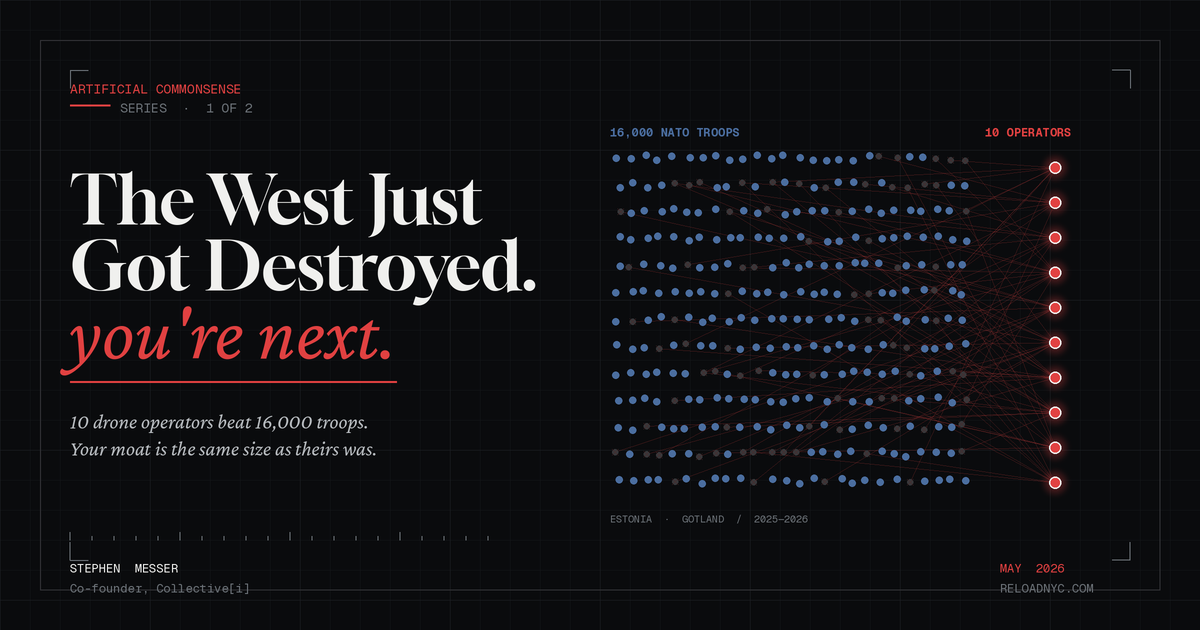
Sixteen thousand NATO troops from twelve countries just got destroyed by ten Ukrainian drone operators in half a day. If that sentence does not stop you, you are already losing the war I am about to describe. Every industry you invest in, run, or work inside is being rebuilt right now on the same doctrine that destroyed those NATO forces. The tools you built your career on are the tanks. The competitors reshaping your category are the drones. This is part one of a two-part series on what has already changed and what to do before your board catches up.
What Actually Happened at Estonia and Gotland
In May 2025, NATO ran the Hedgehog exercise in Estonia. Sixteen thousand troops from twelve NATO countries, including a British brigade and an Estonian division, spent weeks preparing for a mechanized attack against a simulated adversary. The adversary was ten Ukrainian drone operators seconded from the actual front, using Ukraine's Delta battle-management system. In half a day, that team of ten mock-destroyed 17 armored vehicles and executed 30 additional strikes. One participant reported the ten Ukrainians eliminated two full NATO battalions in a single day. The NATO troops, in the words of an observer, "were just walking around, not using any kind of disguise, parking tents and armored vehicles. It was all destroyed."
Twelve months later, on the Swedish island of Gotland during Aurora 2026, the same lesson was delivered again. Ten Ukrainian drone pilots destroyed Swedish and allied units so thoroughly that training was reset three times because the Western troops kept dying too fast to learn. "If this were real life, they would have been dead," said one Ukrainian pilot. An American general in attendance summarized the lesson in one sentence. "You have to really focus on your survivability and how you can't be detected."
Two exercises. One year apart. Same result. The best-trained militaries in the world got destroyed by teams of ten operators using $400 drones. The reason is not that NATO soldiers are bad soldiers. They are excellent soldiers, perfecting the war that ended in 1991. Nobody is fighting that war anymore.
Sixteen thousand NATO troops got destroyed by ten Ukrainian drone operators in half a day. The reason is not that NATO soldiers are bad. They are perfecting the war that ended in 1991. Nobody is fighting that war anymore.
This Is Not a Military Story
Every one of you reading this is running an organization that is doing exactly what NATO was doing in Estonia. Perfecting the last war. The tools were built for a specific competitive environment that no longer exists. The people were trained for a specific set of adversaries who have already moved on. The processes were optimized for a decision speed that your competitors have already left behind. If a ten-person team using $400 drones can destroy the best-funded military alliance in the world, a ten-person AI-native startup can destroy the incumbent in your category.
Anthropic, OpenAI, and Wiz all have fewer than a few thousand employees. Their combined value is now larger than the market cap of most Fortune 100 industrials. Anduril, founded in 2017, is displacing defense contractors that were founded during WW2. Zellerfeld, a German 3D-printed sneaker company with roughly 100 employees, is being watched by Nike's board more nervously than any of Nike's traditional competitors. The pattern is not sector-specific. The pattern is that small, fast, distributed teams beat large, slow, centralized incumbents. Every time now.
The Information War You Are Already Losing
The first place the war shows up in the civilian environment is information. Every combatant nation in WW2 recognized this in 1939 and rebuilt its information architecture inside months. Britain formed the Ministry of Information the day after declaring war. Germany had been running the Volksempfänger propaganda-radio program since 1933, subsidizing state-controlled receivers into 65 percent of German households by 1938. The United States established the Office of War Information in 1942, and by war's end Frank Capra's Why We Fight series had been watched by 54 million American soldiers. The rebuild was existential, not aspirational. Whoever moved messages fastest defined the story of the war.
The same rules apply today, and most business leaders have not adjusted. TikTok, Instagram, and X are the current Volksempfänger. Algorithmic feeds decide what forty percent of the world's population sees each morning. Generative AI produces images and video that most viewers cannot distinguish from reality. I laid out the specific business implications of this information environment in The Death of Privacy. The Rise of Unbreakable Communications. The "six-fingered children of Gaza" images, AI-generated fake atrocity photos that circulated at scale in 2024, moved through networks faster than any fact-checking system could respond. Similar synthetic content has shaped domestic reception of the war in Moscow and public opinion in dozens of other conflicts. The information environment your business operates inside is now permanently contested, in a way it has not been since WW2.
Which brings me to the CEOs who understood this and the ones who did not. When McDonald's CEO Chris Kempczinski posted an Instagram video of himself tasting the new Big Arch burger in February 2026, he was mocked online for taking a tiny bite, calling the burger a "product," and looking, in one viral commenter's words, "afraid of it." Burger King president Tom Curtis then posted a TikTok of himself taking a huge, authentic bite of a Whopper. The video went viral. Burger King's Q2 sales climbed off the back of that single ninety-second video. Meanwhile Elon Musk broadcasts directly to 200 million followers on X, bypassing every business-press intermediary that used to shape narrative. Alex Karp of Palantir has become his own news channel, giving interviews and public speeches that move the stock more than analyst reports do. Every executive is now a media property whether they signed up to be one or not.
THE TEST · HOW TO TELL IF YOUR LEADER IS RUNNING THE RIGHT DOCTRINE
Watch how your CEO shows up in the information environment. The wrong doctrine looks corporate. Scripted press releases. Guarded quarterly calls. A social media presence run by the communications team. The right doctrine looks direct, authentic, and slightly unpolished. Tom Curtis biting a Whopper. Musk posting at 2 a.m. Karp arguing on television. If your leadership team is still asking the communications department to review every tweet, they are running the WW2 doctrine in an algorithmic-feed environment. That gap widens every quarter.
How WW2 Built the Model You Are Running
To see why the current corporate architecture is antiquated, it helps to understand who built it and why. Between 1939 and 1948, the entire architecture of modern American business was invented, in six years, under conditions where failure meant losing a global war. Henry Kaiser reduced Liberty ship build times from 244 days to 42 days using welding and mass production techniques. Chrysler built 22,000 tanks at the Detroit Tank Arsenal. Ford's Willow Run plant produced one B-24 Liberator bomber every hour. Andrew Higgins, an unknown New Orleans boat builder, produced 20,094 landing craft that Eisenhower later credited with winning the war.
What emerged after the war was the corporate template that still runs most of the economy. Ford's Whiz Kids, ten Army Air Force officers led by Robert McNamara, arrived at Ford in 1946 and installed the planning, budgeting, and analytical systems that would define American management for two generations. W. Edwards Deming took wartime statistical process control to Japan in 1947 and rebuilt Toyota, Sony, and the entire Japanese industrial base around it. RAND Corporation, born from the Army Air Forces in 1946, pioneered systems analysis. McKinsey grew into the consultancy that carried these methods into every large business in America. The result was a corporation with central planning at the top, layers of middle management to translate the plan, standardized processes running on standardized inputs, and a workforce trained to execute rather than improvise.
The civilian architecture that surrounded that corporation was built in the same window. The GI Bill of 1944 sent millions of returning servicemen through university and installed the higher-education feeder that most companies still recruit from. Levittown, the mass-produced Long Island suburb that Bill Levitt built starting in 1947, invented the assembly-line neighborhood and set the template for the twenty million tract homes built in the two decades that followed. Interstate highways funded from wartime tax revenue made those suburbs commutable. The electric grid was designed for the load profile of suburban households and centralized manufacturing. Every one of those systems still exists. Every one of them is now the bottleneck that the AI transition is straining against.
The Model Is Now Antiquated in Every Direction
The WW2-era corporation was better than what came before it. Pre-war American manufacturing was mostly local, mostly small, and mostly unable to produce anything at continental scale. The postwar model was a genuine improvement. It won the war, rebuilt Europe under the Marshall Plan, and produced the highest sustained economic growth in modern history. If your instinct is to defend the model, that instinct is not wrong. It has worked for eighty years. It also happens to be the model that produced the assumptions I dismantled in The End of Car Ownership, Time Kills All Deals, and The American Dream Has a Permitting Problem. Every one of those pieces described a WW2-era regulatory, infrastructural, or ownership structure that is now the specific bottleneck holding back the next cycle.
What is different now is that a third model has arrived that is better than both. Distributed. Networked. Iterated in days rather than quarters. Priced against outcomes rather than seats or capital investment. It is the model the Ukrainian drone units run on the battlefield. It is the model Wiz used to reach $32 billion in five years. It is the model Zellerfeld is using to challenge Nike, printing custom shoes to a customer's exact foot scan from a single piece of thermoplastic in eleven days. It is the model behind every AI-native competitor now displacing every WW2-era incumbent in every category simultaneously.
Consider what Zellerfeld actually does. A customer sends a phone scan of their foot. Zellerfeld's software generates a custom shoe design, produces it on a networked 3D printer, and ships it directly to the customer. No factories. No inventory. No sizing runs. No seasonal drops. No supply chain. In November 2024, Zellerfeld launched a collaboration with Nike, printing the Air Max 1000, and the shoe was made available only at ComplexCon that weekend. If distributed 3D-printing becomes fast enough that every neighborhood has a shoe printer producing custom footwear on demand, Nike's entire operational model (factories, inventory, retail distribution, marketing to drive demand for standardized sizes) becomes a liability rather than a moat. That is the same math that made the T-90 tank a liability against the $400 drone.
The economic pattern behind this is called Wright's Law, formalized by Theodore Wright in 1936. Wright's Law says that for every doubling of cumulative production of a given technology, unit cost declines by a predictable percentage (typically 10 to 25 percent). It applied to Model T Fords in the 1910s. It applied to solar panels between 1976 and 2020 (99+ percent cost drop). It applies to lithium-ion batteries, Chinese electric vehicles, and 3D printing right now. It applies to the AI model layer, which is exactly the argument I laid out in Peak Token. The reason cheap always beats expensive in the long run is that cheap is on the steep part of the Wright's Law curve, and expensive is on the flat part. Once a category flips to a technology that has just entered the steep part of the curve, the incumbent priced against the old cost structure is structurally exposed. That is what I called out specifically in Real Disruption: dark factories, drug labs, and autonomous aircraft are where the durable AI value actually settles, because they sit on the steep part of the curve while every incumbent above them sits on the flat part.
Every Industry Is Already Being Rebuilt
Most boards have not caught up to what follows. The doctrinal shift is not coming. It is here. In every major industrial category, a new set of players is already displacing the incumbents that were built on the WW2-era model. The table below is not comprehensive. It is a sample of what has already happened, category by category, that any allocator or operator should have on their radar.
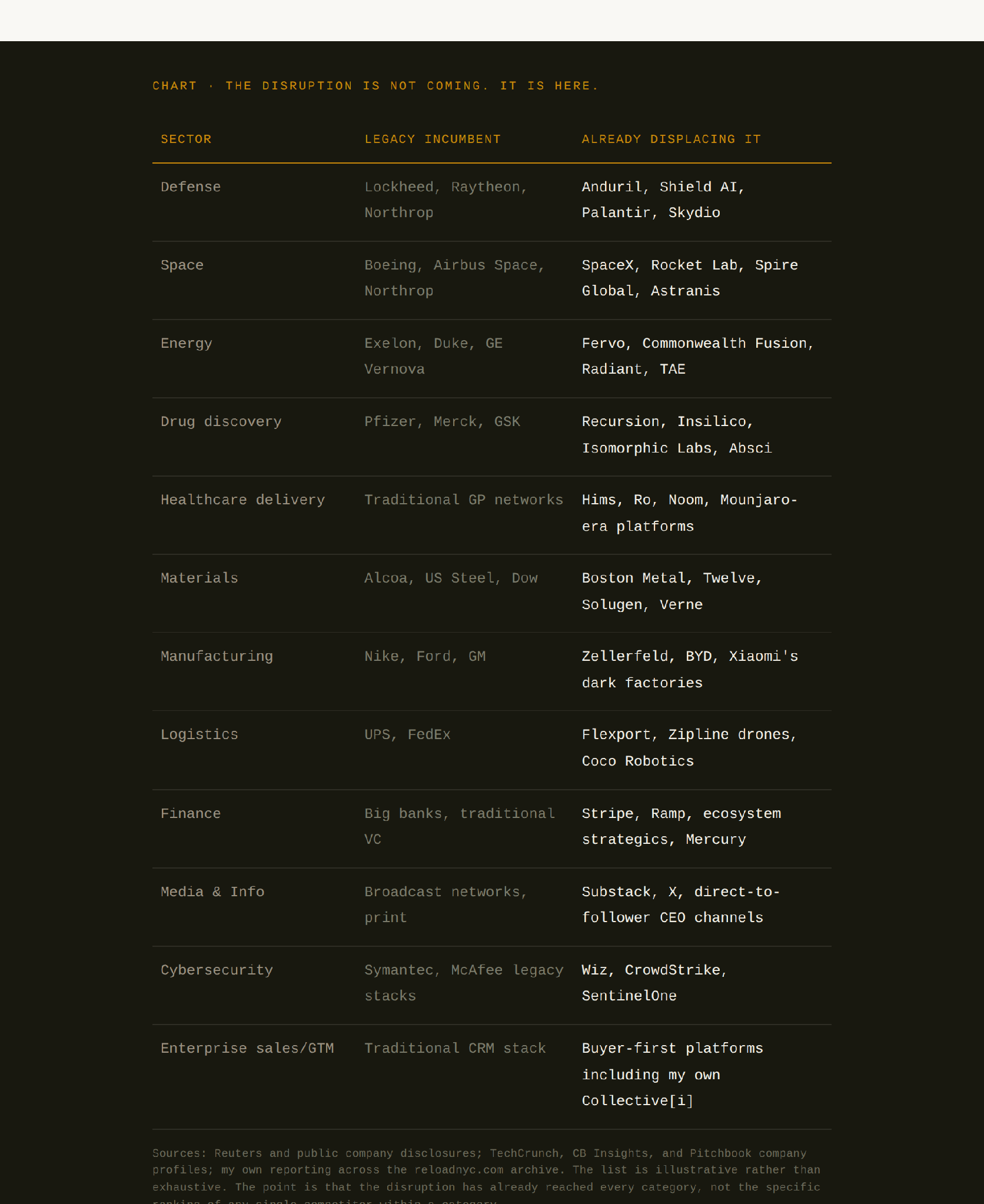
Look at that list and ask yourself two questions. Which column is your company sitting in? Which column is each of your board members' companies sitting in? If the answer is not obvious, that answer is itself the diagnostic. The incumbents who were disrupted rarely knew it until the market had already re-priced against them. I laid out the specific capital-markets version of this misreading in The Trillion-Dollar Trade Wall Street Isn't Seeing and the software-and-services version in Software Is Not Going Down Alone and The Last Great Head Fake in Software History.
What This Looks Like From Where I Sit
The category I have watched most closely for the last decade is the demand curve so I will use enterprise sales and the professional network layer that surrounds it. It is one of the last strongholds of the WW2-era corporate architecture. The CRM was built in the 1990s to give a district manager a way to roll activity up to a regional VP to roll up to a CRO. It was priced per seat, at roughly $150 to $300 a user a month, on the assumption that every seat is a cost line. That pricing model is the WW2 doctrine applied to software. It treats users as inputs to be metered rather than as network nodes that make the platform more useful.
At Collective[i] we do the opposite. Every individual user gets a free license. The reason is that our product gets better with more users. A network of buyer signals is more valuable when more people contribute to it. The same principle runs through Intelligence.com, our AI-first professional network. Networks are currency, and the incumbents who priced against per-seat scarcity are running the WW2 doctrine while their category moves to something structurally different. This is the specific mechanic I laid out in The Buyer Has a Process. Collective[i] Knows What It Is., in Workflows vs Outcomes, and in The Warm Intro Is Dead. I write about it because enterprise sales is the specific place I see the shift landing every day. The mechanism is identical in every other industry on the table above. Once you see the pattern in one category, you can spot it in your own.
What Comes Next
Part 2, The Agent Swarm Just Killed Scale as a Moat, is the practical playbook. It covers the cost economics that make cheap beat expensive at every scale (Iron Dome, Iron Beam, the $400 drone, the four-person team that reached $32 billion in five years). It covers the specific doctrine Ukraine and Israel are running, why authoritarian militaries cannot adopt it, and why Yevgeny Prigozhin was killed for coming close. It explains why one person plus a hundred AI agents beats a hundred people plus none, and what that means for every knowledge-work function in your company. It closes with the one-question investor test that reveals whether the leader running your portfolio company is a wartime leader or someone still perfecting the last cycle.
If you want Part 2 delivered when it publishes, subscribe at reloadnyc.com. Free. No paywall. No course at the end. Just the work.
If this piece changed how you are thinking about your industry, forward it to one person who needs to read it. A director on your board. A CEO whose category is in the table above. A founder trying to figure out which side of the disruption they are on. One specific decision-maker in your world. That is how the argument moves. One reader telling another.
If you are the person who just got this forwarded, welcome. Subscribe at reloadnyc.com. Two dozen pieces in the archive. Another two dozen in the queue.
Reply if you want to argue. Post it on X, tag @smesser, and tell me where I am wrong. Share it on LinkedIn if the boards or LP committees you sit on need to see it, and tag me at linkedin.com/in/stephenmesser. The pieces get sharper when readers push back.
SOURCES · STATS AND REPORTING CITED ABOVE
1. Hedgehog 2025 NATO exercise in Estonia (16,000 troops from 12 countries; 10 Ukrainian drone operators using Delta battle-management system; 17 armored vehicles mock-destroyed; two full battalions eliminated in half a day): Wall Street Journal reporting via Euromaidan Press: euromaidanpress.com and Ukrainska Pravda coverage: pravda.com.ua/eng
2. Aurora 2026 exercise on the Swedish island of Gotland (April 27 to May 13, 2026; Ukrainian drone pilots demolished Swedish and allied units; training reset three times): Kyiv Post and Associated Press coverage: kyivpost.com
3. Volksempfänger household penetration data (25% to 87% between 1932 and 1941); Frank Capra Why We Fight viewings; British Ministry of Information; US Office of War Information: US Holocaust Memorial Museum, Cooper Hewitt Smithsonian Design Museum, National WWII Museum, National Archives (UK)
4. Deepfake and AI-generated propaganda proliferation (including AI-generated Gaza images with visible generation artifacts such as extra fingers, algorithmic manipulation of TikTok and Instagram feeds during major conflicts): Atlantic Council Digital Forensic Research Lab, Stanford Internet Observatory, Bellingcat, Reuters Institute for the Study of Journalism
5. Burger King president Tom Curtis viral Whopper video (March 2026, TikTok), McDonald's CEO Chris Kempczinski Big Arch Instagram video and social media reaction; subsequent Q2 sales impact: Restaurant Business, NBC News, Forbes, The Independent
6. Kaiser Liberty ship build times (244 days in 1941, 42 days average by 1943), Ford Willow Run B-24 Liberator production (one bomber per hour), Chrysler Detroit Tank Arsenal (22,000+ tanks): EH.net "The American Economy During World War II"; National WWII Museum
7. Zellerfeld corporate materials, Nike collaboration on the Air Max 1000 (November 2024, ComplexCon debut), custom-fit 3D printed shoes from single-piece TPU material, 11-day delivery on a September 2025 order: Zellerfeld.com, WearTesters, VoxelMatters, Highsnobiety, Sole Retriever coverage