The Luckiest Decade in Human History.

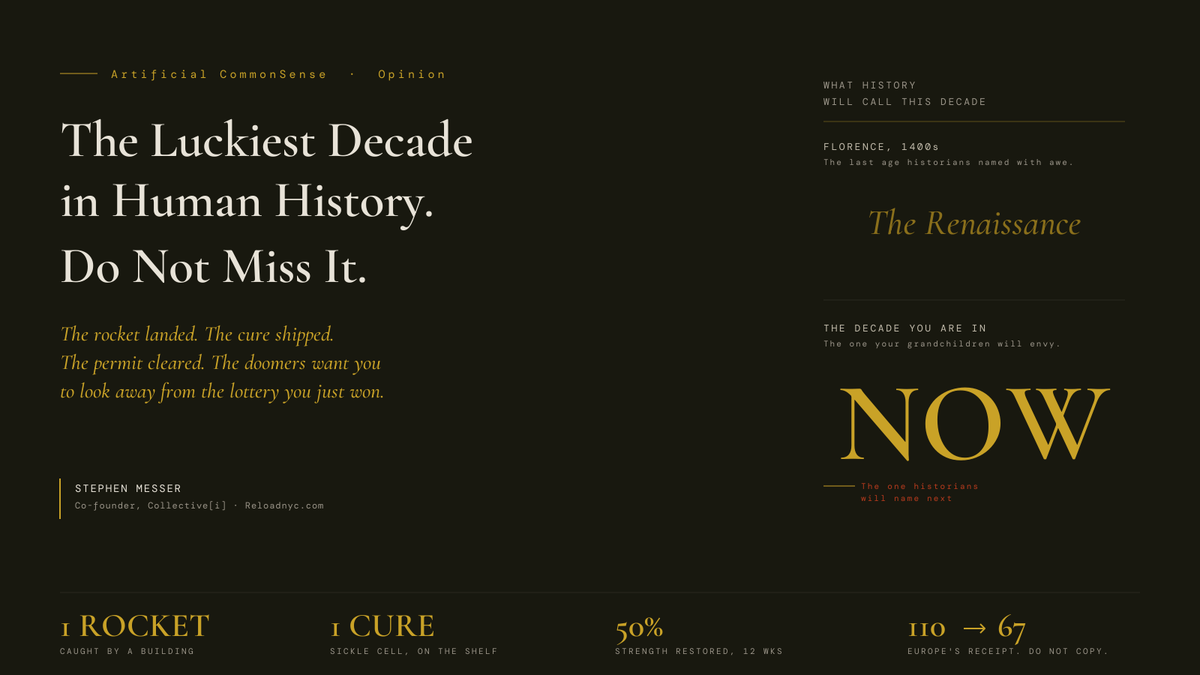
The rocket landed. The cure shipped. The permit cleared. Four hundred years from now, historians will envy you for having been alive this decade. The doomers want you to look away from the lottery you just won. I am going to spend mine looking straight at it.
By Stephen Messer
Co-founder, Collective[i] and Intelligence.com. Co-founder, LinkShare (sold to Rakuten, $425M). EY Entrepreneur of the Year and 2x Deloitte Fast 50 Winner. Board Member, Spire Global (NYSE: SPIR).
October 2026. Join me at Intelligence.com.
On October 13, 2024, a four-hundred-foot steel tower in Boca Chica, Texas reached out with two mechanical arms and caught a rocket. The Super Heavy booster had just lifted a hundred and twenty meters of spacecraft into the sky, separated at the edge of space, flipped itself around, and come back down. It settled between the arms with the delicacy of a bird finding a branch. The engineers inside the control room screamed. Elon Musk cried. Every one of us watching on a phone or a laptop or a TV felt the same specific physical thing. A chill up the spine. The sense that the future we had been told was ten years away had just shown up on a Sunday morning.1 I wrote about a smaller version of the same moment in The Shoebox That Changed Space. The feeling is the same at every scale. Progress is not an argument. It is a chill up the spine.
You know the feeling. The first time you held an iPhone. The first time you watched a Waymo drive you through a city without a driver. The first time you asked a model to write code and it wrote working code. The first time Telli told you a deal was going to close three weeks before anyone on the team believed it, and then the deal closed. There is a particular moment in a person's life where you realize the thing you thought was coming has arrived, and your life is about to be measurably better because of it. Progress is magical. It is also, right now, the thing a specific group of people is trying to take away from you.
Progress is a chill up the spine. It is also the thing the doomers are trying to tax out of your life.
I have been making this case for a year. This piece is the price tag.
I made the direct case against the doomer narrative in The Death of Humanity. The doomer story is the second act of the one these same people were telling about job loss three years ago. When the job prediction failed against the labor data, the prediction shifted to extinction. The actors shifted with it. The mechanic underneath is regulatory capture. The frontier labs sell commodity training-data models whose moat is collapsing against open-weight competitors from China and specialized domain models that outperform general-purpose frontier models at task after task. The pause movement is the industry's attempt to legislate the moat back into existence.
I made the operational version of this case in An AI-First Framework for Responsible AI. The fear framing is a trap at the firm level. I made the earlier version in The Safest Move You Can Make With AI Will Cost You Everything. Caution has a cost nobody is pricing. I made the wall-around-your-data version in Karp and Nadella Are Selling You a Wall. Protection of the vendor, dressed as protection of the customer. I made the displaced-anger version in The Data Center Is Not the Problem. Community anger at data centers is anger at the industry, redirected to the only visible local target.
Each of those pieces made the argument from a different angle. This piece is about what the trade actually costs. Not in the abstract. In the lives of the people you know.
The cost of a pause is paid in cures
Every policy debate has a visible side and an invisible side. The pause movement has a very loud visible side (safety, alignment, existential risk) and a very quiet invisible side. People die while the committee meets.
For most of my life, a cure for cancer has been exactly ten years away. The ten years never arrive. I would like to say that is because I am only ten years old. The real reason is that for forty years the research model was slow and expensive and the discovery cycle was measured in decades. In the last three years, that cycle has started to collapse. Protein folding, structure prediction, molecular dynamics, high-throughput screening, generative chemistry, immunotherapy, trial design, patient matching. Each of these pieces of the drug discovery pipeline has moved from analog to AI-native. The ten years is finally arriving. It is arriving everywhere at once.
Then along comes a pause.
Every quarter the pause movement wins, a specific person in your life is on the wrong side of a specific disease arc. Your father's prostate. Your mother's hip. Your sister's migraines. Your friend's son with the thing nobody can name yet. The window between the day a cure becomes technically possible and the day it reaches your family is where the pause does its damage. The committee says six months. The committee says eighteen months. The committee says we need another study. The person you were trying to save does not get the eighteen months.
A man, a dog, and a cancer vaccine
Paul Conyngham is an IT entrepreneur in Australia. His dog Rosie is a Staffordshire Terrier and Shar-Pei mix. In 2024 Rosie developed multiple tumors. The vets gave the usual answer. Paul refused the usual answer. He sat down with ChatGPT and worked through the molecular biology of Rosie's specific tumor profile with the model as his collaborator. He designed a personalized cancer vaccine. He had it compounded. He injected Rosie last December and gave her a booster a few weeks later. Most of the tumors disappeared, including one that had been the size of a tennis ball. Rosie is running around alive today because her owner used a language model as a research partner and treated the model as a brain capable of actual contribution to a hard problem.2
Paul is not a vet. He is not a drug developer. He is an IT guy who refused to lose his dog. Three years ago this story would have been impossible. Three years from now, it will be routine. The people who stand between those two moments, the ones asking for a pause, are asking Paul to lose his dog and asking you to lose yours.
Three years ago, Rosie dies. Today she lives. The difference is a tool one man was allowed to use.
Sickle cell is cured now. Most patients still do not know.
In December 2023, the FDA approved Casgevy. It is the first CRISPR gene therapy ever approved in the United States. One treatment. The patient's own cells edited to produce healthy hemoglobin. The disease the treatment addresses is sickle cell, a condition that has shortened the lives of hundreds of thousands of Americans, disproportionately Black Americans, for over a century. For my entire life, sickle cell was a disease you managed. In 2026 it is a disease you cure.3
I covered this directly at Collective[i] Forecast in September 2026 with Dr. Peter Fleischut, who runs over a hundred and twenty AI initiatives at NewYork-Presbyterian and oversees the gene-therapy program that is moving sickle cell from lifelong management toward a one-shot cure, and Dr. Pierre Elias, Medical Director for AI at NewYork-Presbyterian and the Columbia cardiologist who built EchoNext, an FDA-cleared model that catches structural heart disease from a routine EKG at 77 percent against the 64 percent that a panel of thirteen cardiologists caught. The saddest beat in that conversation was simple. The cure exists. Most patients who have the disease do not know they can be cured. Doomerism is better clickbait than a cure. The cure sits on the shelf while the doomer narrative gets the headlines. People live and die on which story travels.
The cure arrived because the biology arrived. The biology arrived because the computational tools arrived. CRISPR itself was a bacterial immune mechanism nobody understood until the sequencing cost collapsed, which happened because the compute cost collapsed, which happened because the whole stack of modern computing kept accelerating. Each layer in the stack unlocked the next. Any pause in that chain delays every subsequent layer. The pause-movement framing treats compute as if it were a separate domain from biology. It is not. The same chips that train the next LLM train the next protein-folding model. The same engineers who build the training pipeline build the inference pipeline for the hospital. Choke one, you choke all of them.
The thing they said was permanent
For my entire adult life, orthopedic doctors have said the same thing to anyone over fifty. Cartilage, once lost, is lost. The clock on your knees runs down and does not run back up. You lose the padding between the bones, you walk differently, you fall more easily, you break a hip, you move into assisted living, your family starts to grieve while you are still alive. That whole arc is downstream of a biological belief that cartilage degeneration is a one-way street.
That belief is about to be wrong. I see this early because of what I do. I invest in and sit alongside the companies working at the edges of AI, space, biology, and infrastructure, which means I get to see the next decade of medicine before it reaches a reporter's inbox. One of those companies is Epirium Bio. Their lead program targets exactly this. Their drug, MF-300, inhibits a specific enzyme called 15-PGDH. The enzyme breaks down a signaling molecule called prostaglandin E2, which the body uses to maintain muscle function, bone remodeling, and tissue repair. As we age, 15-PGDH is upregulated in muscle. The level of PGE2 drops. The body loses its ability to maintain and repair. The muscle shrinks (that is sarcopenia). The bone grows porous (that is osteoporosis). The cartilage degenerates. The gut and lung tissue become inflammatory (that is Crohn's, ulcerative colitis, pulmonary fibrosis).
Inhibit the enzyme, you restore PGE2. Restore PGE2, you restore the signaling. Restore the signaling, you restore the muscle, the bone, the cartilage, the gut lining, the lung tissue. One biology. One pill. Oral. In aged mice, the drug restored more than fifty percent of the strength that had been lost to aging in twelve weeks. It shifted the cortical bone structure back toward a younger phenotype. Phase 1 in humans is complete. Phase 2b is starting in sarcopenia with FDA Fast Track consideration. Each additional indication (osteoporosis, SMA, IBD, IPF) is a separate blockbuster market the same molecule may address.4
Sit with that sentence for a minute. Cartilage was permanent. Now it is not. Muscle loss was unavoidable. Now it is reversible. Bone density was a one-way street. Now it is a two-way street. The drug that does this is in Phase 2b. The science that produced it is the kind of science that moves ten times faster when AI is in the loop. The pause asks the Epirium team to wait while the committee catches up.
Cartilage was permanent. Now it is not. The pause asks the person who could not walk last year to keep not walking.
What else is already on the slate
Epirium is one program. The slate is enormous. Researchers at Stanford and at the Buck Institute are testing partial epigenetic reprogramming to turn back the biological age of eyes, skin, and other organ tissue. Teams at the Wake Forest Institute for Regenerative Medicine are 3D-printing functional organ tissue. Celiac trials have moved from management to the first candidates that address the underlying autoimmune mechanism, which has implications for Crohn's. Alzheimer's trials are, for the first time in a generation, showing real cognitive signal from mechanism-of-action drugs that would have taken another decade to design under the old pipeline. Globally, more people have access to an AI doctor than at any moment in human history. In rural India, in sub-Saharan Africa, in the Philippines, a person with a smartphone can now get a differential diagnosis that would have been impossible in that geography three years ago.
Every one of those lines runs on the same substrate the pause movement wants to throttle.
Housing. Transportation. Defense. GDP. The doomers want you to miss all of it.
Healthcare is the sharpest trade-off because the person who dies while you waited is not an abstraction. The same pattern runs across every other line of American cost that has been eating the household budget for forty years.
Housing. The biggest driver of housing cost in American cities is not materials or labor. It is permitting. I made the specific case in The American Dream Has a Permitting Problem. AI Can Fix It Today. and in Time Kills All Deals. Local governments that have adopted AI permit review are turning months into hours. Build times collapse. Cost per unit falls. Pause the model, you pause the permit review.
Transportation. I made the case for the car-ownership line item in The End of Car Ownership. You Just Don't Know It Yet. Self-driving takes the car payment, the gas payment, and the insurance payment off the household budget. Those three items have eaten the median US household budget for a generation. All three are on the way down because of the thing the pause movement wants to pause.
Defense. I made the case in The West Just Got Destroyed. Your Company Is Next. Fleets of autonomous drones have rewritten what warfare costs. Ukraine has been running a defense against a nuclear power using swarms built on the kind of autonomy and signal processing that would have been science fiction five years ago. The organizational mechanics are in The Agent Swarm Just Killed Scale as a Moat. The largest line item in the federal budget is now on a cost curve that bends down for the first time since the Cold War.
GDP. AI-first companies move faster, hire differently, and produce more output per person than any firms in modern history. I showed the individual-job version in Your Job Is Dead. Long Live Your Career. and the operational version in What It Means to Be AI-First. Multiply the pattern across every function in every company in a large economy and you get the productivity gain the United States has not seen since electrification. Pause the models, you pause the growth.
A pause in AI is not a pause in one technology. It is a pause in every line of American cost the technology is driving down.
The doomers are selling you Europe, which isn't great.
Here is why I am writing this piece. Doomerism is having a real-world impact. The policy conversation is moving. The capital is moving. The regulatory wind is picking up. Nobody is telling you what you are being asked to trade away. The frontier labs pretend this is about saving you from a superintelligence. They do not tell you what the pause costs you, your family, your friends, or the future your kids are supposed to inherit.
So look at the trade. We stand at a moment where disease and old age could become things of the past. Where humanity becomes space-faring. Where the mysteries of the universe start turning into tools we can hold. The pace is accelerating. Every quarter the list of things that used to be science fiction and are now shipping gets longer. The right response to this moment is not fear. It is excitement. It is urgency. It is prayer that the acceleration happens in time to reach the people we love before their arcs run out.
The doomers have manipulated the thing that made America what it is. America was never Europe. Europe was always fear. America was the land of progress, of innovation, of the American Dream. The country was built by immigrants who took the risk of crossing an ocean because the thing on the other side was worth more than the thing they left behind. Every generation of Americans has lived inside the same contract. Take the risk. Build the thing. The future rewards it.
The doomers are selling you a European response to an American moment.
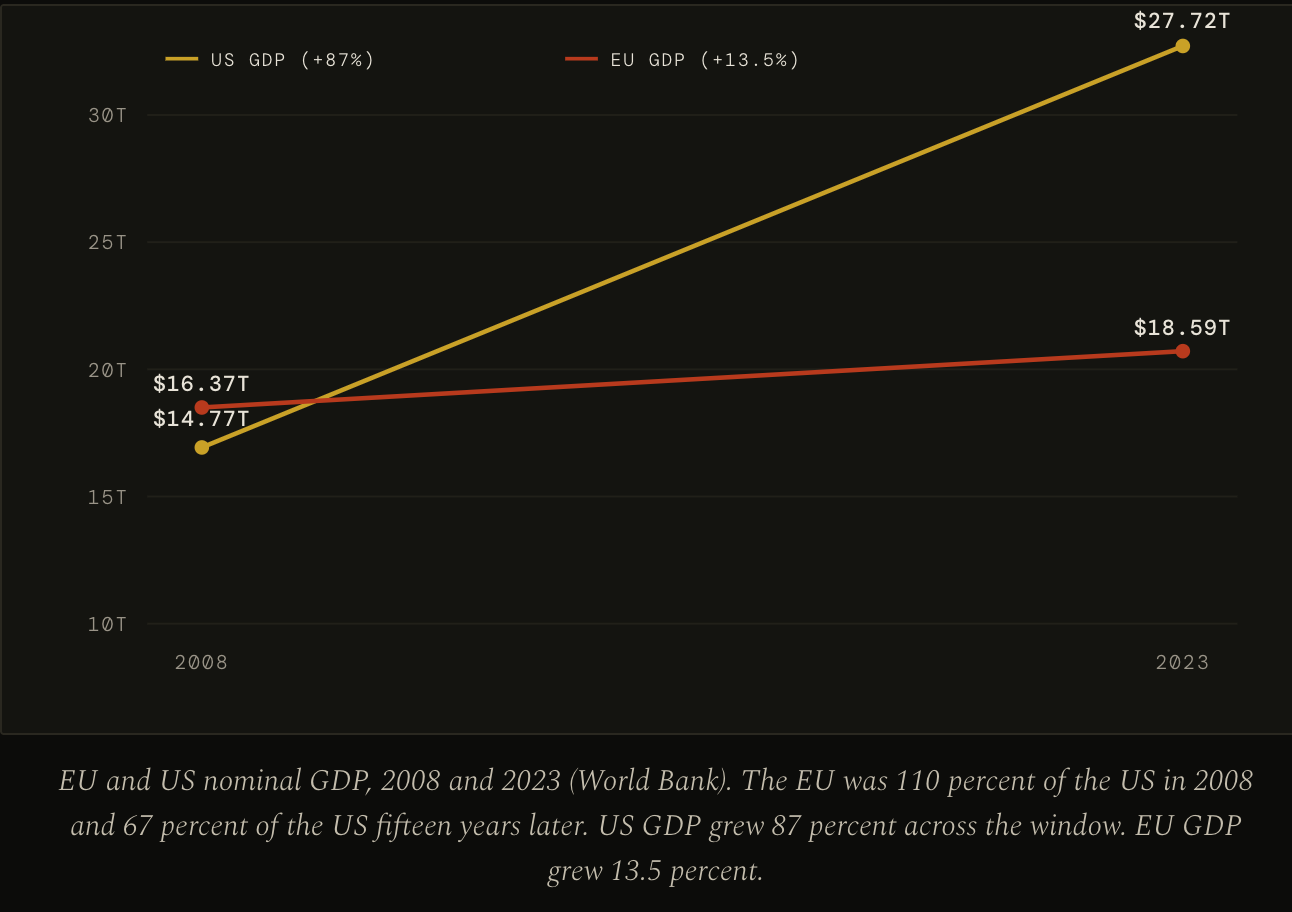
Europe already ran this experiment. The receipts are on the ledger. In 2008, EU GDP was $16.37 trillion. US GDP was $14.77 trillion. The EU was 110 percent of the US. In 2023 the EU had grown to $18.59 trillion. The US had grown to $27.72 trillion. The EU fell to 67 percent of the US in fifteen years, measured in nominal dollars by the World Bank. US GDP grew 87 percent across the period. EU GDP grew 13.5 percent. GDP per capita went from 76.5 percent of US to roughly 50 percent in the same window.5
No major European AI model has emerged. No major European consumer internet company has emerged in twenty years. No major European biotech of the AI era has emerged. US doctors earn more than 2.5 times British doctors. California data scientists earn roughly twice their Berlin peers.5 The gap did not come from bad luck. It came from a culture that regulated faster than it built, that feared more than it took risks, that chose GDPR, the AI Act, the carbon mechanism, and the thousand smaller rules in between, and now has nothing on the other side of those rules to show for them.
The commodity LLM providers want America to adopt the same regulatory framework Europe already adopted. That is the actual ask inside the pause movement. The rest of the model economy gets caught in the net with them. The protein-folding model, the materials-science model, the orbital-imaging model, the epigenetic reprogramming model, the economic model at Collective[i], the EchoNext cardiology model at NewYork-Presbyterian all ride the same compute, the same engineering talent, the same regulatory posture, the same capital market. Choke the frontier LLM through the pause framework and you choke every one of the models that is driving down the specific line items in your household budget and the specific line items in the global disease burden. The commodity LLM crowd is not just saving its own margin. It is pulling every other model into the same regulatory bucket.
The doomers are selling you a European response to an American moment. Europe already ran this experiment. 110 percent to 67 percent is the receipt.
So this piece is a plea. The American Dream is alive. The thing on the other side of this decade is bigger than anything any generation of Americans has had the privilege to walk into. We stand at a moment where our children can grow up healthier, longer-lived, better-fed, better-housed, more mobile, and better defended than any children in human history. We stand at a moment where we are becoming spacefaring. We stand at a moment where cancer, Alzheimer's, sickle cell, sarcopenia, osteoporosis, and the ten other diseases that quietly took the generation before us are becoming things we solve rather than things we survive.
Tell the doomers to go back under the rocks they came from. Do not let them steal the next hundred years of American possibility to protect the quarterly billing on a commoditized training-data business. The American Dream is still the dream. The thing worth fighting for is on the other side of a decade of hard, loud, open progress. For you and for your children, grab it.
Take the dividend. Invest it. Accelerate the parts that are still slow.
Here is the honest policy picture nobody is drawing. The gains from the new technology are not just savings. They are a dividend. The right thing to do with a dividend is to reinvest it in the next layer of acceleration, not to pocket it and declare victory.
The defense dividend. Fleets of autonomous drones are collapsing the per-engagement cost of modern warfare. Ukraine has been running a defense against a nuclear power for cents on the dollar of what the US military would spend on the same mission. Take the savings. Pour them into basic research. Fund DARPA at twice the current level. Fund NSF at twice the current level. The things we need in fifteen years come out of the labs we fund today, not out of the committee that convened last Tuesday.
The healthcare dividend. The AI-discovered-drug pipeline is real. Recursion (merged with Exscientia in November 2024) moved its RBM39 program to a development candidate in eighteen months, which the company says is more than twice as fast as the industry average. Insilico has reported under thirty months from target discovery to Phase 1 for rentosertib. Isomorphic Labs raised a $2.1 billion Series B in May 2026 and expects its first dosed patient by the end of 2026. The programs are real, the data is real, and the pipeline is widening every quarter.6 The policy ask is simple. Expand FDA Fast Track. Fund the next generation of trial-design and patient-matching AI the way the Human Genome Project was funded. Take the cost savings from a cured disease and reinvest them in the next cure. Compound the gain.
The talent dividend. The best biologists, chemists, physicists, and engineers in the world should be allowed to come to the United States, work here, build here, raise their kids here. Right now the H-1B process, the O-1 process, and the green card backlog are an active drag on the thing we claim to be racing for. The best AI researcher under thirty does not have to come to America. She can go to Canada, the UK, Singapore, the UAE. Each of those jurisdictions has rewritten its immigration policy to pull her in. The US has not. That is a self-inflicted wound. The country was built by immigrants who crossed oceans to take the risk. Open the gates to the ones who want to come today.
The transition dividend. The people whose jobs are shifting under AI deserve the training to walk into the new ones. I argued in Your Job Is Dead. Long Live Your Career. that the new jobs are better than the old ones. The transition is still the hardest part. Fund the re-education. Fund it from the productivity dividend the new technology is already producing. The person being told their old job is going away deserves a path to the better one.
None of this requires a pause. All of it requires an accelerate.
Who pays for the pause
Every time a frontier lab CEO publishes an essay about existential risk, a specific set of people are paying for that essay. The grandmother who could have gotten her hip replaced with a drug that regrows cartilage. The sister with sickle cell who waits another year for her Casgevy infusion to come down from millions to hundreds of thousands because the compute cost is still falling and nobody paused it. The toddler in rural Peru whose mother asks the AI doctor what the rash is before the clinic can see her. The dog like Rosie whose owner does not happen to be a programmer.
Not every pause is funded by a lab. Some of it is funded by people who believe the doomer argument sincerely. I take that sincerity seriously. I have no doubt there are smart, thoughtful people who have read the pause letters and signed them because they believe the risk is real. I disagree with them. I made the full version of why in The Death of Humanity. The short version here. The real risk is in the thing they are proposing to delay. The person who gets sick on month thirteen of an eighteen-month pause does not care which committee the pause came out of. The person is still sick. The cure is still delayed. The cost is still paid.
Not every pause is funded by a lab. All of them are paid for by the person on the wrong side of a disease arc.
The moral imperative
I do not believe in a pause in AI. I believe the opposite. I believe the moral imperative, right now, is to accelerate. The suffering under the old model was real. The suffering under the new model, once the new model is built out, will be dramatically smaller. The transition is a window during which the number of people on the wrong side of a disease arc, or a housing cost, or a defense budget, or a job transition, is finite and shrinking. Shortening that window is the moral act. Lengthening it, in the name of a vague future risk that may never arrive, is the opposite.
The people who argue for the pause are, in effect, asking everyone else to carry the cost of a hedge against a scenario they cannot describe in operational terms. The specific cost of the hedge is specific people whose names you know. I am not willing to carry that cost. The dog in Australia should get the vaccine. The grandmother should get the hip. The sister should get the gene therapy. The toddler should get the differential diagnosis. The sales ops lead whose job I wrote about in Your Job Is Dead. Long Live Your Career. should get the better role.
None of that happens if we pause.
The last three decades of my life have been spent building things. LinkShare. Collective[i]. Intelligence.com. Spire Global, which I helped build from the start and still sit on the board of. Every one of them was built on the belief that the right technology, deployed at the right time, does more good than any committee convening to debate it in advance. That belief is not naive. It is the record. Every major technology shift of the last two hundred years has produced the same pattern. Enormous cost at the moment of transition. Enormous gain at the far side.
I made the operating version of this argument in Your Job Is Dead. Long Live Your Career. If you love your kids, push AI. Each new technology produces more jobs of a better nature than the ones it took, and the AI shift is going to be the biggest version of that pattern in a hundred years. The second-order effects multiply the first. More data centers means upgrading the aging US power grid. Upgrading the grid pulls fusion over the finish line. Fusion gives us clean, nearly free power. Clean, nearly free power gives us clean water, cheaper manufacturing, cheaper housing, cheaper medicine, cheaper everything. Each layer of the stack unlocks the next. Pause the first layer, every layer above it stalls.
Anyone who tells you a pause will reduce the cost at the moment of transition is selling you a lie, because the cost at the moment of transition is what pays for the gain on the far side. There is no path to the far side that does not go through the middle.
The next renaissance is already being poured
I am going to spend the rest of this decade on the other side of this argument. I am going to invest in it. I am going to write about it. I am going to build on it. I am going to tag the people who are honest about the trade and praise them, and I am going to tag the people who are selling fear and ask them why.
If you are reading this and you have been sitting on the fence, get off the fence. The thing you are afraid of is less likely than the thing you will miss. Four hundred years ago, Florence poured the foundations of the Renaissance and the people living through it did not know what they were standing inside until historians named it later. We are living inside the next one. The historians will name this one too. The question is whether you spent it looking at the rocket or looking at the pause letter.
Progress is magic. Do not let anyone tax it out of your life.
We are at the moment of launching the next renaissance. I hope we take it.
What comes next
If this piece changed how you are thinking about who is actually funding the doomer argument and who is paying for it, forward it to one person who needs to read it. The friend who signed a pause letter without thinking about who pays. The investor who is throttling drug-discovery deals because the committee got nervous. The policymaker drafting the next AI safety bill without a line item for the cures the bill will delay. The parent who is scared for their kids and does not yet see what the kids are about to inherit.
Subscribe for the next piece at reloadnyc.com. Free. No paywall. No course at the end. Just the work.
Post it on X and tag @smesser, and tell me where I am wrong. Share it on LinkedIn and tag me at linkedin.com/in/stephenmesser. Tag the Epirium Bio team. Tag the oncologists running the trials. Tag the engineers building the next scan-and-diagnose model. Tag the policymakers who have a vote on this. This is the conversation the industry needs to be having in public, and it needs to be having it loud enough that the people selling fear can hear the answer.
Footnotes
- SpaceX Starship Flight 5, October 13, 2024, Starbase, Boca Chica, Texas. The Super Heavy booster returned to the launch pad and was caught by the "chopstick" arms of the Mechazilla tower for the first time, inaugurating full-reusability of the booster stage. Space.com coverage; ScienceAlert coverage.
- Paul Conyngham, Australian IT entrepreneur and co-founder of Core Intelligence Technologies, used ChatGPT as a research collaborator to design a personalized therapeutic for his dog Rosie (Staffordshire Terrier / Shar-Pei mix) after she developed multiple tumors. Most tumors regressed following vaccine and booster administration, including a tennis-ball-sized mass. Report notes complete response was not achieved and that experts have cautioned that AI assisted rather than independently cured. AOL coverage; Sify analysis; Storyboard18 counterpoint.
- Casgevy (exagamglogene autotemcel), developed by Vertex Pharmaceuticals and CRISPR Therapeutics, FDA-approved December 8, 2023 as the first CRISPR-based gene therapy authorized in the United States. Indication: sickle cell disease in patients 12 years and older with recurrent vaso-occlusive crises. Vertex press release; Popular Science coverage.
- Epirium Bio, Oral 15-PGDH Inhibitor Platform, October 2026 Corporate Presentation. MF-300 is an oral small-molecule inhibitor of 15-hydroxyprostaglandin dehydrogenase (15-PGDH), which degrades prostaglandin E2 (PGE2). Preclinical studies in aged mice demonstrated restoration of more than fifty percent of strength lost to aging over twelve weeks at the 10 mg/kg dose, with correlated restoration of ribosomal proteins and cortical bone structure. Phase 1 complete; Phase 2b in sarcopenia initiating with Fast Track consideration from the FDA. Mechanism also indicated across osteoporosis, spinal muscular atrophy (SMA), inflammatory bowel disease (IBD / ulcerative colitis / Crohn's), and idiopathic pulmonary fibrosis (IPF). References: Palla et al., Science, 2021; Ho et al., PNAS, 2017; Bakooshli et al., Science Translational Medicine, 2023; Wang YX, Cell Stem Cell, 2025.
- EU vs US GDP figures (nominal, World Bank): EU GDP $16.37 trillion in 2008 and $18.59 trillion in 2023, a 13.5 percent gain. US GDP $14.77 trillion in 2008 and $27.72 trillion in 2023, an 87 percent gain. The EU was 110 percent of the US in 2008 and 67 percent in 2023. EU GDP per capita fell from 76.5 percent of US per-capita GDP to 50 percent across the same window. Source: Econofact Factbrief. Supplemental data on US-vs-European wages (US doctors earn more than 2.5 times British doctors, California data scientists earn approximately twice their Berlin peers): National Review, "How Europe Fell Behind," November 2025.
- AI drug discovery company data: Recursion / Exscientia merger closed November 20, 2024. REC-1245 (RBM39 degrader) reached development candidate in 18 months, per company reporting. REC-4881 (MEK1/2 inhibitor) median polyp burden fell 43% at week 13 and 53% at week 25 per company Q1 2026 update. Insilico Medicine reports under 30 months from target discovery to Phase 1 for rentosertib. Isomorphic Labs raised a $2.1 billion Series B in May 2026; CEO expects first dosed patient by end of 2026 after earlier guidance for end of 2025. Source: Intuition Labs 2026 review of AI-discovered drugs in clinical trials.
- Dario Amodei, Anthropic co-founder and CEO, public calls for stronger AI regulation, 2024-2026. Representative coverage: ABC News exclusive.
Related Reading
The anchor piece on the doomer argument
- The Death of Humanity. The full case against the doomer narrative. Regulatory capture, LLMs are not alive, the shifting story from job loss to extinction.
Prior pieces in the same series
- An AI-First Framework for Responsible AI. The firm-level version of this argument. Fear was the wrong place to start.
- The Data Center Is Not the Problem. The displaced-anger version. The street wins every time.
- Karp and Nadella Are Selling You a Wall. Walls protect vendors, not customers.
- The Safest Move You Can Make With AI Will Cost You Everything. Caution has a cost.
What a pause actually costs
- The American Dream Has a Permitting Problem. AI Can Fix It Today. Housing cost.
- The End of Car Ownership. You Just Don't Know It Yet. Transportation cost.
- The West Just Got Destroyed. Your Company Is Next. Defense cost.
- Your Job Is Dead. Long Live Your Career. Productivity and the individual job.
- The Shoebox That Changed Space. What progress feels like, at the smaller scale.
While I am a retired lawyer, none of this is legal, medical, or investment advice. These are my opinions. Specific medical, legal, or financial decisions should be made with the professionals who know your situation. I have no financial interest in Epirium Bio at the time of writing.
Artificial CommonSense · reloadnyc.com · © 2026 Stephen Messer