Your Job Is Dead. Long Live Your Career.

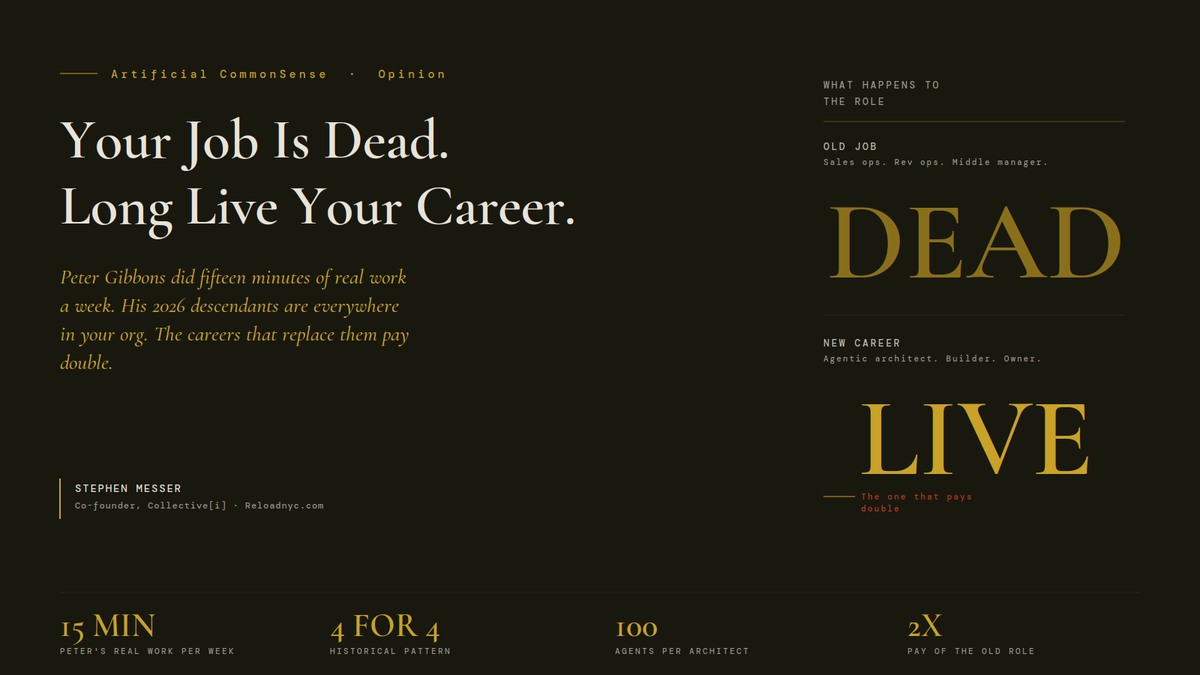
Peter Gibbons did fifteen minutes of real work a week. His 2026 descendants are sales ops leads, revenue ops leads, business analysts. The jobs are dead. The careers that replace them pay double. This is the other half of the story everyone leaves out.
By Stephen Messer
Co-founder, Collective[i] and Intelligence.com. Co-founder, LinkShare (sold to Rakuten, $425M). EY Entrepreneur of the Year and 2x Deloitte Fast 50 Winner. Board Member, Spire Global (NYSE: SPIR).
October 2026. Join me at Intelligence.com.
Since this issue is my Halloween edition I decided to talk about the zombies amongst us, the undead, the ghosts that do not know they are dead yet (metaphorically). Middle managers and cost centers. But just like Halloween is a place where you can reinvent yourself, this story has a happy ending for them. I hope you like it
In 1999, two consultants named Bob Slydell and Bob Porter sat Peter Gibbons down in a glass conference room at a company called Initech. They asked him what he actually did. Peter had just come out of a therapy session that killed every ounce of fear he had about his job. He told them the truth. Fifteen minutes of real work a week. The rest was TPS reports nobody read, status updates that updated nothing, and eight different bosses each wanting a cover sheet. Office Space flopped in theaters. It became a corporate-America touchstone through cable reruns because every person watching knew a Peter Gibbons. Most of us watching were Peter Gibbons.
Twenty-seven years later, Peter is still at your company. His title changed. The job did not. In sales he is the director of sales operations. In finance he is the financial planning analyst. In HR he is the people operations coordinator. In product he is the program manager. On the ninth floor he is a business analyst. He is the middle manager who runs the Monday meeting that reconciles what three other middle managers already reconciled. He is the paper pusher routing approvals between four systems that should have been one. He is the information broker sitting between the executive who needs the number and the engineer who has the number. His tools are better. The CRM is cloud-native. The dashboard refreshes in real time. The reports render in Snowflake instead of Excel. The work is the same work Peter did at Initech, dressed up in a 2026 vendor stack. If a 2026 version of the Bobs sat him down today, his honest answer would be the same. Fifteen minutes of real work. The rest is TPS reports that got rebranded.
AI is coming for Peter's job. I think that is one of the best things that will happen to his career. Everyone is telling only half the story. Tell someone the job is going away, you leave them scared and reaching for a political fix nobody can deliver. Tell them what replaces the job, and how to get there, you give them a path. Both halves are true. Nobody is telling both halves. That is why fear is winning this cycle.
This piece is the other half.
As I have said before, I do not believe in universal basic income. I think it is insane to argue AI takes your jobs. The data shows I am right. What AI actually does is create higher-value roles out of the ashes of the lower-value ones. I made the fuller case in What Jobs Become When the Overhead Is Gone, where you can read more. The short version here. UBI is political cover. It plays on fear for political gain. Or it is the move of people who are already rich saying "AI will not affect me. I feel for the people coming up." The first is cynical. The second is condescending. Both are useless to the sales operations lead at your company trying to figure out what to do next. Nobody who writes a UBI piece ever asks her what she wants. She wants the next job.
That is why parents keep asking me what their kids should study right now. The short answer is the historical pattern. Three times in the last century this pattern ran. Industrial era. Services shift. BPO wave. Each generation panicked. Each generation ended up richer. The AI shift is round four. The kids graduating today into the AI economy are going to end up in jobs that did not exist five years ago, make more than their parents made, and spend less time doing TPS reports. The parent asking what their kid should study is the parent who still believes only the first half of the story.
I use sales/GTM because one in eight working Americans is in sales. The PE analyst building deal memos, the VC scout tracking Series A, the junior banker running comps, the HR coordinator scheduling interviews, the operations lead reconciling a dashboard nobody acts on. Every one of them is inside the same pattern. Sales is the sharpest example because the overhead is the most visible and because Collective[i] has watched it collapse in real customers for the last ten years. The specifics change by function. The pattern does not.
The dead-end job isn't the one AI is coming for. It's the one you already have.
Both halves of the story. In ninety seconds.
Ask any CFO who gets cut first in a cost-reduction cycle. Ask any PE operating partner what they strip out in the first ninety days after close. The answer is always the same two words. Cost centers. Sales operations. Revenue operations. Business analysis. Process management. Product management without product ownership. Middle management layers that pass information up and down. The administrative crust around a decade of SaaS contracts.
These jobs exist because software had limits. Dashboards could not update themselves. Forecasts could not read a calendar. Vendors could not reconcile with each other. The humans in the middle were the translators. They were paid flat salaries and told the complexity they managed was their job security. It was. It was also their ceiling.
AI removes the limits. Agents translate. Agents reconcile. Agents forecast. Agents follow up. Agents route. The humans who used to do that translation work are no longer where the value sits. The humans who build the agents are. In sales at Collective[i] we call these people agentic architects. In finance a client of ours uses the title AI finance operator. Nobody has standardized the name yet. The role is the same across every function. The person who used to maintain the stack of tools now builds and manages a fleet of agents that replace the stack.
The replacement job pays more because the output is attributable. One architect running a hundred agents produces revenue the board can see. One sales ops lead running a Salesforce instance produces a slide the CRO redoes before the board meeting. Attribution is the whole compensation story. Builders own outputs. Owners get paid.
The historical pattern is four for four. Industrial. Services. BPO. AI. Each generation panicked. Each generation ended up richer. Nobody writes the follow-up piece because nobody wants to read a thousand words about why the panic was wrong. This is the follow-up piece, written in advance.
That is the whole argument. The rest is the receipts.
We have been here three times. We got richer each time.
Tractors replaced farmhands. Trucks replaced horse teams. The horse economy, with its breeders and blacksmiths and feed stores and stable hands, collapsed inside a generation. The pessimists at the time wrote exactly the kind of piece that gets written now. The jobs would not come back. The displaced would never work again. The farmer who moved to a factory job in a city made two to five times what the farm job paid. His grandson went to college on the GI Bill and made ten times what the grandfather made. Nobody wrote the follow-up piece.
I would rather buy lettuce at the grocery store than plow a field, pray for weather, and fear pests. The farmer's grandchildren feel the same way.
The services shift was the second round. Factory job after factory job moved to Mexico, Japan, China. Newsweek covers warned about the hollowing out of the middle class. Service jobs now generate the majority of US GDP and pay substantially more in real terms than the factory jobs they replaced. Two generations of knowledge workers now make more than any middle class in human history. Nobody wrote that follow-up piece either.
The call-center era was round three. The 2000s moved inbound and outbound call work to the Philippines, India, Poland. The pessimists said BPO would end the American back office. Twenty years later the back-office jobs that remained paid better and sat inside companies more profitable than the ones that kept the call floors in Dayton. The BPO wave made the US richer, the Philippines richer, and India much richer.
Three waves. Three panics. Three generations that ended up in better jobs that paid more. The AI shift is round four.
Three for three. The follow-up piece has never once gone the way the pessimists wrote it.
Which jobs are actually going. Which are hiding in plain sight.
People read a headline about AI replacing jobs and assume it means their job, or their partner's job, or their brother-in-law's job. The data says otherwise. The jobs AI is coming for first are cost centers. Middle management layers that pass information up and down. Sales operations teams that maintain the CRM, and thirty other sales tools that all get replaced by one model. Revenue operations teams that reconcile the dashboard with reality, that an AI can do better in shorter time. Business analysts moving data between systems. Process managers chasing compliance. Product managers coordinating between engineering and go-to-market without owning either. The administrative crust around a decade of SaaS contracts. Every CFO has stared at these roles for years.
AI is coming for all of them. Let me take the one I see every day. Sales ops and rev ops. Here is what they do with a week. They maintain a stack of SaaS tools that goes away the moment the company adopts an AI model like Collective[i], which I made the broader case for in The AI Shuffle. They run comp planning in a spreadsheet nobody opens until next year. They run territory planning in another spreadsheet that gets rebuilt every time somebody joins or leaves. They buy a forecasting tool and host a weekly or monthly forecast meeting where everyone reads a different dashboard. An AI model does all of it. Better. Daily. Without the meeting. The same breakdown runs for the finance operations lead, the HR coordinator, the product program manager, every cost-center role in your org. The specifics change. The pattern does not.
The sharpest numbers are in sales. Here is what the decade looks like.
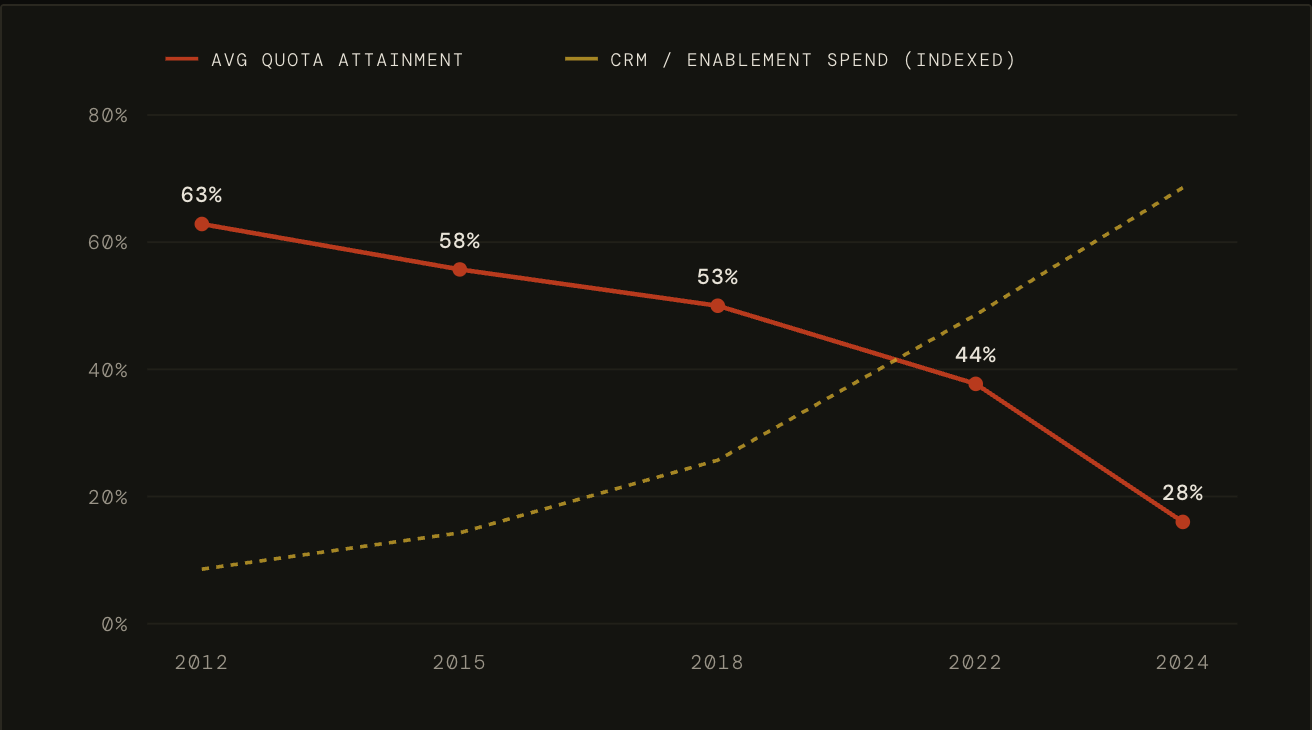
Sales quota attainment fell from 63 percent in 2012 to 28 percent in 2024 (Salesforce State of Sales). CRM and sales enablement spend grew five to six times across the same window. No tool stack has reversed the trend.
In 2012, average sales quota attainment was 63 percent. By 2018 it was 53. By 2022, 44. By 2024, Salesforce State of Sales had it at 28. Bridge Group's 2024 account-executive attainment: 51 percent, down from 66 two years earlier. The Ebsta and Pavilion 2025 GTM Benchmarks: 78 percent of sellers missed quota, up from 69 the year before. Win rates fell 18 percent in 2024 and another 10 in 2025.1
During the same thirteen-year window, CRM and sales enablement spending grew five to six times. Companies hired more sales operations people, bought more tools, built more process, ran more enablement programs, and produced steadily worse results. Read that back. Spent five times more. Hit less than half the target. A performance problem of that scale does not get solved by one more tool. The design of the function itself is broken.
Ask the obvious question. Did any of this work add value? Objectively no, it made things much worse. The function failed to improve the outcome it was built to improve. The outcomes got worse every year the function grew. The output was the endless workflow projects I covered in The Oldest Trick in Management Just Stopped Working. More tools. More process. More enablement decks. Less revenue per rep. Less data the business could trust. The complexity that was meant to be the function's job security made the organization blind to its own numbers. That is the trap. The complexity meant to hold the role in place is the thing that made the role easy to replace.
AI fixes this in days. Our implementation at Collective[i] goes live inside a customer in forty-five minutes. Our average client sees revenue increase is 20-40% in just six months. No people added. The agent takes on the whole workload. The forecast updates every day. We build the new substrate the sales ops lead could never have built from inside a SaaS stack. The thirty tools the company had been paying for go away. The customer gets everything the old function did out of a single brain, and that brain is measurably better at every job the stack was doing badly.
Results drive our adoption. The lack of adoption of the old function is the trigger for its removal. The sales ops lead who adopts the new substrate and upskills into it gets the better role. The one who holds on gets the severance. There is no in-between.
Sales performance declined every measurable year for over a decade while sales tooling spend grew five times. No CFO on earth looks at that ledger and asks for more of the same.
A cost center is a prison with a payroll
Nobody in a cost-center role wants to hear this, but it is true. The job you are in is a dead end.
The power in a cost-center role comes from complexity. You are the person who understands the Jenga tower of integrations between your five CRM add-ons. You are the person who built the Salesforce workflow that nobody else can modify without breaking the reporting. You are the person running those endless workflow projects. The complexity is job security because nobody can fire you without the whole thing falling over. The complexity is also the ceiling. Nobody can promote you because your value depends on staying exactly where you are. Nobody can give you a raise beyond market because the role you are in is priced to the market for the role you are in. Nobody can point to a revenue line or a margin line and say "that happened because of you." You keep the ship floating. You do not make it faster. You do not take it anywhere new. The CRO never puts your work in front of the board because the work is the prerequisite to the work the board actually wants to see.
Think about the career path of a top sales operations leader. The next role is sales operations leader at a bigger company for ten to twenty percent more. The role after that is sales operations leader at a bigger company still. Lateral, lateral, lateral. The people who break out of the pattern almost always do it by tying themselves personally to a specific CRO or CRO-track executive and following that person to the next job, hoping the executive carries them along. A career hitched to one person's ride is a relationship, not a career.
The sales operations lead inside your company is Buddy the Elf. The toys get made. The toys get delivered. Nobody outside the workshop knows Buddy exists. In the Will Ferrell movie, Buddy escapes to New York and ends up with a wife, a family, a city that loves him, and a job that pays better than life in the workshop. In the career version of the story, Buddy stays in the workshop for twenty-five years because he thinks the workshop needs him. The workshop does not need him. The workshop needs the output. The output can be produced a different way.
Buddy got out. The sales ops lead has not.
The complexity that makes you irreplaceable is the same complexity that makes you unpromotable. You are not safe. You are stuck.
What happens when one person manages a hundred agents
The part of the story that is not yet obvious to the people worried about it is what the org chart of the AI-first revenue function actually looks like. More agents than people. Running on infrastructure the old org chart has no vocabulary for. Here is what that number looks like in production.
Klarna published the receipts. Sebastian Siemiatkowski gets flak for being loud about it. I think he is right to be loud. Klarna's AI customer-service agent does the workload of 700 to 853 full-time employees.2 It handles 2.3 million conversations a month at roughly $9,000 of monthly compute cost against the $3.6 million the human team cost. Resolution time dropped from 11 minutes to 2. CSAT held flat. Revenue per employee moved from $400,000 to $700,000 to roughly $1 million inside two years. The company shed from 5,000 to 3,800 employees in twelve months and plans to nearly halve its workforce.3
Cursor is the development-tooling example. Past a billion dollars in annual recurring revenue with a team in the low hundreds.4 That is a revenue-per-employee figure that would have read as a typo three years ago. The remaining team oversees the AI agents that handle marketing copy, customer follow-up, QA cycles, and inbound onboarding.
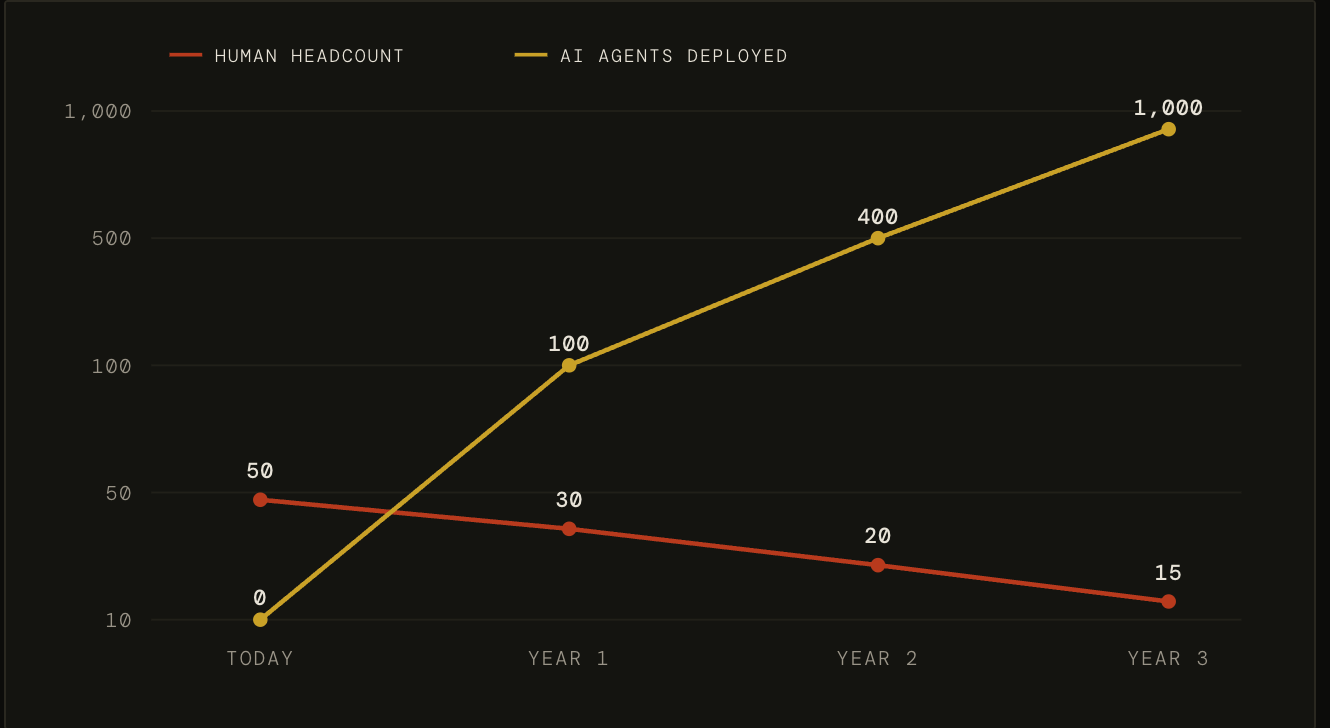
Representative AI-first revenue function over three years. Humans drop from 50 to 15. The agent fleet grows from zero to a thousand. The architect replaces the old sales ops lead's whole function.
Project this forward through a sales organization. The sales ops lead who moves into the architect role manages ten agents in Year One. A hundred in Year Two. Five hundred to a thousand in Year Three. Each agent does the work of what used to require one to five full-time humans. The team around the architect is the agents. The humans in the revenue function shrink from fifty to fifteen. The fifteen who remain are architects, model operators, red-team reviewers, and the people who close the deals that need a human in the room. Those roles do not get lost, the SDR, for example shifts into a forward deployed engineer, or an expert who creates new agents for the prospect or any number of new roles that add more value.
The current org chart has no box for what the architect is. The architect does not sit under the CRO as a service function. The architect sits next to the CRO as a peer, a digital CRO. The agents are the revenue function. The CRO signs the strategy. The architect runs the labor.
The counter-argument I hear most often is that the middle management layer transforms rather than vanishes. Someone still has to sit between the architect and the CRO as the organization scales past a certain size. The function morphs into a smaller, more senior team of agent governance leads rather than disappearing. The counter-argument may be right in the medium term. The compression Mark Leslie and I argued through in The Arc of a Company's Life Now Fits Inside a CEO's First Term makes the point either way. Three or four senior agent governance leads replacing a fifteen-person sales ops team is still a dozen people whose job as it exists today does not exist in three years. Read that line twice.
I covered the organizational mechanics in The Agent Swarm Just Killed Scale as a Moat. One person with a hundred agents outcompetes a hundred people with none. The companies running the motion already know this. The companies hiring one more SDR team and buying one more CRM add-on do not. The SDR hire is the clearest misunderstanding of what AI is doing to this function. Research. Outreach. Qualification. Handoff. Every one of those tasks is now agent-native. One architect building SDR agents produces more pipeline than a twenty-person SDR team at a fraction of the cost. The companies hiring the SDR team are solving a 2019 problem with a 2019 playbook. The companies hiring the architect are the ones taking the pipeline.
More agents than people is not a prediction. It is the inside of Klarna, Cursor, and every AI-first revenue function already running the motion in production.
The architect role. Sales as the running example. The pattern across every function.
I keep using sales because I live inside it every day at Collective[i]. The same architecture applies to finance operations, HR operations, product operations, and every other cost-center function in your org. The specifics change by function. The role is the same. Take the sales version and run it through what we see at Collective[i] every week. The CRM goes away.
Our economic model learns the relationship graph from signals across communications and calendars, not from humans typing. The forecast runs at 93 to 95 percent accuracy without a human producing it.5 The deal room is a single live view that finance, legal, and customer success all work from without needing status meetings to reconcile what is happening. Our Telli Assistants product runs the agent fleet underneath all of this. The sales rep gets back the time she used to spend on admin. The sales ops person who used to maintain the system that the rep hated gets to become the person who builds the next agent that saves the rep another ten hours a week.
As an example of this change lets take the RFP. For many companies the time it takes to respond to these, fill out questions, route the right questions to the right people, review ect is the single biggest bottleneck in enterprise sales. A good RFP can take two to three weeks to complete. It requires pulling references the decision maker will know, filling the boilerplate every response needs, finding the case study that matches the prospect's industry, routing approvals through legal and finance, and shipping before the deadline.
The architect version of that work is one agent. The agent reads the inbound RFP. The agent pulls the right references based on who is on the buying committee and who in your network has worked with them. The agent fills the boilerplate. The agent flags the sections that need human judgment and routes them to the right human. The agent runs the draft past legal and finance in parallel instead of sequentially. Complete response in under a day. Build time for the agent, one weekend. Impact of the agent, more than a decade of sales ops improvement across the whole industry.
The architect spends her first year building ten of those agents. By end of year one, she can point to a specific revenue impact for each agent, measured in cycle-time compression, win-rate improvement, pipeline coverage, or margin recovery. That number goes to the CRO. The CRO takes that number to the board. The board asks who built it. The architect's name goes in the room where the compensation decisions get made. That is a very different conversation than the one the sales operations lead was having a year earlier, where she was explaining why the forecast missed by seven percent and what tool she was going to buy next quarter to fix it.
You will not be replaced by AI. You will be replaced by the person who built the agent that did your old job before you did.
You need a new substrate. Stop trying to protect the old one.
Watch Salesforce or any of the legacy SaaS every quarter. New brand. New wrapper. Agentforce in one quarter. Einstein in the next. Claudeforce in the one after that. Each announcement is a marketing exercise. Marc Benioff, the best of this crew, invented the modern marketing exercise when he ran actors on champagne buses outside the Siebel conference in February 2000. The exercise worked because a lot of the changes were small, and marketing could buy time. It is not working this time with AI. The problem is not a marketing problem. It is the core substrate that is being replaced and that, is their problem. AI is a bigger shift than the internet. Bigger than the cloud. Every attempt to solve it at the brand layer runs into the fact that the incumbent cannot change the substrate without burning the business the incumbent is trying to defend.
The conundrum for the cost center people is they want to protect their stack and it will pull them down with them. I can understand why, its muscle memory, its their legacy of all the work they accomplished, its what they know. But even they can see, no one cares anymore. Worse, the board, the CXO suite has moved on. They know that competitively they need to move to become an AI first org, and fast. So your holding on, asking for renewals with some legacy provider focuses the attention on you as the new issue, that needs replacing. Thats not good.
So my advice, stop hoping the next release from your SaaS vendor is going to save your day. The more you build on Claudeforce, Agentforce, or Einstein, or the headless whatever your incumbent is announcing this quarter, the deeper the hole you are digging for your career. I say this with twenty-five years of watching the pattern. Hoping the vendor rescues you has never once worked. The vendor is defending itself. The vendor is not defending you.
The uncomfortable truth is that you need a new AI substrate. Building AI on top of a SaaS stack designed in 2012 is not AI-first. It is SaaS with a chatbot pinned to the side of it. Look at the AI product announcements from every public SaaS incumbent over the last twelve months. Then look at their stock prices since the announcements. The market is not confused. The gap between what the AI layer promises and what the underlying substrate can actually deliver is exactly what the AI-model companies are eating from below.
I made the case in Software Is Over and in The SaaS Debt Trap: the incumbents are financing the response with debt-funded buybacks that will not survive two more quarters. Their customers are already voting with their wallets. I covered the law-firm receipts in The Hypothesis Company. Kirkland committed five hundred million dollars to build its own AI. Morgan committed a billion over ten years. The substrate under your stack is dying. In the last month alone I have watched the pace of this accelerate at a scale I could not have imagined earlier in the year.
If your career is tied to Salesforce, Workday, ServiceNow, Adobe, HubSpot, or any of the public SaaS incumbents, your career will follow the same arc as their stock price. Scary. When your CIO or CTO decides to use AI to replace that product and they are already doing this, your role has a countdown clock attached to it. The clock is shorter than you think.
That is why at Collective[i] we deal with this directly. Customers can keep their CRM in place while we layer our economic model and agent fleet on top. Moving a sales organization is hard. Nobody rips and replaces in a quarter. Customers typically run both for twelve to eighteen months while we train their reps, build their agents, and prove the forecast. At some point the CRM contract comes up for renewal, and we have the conversation. Keep paying the SaaS vendor for a system the reps barely touch, or save the cost. Either way the center of gravity has already shifted.
The Tarzan effect
So you have to ask, why would anyone tether their career to legacy anything, SaaS just happens to be the bad guy in this case. I call the fear of making this move the Tarzan effect. The middle manager and the cost-center lead will not let go of one vine until they are holding on to the next. The old vine is the SaaS stack, the complex workflow, the CRM-plus-dashboard-plus-reporting-tower that was the whole job. The new vine is the AI substrate. The model. The agent fleet. The architect role.
That is why letting the customers layer us on top without ripping anything out is easier, safer. The sales ops lead cannot let go until she has her hands on the next vine. We give it to her. We let her grip it, learn it, build on it. At some point she has to let go of the old one. The old vine is dying. She liked it because it felt safe.
The old vine is not safe. It is just familiar. Let go of the vine.
There is a memory from LinkShare I keep coming back to. In 2001 we shipped a self-service version of the platform that let our retailer and publisher clients pull their own analytics. The account manager role as it had been drawn in 1999 did not survive. The seven people in those seats were terrified. We sat them down and told them the new job. Teach. Consult. Strategize. Sell new products. Six took the role. One left for a traditional account management seat at a dying ad network. Five years later the six were running strategic partnerships at Rakuten or had been hired by their clients to run digital at two to three times what they had made at LinkShare. The one who left was still an account manager at a different ad network, making ten percent more than she had five years earlier. Six grabbed the new vine. One held on to the old.
The old vine is not safe. It is just familiar. Let go of the vine.
What comes next
If you are in one of these roles today, start building now. Pick the workflow in your function that eats the most time, has the clearest ownership problem, and produces an output that connects to revenue or margin. Build the agent that handles it. The build is faster than you think. Each next agent is easier than the last. The visibility you earn from the first agent gets you authority to build the second. The visibility from the first five gets you the budget and headcount decisions that used to be made above you.
Here is what I watch happen inside the companies that have already made the shift. The first three architects to ship a measurable result get promoted to run bigger pieces of the function inside six months. The next six get retained and paid well. The people who did not make the switch end up in the first round of layoffs when the CFO figures out the stack can be removed. The window for the promotion closes about the time the window for the layoff opens. Early movers get the promotion. Late movers get the severance.
If anyone wants to see this in action, I am happy to have our team at Collective[i] walk through it. The larger point is that the AI-first companies are ripping these systems out for a reason. They are flattening the org for a reason. They are moving faster and growing for a reason. The reason is that the old substrate is not where value gets made anymore. Time is not on your side to keep holding on to the old vine.
The pessimists are three for three wrong across the last hundred years. Industrial. Services. BPO. AI. Same panic. Same outcome. The jobs AI is coming for are jobs nobody should want to keep. The replacement jobs pay more, carry more visibility, and compound across a career instead of flatlining.
Hold on and get laid off. Move early and get promoted. Both options take about the same amount of courage. One leads to a better job in a better company. The other leads to a severance package and a job search in a labor market where every company has figured out that the role you used to do does not need to exist.
The people reading the record correctly are already moving. The people hoping the record is wrong this time are the ones who will be writing the universal basic income pieces in 2029 asking why nobody told them.
I told them. I am telling you.
Grab the vine.
Grab the role while the switch is a promotion. Wait too long and the switch is a layoff.
Build with judgment in the loop
Intelligence.com is the operating layer for sales teams that have decided to build the agent fleet instead of maintain the stack. A network built on scoped, accountable AI. Request access.
Subscribe for the next piece at reloadnyc.com. Free. No paywall. No course at the end. Just the work.
If this piece changed how you are thinking about which jobs AI is actually coming for, forward it to one person who needs to read it. The sales operations lead six years in without a promotion. The CRO looking at the headcount in his revenue operations team. The CFO about to greenlight another SaaS contract renewal. The middle manager in reconciliation meetings for a dashboard nobody acts on. The architect candidate inside your own team who does not yet know the role exists. One specific person. That is how a career moves.
Post it on X and tag @smesser, and tell me where I am wrong. Share it on LinkedIn and tag me at linkedin.com/in/stephenmesser. Tag the sales operations leads, revenue operations leaders, and middle managers who need to see this. Tag the CROs and CFOs at companies hiring one more SDR team instead of building one more agent. This is the conversation the industry needs to be having in public.
Footnotes
- Sales quota attainment: 63 percent (2012) and 53 percent (2018) per CSO Insights / Miller Heiman annual studies; 44 percent (2022) and 28 percent (2024) per Salesforce State of Sales. Bridge Group 2024 SaaS AE Report: AE attainment 51 percent (2024), down from 66 percent (2022). RepVue Q2 2025 Cloud Sales Index: 42.69 percent average across 47,000 reps at 246 cloud companies. Ebsta / Pavilion 2025 GTM Benchmarks: 78 percent of sellers missed quota in 2025, up from 69 percent in 2024. Win rates fell 18 percent in 2024 and 10 percent in 2025. CRM and sales enablement spend grew five to six times across the same window per Gartner and Forrester market data.
- Klarna AI customer service agent: Sebastian Siemiatkowski announcements, February 2024 (700 FTE equivalent) and July 2026 case review (853 FTE equivalent at full deployment). 2.3 million conversations per month. Resolution time 11 minutes to 2 minutes. CSAT held flat. Cost analysis per getcoai.com and Customer Experience Dive: $3.6M monthly human cost against approximately $9,000 monthly AI cost. Sources: TechCrunch, May 2025; Computer Weekly 2026; Customer Experience Dive 2025.
- Klarna workforce: shed from 5,000 to 3,800 in the twelve months ending September 2024 per CEO Sebastian Siemiatkowski; plans to approximately halve the workforce ahead of IPO per interim results. Revenue per employee: approximately $400K (2023) to $700K (2024) to nearly $1M (2025). 90 percent of employees use generative AI daily per Klarna May 2025 disclosure.
- Cursor revenue per employee: past $1B ARR with headcount in the low hundreds, per multiple public coverage threads and company blog posts across 2026.
- Collective[i] forecast accuracy of 93 to 95 percent is the production-grade result on an unassisted daily basis across our enterprise customer base.
Related Reading
Stephen Messer
- What Jobs Become When the Overhead Is Gone. The Peter Gibbons version of this argument. What the work becomes when the overhead is removed.
- The Agent Swarm Just Killed Scale as a Moat. The organizational mechanics. One person with a hundred agents outcompetes a hundred people with none.
- The Oldest Trick in Management Just Stopped Working. The endless workflow projects your cost-center role depends on.
- Software Is Over. Why the SaaS stack your career depends on is itself on the death walk.
- The SaaS Debt Trap. The debt-funded response that is not going to save the incumbents.
- The Arc of a Company's Life Now Fits Inside a CEO's First Term. The compression that makes the window shorter than you think.
- The Hypothesis Company. Your customers are already building the AI the vendor keeps promising. The receipts.
- The AI Shuffle. The SaaS category being replaced by AI models from under the stack.
While I am a retired lawyer, none of this is legal, financial, or career advice. These are my opinions. Specific career decisions should be made with the professionals who know your situation.
Artificial CommonSense · reloadnyc.com · © 2026 Stephen Messer