The Quiet Veto

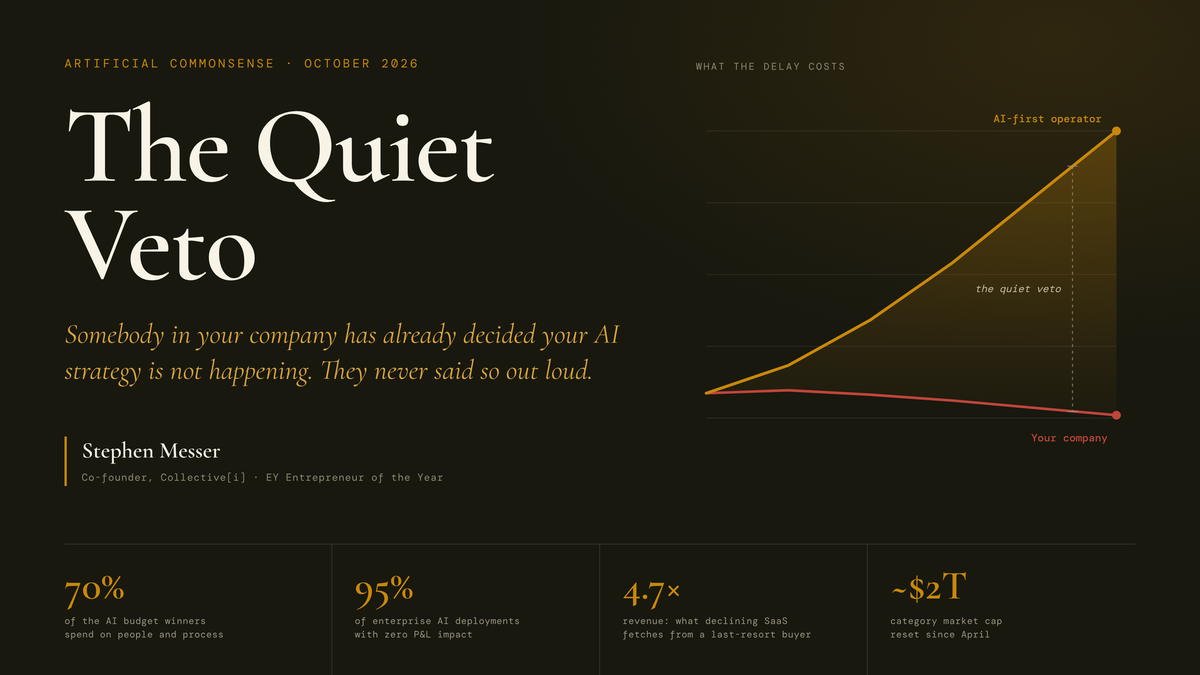
Somebody in your company has already decided your AI strategy is not happening. They have never said so out loud and they never will. Here is how to find them, what the delay is costing you, and the game plan for getting them across.
By Stephen Messer
Co-founder, Collective[i] and Intelligence.com. Co-founder, LinkShare (sold to Rakuten, $425M). EY Entrepeuner of the Year/Deloitte Fast 50 winner (2x). Board member, Spire Global (NYSE: SPIR). Join me at Intelligence.com
November 2026
Somebody in your company has already decided your AI strategy is not happening.
They have never said so out loud. They never will.
You know this person. You probably like them. They were in your last strategy session agreeing with you. Ask them today and they would say yes and mean it. Then they go back to their desk and the work stops moving.
Your last board update said the initiative was on track. It was not. Nobody lied to you. A decision never got made, so a decision never got reviewed, so what is actually happening has never appeared on a slide you have seen.
The gap between AI-first companies and everyone else is widening faster than any shift I have lived through. What stands between you and that transition is almost never the technology.
It is a person, and probably more than one. If you cannot name them by the time you finish reading, you are the one being managed.
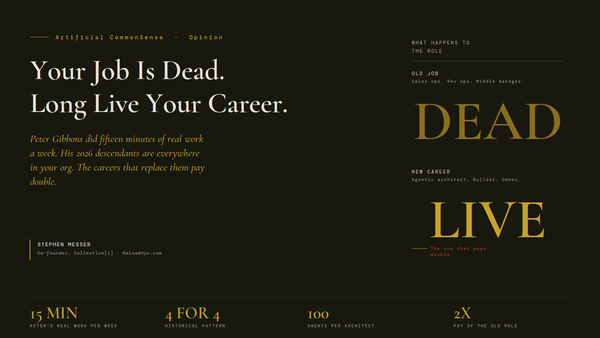
Last week I published Your Job Is Dead. Long Live Your Career. for the person in the chair. The job is going away. The career replacing it pays roughly double. The universal basic income conversation is political cover for people who never bothered to imagine the replacement. This is the other half. If you allocate capital, sit on a board, or run the company, your problem is telling a real AI-first leader from one who has learned the vocabulary.
What it actually looks like
On Tuesday your head of operations tells the strategy committee she is all in on AI. She means it. On Thursday a ticket crosses her desk and the API keys for your team's demo get pulled, pending a security review.
Both things happened. Neither was a lie. Ask her and she will tell you, truthfully, that she never opposed anything.
That gap between Tuesday and Thursday is the quiet veto. It never produces a decision you can review. It produces delay, and delay does not show up in a board deck.
Resistance used to announce itself. Somebody called the technology unproven and you argued in the open. The 2026 version hides better. It arrives wearing the thing it opposes.
Your CIO rebuilt your sales dashboard with an AI coding tool for a tenth of what Salesforce charged. On Tuesday your CIO is in your board meeting arguing the team should own the whole stack now. The savings are a seven-figure line item. The argument lands.
Your head of HR is in the same meeting arguing the opposite. Workday shipped agentic features your CIO cannot match, and handing HR tooling to engineers is how a good HR system becomes a bad one. That argument lands too.
Both want the budget. Both have dressed the fight in AI language your board can nod along to. Neither one of them has any idea what AI-first means.
The savings are real. I am not telling you to pass them up. Replace the SaaS. Bank the money. Spend it on what comes next. The mistake is calling the savings the destination. An AI-coded clone of Salesforce is Salesforce. An AI-washed renewal of Workday is Workday.
Nobody in that room is hostile. That is exactly why it works.
You cannot spot the fake without the real thing
A model is a brain. Software is a tool. The tool waits for instructions and does the same thing every time. That consistency was the point of buying it. A brain learns your business, makes the call, and gets better every cycle. I made the long version of the argument in Software Is Over. The industrial era ran on electricity. The information era ran on software. Intelligence is the substrate now. You did not bolt electricity onto a steam engine. You redesigned the machine.
The brain does not sit beside your stack. It eats the stack. The average enterprise runs between 130 and 900 SaaS applications. Each was bought for one process. Each got wired to two or three others. Every wire breaks when either side updates. Twenty-five years of correct decisions, piled on each other, and poison for agents. An agent has to see your CRM, your ERP, your support desk and your finance system at once. Your data sits in silos built to stay separate.
So the winners remove tools instead of connecting them. Klarna deleted about 1,200 applications. Revenue per employee went from four hundred thousand dollars to seven hundred thousand. Curative rebuilt a health insurance back office around AI. They canceled a six-hundred-thousand-dollar Salesforce contract on the way out and went from six hundred and fifty people to four hundred.
A brain also bends. A workflow treats every user the same. A model works the account in front of it, in the situation in front of it, and changes as the world does.
Four properties. Learns. Replaces. Compounds. Adapts. Now look at what is on your agenda and ask which of the four either side is offering.
Neither one offers any of them.
One number exposes both sides
BCG studied the companies actually getting returns on AI. The winners put about seventy percent of their AI money into people and process redesign. Thirty percent went to technology. The companies getting nothing run those numbers backwards. They buy the algorithms and wait for the org to reshape itself around them. It never does.
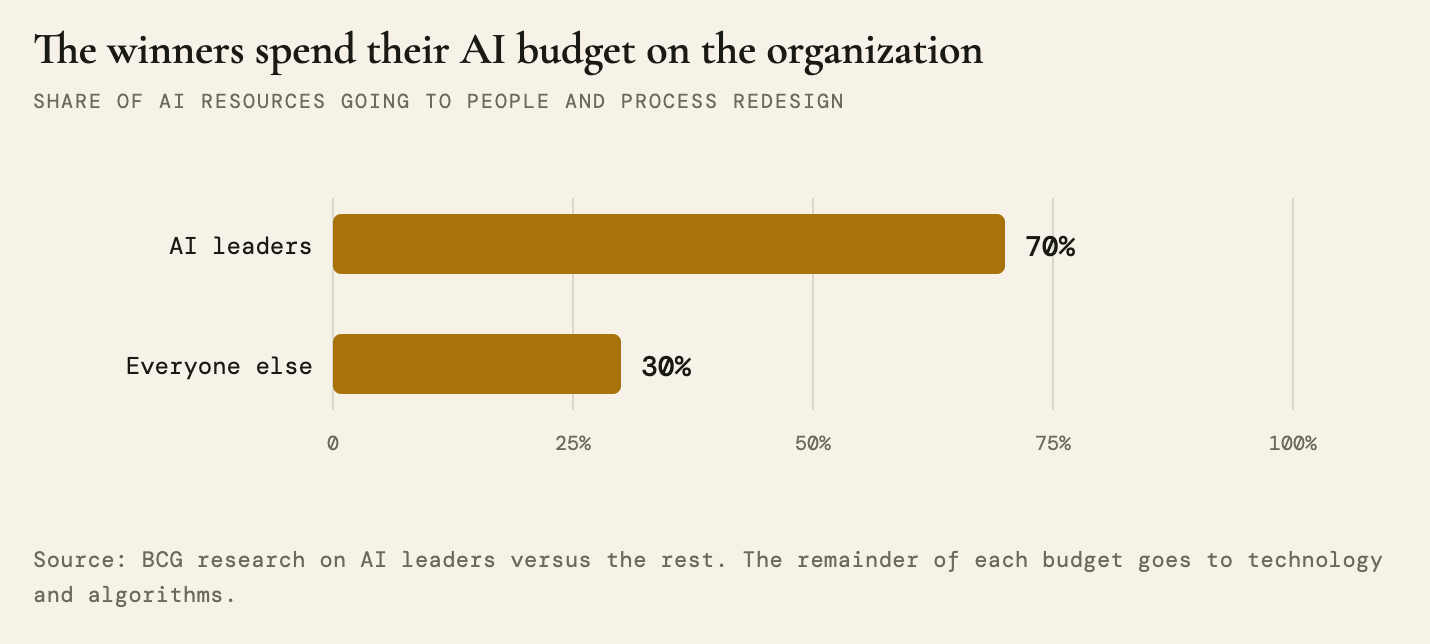
Every item on your agenda sits inside the thirty percent. Which vendor. Which build. Which contract. Nobody in that room has proposed touching the seventy.
I named this pattern in The AI Shuffle. The shuffle is sustaining innovation wearing a disruption costume. Salesforce becomes Salesforce plus Einstein. Marketo becomes Marketo plus generative content. Zendesk becomes Zendesk AI. Same architecture, same silos, same human checkpoints, new logos, bigger contracts. The deck transforms. The business does not.
The shuffle is not stupidity. Smart people answered the question they were handed. The CEO said get AI. The team went and got AI. The question was the problem.
I watched the first version of this at JC Penney in the early internet years. Somebody said the website was doing the same revenue as a store in a mid-size market. Reasonable sentence. Fatal one. The new thing got measured with the old thing's yardstick, and nobody asked what a website could do that a store could not. The dot-com became a store. The dot-ai is becoming a department.
The question nobody asked is the one in The Art of Subtraction. Most companies ask how to apply AI to what they already do. The winners ask whether the work should exist at all. Neither side of your fight has asked that.
Even the smart version fails
Your CIO has the better of the two cases. Own the code. Keep the data inside. Cut the bill by ninety percent. A respectable-sounding argument backs all of it. It is wrong.
In July, Alex Karp and Satya Nadella told enterprises ten days apart to wall off their data and keep it away from frontier models. I wrote about it in Karp and Nadella Are Selling You a Wall. Karp sells the software that locks your data behind Palantir. Nadella sells the environment that keeps it inside Microsoft. Each was selling the wall he was describing.
Only about ten percent of your data is truly proprietary. The signal that predicts outcomes does not live inside your walls. It lives in the pattern across thousands of companies facing the same thing. Cybersecurity settled this a decade ago. CrowdStrike and Cloudflare win by pooling threat signal across their whole customer base, and no serious CIO buys standalone antivirus anymore.
So what does the in-house rebuild buy you? A cheaper wall. The silo is still a silo. The agent still cannot see across the business.
It goes deeper. In Workflows vs Outcomes I argued that CRM-first is the wrong foundation for AI. A workflow system is built to record what people did. It was never built to produce an outcome. Rebuild that for a tenth of the price and you own a cheaper version of the wrong foundation.
That foundation is also protecting somebody. I called it The Weakest Link: the human-gated bottleneck every agent architecture is built to remove. Somewhere in your stack, work stops and waits for one person to decide. That checkpoint is somebody's job. It is also why your cycle time has not moved in four years. Propose replacing the stack and that person hears what you are proposing.
Read that back. The architecture and the resistance are the same problem.
What the delay is costing you
Every technology wave has arrived faster than the one before it. This one is arriving faster than any of them.
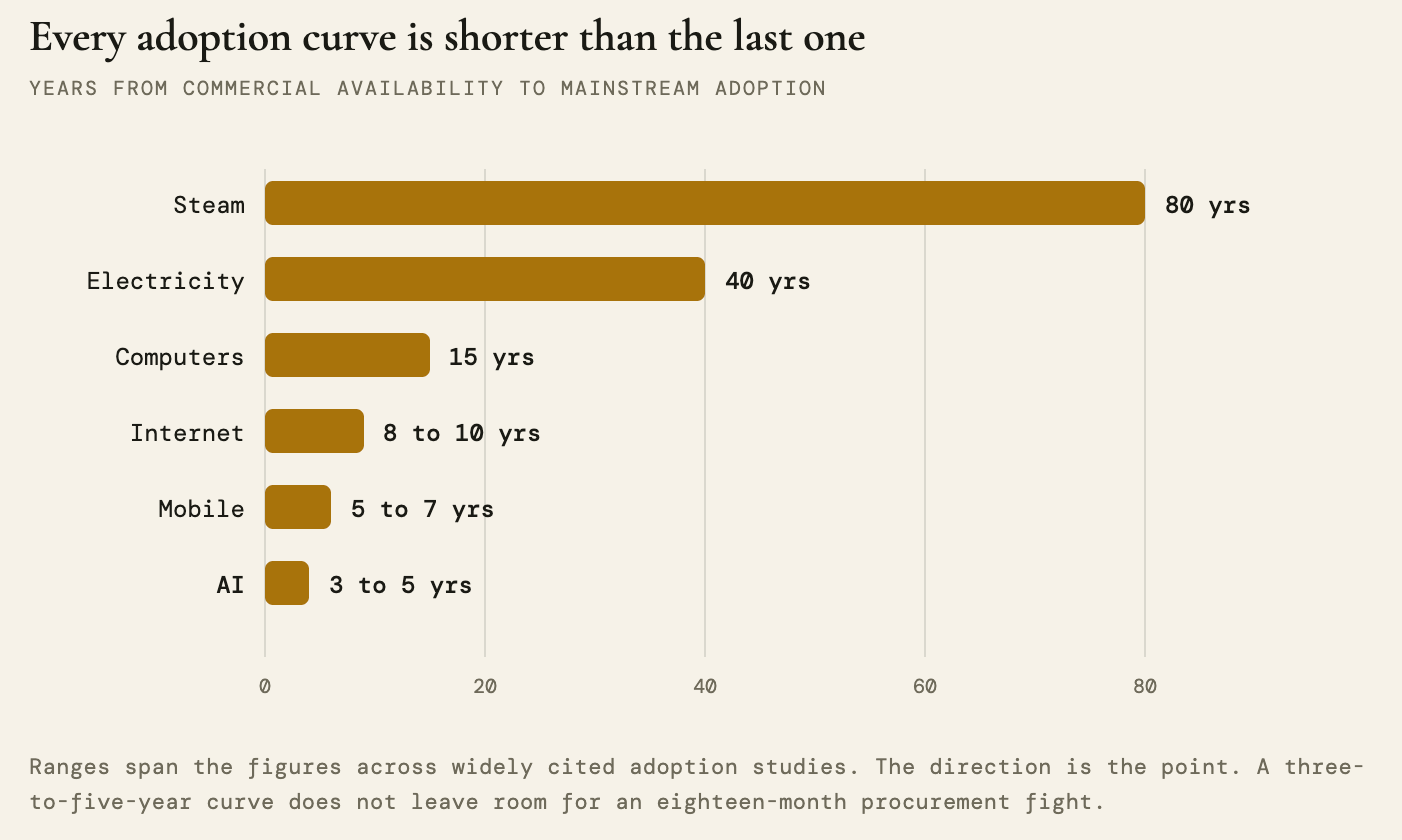
I mapped the milestones in The Race Is On. Being late used to cost you a quarter. Now it costs you the category.
The gap is not only the curve. It is decision speed. In AI-First Rivals Are 50x Faster Than You I ran the arithmetic. Your buying committee: eleven people, eleven and a half months. Your AI-first rival: one person, one week, same decision. Gartner has eighty-six percent of B2B purchases stalling somewhere. Amazon runs a pricing test in a day. Nvidia runs on thirty-six direct reports and no one-on-ones.
Underneath it is a shift from belief to hypothesis. A belief is a conclusion. A hypothesis is a question with a test attached. The AI-first company runs fifty experiments in the time the belief company runs one.
Then there is headcount, which I covered in The Agent Swarm Just Killed Scale as a Moat. One person with a hundred agents beats a hundred people with none. Wiz reached thirty-two billion dollars in five years. Being big stopped being protection. Your six-hundred-person advantage over a six-person competitor is now a cost structure.
Your skeptic's best argument is that most AI projects fail. He is right. The MIT NANDA study found ninety-five percent of enterprise AI deployments produced no measurable P&L impact. I wrote about it in The Companies Winning at AI Are Playing a Different Game. Now the other tail. The five percent that worked beat the S&P by twenty-nine percent. They rebuilt the operating model. The ninety-five percent ran pilots inside the one they already had. That failure rate is not an argument for waiting. It is an argument against doing it your team's way.
Your vendor may not outlive your decision
Your HR lead is not being stupid, and she is not only afraid. She is buying air cover. The modern version of nobody ever got fired for buying IBM. Pick the category leader and a failed project still looks defensible, because everyone else bought the same thing. She is also buying a story. The renewal comes with a new product name and a roadmap slide, and now she has something current to say at the next board meeting. The check is the price of the story.
Air cover holds only as long as the vendor's message holds. When the substrate moves, the message is the first thing to stop being true. The buyer is left holding a three-year commitment to a story that expired in month four.
Siebel is the cleanest version. Through the 1990s it was the safest CRM purchase on earth. Category leader. Stock near two hundred dollars a share. Oracle announced the acquisition in September 2005 at ten sixty-six, five point eight five billion for the whole company. Execution did not kill Siebel. The substrate moved from on-premise to on-demand, Salesforce owned the new ground, and the message Siebel was selling stopped describing the world. PeopleSoft went the same way for ten billion that January.
That cycle took a decade. The language model companies went from near zero to tens of billions in three years, and Cursor and Harvey did it faster. Three years is now longer than the half-life of the thing being sold. The story will not survive the renewal.
Count the names Salesforce has put on the same AI story. Einstein. Einstein GPT. Einstein Copilot. Agentforce. Headless 360. Claudeforce. Four of those landed inside about two years. Your head swirls trying to keep the roadmap straight. The products arrive and depart faster than the board meetings where they get discussed.
Now the numbers. In March, Salesforce bought back twenty-five billion dollars of its own stock with twenty-five billion of new debt, some of it maturing in 2066. The repurchase cleared near a hundred ninety-eight a share. The stock ran to the two-sixties on Claudeforce and gave it back. Worst performer in the Dow this year.
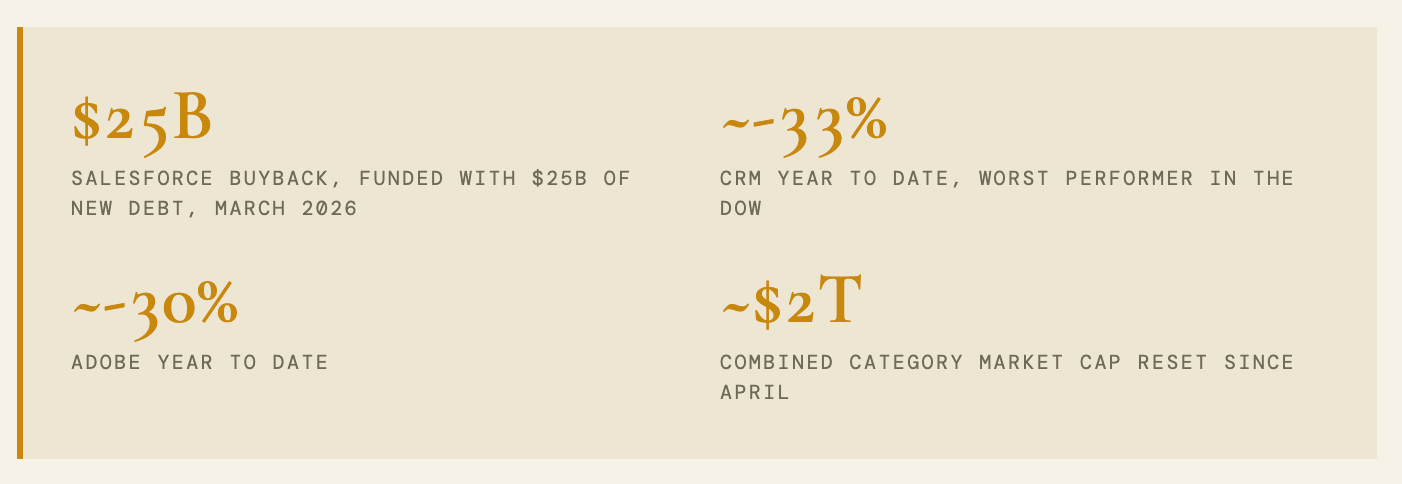
I walked the mechanics in The SaaS Debt Trap. While everyone argued about whether AI was a bubble, the SaaS incumbents did something more dangerous. They borrowed to buy their own stock and called it an AI strategy. A buyback manages a share price. It does not build a model.
That piece also set a floor. Bending Spoons bought Airtable in August for about 1.285 billion against roughly four hundred eighty million in ARR. Call it 4.7 times revenue. Airtable was worth eleven billion in 2021. Bending Spoons has bought more than fifty companies and usually cuts seventy percent of the staff. That multiple is what a declining SaaS company is worth to a buyer of last resort.
Three of five are already at or below the vulture floor
Market cap vs. implied value at 4.7× revenue · mid-September 2026
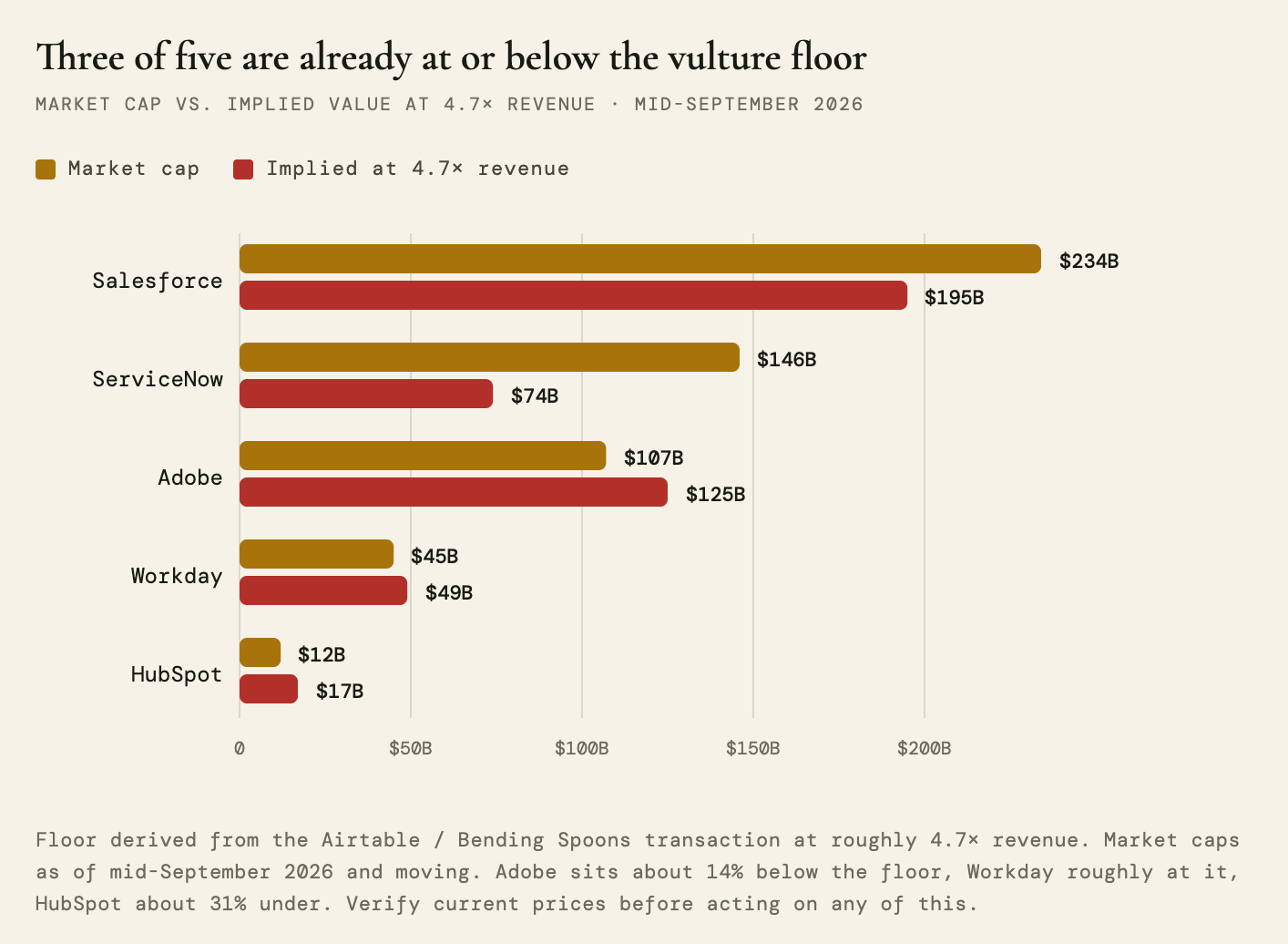
Adobe already trades below what a liquidator would pay. Workday sits at the line. In August Reuters reported Silver Lake was in talks to take it private, and the stock jumped eighteen percent on the leak.
So your HR lead is not choosing a vendor. She is choosing a counterparty whose own shareholders have priced in the chance it gets sold for parts inside the term she wants to sign.
Your team is arguing about which vendor to bet three years on, while the market is already pricing what those vendors are worth to a liquidator.
One comparison should embarrass the whole category. Kirkland & Ellis committed five hundred million dollars to build proprietary AI. Morgan & Morgan committed a billion over ten years. Not one public SaaS company has committed comparable sums to building a frontier-class model of its own. Law firms did what the software industry chose not to do.
The reason nobody says out loud
So why does this fight keep getting your calendar time? Because it is safe. It is a power grab in an LLM wrapper. It looks like work. It sounds like AI. It carries none of the risk of changing anything, and none of the benefit.
It hands each side a story. Your CIO gets to be the one who understands AI because he used an AI coding tool. Ask him what an economic model does, or a world model, and watch what happens. Your HR lead gets to be the one protecting institutional knowledge while reciting a vendor's deck almost word for word.
Under both stories is the thing nobody says in a meeting. Your senior team has imposter syndrome about this whole shift. They do not understand it. They assume everyone else does. They believe admitting the gap ends their career.
There is a sharper version, and it explains the intensity. Many of your senior leaders got their jobs by pushing out the people who never made it to digital. They know how that play runs. They ran it. Now they are the incumbent in the same story.
I wrote Your Gut Was Your Edge about the mechanics. Pattern recognition built over a career was a real edge until a model could do the same matching across a thousand times more data. Then it became a liability, and the person holding it is the last to notice. You are asking people to volunteer that their best asset has depreciated.
Almost nobody does that unprompted.
Three fears, identical from the outside
Flatten these into one archetype and you will fix the wrong thing.
The fear of being erased. Middle management was the glue code of a company running on heuristic workflows. Agents replace that glue first. I went through the mechanics in The Oldest Trick in Management Just Stopped Working. Twenty years of knowing how work really gets done lives in your senior manager's head. He knows the next org chart values that less, and nobody has described his job on the other side. I called this the Tarzan effect in the Halloween piece. Nobody lets go of the vine until somebody hands them the next one.
The fear of the probabilistic. A career on decision trees and if-then logic is a career spent being reliably right inside a narrow box. A model is right across a distribution and wrong now and then on the case in front of you. If your reputation rests on being right, usually-right reads as a demotion. The workflows he defends have produced uneven results for years. Nobody minds that. The discomfort is the shape of the error, not the size.
The fear that makes the other two survivable. The story that it all passes. They have read the pieces calling AI overhyped and the ones calling it the end of the world. They picked hype. The other story is unbearable, and hype lets them keep the job they built. So the fear arrives dressed as prudence. I wrote The Safest Move You Can Make With AI Will Cost You Everything about that disguise. Caution is the most expensive position on the board right now.
In 2008 these were the people in my inbox explaining why putting customer data on AWS was a legal exposure. The companies that listened paid Rackspace for five more years, then paid again to migrate.
None of these three is sabotaging you. They are protecting a career. Spread that protection across a hundred small decisions a quarter and your balance sheet cannot tell the difference.
How to spot it on your calendar
I compare notes with other leaders doing this work. The playbook barely varies.
The clearest tell is the API cutoff before the big demo. A new frontier model lands on a Wednesday. By Friday somebody has found a reason to pull the keys. Security scan. Cost overrun. Compliance review. Pick one, then ask who it was the last two times.
The second is the pilot that never leaves pilot. A pilot is a project. A project has a scope and an end date. Systems do not. Somebody who is afraid prefers the project framing. A project never gets measured as infrastructure.
Third, the ninety-day risk assessment stacked three deep. Each window is defensible alone. Chain three and what you were going to pilot in April is a procurement memo in October.
Fourth, the renewal dressed as an AI strategy. The vendor added a feature in April. The feature is a demo. The renewal is three years. The person signing tells themselves they locked in a discount.
Fifth, the review board assignment. Watch who volunteers for the AI software review. Watch who gets volunteered for being detail-oriented about risk. Reviews are where things go to die slowly. The people who kill things know it.
These are the same people who threw wrenches into the gears during the industrial age, in better suits and with a deck. Fear leaves a lot of room for justification.
One question for your next board meeting
One test cuts through every version of the shuffle in about ninety seconds. I closed the 50x piece with it.
The board test
Can your CEO name three hypotheses currently under test, say when each one gets read, and name the decision that changes based on the result?
Three live experiments with dates and decision points attached means you have a company running on hypothesis. A slide with a vendor logo and a maturity model means you are looking at the compounding-error machine. The fight on your agenda is the symptom.
Run it one level down on whoever is arguing about the stack. Neither your CIO nor your HR lead will have an answer, because neither has proposed a test. They have proposed a purchase and a build. Those are conclusions.
Your window is shorter than your board thinks
Earlier this year I co-wrote a piece with Mark Leslie about the arc of a company's life. Every company passes through a Sweet Spot of Maximum Optionality, a window when it still has the cash, the talent and the momentum to become something else. Outside it the options close one at a time.
Mark and I disagree on the shape. He treats the sweet spot as a recurring window a good leader plans for. I think it is a permanent condition, because the moment you call it a window you start waiting for the next one. We agree on boards. They wait too long on CEO fit while the window shuts.
AI compressed that window from roughly a decade to a handful of quarters. The fight over who owns your stack is how companies spend the compressed version. Six quarters, and most of it already gone.
What private equity does while you argue
Private equity is running the play your board is too polite to run. The names are in your newsfeed and the playbook is specific enough to map onto your own company.
General Catalyst has deployed over seven hundred fifty million of a one and a half billion dollar AI roll-up fund. Crescendo in contact centers, now worth around five hundred million, billing per resolved ticket instead of per hour. More of the same in IT services, legal and accounting. The sequence never changes. Build the AI platform. Buy the labor-heavy services firm with the customers, the cash flow and no technology. Move EBITDA margins from five or ten percent toward thirty or forty. Their healthcare arm took control of Summa Health last year, the first VC-owned hospital in the country.
Thrive Holdings, Josh Kushner's spin-off from Thrive Capital, raised two billion dollars at a twelve billion valuation in August with OpenAI taking equity. They hold long instead of flipping. Thirty percent of the equity stays with the founders and the local brand stays on the door. Their accounting arm has absorbed close to fifty firms. At Larson Gross in Washington state, a tax return that took a hundred eighty hours now takes fifteen.
Silver Lake is going at the public incumbents directly, with the Workday talks as the live example. The same firm took Electronic Arts private at fifty-five billion. Michael Dell ran the original version in 2013. Silver Lake took Dell private for twenty-four billion, rebuilt it around the enterprise stack, and brought it back public as the AI infrastructure company every hyperscaler now buys from.
Three firms, one playbook. AI-first written into the operating agreement before the closing dinner. Then the headcount reset, starting with the people whose job was managing the resistance layer.
Notice what this does to the adoption curve you grew up with. Early adopters, early majority, late majority, laggards. That model assumed the laggards chose when to move. These firms buy the laggards and install new operators by Friday.
The private equity partner you will resent at next year's board dinner will run the pilot your frightened senior manager killed in May. They are paid to make the call your organization could not.
The game plan
You do not fix this by firing the person who said no to the demo. You fix it by changing what they can see, what they can decide, and what they are becoming. In that order.
Map it before you judge it.Pull the last four frontier model releases and the last four vendor review cycles. Write down who found a reason to cut off access each time, and who sits on which review board. This is not a witch hunt and it should not feel like one. It is a map, and you cannot help somebody across a river you have not drawn.
Move the decision, not the person.A frightened senior manager cannot chair your AI vendor review, hold the keys on API access, or own the renewal budget. They can sit on the review. They cannot run it. You are changing the structure, not punishing a person. Done with any candor it lands as relief. Most of them know they are in over their heads.
Make them builders.This is the move everyone skips and the one that works. Twenty years of judgment is the raw material for an agent. The person who knows how a renewal really gets negotiated knows more about what to build than any new hire you could seat beside them. Give them a model that learns the business. Give them a harness that lets it work alongside your people. Give them one visible win. The grief about depreciating skills ends the moment those skills become the inputs to something new.
Decide now what happens if the first three fail.Some people will not cross and a few will choose not to. Work out in advance what the exit looks like, who takes the function, and how that renewal does not get signed anyway. Answering it before month eighteen separates a leader doing the work from a board handing the company to somebody who will.
Move three is the whole ballgame, and the start is smaller than anybody expects. Pick one outcome that matters. What intelligence closes the gap. What it has to do about it. What feedback makes it better next cycle. That is your first agent. One outcome, one brain, one agent, one loop. You can be live in days.
I can describe the far end of that loop because I have run it for a decade. At Collective[i] the model produces the forecast without a human touching the number, and it lands between ninety-three and ninety-five percent accurate. It is not clever. It learns from a network of commercial behavior instead of whatever one company's reps typed into a CRM field late on a Friday. The first version went live in forty-five minutes.
Repeat that and you end up where Infinite Leverage landed. A company where the agents doing real, accountable work outnumber the humans. That ratio is the operating model, not a cost-cutting milestone. The number that matters is revenue per employee, and increasingly revenue per agent. Neither side of your vendor fight will move it.
Can you name them yet
A mandate tells people what to do. A vision shows them the win with their name on it. If your team is buying legacy software this quarter, they cannot see the future you keep describing. If they fear the org flattening, nobody has shown them a builder's job. You paint the other side and put each person on it. Not the vendor. Not the consultant. Not the AI strategy committee.
So go back to the question I opened with. Can you name them?
If you can, make the four moves in order, starting with the map. This quarter, not after the next planning cycle.
If you cannot name them, that is your answer. Somebody is managing your attention and doing it better than you are noticing. None of these people is your enemy. Every one of them is waiting for somebody to show them where they fit.
Show them, or hand the company to a firm with a two billion dollar fund that will do it for you.
What comes next
I publish these at reloadnyc.com. Free. No paywall. No course at the end. Two dozen pieces in the archive, another two dozen in the queue.
If this changed how you are reading your own org, forward it to one person. A director on your board. The CEO you keep having this argument with. A partner at your firm looking at a company whose AI story does not add up. That is how the argument moves, one reader telling another. If you are the person who just got this forwarded, welcome.
Reply if you want to argue. I read every one, and the pieces get sharper when readers push back. Post it on X and tag @smesser to tell me where I am wrong. Share it on LinkedIn and tag me at linkedin.com/in/stephenmesser.
Subscribe
The next piece is already drafted.
Get it when it publishesRelated Reading
Not investment advice. Not a recommendation to buy, sell or short any security. Not a solicitation. Market capitalizations, share prices and multiples reflect public reporting as of the dates noted and change constantly. Verify before acting.