The Art of Subtraction
Most companies apply AI to what they already do. The ones who win ask whether what they're doing should exist at all. The sales forecast is the perfect place to start.

How AI-First Companies Think Differently
Stephen Messer, Co-founder of Collective[i] and LinkShare (sold to Rakuten for $425M, 1996–2005). EY Entrepreneur of the Year/Deloitte Fast 50 winner. Board member, Spire Global (NYSE: SPIR). Building intelligence.com
What First Principles Actually Means
There is a particular kind of intelligence that does not come from knowing more.
It comes from being willing to unknow things.
To look at something familiar and ask not 'how do we improve this?' but 'should this exist at all?'
That is first principles thinking. And it is the single most important cognitive skill for anyone building or leading an organization in the age of AI.
Aristotle called a first principle 'the first basis from which a thing is known.' In practice it means refusing to inherit the assumptions of previous generations. Separating the goal from the method historically used to achieve it.
Every field accumulates what I call method calcification. The gradual hardening of a particular approach into received wisdom, until the method and the goal become indistinguishable. The method stops being a means to an end. It becomes the thing itself. People who master it get promoted. Its limitations get treated as inherent constraints of the problem rather than artifacts of the approach.
First principles is the antidote. Strip away the historical method. What is the actual goal? What do we know to be true? What does that imply we should do?
BOOKS WORTH YOUR TIME
The Beginning of Infinity — David Deutsch. The best argument for why explanatory knowledge, not incremental improvement, is the engine of all real progress.
Zero to One — Peter Thiel. Contrarian questioning as business strategy. What do you believe that almost no one else agrees with?
Thinking, Fast and Slow — Daniel Kahneman. Why intuitions calcify into assumptions, and how to catch yourself doing it.
The Innovator's Dilemma — Clayton Christensen. What happens when incumbents are too invested in existing methods to question them.
Elon Musk — Walter Isaacson. Much noise. The engineering process sections are worth the book.
Elon Musk's Algorithm
No one has applied first principles thinking at industrial scale more systematically than Elon Musk.
His five-step Algorithm is not creative thinking. It is a disciplined engineering process. In sequence:
1. Question every requirement. Every constraint should be attributed to a specific person. Requirements from smart people are the most dangerous because they are the least likely to be challenged.
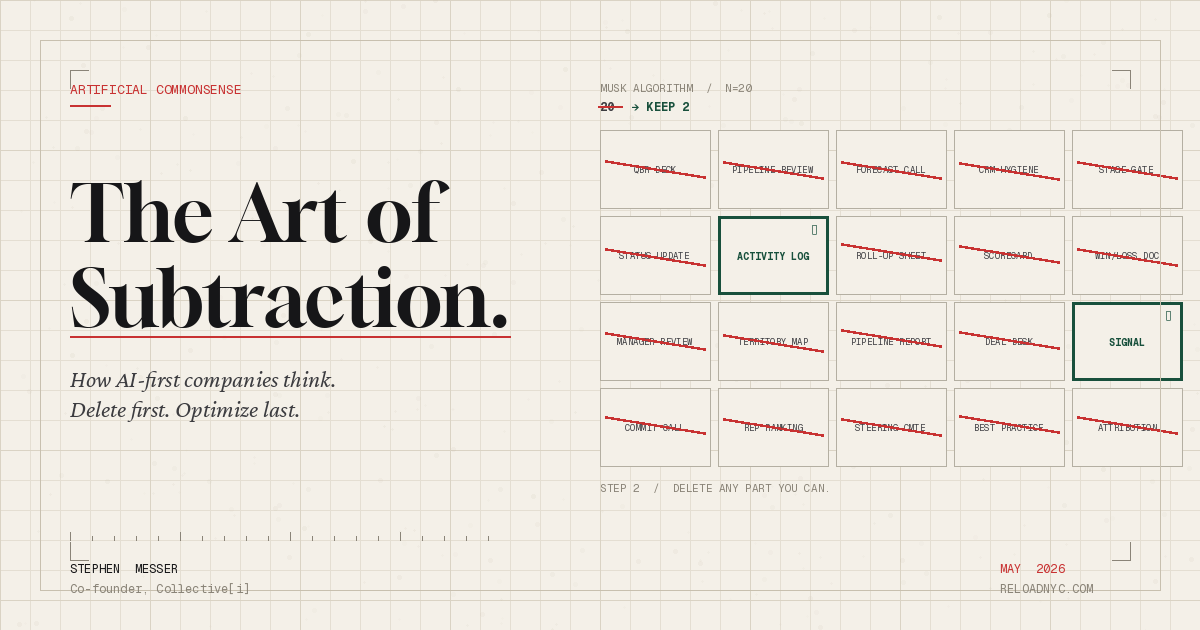
2. Delete any part or process you can. Elimination, not optimization. If you don't end up adding at least 10 percent back, you didn't delete enough. Deletion is the default. Keeping requires justification.
3. Simplify and optimize. Only after deletion. This is where most companies start. That is the wrong starting point.
4. Accelerate cycle time. Only after you have stripped the process to what actually needs to exist.
5. Automate last. Automating a broken process does not fix it. It locks it in.
"Possibly the most common error of a smart engineer is to optimize a thing that should not exist."
— Elon Musk
Most AI transformation programs are step five with steps one through four skipped. The result is faster calcification.
The sales forecast is the most instructive example I know of.
The Sales Forecast: Thirty Years of Drift
For decades, the sales forecast has been one of the most sacred rituals in business.
Teams update deal stages in a CRM. Managers roll up the numbers. A forecast lands on the executive team's desk. The CRO calls the board.
The ability to call your number was respected. Leaders built careers on it.
Now apply first principles.
THE ACTUAL GOAL
Strip away the method. What is a forecast supposed to accomplish?
One thing. Give the business a reliable prediction of future revenue so leaders can make decisions on hiring, spending, investment, and market guidance.
Revenue predictability. Not the weekly call. Not the CRM entries. Not the methodology. Revenue predictability.
WHAT WE ACTUALLY KNOW TO BE TRUE
The most fundamental claim in the whole process is that human beings can accurately predict, deal by deal, which specific deals will close in a given period.
They cannot. No one can.
The way forecast accuracy is measured in the market is specifically designed to conceal this failure. Companies reporting 85 percent forecast accuracy are measuring whether total quarterly revenue came within some range of the predicted total. Almost none are measuring what percentage of the deals they committed actually closed, on time, at the predicted value.
At the aggregate level you are not measuring prediction. You are measuring reversion to the mean. A large enough book of business will produce a revenue number that roughly tracks historical trend. This is not forecasting. It is base rate statistics dressed in the language of expertise.
Sources: Xactly 2024 Sales Forecasting Benchmark Report; Gartner; Landbase 2026
POLLING: THE WORST METHOD AVAILABLE
When you look at how institutions across history have tried to predict future events you find a spectrum of approaches with very different track records.
Banks. Meteorologists. Military planners. Epidemiologists.
Sales chose the worst of all of them: polling.
Ask sellers which deals they will commit to. Roll those answers up to a manager, to a VP, to the CRO. Present a number. Consider what that actually is.
Professional pollsters with massive budgets and decades of refinement cannot predict elections reliably. The same method that gave us Dewey Defeats Truman is the backbone of enterprise revenue forecasting. The same biases, happy ears and sandbagging, are so well understood in sales that the industry named them and simply accepted them as permanent features of the process.
Sellers are explicitly incentivized to distort their predictions. Every forecast review is a negotiation between a manager trying to extract truth and a seller with multiple reasons not to provide it. The information asymmetry is structural. No methodology fixes it because the problem is not the methodology. It is the source.
Sellers become information brokers. They manage what they surface and when. Deals get held back as strategic reserves. Unfavorable signals get buried. Rational behavior inside the incentive structure the process creates.
And yet the process keeps running. Every week. Everywhere.
HOW AN EFFICIENT PROCESS BECAME AN EXPENSIVE RITUAL
The first sales forecast was the Quarterly Business Review. A few days each quarter to think strategically about the pipeline. Directional. Nobody called it precision.
QBR era combined with early monthly forecasting: roughly 12 days per year total. Manageable. The tradeoff made sense for organizations needing tighter budget cycles.
Then it went weekly.
One dedicated day every week. Forecast Friday. That is 52 days per year. There are roughly 270 working days in a year. Nearly 20 percent of annual productive selling time, gone. Not to selling. To talking about selling. Based on a method that was never accurate to begin with.
52 days a year. Gone. Not to selling. To talking about selling. Based on a method that was never accurate to begin with.
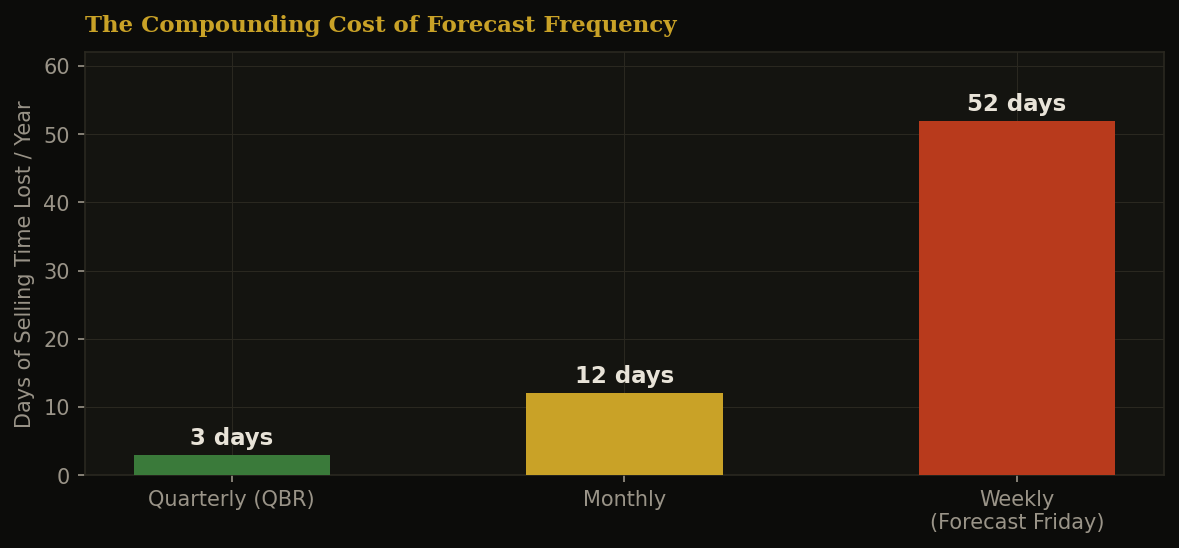
Days of productive selling time consumed per year by forecasting cadence.
An entire generation of sales software companies built empires on this problem. The forecast intelligence category alone attracted billions in venture capital, premised on the idea that more data capture, more analytics, more process layered on top of polling would solve the fundamental issue. You know who they are. You have probably bought one of them.
It did not. The vendors got richer. Win rates continued to decline. Quotas stayed flat.
Sources: Salesforce State of Sales 6th Edition; QuotaPath 2024 Compensation Trends Report
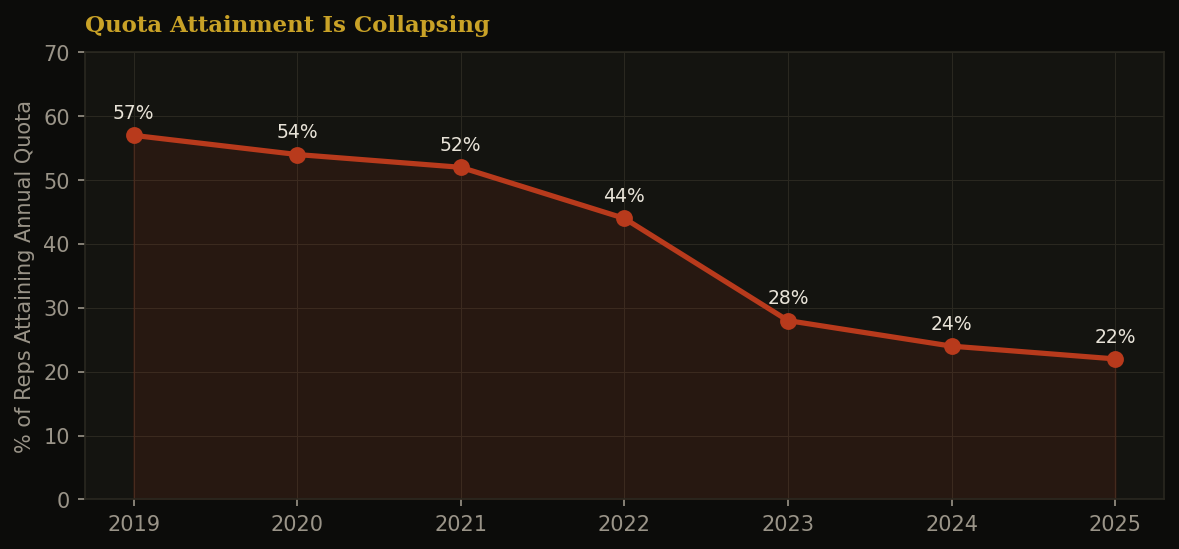
% of enterprise sales reps hitting annual quota — Salesforce State of Sales 2019–2025.
These numbers are not coincidences. They are the same problem measured from different angles.
And the industry's response has been to add more process. More methodology. More tooling. More forecast calls.
Each one a violation of step two in Musk's algorithm. Optimizing things that should be deleted.
What First Principles Actually Produces
FROM PREDICTION TO GUIDANCE
Think about how Google Maps works.
When you enter a destination you get an estimated arrival time that is remarkably reliable. Not because it measured the distance but because it aggregates the behavior of every driver who has ever taken that route, layers in what current drivers are experiencing right now, and updates continuously as conditions change.
Nobody holds Google Maps to its original estimate. We value the update. We trust the system because it learns from reality, not from polling us about our intentions. We expect the reroute. A fixed prediction would feel like a failure. The value is in the guidance.
Now ask yourself this: if you had a reliable estimated arrival from Google Maps, would anyone in their right mind suggest stopping to poll the passengers to see if they agreed with it?
That is the insanity a CRM-first company defends when it argues for keeping the forecast call. And that is the gap between a company that thinks in software and one that thinks in AI.
That reframe is the key one for sales forecasting. The goal was never a number. The goal was guidance. Reliable, continuously updated, actionable intelligence about what is coming so the business can optimize in real time.
STUDYING BUYERS, NOT SELLERS
The reframe reveals a second structural flaw.
Every data system in enterprise sales was built to monitor sellers. CRM tracks what the seller enters. Call recording analyzes whether the seller followed the script. Forecast calls ask the seller what they think.
None of that is the signal that matters.
Revenue outcomes are driven by buyer behavior. Not seller behavior. The industry had been studying the wrong subject for thirty years.
One of the most repeated sayings in sales is that buyers lie. Stated openly. Accepted as fact. And the entire forecasting infrastructure is built on asking buyers' counterparts what buyers will do. The insanity of that arrangement is only visible when you state it plainly.
The entire industry was studying the wrong subject. Then asking those people to predict what the people they were ignoring would do.
At Collective[i] we built a neural network trained on buyer-side behavior across a network. Thousands of companies. Hundreds of thousands of deals. Years of outcomes. Automatic activity capture. Buyer engagement patterns. Organizational buying signals. All of it aggregated at network scale, processed continuously, without human polling.
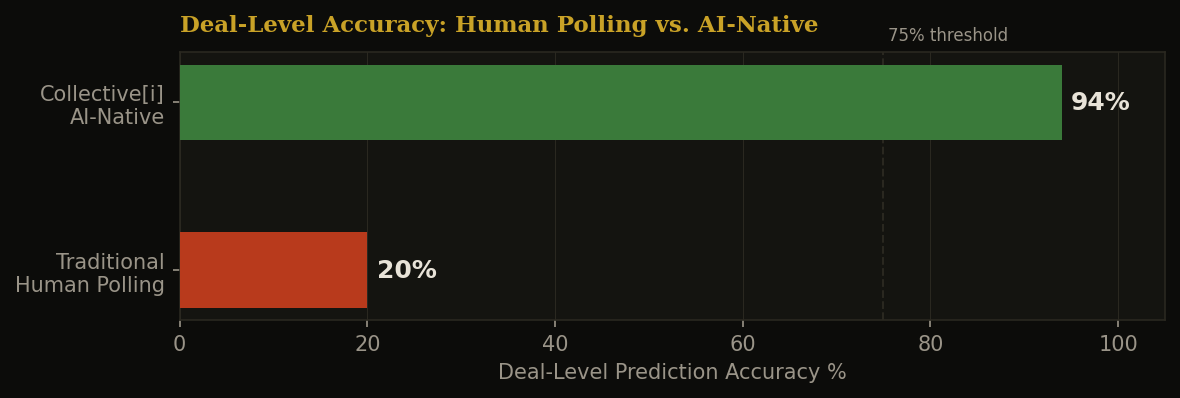
Deal-level forecast accuracy — traditional human polling vs. buyer-behavior neural network.
The 93 to 95 percent is deal level. Individual deals. Not aggregate reversion to the mean.
The forecast updates every day, automatically, without a single forecast call, a single CRM update meeting, or a single Friday lost to the ritual.
Information brokers disappear. When intelligence is surfaced automatically for everyone in a deal room, there is nothing to broker. Collaboration replaces politics.
We do this for new clients in days. Not a multi-year transformation program. The speed is a consequence of the deletion.
This Changes Everything. Not Just Sales.
A reliable, continuously updated, deal-level forecast is not a sales tool. It is company infrastructure. When you remove the volatility from the most volatile input in any business, future revenue, you do not just improve sales productivity. You change what is possible across the entire organization. And you change the company's relationship with capital.
THE CAPITAL CONVERSATION CHANGES FIRST
The single biggest driver of valuation, for both public and private companies, is predictability.
Investors pay a premium for businesses where future cash flows are reliable. Recurring revenue models command higher multiples precisely because of this. SaaS companies at scale trade at 4 to 8 times ARR. Businesses with lumpy, unpredictable revenue trade at a fraction of that even with identical growth rates. The discount is the risk premium for forecast uncertainty.
When a company has a genuinely reliable revenue forecast, not a quarterly number managed to reversion to the mean but a daily deal-level signal with 93 to 95 percent accuracy, it changes the conversation with every capital provider in the room.
THE WHOLE COMPANY CHANGES
Once the revenue forecast becomes a reliable, live data feed rather than a periodic human estimate, it becomes input to everything else.
- HR and hiring. If you know with high confidence what closes and when, you hire in anticipation of growth rather than scrambling after it closes. The talent lead time, often 60 to 90 days, becomes manageable instead of perpetually behind.
- Finance and cash flow. Not a quarterly estimate based on historical averages. A daily, deal-level signal that finance can actually plan around. Lines of credit, factoring, capex timed to revenue reality.
- Logistics and operations. Manufacturing, shipping, and service delivery can be staged to revenue rather than reacting to it. The compounding cost across large organizations is substantial and almost never attributed to forecast failure.
- Leadership focus. Win rates. Deal rescue. Buyer experience. Internal coordination. The things a good leader actually moves, instead of spending political capital managing a forecast they were never going to get right through force of judgment.
- AI agents. Once data is reliable, updated daily, and accessible across functions, agents can be applied to each of these workflows. The reliability of the underlying signal is what makes agents trustworthy. Without it you are automating noise faster.
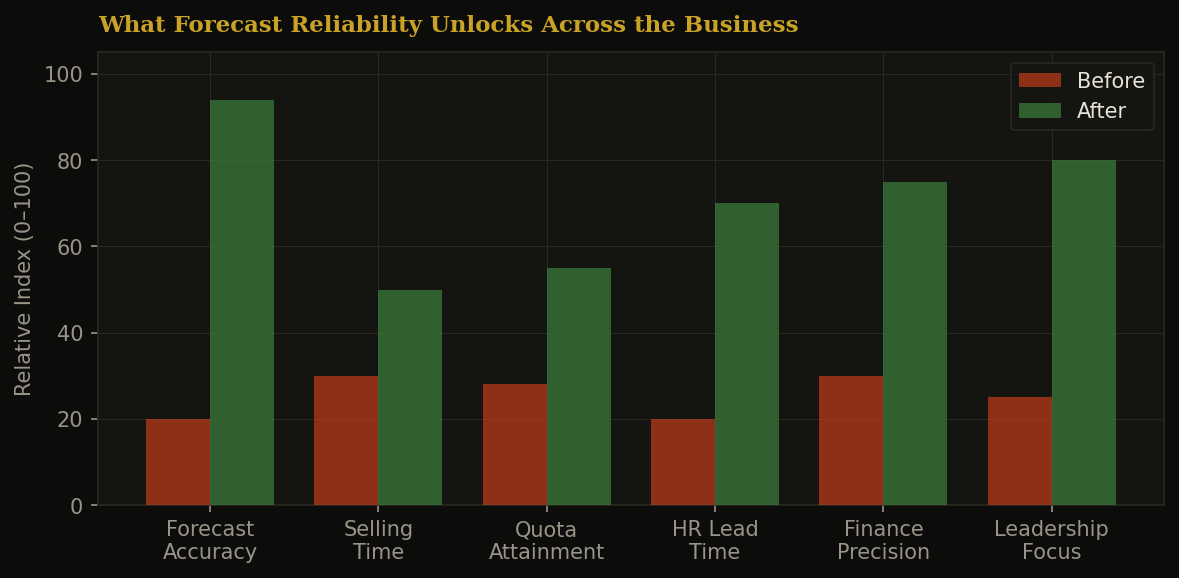
Illustrative impact across business functions — traditional forecast vs. AI-native daily guidance.
MANAGING A COMPANY IN REAL TIME
The most volatile, least reliable, most consequential input into any business, future revenue, has gone from a periodic polling-based estimate to a continuous, buyer-grounded, AI-updated signal.
Companies have historically managed revenue volatility by building buffers into every downstream function. Cash reserves for forecast misses. Hiring freezes when the number comes in light. Emergency budget cuts when the quarter falls short.
Remove the uncertainty and you remove the need for the buffers.
The capital that was sitting idle as insurance against forecast failure becomes capital available for offense. The leaders managing consequences are now managing growth.
Companies do not need safety margins when they have reliable signals. The capital held as insurance against forecast failure becomes capital available for offense.
One Example. One Decade. What It Means for Everything Else.
We have been doing this in the GTM world for ten years.
One process. Rebuilt from first principles. Deployed for clients in days. The result is not a feature update. It is a different kind of company on the other side of it.
But here is what I want you to understand. The sales forecast is not special. It is just the example I know best because I have been living inside it for a decade. Every company, in every industry, is running its own version of Forecast Friday. A process that calcified long ago. A metric designed to hide the failure of the method. A cost that nobody added up. A ritual defended by the people whose careers are built on executing it.
This is exactly what we mean when we say software is dead.
Not that software stops running. That the operating model built on top of software, the SaaS stack, the workflow, the weekly ritual, the human-in-the-loop assumption, stops being the ceiling. AI does not fit into that model. It replaces it. What gets built on top of AI looks nothing like what got built on top of software, for the same reason that what got built on top of the internet looked nothing like what came before it.
And this is what we mean when we say the race is on.
Not a race to adopt the best AI tool. A race to rebuild from first principles fast enough that the companies still running Forecast Friday do not realize they have already lost until the gap is too wide to close.
The companies that win will not be the ones that added AI to what they had. They will be the ones that looked at what they had, asked which parts should not exist, and built something new from what remained.
The race is not to adopt the best AI tool. It is to rebuild from first principles fast enough that the companies still running Forecast Friday do not realize they have already lost.
I chose the sales forecast for this article because it is the oldest, most calcified, and most universally recognized example in GTM. But it is one of dozens we have rebuilt from first principles over the past decade. Territory design. Onboarding. Quota setting. Handoff from marketing to sales. Pipeline review. Every one of them had the same fingerprints: a goal that made sense, a method that drifted, a metric that learned to hide the failure, and a constituency that had organized around defending the process rather than achieving the outcome.
If you want to hear more of these, the mechanics, the before and after, what the rebuild actually looked like, let me know and I will keep writing them.
Next up: the space industry. Specifically how the founders of Spire Global asked a simple question about what a satellite actually needs to do, and built a constellation of shoebox-sized cube satellites that compete with assets costing hundreds of times more. Same method calcification. Same inherited assumption. Same categorical leap when someone refused to accept the inherited question. Different industry. Same logic.
In the meantime, start here. Pick one process your organization treats as essential. Ask what it is actually supposed to accomplish. Measure it honestly, not charitably. Ask who benefits from the process continuing to exist.
The answers are usually uncomfortable.
They are also usually the most valuable thing you can learn.