The AI Shuffle
Your teams came in with a deck. Old tools on the left, new tools on the right. Same boxes. Same workflows. Same logic. Just .ai instead of .com. It looked like transformation. It was a shuffle. And it’s happening in almost every company I walk into right now


Stephen Messer, Co-founder of Collective[i] and LinkShare (sold to Rakuten for $425M, 1996–2005). EY Entrepreneur of the Year/Deloitte Fast 50 winner. Board member, Spire Global (NYSE: SPIR). Building intelligence.com
I'm in a board meeting. The presentation has been going for twenty minutes. The slide on screen is a grid — logos on the left, logos on the right. The left column is the current tech stack. The right column is the new one. Salesforce is still there, just with an AI layer bolted on. The marketing automation platform has a new name ending in .ai. The forecasting tool has been swapped for something with "intelligence" in the product name. The SVP who built the deck is walking through each row, explaining how the new tool does what the old tool did, but smarter. The board is nodding. The CEO is nodding. I'm watching the company's competitors build an entirely different business while this room congratulates itself on having done the work.
That's the AI shuffle. You recognize it when you see it. Most boards don't see it until the damage is already priced in.
It's not laziness. It's not stupidity. The people doing the AI shuffle are rational actors responding to a situation that almost guarantees they'll do it. Understanding why it happens is the only way to stop it.
The numbers are brutal
Before the why, the what. Here's what the AI shuffle produces — measured.
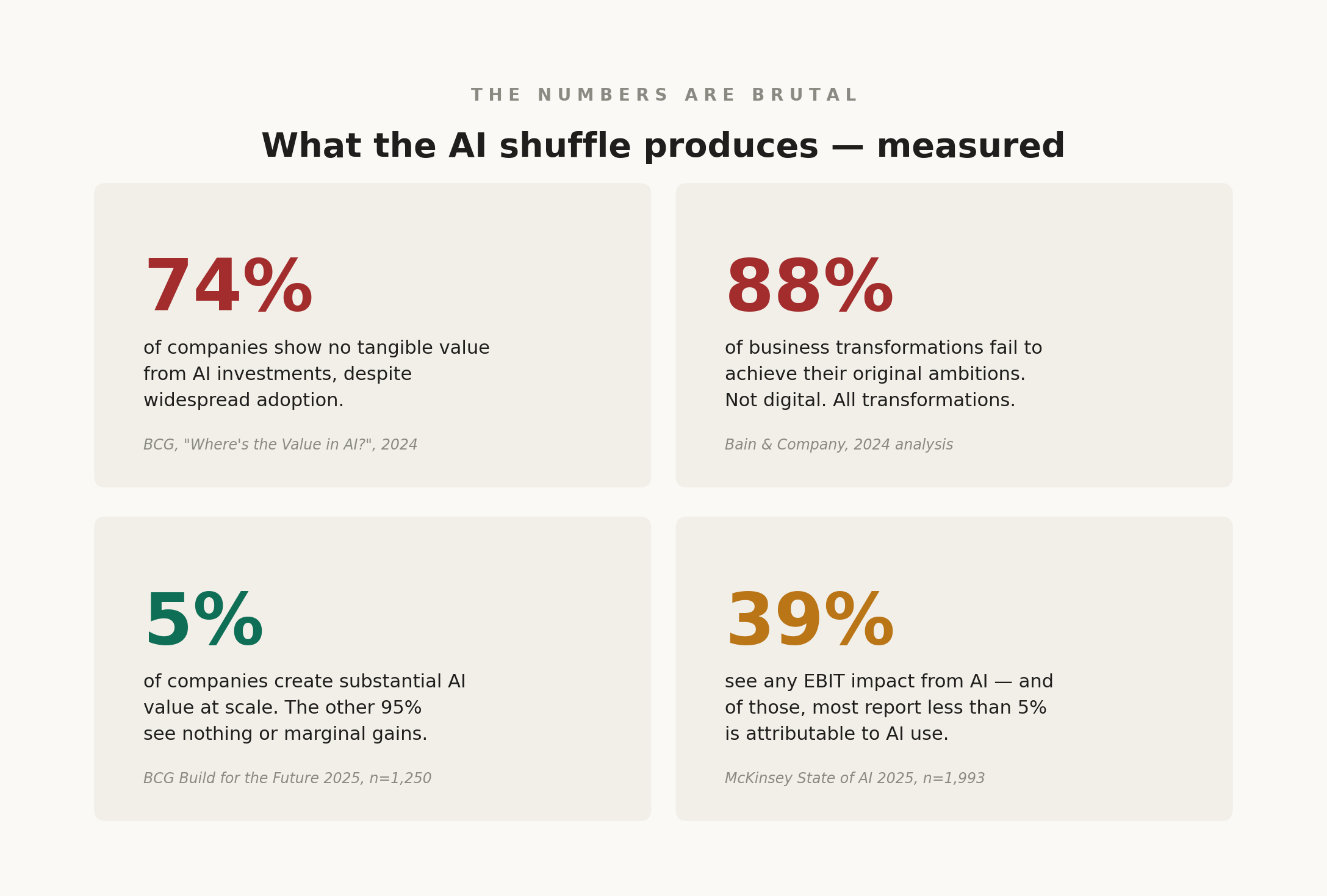
Think about that last one. 88% of companies are now using AI in at least one function (McKinsey, same study). Nearly all of them. But only 39% see any profit impact at all — and when they do, it's less than 5% of earnings. You've spent the budget. You've done the implementations. You've sat through the vendor demos and signed the contracts. And the P&L has barely moved.
That's not a coincidence. That's the shuffle, measured.
BCG put it plainly in their 2025 analysis: companies that see real AI value don't buy more tools — they redesign around fewer, better outcomes. Leaders focus on roughly 3.5 use cases. Everyone else chases 6.1. The winners go deep. The shufflers go wide. Going wide produces exactly the numbers above.
Why it happens: four characters you already know
Every company running the AI shuffle has at least one of these people in the room. Usually all four.
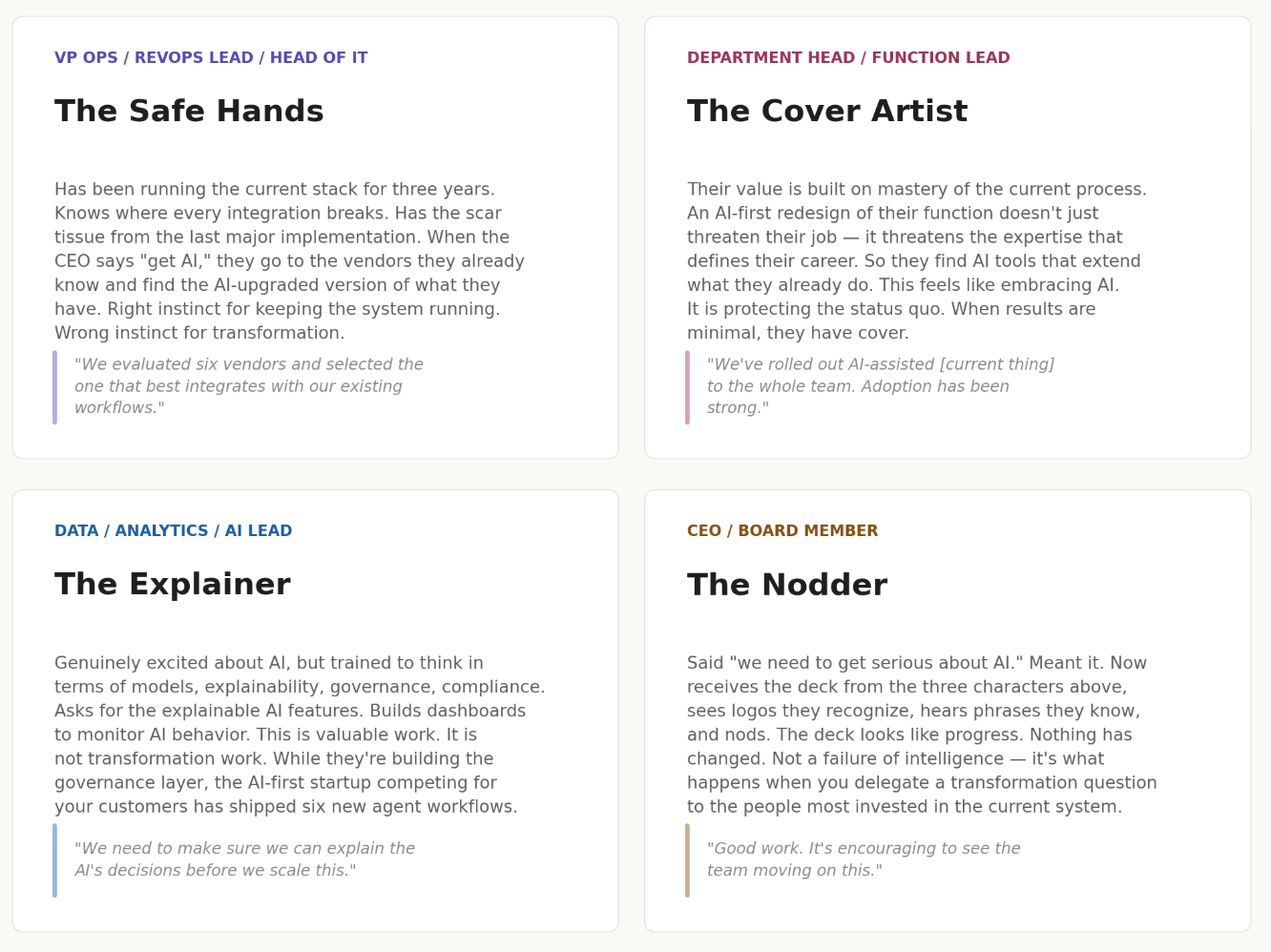
Christensen named the underlying dynamic in 1997. The Innovator's Dilemma showed how the same practices that make companies great — listening to customers, protecting margins, managing risk — make them structurally incapable of responding to disruption. What he called "sustaining innovation" (making what you have incrementally better) always beats "disruptive innovation" (building something different) inside an established organization. The AI shuffle is sustaining innovation wearing a disruption costume.
The companies capturing real value don't improve existing workflows. They throw them out. BCG's study of AI leaders found they put 70% of AI resources into people and process redesign, and only 30% into technology and algorithms. The shufflers do the reverse. They buy the algorithms and hope the organization changes around them. It doesn't.
What the shuffle actually looks like
Walk through a real example. Here's what a typical mid-market company's "AI transformation" deck shows after six months of initiative:
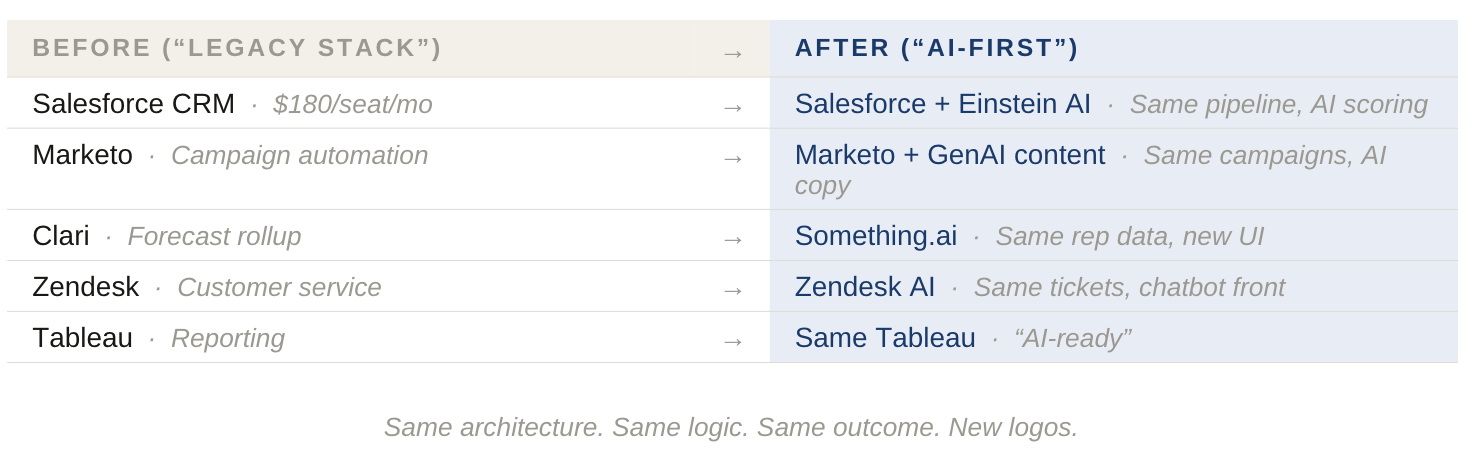
The architecture is identical. The data still lives in the same silos. The workflows still require the same human decisions at the same checkpoints. What changed is the vendor names and the price of the contracts.
Now look at what an AI-first company is building in that same time period. Not better CRM. An agent that researches accounts overnight, drafts personalized outreach, flags risk signals before the seller's day starts, and updates the system of record automatically. Not a chatbot on top of Zendesk. An agent that resolves 70% of support cases without a human in the loop, learns from every resolution, escalates with full context already assembled. The gap isn't a feature gap. It's a philosophical one. One is process-first. The other is outcome-first.
The shuffler asks: how do I do what I currently do with AI? The AI-first company asks: what would I build if none of my current workflows existed? These are not different versions of the same question. They produce different companies.
You've seen this before, you just called it .com
In the late 1990s, I ran LinkShare — one of the first affiliate marketing networks. I worked with every major retailer trying to figure out what the internet meant for their business. I watched it happen across dozens of companies: leadership would measure their website against their store portfolio. "Our website is doing about the same revenue as our store in [midsize city]." Good shorthand for getting the board to take it seriously. Catastrophic framing for building the right thing.
Because while they were thinking about the web as another store — another channel, another revenue line — Amazon was asking what you could do online that you couldn't do in any store. Endless selection. Dynamic pricing. Network effects from reviews. Personalization at scale. A logistics operation that eventually made two-day delivery the baseline expectation for all of commerce.
JC Penney measured its website against a store in Topeka. Amazon was building the end of JC Penney. Same era. Same internet. Completely different questions.
Seth Godin wrote it plainly in Purple Cow: being remarkable isn't about being better at what everyone else is doing — it's about being worth talking about. The companies that survived the internet era weren't the ones that built better online versions of their existing business. They asked what the internet made possible that hadn't been possible before. The .ai is the new .com. The shufflers are building websites that look like stores. The AI-first companies are building Amazon.
Three questions to ask this week
Not next quarter. This week. In your next leadership meeting, before you approve another vendor contract or sign off on another implementation budget.
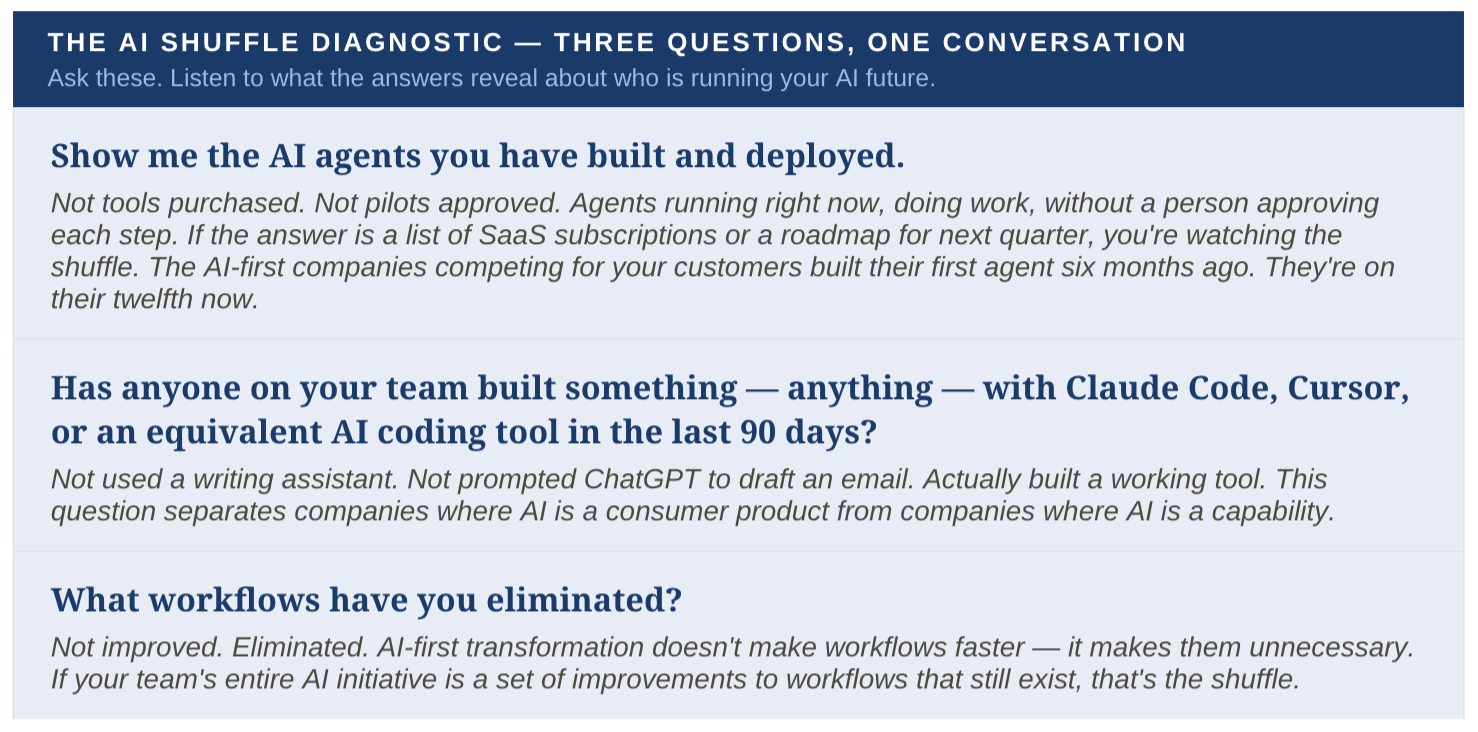
If the answers are "none," "no," and "we haven't eliminated anything yet" — you know what's happening. You're not in an AI transformation. You're in an AI renewal cycle. New contracts, same architecture, same outcomes.
That's not a failure of the people you hired. It's the predictable output of asking the wrong question. You said "get AI." They got AI. What you should have said is "show me what we can stop doing because AI does it better." That's a different conversation. It produces a different company.
Read these
Three books that frame exactly why this keeps happening, and why it's so hard to stop from inside an organization:
01. The Innovator's Dilemma — Clayton Christensen. The original diagnosis. Christensen shows how the same management practices that make companies successful make them structurally unable to respond to disruption. Good companies fail not despite doing everything right but because of it. The AI shuffle is Christensen's "sustaining innovation" in a new costume. If you haven't read it, read it now. If you have, reread chapter four.
02. Purple Cow — Seth Godin. Godin's argument: in a crowded market, safe is the riskiest strategy. The AI shuffle feels safe — it looks like progress, it protects the existing stack, it avoids the uncomfortable conversations. But fitting in is failing. The companies doing the shuffle aren't standing still. They're moving backward relative to anyone asking the transformation question.
03. Only the Paranoid Survive — Andy Grove. Grove's "strategic inflection point" — the moment when the rules of your industry change so fundamentally that the old map stops working — is exactly what's happening right now. Grove's lesson: most leaders don't recognize the inflection point until they're already past it. The AI shuffle is what happens when you feel the inflection coming and respond with a sustaining move instead of a strategic one.
BCG's research on AI leaders found one thing that separated them from everyone else more than any other: they didn't try to do more with AI. They chose to do different with AI. They redesigned around outcomes, not processes. They asked what they could eliminate before they asked what they could improve. They treated AI as an architecture question, not a vendor question.
Sources & data
74% no tangible AI value: BCG “Where’s the Value in AI?” survey of 1,000 CxOs, 59 countries, October 2024 · 88% transformations fail: Bain & Company 2024 · 5% create substantial value at scale: BCG Build for the Future 2025, n=1,250 · 39% see any EBIT impact, most under 5%: McKinsey State of AI 2025, n=1,993 in 105 nations, November 2025 · AI leaders focus on 3.5 use cases vs 6.1: BCG “Closing the AI Impact Gap” 2025 · 70% of AI investment in people/process: BCG AI leaders analysis 2025 · 88% companies using AI in at least one function: McKinsey State of AI 2025 · Christensen sustaining vs disruptive innovation: The Innovator’s Dilemma, Harvard Business School Press, 1997 · Godin: Purple Cow, Portfolio, 2003 · Grove: Only the Paranoid Survive, Currency Doubleday, 1996