Access Capital. The Richest Firms in Venture. The Easiest to Replace.

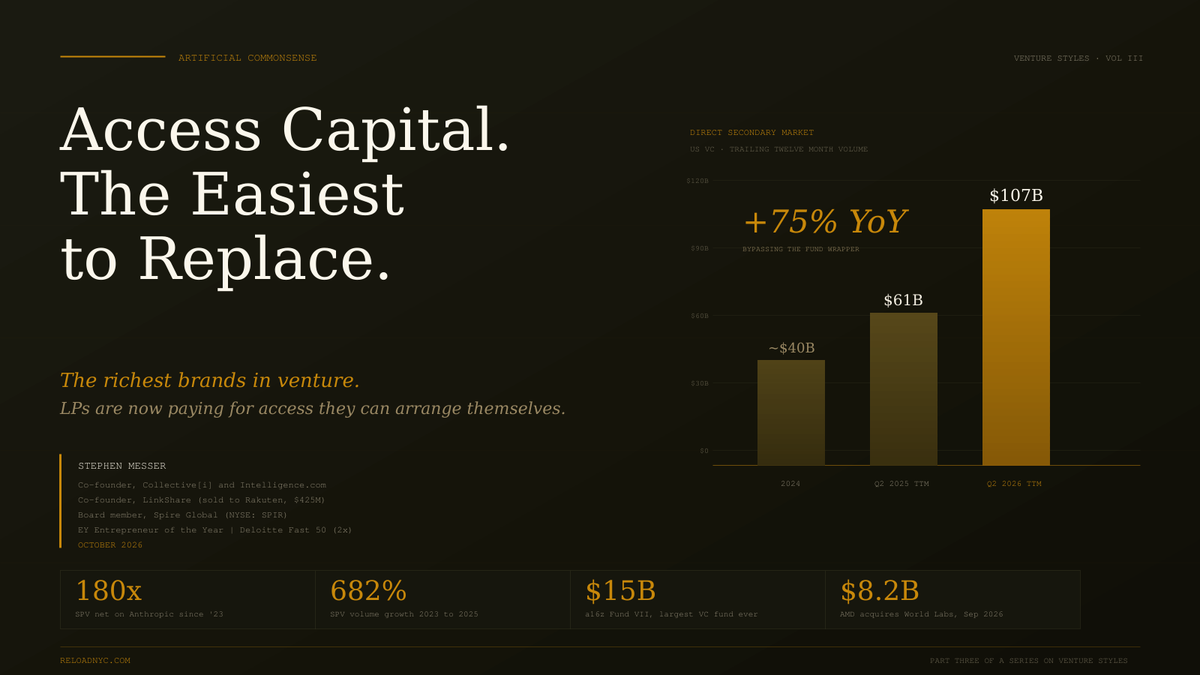
a16z, Sequoia, Benchmark, General Catalyst. The biggest brands in the business sell access to the hottest deals. The founder cares about the check, not the logo. Family offices and hedge funds already figured this out. The $120 billion secondary market just made it operational.
By Stephen Messer
Co-founder, Collective[i] and Intelligence.com. Co-founder, LinkShare (sold to Rakuten, $425M). EY Entrepreneur of the Year / Deloitte Fast 50 Winner (2x). Board member, Spire Global (NYSE: SPIR). Join me at Intelligence.com.
November 2026
a16z closed Fund VII in January at $15 billion, the largest venture fund in history. If the firm hits its numbers, the returns will come almost entirely from four or five companies everyone in the business already knows the name of. OpenAI. Anthropic. xAI. Databricks. Cursor. The LPs who paid two and twenty for a16z to buy them tickets into those names are starting to realize they could have written the checks directly.
The trade is older than the fund. For fifteen years the smartest single move in venture was to pay whatever the founder asked and trust growth to close the gap. DST wrote $200 million into Facebook in 2009 at a $10 billion mark half of Silicon Valley called insane. Facebook went public three years later at $104 billion. a16z led the Coinbase Series B in 2013 at a $25 million post that most institutional investors would not touch. At Coinbase's direct listing in April 2021 that stake was worth over $11 billion. Pay what the founder asks. Let growth do the work. Collect the carry on a 100x. For a decade and a half this has been the single most profitable trade in venture, and the firms that built their whole fund strategy around it have become the biggest brands in the business.
The founders who built it were not Silicon Valley royalty when they started. Marc Andreessen was best known for losing the browser wars. Netscape, the company he co-founded, had been crushed by Microsoft Internet Explorer and sold to AOL in 1998 as the consolation prize. Ben Horowitz was his lieutenant. The two of them built Loudcloud, pivoted it into Opsware, sold it to HP in July 2007 for $1.6 billion in cash. A good outcome. Not a Google outcome. In July 2009 they raised a $300 million first-time venture fund on the view that every disciplined firm on Sand Hill was underwriting the wrong thing.
What they figured out is what every first-principles founder figures out when they look at a system nobody has questioned in a generation. The business-school rule against overpaying is what kept the disciplined firms out of Facebook, out of Google, out of every outlier that paid for the entire industry. The access thesis is the inverse. If the company is already working, pay what it takes to get in. The job is not to find the winner. The job is to be in the winner when the rest of the market finally agrees. Within three years, Fortune called a16z the hottest venture firm on the planet. Fifteen years later it has over $90 billion in AUM. They ran past Kleiner Perkins, past Accel, past almost every brand that had been on top for a generation. They did it by refusing to be disciplined about price.
This is the third piece in a series on venture styles. The first, Value Venture Capital, was about the guy who applies public-market discipline to a private-market asset class and misses every winner. The second, The Conviction VC, was about Jurvetson writing the SpaceX check in 2008 when nobody else would. The access VC figured out that neither of those matters once the deal is obvious. It is the smartest trade in venture over the last decade. It is also, I am going to argue, the trade the LP is now overpaying someone else to execute, at exactly the moment family offices, hedge funds, and sovereigns are running it directly for a fraction of the cost.
What access capital actually is
Access capital is the model where the largest venture firms stopped underwriting the next great company and started paying up for allocation to the obvious winners. The firms still write seed checks. The returns the LP sees come from the mega-rounds at the top. Everyone already knows the name. The founder has ten offers on the table. The firm's edge is being the one who gets a slot in the round, and the way they get it is by paying the price.
a16z closed Fund VII in January at $15 billion, the largest VC fundraise in history, with AUM above $90 billion. Sequoia sits around $85 billion, holds $6 billion in xAI, and a Stripe stake worth roughly $21.5 billion. Benchmark raised its first-ever growth fund in June 2026 as part of a $2 billion raise, breaking the model that defined the firm for thirty years. General Catalyst raised $8 billion in October 2024, AUM above $32 billion, and bought Summa Health in Ohio through HATCo for $515 million. General Catalyst is the one firm in this group running a real experiment with structure. The rest are running the same play at a larger size.
The access capital pitch, in one sentence
Give us your capital and we will get you into the rounds you cannot get into on your own, at whatever price the founder asks, because we are the one firm the founder answers the phone for.
Everything in the pitch depends on that last clause. Founders answer the phone because of brand, network, marketing engine, and alumni referrals. Give the LP a reason to believe the phone still rings and the pitch works. Until recently, it did.
The counter-argument, and why it is partly true
The access capital partners read a piece like this and send a reply pointing at Speedrun. a16z's Speedrun is a real gaming accelerator writing $750K to $1M checks, running its fifth cohort in 2025. Sequoia has Arc. Benchmark still writes early-stage checks. All real. The question is not whether these firms do early-stage venture. The question is where the LP returns come from. On a $15 billion fund, a $1 million seed check that returns 100x contributes 0.07 percent. A $500 million check into Anthropic that marks up 15x contributes 50 percent of the fund. Both matter to the brand. One is why the LP wrote the check. The pitch to the sovereign writing a nine-figure commitment is not about Speedrun. It is about Anthropic, OpenAI, xAI, Stripe, Databricks, Cursor. The seed program is the brand's reason for existing. The growth check is the return. Two different businesses that share a logo.
What access capital actually sells, past the willingness to pay
The second lever is marketing and talent, and it has to be understood before the thesis of this piece makes sense. a16z has 300+ employees. Sequoia has 200+. Both firms employ ex-operators, ex-journalists, PR teams, policy teams, recruiting teams. For a founder choosing between a $20 million check from a16z and a $20 million check from a hedge fund the founder has never heard of, the choice has historically been obvious. The firm sells itself as a value-add. The LP pays for the value-add through fees. The founder pays for it through dilution the firm captures at the entry round.
The counter is the solo GP who knows a sector better than any 300-person firm ever will. Elad Gil has quietly outrun almost every brand on a book that includes Stripe, Airbnb, Pinterest, Square, Instacart, Perplexity, Figma, and Anthropic, writing checks on his own capital and a modest fund. Yossi Vardi did the same thing in Israel for twenty years before him. These are the conviction investors I covered in the last piece. One operator who sees a market before the consensus will beat a firm with a thousand associates every time, because the firm's job at scale is to deploy, which forces consensus. The a16z or Y Combinator cohort now ships with published investment theses. They are not hunting great founders with new ideas. They are hunting consensus founders. Consensus exits rarely go supernova.
The access capital setup is also flipping on the founder's side. If the same $20 million check comes in as common stock, with no board seat, from a hedge fund or family office that writes fast and leaves the founder alone, the a16z brand starts to feel like a leash rather than support. The founder can hire the comms person, the recruiter, and the policy consultant on salary and still have most of the capital left for the business. The value-add that justified the brand becomes a line item the founder can budget for directly.
Meanwhile, nobody mentions NEA anymore.
NEA is still one of the largest venture firms in the world. The firm manages around $25 billion. It closed Fund 17 at $3.6 billion in 2020, closed a $6.2 billion pair in 2023, and operates one of the only true early-stage-to-growth continuity models left. Scott Sandell handed the executive chairmanship role to Tony Florence and Mohamad Makhzoumi, who now run the firm as co-CEOs. NEA still invests the way venture firms used to invest. Find a great founder early. Lead the Series A. Build the company over a decade. Do not pay above where the business supports. The firm has produced companies ranging from Databricks to Robinhood to Hims to Tempus and continues to put up top-quartile returns in several vintages.
Ask the next twenty founders you meet to name five venture firms. a16z, Sequoia, Benchmark, Founders Fund, Khosla. Access capital brands fill the list. NEA, which was the brand to beat for most of the 1990s and 2000s, almost never comes up. That is not because NEA stopped working. NEA still works. It is because NEA did not spend the last decade turning itself into a media company, which is what the access capital firms did, and it is what founders now treat as the signal that a venture firm is relevant.
NEA is the control group for this piece. Same scale as the access firms. Different style. Different marketing. Different media presence. The returns are perfectly respectable. The brand recognition outside the LP community has quietly collapsed. If you want to see what access capital is actually spending its fees on, compare the two.
Why the model worked, and why that is the problem.
For fifteen years access capital produced the top returns in venture. The explanation is the one I made in the Value VC piece. Growth closes the gap. If you pay $10B for Facebook in 2009 and the company is worth $104B three years later, your entry price was a rounding error on the outcome. If you pay $4.55B for Anthropic in 2023 and the company is worth $965B in 2026, same answer. The math of a power-law asset class means being in the winning deal pays for every other mistake. Access capital was built around that single insight.
The problem is that nothing in that insight is proprietary. The thesis works for anyone who can write the check and get into the room. The brand got the firm into the room for a long time. The brand is no longer the only way in.
The Dead Presidents thesis.
I ran a test on this with the founder of a $4 billion AI company last month. I asked what he actually got from his lead investor, one of the top three access capital firms. Standard answer. Great brand. Great network. Opens doors. I asked if he would have taken the same check from Bill Ackman at the same valuation. He paused and said yes, probably. From Steve Cohen? Yes, faster. From an endowment he had never met? Yes, if the terms were common stock and the capital landed in a week. From a family office in his specific sector who ran a drama-free diligence process? He laughed and said that was already who most of his later rounds came from.
No VC brand matters more than dead presidents. When a founder is raising at a $4 billion mark and the check is $100 million, the brand on the term sheet is a tiebreaker, not a reason. The reason is price, speed, and terms. The access firms still win plenty of those tiebreakers. They do not win them for free. When the alternative capital source gets smarter about pricing and terms, the tiebreaker shrinks to nothing. A family office with a stake in a specific sector often wins outright. If I am building an AI company for film, the Comcast family or John Malone's team is a better partner than any Sand Hill firm, because the family office brings customers, distribution, and credibility a generalist cannot match.
The access brand is only worth what it saves the founder. When family offices, hedge funds, and corporate strategics match the price, the speed, and the terms, the brand saves nothing. It becomes decorative.
The SPV just ran the experiment.
OpenAI, Anthropic, SpaceX, and Databricks never really needed traditional venture capital. The rounds got too big for the fund model early, and the founders already had direct access to larger pools of money. Venture firms showed up because they had to. So did everyone else who knew the founder from school, or who knew wealthy people who did. Those allocations became SPVs. Venture capital was not fighting other venture capital for the slot. It was fighting the kid who went to Stanford with the founder and had $500,000 of his own money, who then syndicated the rest through a Slack channel of friends. Secondary SPV transactions through Sydecar alone rose 682 percent from 2023 to the end of 2025. Direct secondary hit $107 billion in trailing-twelve-month volume as of Q2 2026, up from $61 billion a year earlier.
The math is why it keeps growing. Median SPV carry is 15 percent, five points below fund convention. Only 53 percent of SPVs charge a management fee at all, and 80 percent of those charge it for one year rather than for the life of the vehicle. The LP who got into Anthropic through an SPV at the Series C in May 2023 at a $4.55 billion post is marked today at a 212x gross. Net of SPV carry, the LP keeps roughly 180x. The same exposure inside a $15 billion access fund is diluted by every losing position in the book and taxed by 2 percent management fees for the life of the fund. On the exact same winner, the direct holder captures multiples more.
Friends of founders are the sharpest version. In every major AI round there are checks that come from the founder's own circle. Early employees from a prior company. People the founder wants on the cap table personally. Those come in at round price or better, with no wrapper, no carry, no management fee. The returns beat every a16z fund by orders of magnitude. The sophisticated LP who used to wonder how to get in now wonders whether to hire the person who already knows the founder.
The companies pushed back. Anthropic says it does not permit SPVs. OpenAI and SpaceX put terms in their round docs limiting SPV sales. The pushback changes the structure, not the demand. Tender offers the companies run are now in the billions. Direct secondary from employees and early investors remains open. The $107 billion market exists because the demand to bypass the fund wrapper is real and the structures to serve it keep multiplying.
This is the new alpha. The LP writes small checks into a basket of the dozen names everyone agrees are the AI winners of this cycle. Most produce modest returns. One produces a return big enough to pay for the entire basket. Any hedge fund, family office, endowment, or sophisticated individual can run it. The only edge the access firm ever had was knowing which names to pick. Once the market is naming them for you, the edge is gone.
Who already figured this out
The LPs who used to pay 2 and 20 for access are running direct programs now, and the early movers have produced the sharpest returns in the industry. Leopold Aschenbrenner's Situational Awareness, which I covered in the VVC piece, launched September 2024 with $225 million and returned 439 percent net through the first half of 2026. The public book blew up in July 2026 when the AI capex trade reversed and Aschenbrenner was forced to sell to Citadel, dropping AUM from $45 billion to roughly $10 billion in days. The private positions, including Anthropic, Fluidstack, and MatX, stayed intact and are still worth multiples of what the fund paid. Brad Gerstner's Altimeter runs the same model with public hedging. $20 billion AUM today, public book compounded at 29.5 percent annualized since 2011, direct stakes in OpenAI, Anthropic, Cursor. Thrive Capital in New York led the recent OpenAI round at a $500B valuation and owned Instagram before Facebook bought it. None of them paid a venture firm for access.
The banks are in it too, which is the signal the trade has gone fully mainstream. When Jeff Bezos closed the Series B on Project Prometheus in June 2026, a $12 billion round at $41 billion, the investors were JPMorgan, BlackRock, Goldman Sachs, DST Global, and Arch Venture Partners. Not a traditional venture syndicate. The banks packaged their allocations into SPVs for their private wealth clients. Morgan Stanley and Goldman both ran SPVs for Anthropic's $30 billion February 2026 raise. Morgan Stanley charged 1 percent management with no co-invest. Goldman charged 1.25 percent plus 17.5 percent carry over an 8 percent hurdle, co-investing alongside clients. Both are materially cheaper than any access fund, and both put the richest LPs in the country into the deals they used to pay 2 and 20 for.
Three reasons direct beats fund.
Fee math. An LP commits $100 million to a venture fund. The fund invests in 30 companies. 20 go to zero. 8 return capital. 2 are rocket ships that return 25x. The fund produces 3.5x net. Now run the same money direct. The LP picks the same 2 rocket ships. No 2 percent fee. No 20 percent carry. No 20 zeros dragging the blended number down. The reason the LP used to pay 2 and 20 was that picking the rocket ships was impossible. That logic held when the rocket ships were obscure early-stage companies. It stopped holding when the rocket ships are OpenAI, Anthropic, SpaceX, xAI, Databricks, and Stripe. Fund LPs pay for the losers. Direct LPs do not. On a known winner, that difference is the whole return.
Liquidity. Venture funds have 10 to 15 year lives. The LP's capital is locked. Marks are quarterly, lagged, and unreliable. The direct position changes all of that. The LP owns the stake. The secondary market gives it a price. The US VC secondary market hit $121.7 billion in trailing-twelve-month volume as of Q2 2026, up from $61 billion a year earlier. The LP who owns Anthropic directly can sell to that market anytime. The LP who owns the position inside an a16z fund can sell the LP interest at a 15 to 25 percent discount, only when the GP permits a transfer. Common stock makes the secondary market work. Preferred stacks slow it down. Any direct investor writing a $50M+ check into a growth-stage company should be asking for common. Many are. Founders who want speed say yes.
Capital flexibility. Venture firms do equity. Hedge funds and family offices do equity, debt, convertibles, SPVs, and secondary from founders. A late-stage company that needs $200 million of growth capital often wants half of it as something other than preferred equity. A hedge fund structures the whole package. A venture firm hands the founder off to a referral. Once a founder has had the flexible version once, they do not go back.
Where the access talent goes next
The honest objection to the direct trade is experience. Family offices and hedge funds that have not done venture before do not know the market, the founders, or which deals to run from. That is a real objection, and the solution is already in motion. The next generation of venture GPs who cannot raise another fund are becoming the operating partners, advisors, and sector leads for the direct capital pools that are replacing their firms. The venture associate who spent three years at a Sand Hill firm, learned the market, and did not make partner has value to a Fidelity, a Blackstone private wealth group, a Nvidia venture arm, or a family office trying to build a direct AI book. The fund model is contracting at the mid-tier. The talent coming out of it has somewhere to go. Where it goes is where the next wave of access-equivalent investing happens, without the fund wrapper.
Who is already winning the biggest AI outcomes without the access brand
The cap tables tell the story. Anthropic's Series F and the follow-on at $965B in May 2026 were led by Microsoft and Nvidia, who together committed up to $15 billion in November 2025. OpenAI runs through Microsoft, Thrive, SoftBank, Fidelity, and sovereigns. Fidelity has been in SpaceX since the early rounds and sat on a multi-decade mark when the stock priced at a $220 billion float in June 2026. Databricks is Fidelity, Baillie Gifford, Capital One. xAI took in more from sovereigns than from the VC syndicate. a16z and Sequoia are in all of these deals. They are not the biggest check in any of them.
The biggest checks came from Microsoft, Nvidia, Fidelity, Baillie Gifford, Thrive, and the sovereigns. None of them paid an access firm to get there. They built the capability in-house, or paid much lower fees to a crossover fund that runs the same book with 1 and 15 instead of 2 and 20.
The hyperscalers are the other squeeze
The ecosystem partnership is the second force pushing access VC returns down. I made the structural case in Karp and Nadella Are Selling You a Wall and The Most Expensive Money in the Room. Microsoft, Nvidia, Amazon, and now AMD do not have to invest in AI companies on terms an LP would call attractive. They invest on terms that lock in chip orders, cloud contracts, and distribution. The compute margin pays back the equity before the equity itself has to perform. Their effective cost of capital on the equity is negative.
Microsoft and OpenAI was the opening act. Nvidia committing up to $15 billion into Anthropic alongside Microsoft in November 2025 was the second. AMD acquiring Fei-Fei Li's World Labs for $8.2 billion in all-stock in September 2026 is the next move, with Fei-Fei Li joining AMD as EVP and chief scientist reporting to Lisa Su. Expect every hyperscaler to pick off a lab whose research closes the loop on its own stack. Amazon has not made its big move yet. Google has not made its big move yet. Both will.
What this does to the access VC is make every hot round more expensive. The hyperscaler can afford to pay more because the equity is only half the trade. The access firm pays the same price without the chip orders or distribution to balance the economics. The two investors are not running the same math. When the hyperscaler bids up the next round, the access firm either bids higher to stay in or gets diluted out. Returns get worse. The LPs notice. The direct market absorbs the capital that would have gone to the access fund.
The trade is moving earlier
Everyone watched the direct trade work on Anduril, OpenAI, Anthropic, SpaceX, and Databricks. The next chapter is the trade moving earlier, into Series B and Series C companies that will be household names in two years. Those companies are easier to spot now because the data on who is actually working travels through the same social and professional networks that produce the deal flow. Common stock makes them easier to get in and out of via secondary. As access gets more competitive at the mega-round stage, direct investors will go earlier. A hedge fund that puts $50 million across ten pre-Series B names in AI infrastructure can afford to lose on eight of them. The one that hits returns the whole book. The access firm's edge was knowing which Series C names to pay up for. The direct investor's edge is going to be the Series A names three years before the access firm shows up.
Access capital does not disappear. The fees do.
Access capital stays around a lot longer than this piece makes it sound. The brands and relationships have real tenure, and that does not evaporate because an LP learned to buy SPVs. What changes is the fee. Fund-of-funds had its fees crushed when LPs figured out they could pick funds directly. The same is coming for access capital. 2 and 20 becomes 1 and 15, then 1 and 10, then co-invest at zero on anything the LP can source themselves. If there is a waitlist to get into these funds today, expect it to evaporate over the next ten years. The people not on the waitlist are the people who will go direct.
What also comes is retail. Expect Vanguard-style baskets of private tech winners, mutual fund structures that give the accredited retail investor access to the same OpenAI, Anthropic, and SpaceX positions the sovereign is now buying through SPVs. The product has not been built yet. The regulatory path is forming. The demand is massive. The access firm's logo on a cap table stops being the only way an ordinary investor gets exposure to the next OpenAI. It stops being any way at all.
General Catalyst is the one firm trying hardest to escape this trap. HATCo and the $515 million Summa Health acquisition are a bet that venture can act like a holding company. The customer value fund is a bet it can price enterprise software contracts directly, lending against receivables instead of taking equity. If any mega-firm figures out the next model, it will be the one most willing to look like a private equity firm the fastest.
What this means if you are an LP today
If you are a sovereign, an endowment, or a $5B+ family office, build the direct capability. Hire two or three people with ten years inside the venture ecosystem and give them the mandate to buy direct positions in named growth-stage companies through SPVs, direct allocations, and the secondary market. Mark the book quarterly. Keep 10 to 20 percent of the venture allocation in a conviction GP relationship for the deals you cannot source yourself, and run the rest direct. If you are a smaller family office or a $50M to $500M allocator, the hedge fund hybrid is the better path. Pay a hedge fund 1.5 and 20 instead of an access firm 2 and 20 and get both a hedge and a direct AI book. If you are a traditional pension, negotiate zero-fee co-investment rights on the fund you already pay. The access firms will say yes, because the alternative is losing the allocation.
Three pieces, three styles, one answer.
If you have read all three pieces, the answer is simple. The conviction VC is worth every penny when you can find one, and you rarely can. Jurvetson writing the SpaceX check in 2008 is one of maybe a dozen bets of that quality any decade produces. If you have access to a conviction fund with real pattern recognition and the stomach to hold through the ugly middle, pay the carry and be grateful. The access VC is easy money that someone else is making. Go direct, run the hedge fund hybrid, or sit on the SPV syndicates the banks are now packaging. The value VC is the one to stay away from. Forty years of returns say so.
The bigger story is the one that matters. Tech is now the economy, and the economy is in the middle of a disruption on the scale of industrialization replacing agrarian life, or services replacing industry. Each of those transitions produced a decade of pain, two decades of reorganization, and then a bigger pie for everyone who stayed in. Each made life significantly better. Intelligence is doing the same thing to everything else. The capital pools pricing growth directly are putting their money where the pie is actually expanding. This is a very good time to be an investor. The LPs who build the muscle for direct investing now, who treat venture style as a decision rather than a default, are the ones who will own the next thirty years of returns. Change is good. Disruption is good. Intelligence is the next pie.
Argue with me.
If you are an access capital partner and think the fee drag is overstated, show me the net-of-fees numbers against a direct portfolio of the same names over the same vintages. If you are an LP who has run both strategies, I want to hear what the direct book missed that the fund captured. If you are a founder who thinks the access firm earned its position on your cap table, I want to know what it did for you that a direct investor at the same price would not have done. Those are the stories that sharpen the thesis.
If you want the next piece in the series, consensus capital when it drops, subscribe here. Next up is momentum capital, the Tiger Global and Coatue model that briefly ate the market and then had to rebuild. After that, ecosystem capital, the Microsoft and Nvidia model that is quietly funding more AI than every venture firm combined.
Collective[i] has spent ten years building a verified relationship graph and an AI model for how the world actually does business. A real neural network, real time-series data, real forecasts running at ninety-three to ninety-five percent accuracy in production.
Intelligence.com opens that same graph to anyone with a professional network worth using. If your capital calls, co-invest introductions, or direct deal flow depend on who you know, this is where the network gets real.
Related reading
- Value Venture Capital. Part one of this series. The guy at every dinner who missed every winner.
- The Conviction VC. Part two of this series. Jurvetson, Founders Fund, Valor, Altimeter, and the firms that build on one deep bet.
- Tech Is Not an Asset Class Anymore. Why venture style matters more than stage now.
- Bubble Talk Is How You Spot Someone Who Missed AI. The tell in real time.
- Big Tech, Wall Street, and Sovereigns Just Took AI Away from VC. Where the biggest checks are actually coming from.
- The SaaS Debt Trap. How the biggest access-firm portfolio category is being replaced from under them.