Consensus Venture Capital. The Hot Tub Investor.

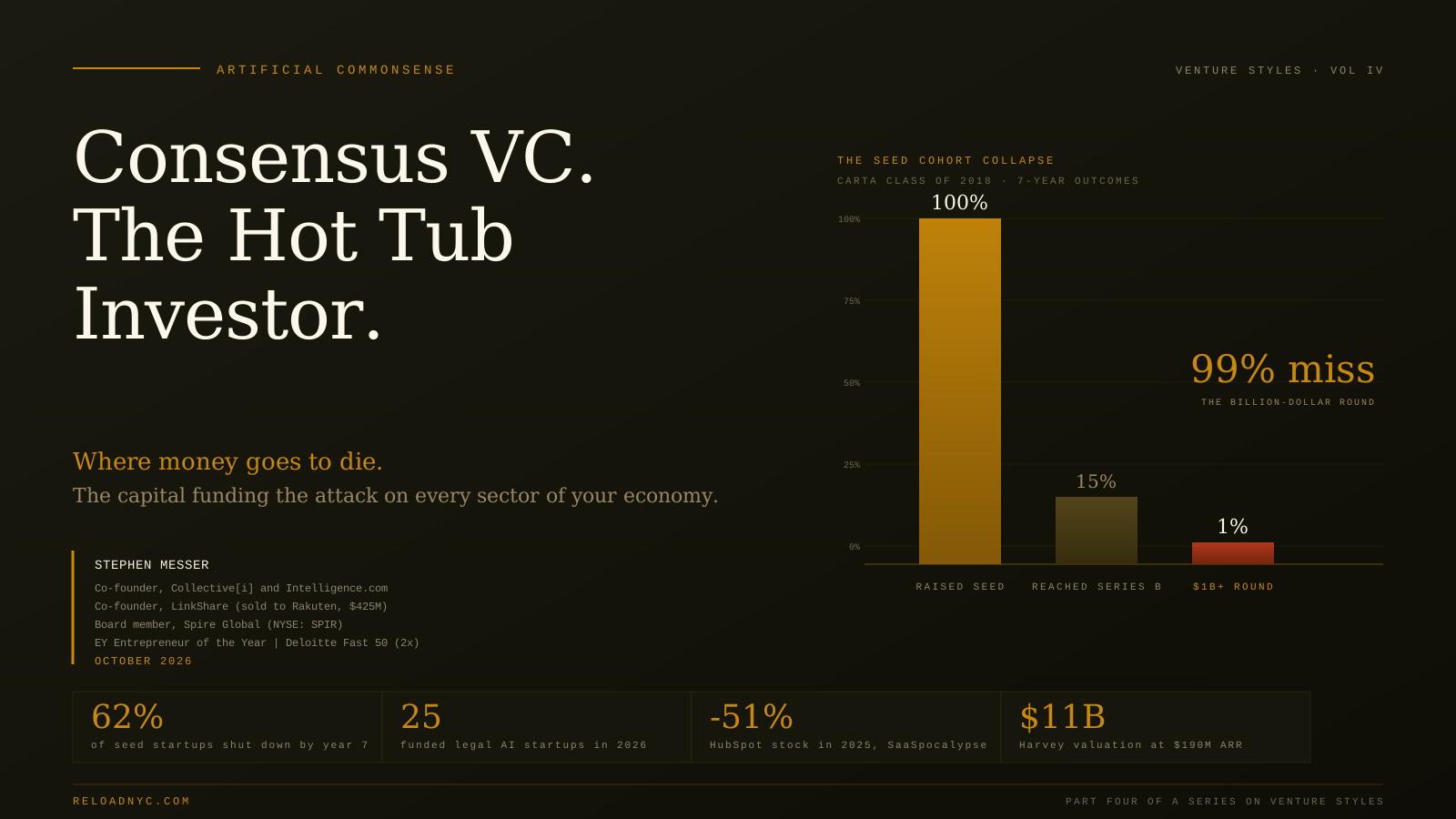
Y Combinator used to find founders. Now it posts a list of problems and waits for applications. Carta says 62 percent of seed startups shut down within seven years. Roughly 1 percent raise a billion-dollar round. This is the biggest and laziest style of venture capital in history, and it is funding the attack on every sector of your economy.
By Stephen Messer
Co-founder, Collective[i] and Intelligence.com. Co-founder, LinkShare (sold to Rakuten, $425M). EY Entrepreneur of the Year / Deloitte Fast 50 Winner (2x). Board member, Spire Global (NYSE: SPIR). Join me at Intelligence.com.
November 2026
In late April 2026, Y Combinator published its Summer 2026 Request for Startups. Fifteen categories. Software for Agents. Company Brain. Dynamic Software Interfaces. SaaS challengers for ERP, chip design, industrial control. Counter-swarm drone defense. Inference chips for space. Lunar manufacturing from molten regolith. Each one came with a short description of the problem the incubator wanted founders to solve. The application window closed days later.
This is not the YC that funded Airbnb when two guys were renting air mattresses in a San Francisco apartment because they could not make rent. Or Dropbox when every serious investor said file sync was a solved problem. Or Reddit, Stripe, Coinbase, DoorDash, Twitch, or Cruise. None of those companies would have been on a posted list. The people building them were two or three years ahead of any list anyone was writing.
What is on that web page is a paid hackathon for Big Tech alumni and Ivy League grads looking for a resume line. If you have never written a check into a startup, here is why you should care. Tech is coming for every sector of the economy at once. Pool service. HVAC. Auto repair. Insurance. Elder care. The capital funding that attack is the biggest and laziest style of venture capital in history. Welcome to Consensus VC. The hot tub investor. Where money goes to die.
This is the fourth piece in a series. Value Venture Capital is the guy who lectures founders on price and misses every winner. The Conviction VC is Steve Jurvetson writing the SpaceX check in 2008 when nobody else would. Access Capital is a16z and Sequoia paying up to be in every deal everyone else has already named. The fourth style is the biggest by headcount, by dollars, and by distance from how real companies get built.
What a Consensus VC actually is
Consensus VC is a style, not a firm or a person. It is the discipline of putting money into the flow with no view of your own on where the flow is going. The partner wants the warm blanket of safety. The same vest. The same shoes. The same clubs. The same dinner party where everyone repeats what one smart person said and nobody contradicts. The warm water of the hot tub.
The style produces the investor who writes the check into the thirteenth identical company that looks like the one a larger fund invested in six months earlier, who argues the market is huge so there is room for twenty-five legal AI startups and twelve coding agents, and who is first-check lead on number fourteen and number eight.
The thunderdome of sameness.
Pick any hot category. Legal AI in mid-2026 has Harvey at an $11 billion valuation and $190 million ARR, CoCounsel from Thomson Reuters, Lexis+ AI, Luminance at $1.5 billion, Spellbook at $350 million, Ironclad at $3.2 billion, vLex which Clio bought in December 2025 for $1 billion, plus GC AI and Eve.legal. Nine named players. Dozens behind them, each with a 2-and-20 fund writing a $5 million seed and a $20 million A into the next one.
Coding agents is worse. Cursor, Windsurf, Cognition, Replit, Factory, Codeium, Zed, plus every incumbent IDE and every hyperscaler. All raised at a billion-plus. All pitched as the winner. Three or four will survive. The rest will burn out as the frontier labs absorb the surface area the agents sit on top of. The LP who wrote checks into ten of these is not getting a 2-and-20 edge. They are paying someone to buy the index at a markup.
A category with twenty-five funded players is not a market with room to run. It is a signal that the venture industry's hot tub is full and nobody wants to get out.
Most do not get Cursor's outcome
Cursor got the one great exit in that category, and it is worth being honest about why. Cursor was not a copycat. Anysphere was incorporated in 2022 by four MIT students and shipped the editor before most people had heard of an AI code editor. First in the water, not number thirteen. SpaceX acquired Anysphere for about $60 billion in Class A stock, closing August 14, 2026, after Cursor hit roughly $3 billion in ARR. One trade, enormous.
It is not the base case for the twelve coding agent companies behind it. The base case is a slow retreat as the frontier models absorb the surface area the agent was sitting on top of. The real question is what the founders of those twelve copycats do when the window closes. The ones who got in because the consensus was already there are not going to white-knuckle through three bad years. They will look for the next hot list and jump. Ship to ship, resume to resume. Nobody climbs out of a hot tub voluntarily. They just move to the next one.
The Consensus VC's answer, when you push, is that the market is big enough for everyone and the losers will get bought or merged into the winner. Most will not. Carta tracked its Class of 2018 seed cohort through seven years and found 62 percent shut down, 15 percent reached Series B, and roughly 1 percent raised a round of $1 billion or more. CB Insights found 70 percent of shutdowns cite running out of capital as the proximate cause, and 43 percent cite the absence of product-market fit as the root cause.
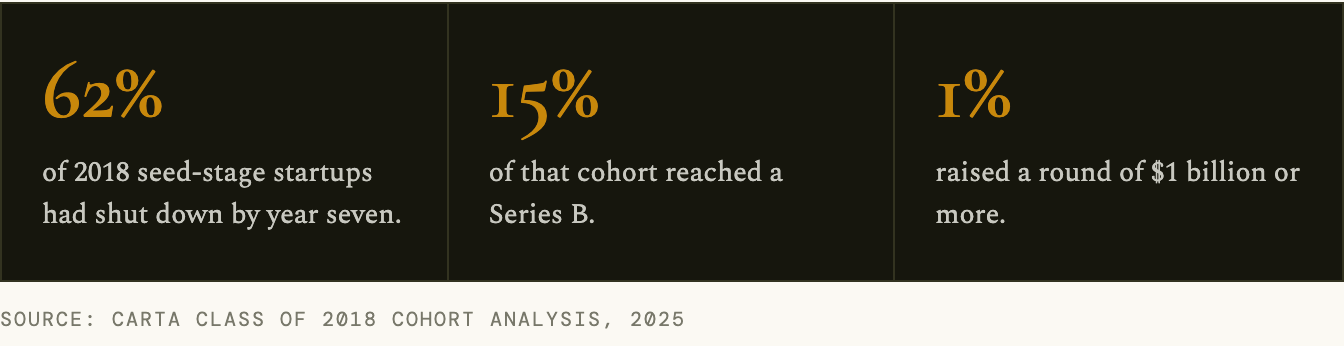
These are not acqui-hire statistics. They are shutdown statistics. The majority of consensus-funded startups do not get bought. They do not get merged. They stop existing. The LP paying 2-and-20 for exposure to that cohort is paying for a lottery ticket at an index-fund price.
The frontier labs are making it harder, not easier. Anthropic's confidential draft S-1, submitted in June 2026 and expected public before the IPO roadshow, tells the market where the application layer is going. Claude, Claude Code, enterprise orchestration, agent runtimes, and the developer surface are shipping together under one contract. OpenAI is doing the same. Google is doing the same. The independent coding agent lives in a smaller space than it did eighteen months ago.
Why rational people cluster into the same ten deals
Herding behavior in capital allocation is one of the most-studied patterns in behavioral finance, and the foundational paper is Scharfstein and Stein's 1990 model of reputational herding. Their argument is simple. When a manager's ability is uncertain and their pay tracks how that ability is judged after the fact, the manager has an incentive to copy the market. The first investor into a category uses their own information. Every investor after that gets more credit for matching than for being right alone.
If the bet works, the thesis gets the credit. If the bet fails, the loss is a market-wide shock that would have fooled any competent manager, so the manager's reputation survives. Scharfstein and Stein called this the sharing-the-blame effect. It is why rational, well-paid people cluster into the same ten deals. Herding is not a character flaw. It is what happens when incentives reward matching more than they reward being right. The side effect is that the market stops aggregating information. Every later investor is reacting to the pattern, not to the business underneath it. That is venture in 2026.
Dan Pink, who spoke at CI Forecast on exactly this, makes the related argument on the human side. His book Drive showed that carrots and sticks fail on creative work. The three things that drive performance on hard, uncertain work are autonomy, mastery, and purpose. The Consensus VC is set up to pay for the opposite. No autonomy because the IC decides. No mastery because the partner moves theme to theme every eighteen months. No purpose because the goal is to look smart to the LP, not to be right about an industry.
The partner is paid to look smart to the partnership. The founder is paid to be right about the market. The two activities almost never produce the same decision. Dan's conversation is on CI Forecast, free to watch after a one-time sign-in at Intelligence.com.
The CVC exceptions, the ones who got it right
Before I go further, I want to be fair. Some corporate venture arms have been exceptional. Julian Brodsky, who sadly just passed away, built Comcast Ventures from inside Comcast and quietly backed real companies for a generation. Nvidia's NVentures under Mohamed Siddeek has become one of the most useful corporate investors in AI, across more than 125 rounds since early 2025. Microsoft's M12 keeps the biggest strategic bets on the balance sheet, which is how roughly $13 billion ended up in OpenAI and how Microsoft and Nvidia together committed up to $15 billion into Anthropic in November 2025. Intel Capital was the archetype for decades. $20 billion into 1,800 companies, over 700 exits. David Horowitz went from Comcast Ventures to Touchdown Ventures, which runs corporate-venture-as-a-service and has done it well for over a decade.
The exceptions are about to get larger, and the reason is the ecosystem deal. Ask anyone running corporate development at OpenAI, Anthropic, Microsoft, or Amazon in private, and they will tell you the biggest wins of the last three years came from investing paired with distribution and product integration, not from investing alone. Capital is table stakes. The GTM pact and the shared product roadmap are where the value transfers.
Microsoft is the proof. The only legacy software giant the public market now treats as AI-first, and it got there by doing two things at once. It put roughly $13 billion into OpenAI, and it built OpenAI into Office, Dynamics, GitHub, Azure, Teams, and Bing. The capital and the distribution were one deal. The market has rewarded it. Through most of 2025, the traditional SaaS cohort was punished for not having done something similar. HubSpot was down roughly 51 percent, Adobe down 35 percent, Salesforce down 31 percent, ServiceNow down 26 percent.
These are not failing companies. They are companies the market has concluded will not own the next cycle, and that debt-funded buybacks are hiding how much of the business is already being replaced. I wrote about that dynamic in The SaaS Debt Trap. CIOs and CTOs are now ripping out SaaS incumbents and replacing them with AI-first alternatives at a pace nobody projected two years ago. The exceptional CVC is not writing checks into the hot category. It is sewing an ecosystem together on behalf of a parent that is otherwise going to lose the next decade.
Y Combinator just told you where the top of the funnel is
Paul Graham built YC on a simple bet. Pay enough attention and you will spot the founder nobody else is listening to. More recently, most incubators became something else. Techstars, YC, and the newer accelerators now publish the problems they want founders to solve, as if the investor is somehow better than the founder at seeing what comes next, despite having never built the thing themselves. It is the backseat driver who has never been in a race telling the driver how to take the corner. Don't believe me, I wrote "The American Dream Has a Permitting Problem. AI Can Fix It Today." in June of this year about how you could cut the cost of housing by using ai to review permits. Almost 6 months ago!
But if you watch this for their upcoming class https://www.youtube.com/shorts/VoSVN7H07-Q?feature=share
you might think this is a new idea, its not even new-ish. For any founder reading this, when I wrote about this opportunity...six months ago, it was already late. There are already a number of great companies live in production, embedded inside of cities....working...well with founders who saw this opportunity over a year ago. This is what it looks like when an investor builds lists. Consensus.
The incubator stopped looking for strangers and started matchmaking around a theme. The matchmaking is not even matchmaking. It is label matching. Take an MIT, Harvard, or Stanford grad, or a Google, Meta, Ramp, or OpenAI alum, and pair the pedigree with an idea the consensus funds already like. Safe label on the founder side. Safe label on the idea side. That is category staffing. This is where money goes to die.
Ask yourself as a founder. If YC posts Company Brain as a category and 400 founders apply with Company Brain pitches, how many had been thinking about Company Brain for three years before the post. Zero. They are responding to the post. The founder who had been obsessed with the problem for three years was already building.
What strong founder willingly jumps into an idea everyone is already talking about. Who wants to be a commodity on day one. Name the founder you admire most, and ask what they would do. Would Mark Cuban apply to a themed cohort. Would Elon Musk. Palmer Luckey. Mark Pincus. Marc Benioff. Travis Kalanick. Not one of them. Broadcast.com, SpaceX, Oculus and Anduril, Zynga, Salesforce, Uber. Every one of those came out of the blue. New angle, new market, no posted list, no permission.
A founder who takes money from a Consensus VC is not raising capital. They are joining a cohort of twenty-four other founders raising to build the same thing.
Consensus founders are the natural product of Consensus VCs
As venture moved from backing crazy ideas to backing posted themes, the applicant pool shifted. Stanford and MIT grads treat YC like a Semester at Sea. Take the idea the incubator posted. Use the school and the degree. Raise a couple of million. Build something for a semester. See what happens. What is the worst case if it goes nowhere. You met people, added a founder line to a resume, and went back to a cushy job at an AI lab or a hyperscaler with better comp than you had before. Starting a company requires a lot more than being able to tolerate that worst case.
Google and Meta engineers are the second cohort. They leave to raise seed rounds with the explicit expectation of being bought back by their old employer at a markup, with a VP title on the way back in. For most people outside the Valley, this is not obvious. Inside Google, Meta, and Microsoft it has been a main promotion strategy for a decade. Leave for a startup, let your old employer acquire it, walk back two levels higher. The seed is not a founding event. It is an HR event.
Look at the LinkedIn profiles. Ex-Meta. Ex-Google. Ex-Ramp. Ex-OpenAI. Ex-Stripe. The founder bios read like a stack of employer logos. The consensus founder traded in their Harvard sweatshirt for one that says OpenAI, and will trade that one for whatever brand confers smartness next.
They need the brand because the motivations are corporate. A promotion. A better resume. A chance to brag at a reunion. These are people playing at being founders for a corporate goal. When the market tells them the next five years are going to be hard, most will flee back to the lab or the hyperscaler. The real founder has nowhere to flee. The thing they are building is who they are.
Alex Wang is a useful counterexample. Scale AI did go through Y Combinator in 2016, but 2016 YC was a different animal. It was still finding founders, not posting themes. Nobody had AI data labeling for autonomous driving on a list that summer. VCs told Wang the idea was stupid. He built it anyway, and Scale became the backbone of training data for most of the frontier labs. The point is not that he skipped YC. The point is that he picked a market everyone around him dismissed, and he was going to build it with or without the stamp of approval.
The sharper way to say it is that the consensus founder is an employee in a founder costume. Great at one thing inside a company that protected them from everything else. A real founder has to be great at everything the company needs in the first eighteen months, or has to find someone who is. The consensus founder spent their career optimizing to look smart in a performance review. The job of a founder is to look stupid, in public, for years, until the market catches up.
Disruption lives where consensus does not go.
Palmer Luckey was laughed at by the gaming industry for building a strap-on-your-face headset in his parents' garage. He sold Oculus to Facebook for roughly $2 billion in 2014. Three years later Facebook pushed him out after a political donation story about his support for Trump went public. Palmer went off and started a defense company. Silicon Valley laughed at him again, this time for building weapons when consensus VC had been running from defense tech for a generation. Anduril is now one of the most important defense primes of the AI era. Twice counted out, twice right.
Elon Musk flew to Moscow twice in late 2001 and early 2002 trying to buy refurbished Russian ICBMs for a Mars project, got quoted $8 million a rocket, and in the accounts from those trips the Russians did not take him seriously. He ran the numbers on building his own rockets on the flight home and incorporated SpaceX in March 2002.
Stewart Butterfield spent years building a multiplayer online game called Glitch at a company called Tiny Speck, shut it down in December 2012 when it did not work, and spun out the internal chat tool his team had built as Slack. Slack sold to Salesforce for $27.7 billion.
Every one of those founders went through a public failure that would have ended a consensus founder's career. The consensus founder cannot afford public failure. Their identity is attached to the brand on their resume. The real founder's identity is attached to the thing they are building, which lets them survive the twenty failures that come before it works.
Here is the test. Would a real founder take a consensus check?
Mark Pincus answered that question in his new book Life at the Speed of Play, published this fall. When he was raising for Zynga, he opened pitches with a line nobody in venture had heard before. "Here are the top 10 reasons you won't want to invest in my company. If you still want to talk, great." Ninety-five percent of the investors hung up. One actually thanked him for saving the time. When Sequoia later pushed back on his valuation, Pincus's answer was that if the firm was worried about the difference between $15 million and $20 million, it was not the right investment.
That is what a real founder sounds like. They are not optimizing to look like the thesis. They are telling the room most of the room should leave. The partner who stays is the one who actually believes.
Now ask yourself. If you are a strong founder, would you ever invest the only thing you can never get back, which is time, into a product that every VC posted on their website as something they wanted to fund. You would be committing to a market guaranteed to have twenty-five funded competitors by the time you shipped. Name something big that has come out of that funnel in the last five years. I cannot. Maybe there is something. Mostly it is employees playing dress-up as founders, and investors playing dress-up as venture capitalists.
I have spent most of my career hearing some version of you do not understand your own market. At LinkShare in 1996, my sister Heidi and I were pitching merchants on paying only when a customer bought something after clicking a link. The merchants were running mail-order catalogs and had no idea what a click was. More than one told us the internet was a fad. We landed our first fifteen clients the hard way, dinner by dinner, meeting by meeting. The dot-com bubble popped. The affiliate model survived. We sold to Rakuten for $425 million in 2005.
At Spire Global we built a satellite company around a cubesat the size of a shoebox when every incumbent said satellites had to be the size of a school bus. The aerospace primes refused meetings for years. Spire went public in 2021 and sits on the NYSE. I covered that in The Shoebox That Changed Space. I advised the founder of Massive, a friend pushing in-game advertising when the ad world was obsessed with display and search. Microsoft bought that company in 2006. At Collective[i] we built an AI model for predicting economic outcomes before most of enterprise software believed in AI as a system of record. The general version is in The Hypothesis Company.
Jensen Huang was thirty days from bankruptcy.
Nvidia was thirty days from running out of cash in the mid-1990s. The first chip, NV1, failed when Microsoft made triangles the standard for PC graphics with DirectX. Jensen Huang asked Sega to turn a contract payment into equity. Shoichiro Irimajiri backed the move and persuaded the Sega board. Sega put in $5 million, which bought six months of runway. Nvidia used that time to build the RIVA 128, which shipped in 1997 and reset the business.
If Sega had treated that moment the way a 2026 CVC treats a late-stage AI check, Nvidia would have died in 1996. Every chip in the AI buildout running today would have come from someone else, or from no one.
The gift of consensus is the air cover it buys the real winner
You might think I resent consensus investors. I do not. I am grateful for them. The consensus funds in affiliate marketing in the late 1990s financed a dozen me-too networks that gave LinkShare room to run the real one. The consensus funds in search backed every portal that was not Google. The consensus funds in social backed every Friendster competitor instead of Facebook. Every real winner gets a cohort of consensus-funded companies around it. The consensus money funds the demand curve the real winner then captures.
The conviction pair, and why it wins
I covered the conviction investor in The Conviction VC. The reason the conviction investor matters is that they do two things no consensus player can. They learn a market in enough detail to spot the founder willing to fight for it before anyone else is paying attention. They sign up for the ride knowing it will be hard, and they do not reach for the ejector seat when the market tells them they are wrong. That pairing of a conviction investor and a conviction founder is where the biggest wins come from. Both know what they signed up for.
Those bets no longer have to be venture bets. I argued in Access Capital that hedge funds, family offices, SPV syndicates, and ecosystem partners from Microsoft and Nvidia to AMD are increasingly where the real risk capital for frontier work is coming from. The hard part is finding the outlier founders before the consensus has named them. That is the problem Intelligence.com was built to solve. A verified relationship graph is how direct capital finds real builders without the consensus funnel in the middle. Big Tech, Wall Street, and sovereigns are already taking the AI book away from venture.
Four pieces, four styles. The series answer.
Here is the summary. The conviction VC is worth every penny when you can find one. Pay the carry and be grateful. The access VC is easy money someone else is making, and the LP is now overpaying to have them make it. Go direct, run the hedge fund hybrid, or sit on the SPV syndicates. The value VC is the one to stay away from. Forty years of returns say so. The consensus VC is the one you are swimming next to if you did not pick a style and just allocated to brands. Also the one to stay away from, for the same reasons as the value VC but at a much larger scale.
What should scare the rest of the economy
Here is the part most readers need to sit with. For forty years, tech came for one sector at a time. The 1980s was PCs. The 1990s was the internet. The 2000s was mobile and social. The 2010s was cloud and SaaS. Each cycle took a decade to flip one industry. The rest of the economy had time to watch, learn, and adjust.
That is over. Tech is now a solvent, not a sector. AI models, agents, autonomy, drones, 3D printing, defense, space, biotech, energy, robotics. The attack is happening to every sector in parallel, not in sequence.
Look at auto. Uber redefined the ride. Waymo scaled true autonomy. Lyft rolled a national network. Tesla pushed FSD into the mainstream. The entire auto chain, livery, repair shops, auto insurance, aftermarket parts, dealerships, is being restructured at the same time, and nobody along that chain planned for it. The slow motion was only slow from the inside.
Now imagine the same compression in the sectors nobody has yet thought about. Pool service. HVAC. Commercial cleaning. Pest control. Landscaping. Appliance installation. Elder care. The margin pools are enormous and the operators are not technical. A founder with a routing agent, a sensor layer, a dispatch model, and a billing stack can take real market share before the incumbent knows it is in a fight. Multiply that across every service business and every mid-market vertical, and you can see the shape of the next five years.
Venture is already borrowing from PE and PE is already borrowing from venture. General Catalyst bought a hospital through HATCo for $515 million. Michael Dell's family office, BDT & MSD Partners, raised its first dedicated technology fund in 2025 at $832 million and in July 2026 hired Darren Cohen out of Goldman Sachs to build the practice. Co-CEO Gregg Lemkau publicly described the old mindset as "diversify away from technology." The vehicle that managed Dell's own fortune for twenty years by staying out of tech is now actively trying to get back in, with existing stakes in OpenAI, Waymo, Helsing, Revolut, and Jeff Bezos's Project Prometheus.
When the family office that spent twenty years diversifying away from tech is now the one hiring a Goldman partner to buy it, you are late. The style you funded is not the style that will own the next cycle.
The next consensus bet is not another legal AI or another coding agent. It is applying mature AI to the parts of the economy where tech has barely shown up and the operator does not know how to use any of this. I argued in Karp and Nadella Are Selling You a Wall that the ecosystem partnership is how the frontier labs are already running this play at the top of the market. The same move at the bottom, applied to roofing or dry cleaning or regional auto body, is a venture nobody has yet turned into a consensus. Someone will. Every consensus fund will jump in right behind them. One thing works, the hot tub refills with a new theme.
What is next, and when
This is the last venture style piece for the year. Next come pieces on debt as a tech instrument, and on why private equity may be in a stronger position to play tech right now than PE itself realizes. PE funds that can run a mature business for cash and buy the frontier technology that upgrades it have a weapon pure venture does not.
Argue with me.
If you are a Consensus VC and you think I am overstating this, show me the names from your fund over the last five vintages that went to a billion or more without the thesis being obvious at the time of entry.
If you are a corporate venture partner who thinks your fund is one of the honest ones like Comcast Ventures used to be, tell me how your investment committee works.
If you are a founder who went through YC or Techstars or any other recent incubator cohort and feel seen or unseen by this piece, write me. The stories sharpen the thesis.
If you are an LP who has been allocating to the biggest brands because they feel safe, this is a nudge to look at the net-of-fees numbers against the direct trade I laid out in Access Capital.
If you want the next piece in the series when it drops, subscribe here.
Related reading
- Value Venture Capital. Part one. The loudest guy at the dinner table, with the worst returns.
- The Conviction VC. Part two. The investor and founder who sign up together for the long fight.
- Access Capital. Part three. The richest brands in venture, and why the LP is now overpaying for them.
- Tech Is Not an Asset Class Anymore. Why venture style matters more than stage now.
- Big Tech, Wall Street, and Sovereigns Just Took AI Away from VC. The direct trade in one piece.
- Karp and Nadella Are Selling You a Wall. The ecosystem partnership as the new winning model.
- The SaaS Debt Trap. How tech-first PE is already running the playbook on legacy software.