The End of Periodic Learning. The Rise of Perpetual Retraining.
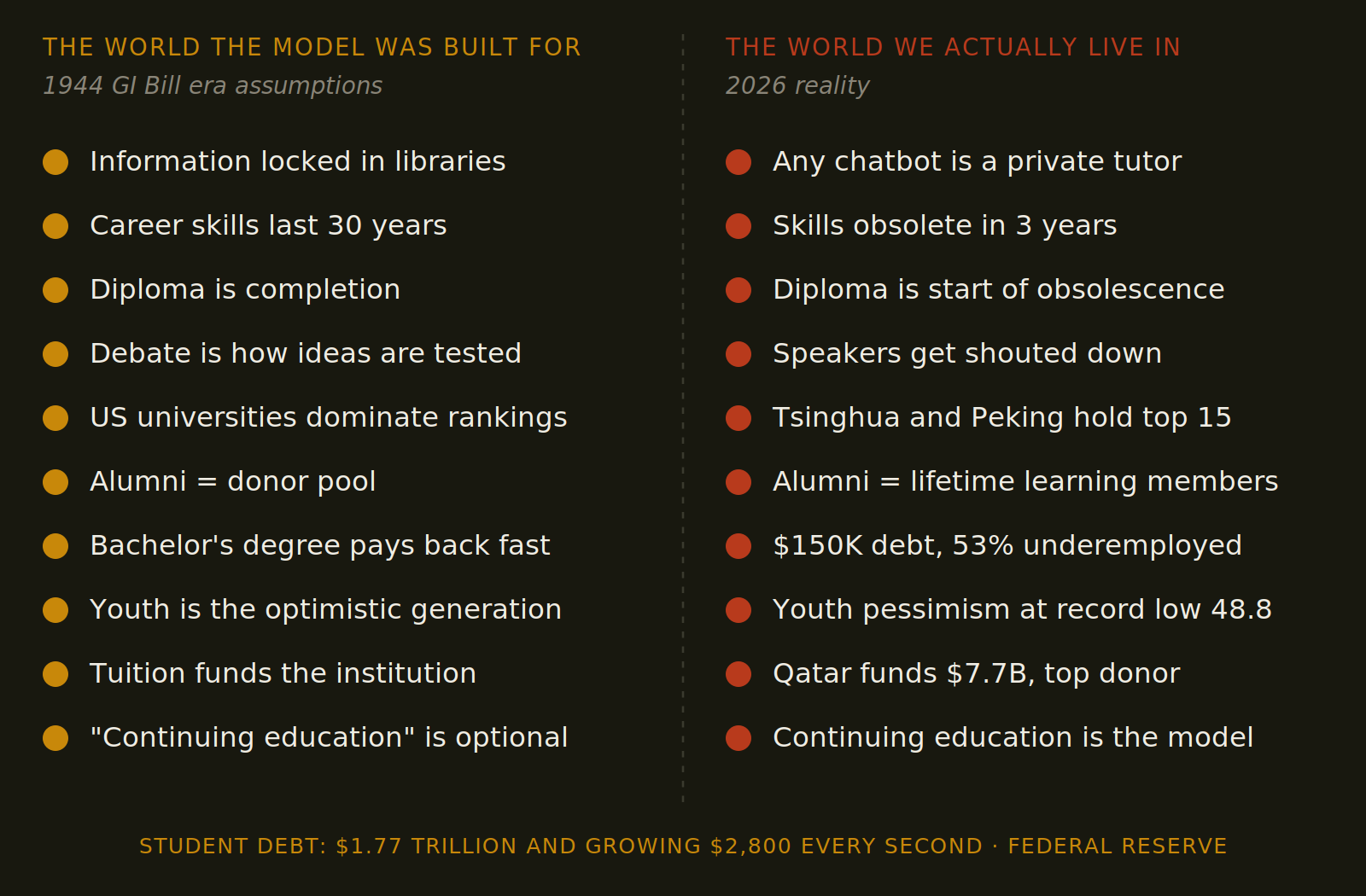
The university model was built for a world where information was locked in libraries and career skills lasted thirty years. None of that describes 2026. What comes next runs on the alumni relationship for the forty years after graduation, not the four years before it.


The Real University Runs on Alumni Programs, Not Freshman Classes.
Stephen Messer, Co-founder of Collective[i] and LinkShare (sold to Rakuten for $425M, 1996–2005). EY Entrepreneur of the Year/Deloitte Fast 50 winer (2x). Board member, Spire Global (NYSE: SPIR). Building intelligence.com
I am the proud uncle of two incredible kids. My nephew is applying to college as this is published. Grades near the top of his class. A varsity athlete in a sport I never had the coordination for. A list of accomplishments longer than mine was at his age. His sister is right behind him on her own version of the same track. Two amazing kids. Like a lot of families right now, we have been sitting at kitchen tables asking two questions at once. What is the best way to educate a bright, ambitious teenager in a world moving faster than any curriculum can be revised. And the question nobody used to have to ask. How do we make sure they come out of this system better than they went in.
I have been thinking about this a lot. As an uncle. As someone who has spent thirty years building companies in the AI and technology space, and more than a few late nights with other founders arguing about whether higher education is a category ripe for disruption. As a longtime affiliated research fellow at the Columbia Institute for Tele-Information at Columbia Business School, where I have watched the university model up close, both when it worked and when it stopped working.
I do not have children of my own. On this question that might be the clearest view I can offer. Whatever I am about to argue, my own tuition bills are not on the line.
The short version is that the university system is breaking. That might be a good thing. It does not need small reforms around the edges. It needs a redesign from first principles around what learning actually has to look like when the world changes faster than a syllabus can be revised.
Regular readers know I have argued the first-principles version in almost every piece on this blog. What It Means to Be AI-First laid out how operating models have to be rebuilt from the ground up for the AI era, not layered over the old one. The Jobs Nobody Has Heard of Yet described the categories of work being invented in real time, most of which the current curriculum has no framework for. The Safest Move You Can Make With AI Will Cost You Everything argued that responsible-sounding conservatism is the most expensive boardroom position right now. The university is the same argument. First principles. Rebuild the model, not the trim.
The fix is not Peter Thiel’s answer, which is to skip the on-ramp entirely. The fix is to keep the on-ramp and completely rebuild the off-ramp. Graduation should not mean “you are done.” It should mean “welcome to the network you now have access to for the next forty years.”
And before I forget make sure to join todays CI Forecast, "Sex, Lies and Videochips" Inside the Honey-Trap Scandal That Shook Nvidia, Wall Street, and Washington featuring Neil Strauss and Mike Casey at 4:30 pm ET.
The University Was Built for a Slower World
The modern American university system is roughly a hundred years old at its current scale. The GI Bill of 1944 sent millions of returning veterans to college, and the model that worked for that generation was exported through the second half of the twentieth century. It became the assumed pathway. Everyone was supposed to go. Not going was the exception that had to be defended. Toby Stuart and I debated adjacent terrain this week on CI Forecast, which is free to join and watch.
The model made sense for a specific set of conditions. Information was scarce and expensive. Libraries were the primary storehouse of human knowledge, which is why library size used to be a university bragging right. Harvard’s Widener holds more than three million volumes, and that number used to describe a competitive advantage. Career skills, once learned, tended to remain useful for decades. A physician trained in 1960 could practice, with continuing education around the edges, until retirement. A lawyer, a banker, an engineer, an architect, the same.
None of those conditions apply in 2026. Information is free and available. Any student with a chatbot has, in effect, a private tutor patient enough to explain any concept at any level. Career skills learned in year one of a four-year degree are stale by the time the same student graduates in year four. The doorway between learned and obsolete has collapsed from thirty years to about three. I have written about the speed of adoption from every angle on this blog, from the productivity paradox in AI Is Everywhere Except in the GDP Numbers to the operational playbook in What It Means to Be AI-First. The university system was designed for ground that did not move.
Every Signal Points to the Same Thing
Look at the signals independently and each is an interesting anecdote. Look at them together and they describe a system in advanced decline.
Earnings. A journeyman plumber in the United States earns around $60,000 a year with zero debt, having earned another $250,000 across a four-year apprenticeship. A journeyman electrician clears the same range. Master plumbers and specialized welders earn well into six figures. A recent college graduate starts at roughly $55,000, carries an average of $150,000 in student debt, and has lost the four years of earning a plumber accumulated. Across a working lifetime, a plumber earns approximately $2.77 million. An electrician clears $2.63 million. Both begin without debt. Fifty-three percent of recent college graduates are underemployed. Total student loan debt in the United States is $1.77 trillion and grows at $2,800 every second. Plumbers now out-earn most college graduates in thirty-two states. HVAC technicians out-earn nurses in sixteen.
The ideological signal. Peter Thiel has been paying twelve to twenty young people a year to skip or leave college since 2011. The Thiel Fellowship now offers $250,000 over two years to anyone under twenty-two who agrees to drop out. The acceptance rate is 0.1 percent. The alumni list includes Vitalik Buterin of Ethereum, Dylan Field of Figma, Lucy Guo of Scale AI, and the founders of two frontier AI labs. Thiel’s stated thesis is that the traditional university had become an expensive, slow pipeline that selects for compliance over capability. The alumni list is starting to make that thesis hard to dismiss.
The political signal. Foreign contributions to American universities have been reported at $67.6 billion since 1986, most of it disclosed only since 2019. Qatar is the largest single-country donor at $7.7 billion. Cornell has received $2.3 billion from Qatar. Carnegie Mellon has received $2 billion. Georgetown has received $1 billion. Texas A&M, which received close to $1 billion, closed its Qatar campus in 2024. Northwestern has received $766 million. It is fair to ask what shape of institutional debate emerges from universities funded at billion-dollar scale by foreign states, and what shape does not.
The outcome signal. Youth job-market sentiment in the United States hit an all-time low of 48.8 in January 2026. Only 43 percent of Americans aged fifteen to thirty-four think it is a good time to find a job locally, versus 64 percent of those over fifty-five. The twenty-one-point pessimism gap is the largest of any of the 141 countries Gallup surveys. In most of the world, older people are the pessimistic ones. In America, the young have inverted the pattern.
The ranking signal. In the 2026 Times Higher Education World University Rankings, Oxford holds the number-one position for the tenth consecutive year. Tsinghua holds twelve for the third straight year. Peking holds thirteen. China now has five universities in the top forty, up from three the year before. Whether an American university tops the list is no longer a question with an obvious answer. Eric Gertler of U.S. News and World Report and I spoke about this on Upskill, and it is free to watch.
Each signal has a plausible individual explanation. Taken together, they describe a system that has stopped delivering on its original promise to the people paying for it.
The Root Cause Is the Model, Not the Symptoms
Each signal gets treated as its own crisis. Student debt is one policy problem. Campus politics is another. The rise of the trades is a third. Youth pessimism is a fourth. They are not separate problems. They are symptoms of a single root cause. The model itself is no longer aligned with the world it is preparing students for.
The university, at its best, was designed to be the starting point. It was where a student learned how to think, how to argue, how to hold contradictory ideas at once, and how to find their way through unfamiliar material without a map. Graduate programs then trained the same student into a specific profession. Once four or six or eight years were done, the graduate went out and worked for forty years. Continuing education existed at the edges, bar prep for lawyers, board recertification for physicians. The assumption was that most of what a person had learned would carry them through their career.
That model does not work when the fundamental substrate of every profession changes every three years. A lawyer whose training ended in 2020 has no formal exposure to how a general-purpose language model changes discovery, drafting, or research. A physician whose training ended in 2020 has no formal exposure to how the same technology changes diagnosis or documentation. A CFO whose training ended in 2020 has no formal exposure to how autonomous agents change the finance function, or to what quantum computing means for the cryptography their business runs on. Diplomas do not expire. Knowledge does.
The community college system has been the quiet exception. It teaches concrete skills to adult learners on industry-connected curricula. It has held up specifically because it does not pretend to be forever. It fits its students at a particular moment and lets them come back for the next skill when the world moves on.
When the Debate Society Cannot Debate
The symptom I pay closest attention to is the one that undermines the whole purpose of a four-year degree. Learning how to think independently. Not just a critical life skill. A republic depends on it.
The Oxford Union is the most storied debate society in the English-speaking world. Churchill spoke there. Malcolm X spoke there. Reagan spoke there. Its practice for two hundred years was that a proposition was debated by speakers on both sides, that opposition speakers were treated with the same courtesy as proposition speakers, and that the president stood above the fray to keep order. That practice is what taught generations of British and American elites how to defend a position they disagreed with and how to attack a position they did agree with.
The Union’s November 2024 debate on the motion on Israel broke that practice in several ways at once. The president of the Union joined the proposition speakers without recusing. Insults were shouted freely at opposition speakers throughout. One opposition speaker, Yoseph Haddad, was physically removed from the chamber during the proceedings. Whether one agrees with the motion or not is beside the point. The mechanics of debate broke. The place that used to teach students how to argue a position they did not hold produced an evening in which arguing the opposing side got a speaker ejected.
Multiply that pattern across campuses over the last three years. The lecture that gets shouted down. The invited speaker who is disinvited. The professor who declines to touch the third-rail topic. Each incident is defensible on its own terms. The pattern is that the muscle for genuine debate is atrophying at exactly the institutions whose purpose was to train it.
Employers have noticed. After the October 2023 Harvard letter on the Hamas attack, Bill Ackman publicly asked for signatories’ names so companies could avoid hiring them. CEOs at Sweetgreen, EasyHealth, Dovehill Capital, and FabFitFun endorsed the position within days. Davis Polk rescinded offers to three students who had signed. Winston & Strawn withdrew an offer for related comments. The list of firms quietly reaching the same conclusion is longer. Belief formed through actual debate is a resume line. Belief formed through group pressure is a warning. Parents watching this are asking a specific question. Is the school we picked helping our child get a job, or is it now hurting the chances.
The Second-Order Effects Reach the Ballot Box
Step back from the balance sheet for a minute. The high-cost, low-return education has consequences that reach past the personal financial one.
A person graduating from a state university in 1946 could pay off tuition inside two years of work, buy a house on one income, marry, start a family, and take a job at a fair salary. If they wanted to teach, or run a small business, or serve in local government, the numbers worked. The postwar middle class was built on that set of possibilities.
Fifty years of degree inflation and stagnant wages have produced something different. American home ownership rates for adults under thirty-five are at their lowest since the early 1990s. The average age of first-time buyers has moved past thirty-six. Family formation rates have collapsed. Fertility has dropped below replacement. The teacher shortage is real and structural. Nobody with $150,000 of student debt can take a starting teacher salary. Nobody with the same debt can afford to serve on a local school board without a working spouse. The professions we most need people in are the ones the debt structure now makes economically irrational to enter.
Some of this is a permitting problem, which I laid out in The American Dream Has a Permitting Problem and Time Kills All Deals. Housing that takes months rather than years to approve gets built at prices young families can actually pay. Three-dimensional printed construction is another lever. It brings costs down thirty to seventy percent and timelines from months to days. These are the fastest levers on the affordability problem and none requires a single new law.
The education crisis leaks into the political crisis. A generation carrying more debt, living at home longer, unable to start families, told for four years that the economic system is rigged against them, and arriving into adulthood without the habits of independent thought that a working university was supposed to teach. I wrote about the broader frame in The Luckiest Decade in Human History. The habits a working university once produced, research, argument, evidence, changing your mind when the facts change your mind, tolerating people you disagree with, are the habits a democratic republic runs on. Break them at institutional scale and the political consequences show up two election cycles later. They are showing up now.
No parent wants their child on that side of the trade. Not the debt side. Not the pessimism side. Not the never-leaves-home side. That is what a broken university system does to the family and to the republic. It is the single strongest argument for redesigning the model rather than tinkering with the trim.
The Fix Is Not Skipping. It Is Continuing.
Peter Thiel’s answer, which is to skip the university entirely, is the right answer for a specific and small population. Twelve to twenty exceptional young people per year, all of whom already know what they want to build, most of whom would have been fine anywhere. It is not the answer for a whole society. Most eighteen-year-olds do not yet know what they want to build. Most of them need the on-ramp a four-year degree provides, even a diminished one, because it introduces them to ideas they would not have otherwise encountered and puts them in a room with a peer network they would not have otherwise built.
The right fix is to keep the on-ramp and completely rebuild the off-ramp. Graduation should stop meaning “we are done with you.” It should start meaning “welcome to the forty-year alumni network you now have access to.”
The specific mechanism is short-form continuing education for alumni. One-week programs, taught by the same faculty, priced for corporate sponsorship rather than for the alumnus personally, aimed at whatever the world has just done that the alumnus has no formal training in.
The economic move that unlocks the whole model is lowering the upfront cost of the four-year degree. Once the student is the ongoing revenue stream, the university does not need to price the entry ticket for a lifetime of returns. It needs to price the ticket to get the student in the door and earn from the forty-year membership that follows. Every high-end professional-service business already runs this way. A doctor does not overcharge for one consultation. A therapist does not extract lifetime value at the first session. A private banker prices to acquire and compounds the relationship for decades. The university is the only major professional-service business still trying to extract the whole lifetime value at the front door and then wondering why the alumnus disengages after graduation.
For parents trying to decide where to send a child, the choice becomes clearer when the model is framed this way. Which would you rather write the check for. A university that will be done with your child in four years and treat them as a donor prospect for the next forty. Or one investing in your child’s continued success for the next forty years and treating the four-year experience as the on-ramp to a lifetime relationship. One of those universities is aligned with your child. The other is aligned with its endowment.
The financial mechanism already exists in embryonic form. Income-share agreements. Buy-now-pay-later structures for tuition. Straight equity in future earnings. If the university is confident enough in the value of its education, it should be confident enough to take part of the payment as a share of the student’s income for the first ten or twenty years after graduation (either as an offset or as the expectation of an ongoing continuing education source of revenue).
Universities that recruit the best students with a low or zero upfront cost in exchange for a modest share of future earnings produce two effects at once. They select for students who believe in the outcome enough to bet their own income on it. They align the university’s economic interest with the student’s professional success. Purdue ran a version of this called Back a Boiler under Mitch Daniels. A handful of other institutions have experimented at the margins. Nobody has yet built it at flagship scale. The first flagship that does will pull the best students in the country away from the current price-fixed alternatives because those students will see the alignment on the term sheet.
What the Newer Model Looks Like
Think about the leaders currently running major companies and government agencies. Almost none received formal university training in AI, autonomous agents, quantum computing, quantum communications, 3D printing, robotics, synthetic biology, or the specific class of harvest-now-decrypt-later attacks I wrote about in The Death of Privacy. Every one of these is now central to how their businesses run. Everyone has evolved past what the leader learned in graduate school. The past few weeks have shown that new, AI built cyber attacks are a major risk to everyone. But where does the CEO, CTO or any of the leadership get training to understand this?
A working continuing-education program would offer these leaders one week per topic, twice a year, with the university’s own faculty and graduate students as tutors, priced to be paid by the company rather than the individual. In one week the CFO of a bank would learn what a quantum attack on their treasury systems actually looks like from the physicist teaching quantum information. In one week the general counsel would learn what an autonomous agent means for signed contracts and discovery, from the same faculty who trained the associates. In one week the CMO would learn what AI-mediated attention economics look like from the professor writing on it.
The benefits stack in ways that solve several problems at once. An ongoing revenue stream for the university, most of it paid by corporate learning-and-development budgets rather than by strapped alumni personally. A deeper alumni relationship, which is the actual driver of long-term donations, and all of it tied to something that is in practical need. The four-year degree turns from a one-time transaction into a lifetime membership, which changes how prospective students evaluate the price.
A second order benefit happens at the saame time. If graduate students working in faculty labs are part of the tutoring, the executives get first-look exposure to talent, and the students get pipeline and network access no career-services office can produce. Cross-program mixing solves the corporate isolation problem. Law-school alumni doing continuing legal education end up in the same week as business-school alumni doing an AI update. Engineering alumni end up in the same week as medical alumni.
Quietly but importantly, the room becomes a safe place to admit what you do not know. A CFO cannot easily tell their board they do not understand quantum key distribution. They can tell a room of fellow alumni on a one-week program that they do not understand it and ask the physicist to please explain it again. The community that forms in that room does not exist inside corporate politics, and it is the community that will matter most to how these leaders navigate the next decade.
Two Universities Are Already Running a Version of This
The transformation is not theoretical. Two American universities have been running partial versions of this play for a generation.
Northeastern University has run a cooperative-education program since 1909, alternating academic study with full-time paid industry work. For most of the twentieth century it was an evening college and then a commuter school, ranked well outside the top hundred. Under a multi-decade strategy that made the co-op its signature product, Northeastern moved to a 5.2 percent acceptance rate in the 2024 cycle, a top-fifty U.S. News ranking, and a global network of 3,800 employer partners. Applications are up 52 percent since 2020. Ninety-five percent of undergraduates now complete at least one co-op. Whatever criticism has been made of the ranking game Northeastern played along the way, the strategic bet was correct. The value of the degree stopped being measured by the four years and started being measured by what happened after.
Arizona State University under Michael Crow, who took over in 2002, made a bigger version of the same bet. Crow rebuilt ASU as the New American University, established more than thirty transdisciplinary schools, grew research expenditures more than eight-fold, and pushed the institution into every category U.S. News tracked. ASU has been ranked first for innovation for eleven consecutive years, joined the Association of American Universities in 2023, and now cracks the top one hundred globally in Times Higher Education. Crow bet that a public university could compete on innovation and outcome rather than on selectivity and legacy. That bet worked.
Northeastern and ASU are the exceptions. They are also the proof that the rest can change if the leadership is willing to bet.
This Model Is Already Being Built. Just Not by the Universities.
We see the demand every day at Collective[i]. Clients arrive expecting help operating their sales function, their PE fund, their VC investments and end up needing help becoming an AI-first company. They arrive expecting insight into a specific deal and end up needing a framework for how to think about the next decade of technological change. We ended up building the education layer their universities did not build for them.
The blog you are reading, Artificial CommonSense, is the informal version. Every week I publish a piece on some aspect of the AI-first transition, most recently the operational playbook in What It Means to Be AI-First, the architecture in The Intelligence Stack and The Next Computer Is Alive, and the strategic frame in The Companies Winning at AI. Two dozen pieces in the archive. Another two dozen in the queue. The pieces exist because the demand exists.
The more formal version lives at Intelligence.com and Collective[i], where we built Upskill, a section devoted to learning any new topic that technology or the world’s shifts have created. Members can go there this morning and get up to speed on whatever they need to understand by this afternoon. Upskill has a conversation with Eric J. Gertler, executive chairman and CEO of U.S. News & World Report, titled “Is a College Degree Worth It Today?” Free to join. Free to watch at intelligence.collectivei.com/upskill/video/1190281598.
The most direct version is ciforecast.com, our weekly ninety-minute conversation open free to anyone. Past guests include Eric Schmidt, Reid Hoffman, Yann LeCun, Fei-Fei Li, Kai-Fu Lee, Yoshua Bengio, Nouriel Roubini, and Brian Greene. Eighteen thousand members strong. Anyone who wants to join a live session can register free at Ciforecast. The reason it exists is the reason the universities should be building the same thing. When the world moves this fast, the people running it need a place to keep learning, from other people running it, with no pretense that anyone has all the answers already.
The universities that build this first will pull ahead. The ones that keep charging for a four-year experience and treating the alumnus as a donor rather than a lifetime member will lose to the ones that do not.
The Same Problem Runs Through the Trades. Germany Has the Fix.
My nephew’s classmates are not all heading toward four-year universities. Some are heading toward the trades. Their families are asking the same question on a different scale. Is the training path aligned with the world their kid will actually work in for the next forty years. The answer looks the same. Initial training is fine. Continuing training does not exist at scale.
Roughly half of German upper-secondary students, close to five hundred thousand a year, enter the country’s Dual Vocational Training system rather than university. Four hundred thousand German companies participate. Students split the week between a company that hires them under an apprenticeship contract and a vocational school teaching the theory of their trade. The apprenticeship lasts two to three and a half years, paid throughout at roughly four to six hundred euros a month. Two-thirds of apprentices are hired as full employees at the end. The system has been enshrined in federal law since 1969. Three hundred thirty occupations run through it. Germany has one of the lowest youth-unemployment rates in the industrialized world, and its manufacturing base has stayed globally competitive precisely because its workforce is trained inside the companies that will employ it.
The United States has a fragmented version in community colleges and union apprenticeships. It has never had a national system that maps to Germany’s scale or coordination. The gap widens every year the trades absorb newer technology, robotics, autonomous vehicles, additive manufacturing, quantum-safe electrical grid infrastructure, faster than the existing training system can keep up. These are all areas that tech is innovating rapidly. Think about dark factories, self driving construction, robotics 3-d printing/Additive materials.
The fix is the same fix I have been describing for four-year universities. Continuous training. A journeyman electrician graduating today should have structured retraining every two years for the rest of their career, delivered by the trade school that certified them originally, paid for by the industry association or the employer that benefits from the newly-trained worker. Do that at national scale and two things happen at once. American companies adopting new technology stop facing worker resistance, because the workforce has been continuously updated and does not feel obsolete. American trades become the most technically proficient in the developed world, which is where the industrial policy dollar should be going anyway.
Community colleges are the natural infrastructure for this. They already teach concrete skills to adult learners. They already coordinate with local employers. What they do not yet do at scale is the two-year retraining loop for their graduates. That is a relatively cheap thing to add. The community-college system that adds it first will pull ahead. This is one of the largest workforce-policy opportunities in the United States right now, and it is currently sitting untouched.
The Trade
For readers thinking about what all of this means for the companies and institutions you underwrite or advise, five moves matter.
Watch continuing education as an investable category. US corporate learning-and-development spend runs above one hundred billion dollars a year, most of it going to third-party providers because universities have not built the product. Universities that build a serious executive continuing-education program in the next thirty-six months pull ahead on alumni engagement, corporate revenue, and long-term donations. The ones that treat continuing education as an afterthought fall out of the top tier.
Watch the trades as a stable labor category. Plumbers, electricians, welders, and HVAC technicians are not being replaced by autonomous agents this decade. Their skills are physical, their labor markets are local, and the demographic pipeline is thin. Investment in the training infrastructure that produces them, in the private equity buying the service companies that employ them, and in the technology serving them (dispatch, quoting, parts) is a category with a durable tailwind that most tech capital is currently ignoring.
Watch community colleges as the model that already works. They teach concrete skills to adult learners, connect to local employers, and price without producing $150,000 of debt. In the reordering of higher education, they are the survivors. Private-capital opportunities around community-college-adjacent training, credentialing, and workforce partnerships are underappreciated.
Ask every board you sit on what its continuing-education strategy actually is. Where do senior executives learn what the world has just done that they did not learn in graduate school? “We hire consultants” is not an answer. “We watch the news” is not an answer. Boards that build a real continuing-education mechanism for their executives make better decisions in 2027 and 2028. The ones that do not will be surprised.
Watch investors like private equity for the acquisition of universities. This may be the largest institutional opportunity of any of these moves. Middle-tier universities where the model is broken and the leadership cannot change it from inside are exactly the kind of stuck asset private-equity capital was invented to unstick. The Ivies are self-sufficient. The community colleges are already close to the right model. The middle tier is where the transformation has to happen, and it is not going to happen through internal reform.
The non-profit status combined with the endowment structure produces exactly the kind of long-duration, low-cost, perpetually-renewing capital pool Warren Buffett recognized when he acquired National Indemnity in 1967 and built the Berkshire Hathaway compounding engine on top of insurance float. Berkshire’s float grew from $39 million in 1970 to $176 billion at the end of 2025, at a negative cost, because policyholders effectively paid Berkshire to hold their money. Universities have the same shape of asset. Tuition arrives up front. Alumni relationships compound for decades. The endowment sits, invested, generating perpetual returns. Apollo has already built a version of this playbook using annuity liabilities. Nobody has yet built it using university endowments and continuing-education revenue streams as the capital vehicle.
The universities that get acquired and rebuilt around the continuous-learning model will out-earn and out-recruit the ones that stay non-profit and stay slow. The obstacle is not economic. It is regulatory, political, and cultural. The first serious private-equity firm that clears those obstacles will have a category to itself.
What Comes Next
Every piece in Artificial CommonSense takes something the market treats as consensus and shows what it is missing. If you are interested in one of these stratgies reach out to me. As you might guess I turn each piece into an action I am taking. If you find it something you want to get more involved in, let me know.
The next piece goes deeper on the role that has been protecting the CRO’s dashboard from every side. The information broker. The middle manager. The sales ops analyst. Why the pyramid was breaking before AI arrived, why Amazon, Meta, and CVS all cut middle-management layers in 2024, and why the transition ends up good even for the people losing their roles. Subscribe at reloadnyc.com. Free. No paywall. No course at the end. Just the work.
If this piece changed how you are thinking about the university you graduated from, or the one your children are looking at, forward it to one person who needs to read it. The trustee who has not thought about continuing education as a strategy. The dean who has not thought about it as a revenue line. The parent trying to decide whether to write the tuition check. The state legislator trying to figure out what to do with the community-college budget. One specific decision-maker in your world.
Reply if you want to argue. I read every one. The pieces get sharper when readers push back.
Related Reading · reloadnyc
- What It Means to Be AI-First. And How to Get There.
- The Jobs Nobody Has Heard of Yet
- The Companies Winning at AI Are Playing a Different Game
- The Intelligence Stack. What to Buy, What It Replaces, How to Wire It Together.
- AI Is Everywhere Except in the GDP Numbers.
- The Safest Move You Can Make With AI Will Cost You Everything
- The Death of Privacy. The Rise of Unbreakable Communications.
- The American Dream Has a Permitting Problem. AI Can Fix It Today.
- Time Kills All Deals. America’s Permitting Process Is Killing Yours.
- The Luckiest Decade in Human History.
- The Trade-Off Nobody Is Making
- The Next Computer Is Alive
RELATED READING · RELOADNYC
What It Means to Be AI-First. And How to Get There.
The operational playbook for phase three. What the companies pulling away are actually doing.
The Companies Winning at AI Are Playing a Different Game
Systems of intelligence versus silos of intelligence. Why the winners rebuild instead of layer.
The Intelligence Stack. What to Buy, What It Replaces, How to Wire It Together.
The equipment list for phase three. Connected intelligences pointed at the right problems.
AI Is Everywhere Except in the GDP Numbers. Here Is What Triggers the Break.
The productivity paradox in real time. Why the AI trigger is closer than most investors think.
The Death of Privacy. The Rise of Unbreakable Communications.
Two mega-trends landing in the same year. Both reshape society more than the AI transformation everyone is still writing about.
The Trade-Off Nobody Is Making
Millions of people now have access to a doctor, a lawyer, or a tutor through AI who never had access before. The upside nobody is pricing.
Stephen Messer
Co-founder of Collective[i] and Intelligence.com. Co-founder of LinkShare (sold to Rakuten for $425M). Board Member, Spire Global (NYSE: SPIR). Writes at reloadnyc.com.
Intelligence.com maps the relationships you actually have, not the connections you collected. Connect with me there and let us share our networks with each other.